
Fluted Wall Panels in Florida Humidity: MDF, WPC and Veneer (2026)
Fluted wall panels in Florida humidity, ranked honestly: MDF is strictest, WPC most tolerant, veneer in between. Grooves, bathrooms, seasonal homes and care.
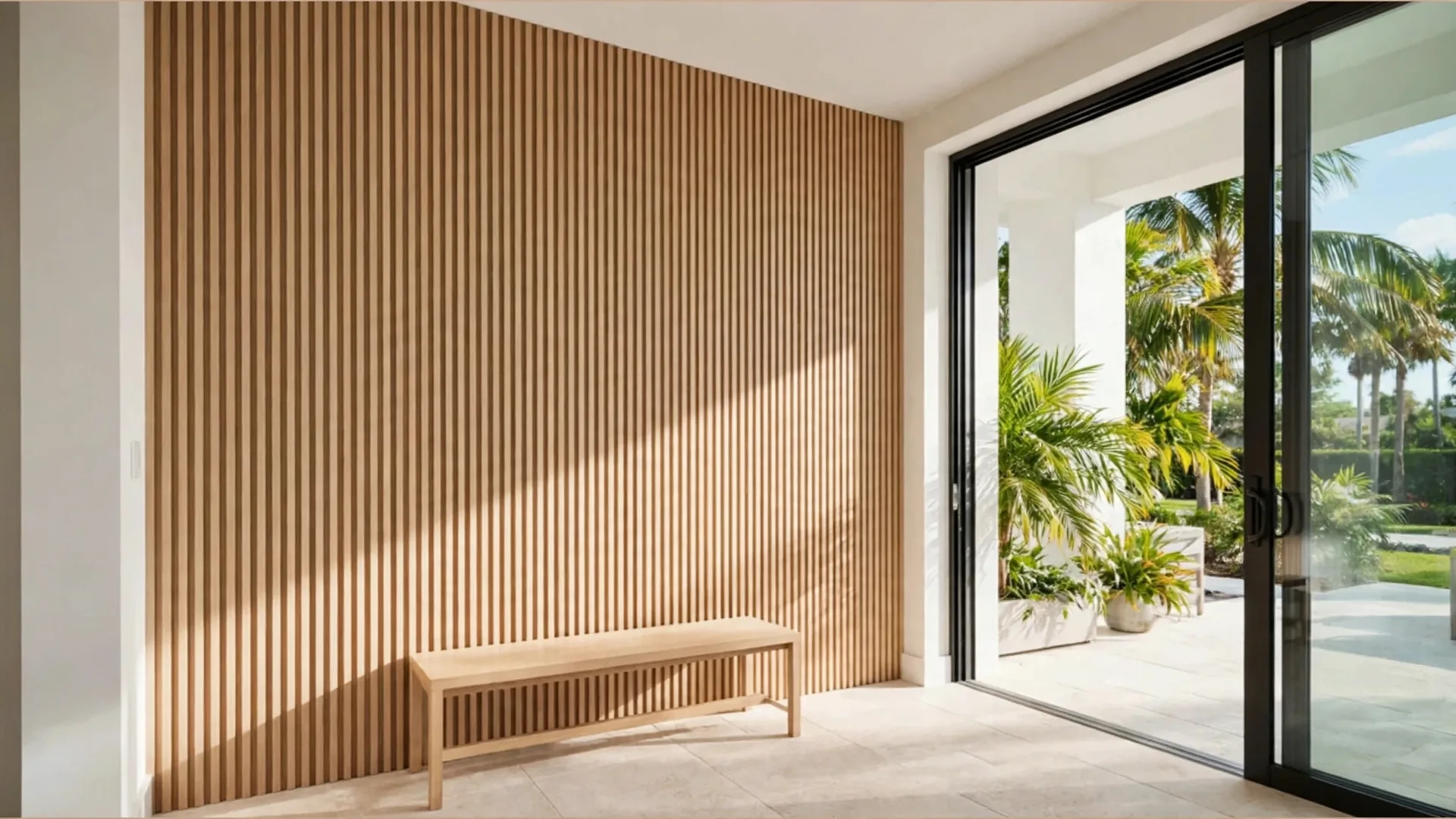
A fluted wall is a wall of grooves. In most of the country that is a design detail. In Florida it is also a moisture detail, because every groove is a sheltered channel where damp air sits longer. Dust settles deeper, and a damp cloth reaches last. The panel material decides what happens next. The same profile cut into three materials gives you three very different walls: MDF fluted panels live under the strictest humidity rules, WPC fluted panels tolerate the most. Veneer fluted panels sit in between, protected on the face and vulnerable underneath.
Our fluted wall panels guide covers the full picture: profiles, sizes, general costs, and where fluted walls look best. This article takes one slice of that picture and goes deep on it – fluted wall panels in Florida humidity, room by room and material by material. The general climate attack on any paneled wall is covered in our accent wall panels in Florida humidity article. Here we stay with the grooves themselves.
The climate the grooves live in
TL;DR: Miami averages 82 percent relative humidity in the morning and 61 percent in the afternoon across the year. Rising to 86 and 66 percent in September (Florida Climate Center, from NOAA data). Indoors, the EPA sets the working line: keep relative humidity below 60 percent, ideally between 30 and 50 percent. A fluted wall inside that indoor range is a normal wall. A fluted wall in a room that leaves that range for weeks is a maintenance project.
Start with the outdoor numbers. They explain why Florida owners ask this question more than anyone else in the country, and why the answer here runs longer than a simple yes or no. The Florida Climate Center's normals for Miami, drawn from 71 years of records. Put the annual average at 82 percent relative humidity in the morning and 61 percent in the afternoon. September is the peak: 86 percent in the morning, 66 percent in the afternoon. West Palm Beach posts the same annual pair, 82 and 61. The center also notes that maximum relative humidity values usually occur during morning hours. Matters for a wall: the dampest air of the day arrives while the house is coolest and the air conditioning cycles least.
None of that outdoor air is what your panel actually lives in. Air is the medium. The panel just lives in it.
The panel lives in your indoor air, and indoor air in a South Florida home is a choice made by the thermostat. The system's sizing, and your habits when you travel. The EPA's mold guidance gives the target in one sentence: indoor relative humidity should be kept below 60 percent, ideally between 30 and 50 percent, if possible. The same guidance adds two rules that run through everything below. Relative humidity greater than 60 percent is likely to result in condensation, which can lead to mold growth. And wet areas should be completely dried within 48 hours to prevent mold from growing.
Hold those two numbers side by side and the Florida problem gets specific. Outdoors, the air spends much of the year above the EPA ceiling. Indoors, a working air conditioner holds the line with room to spare. So the honest question for a fluted wall is rarely "can this material survive Florida?" The honest question is "can this material survive my Florida – my room. My ventilation, my months away, my bathroom fan habits?" The materials rank differently depending on your answer, and the ranking is the subject of this article.
One more climate fact before the materials. Condensation forms on the coolest surface in the room. And in a Florida summer the coolest surfaces are often exterior walls chilled from inside by air conditioning while warm damp air presses from outside. A paneled wall on an exterior wall lives closer to that dew point than a paneled interior partition. That is why two identical fluted walls in the same house can age differently. Why the room-by-room verdicts later in this article separate exterior walls from interior ones.
Why grooves change the humidity math
TL;DR: A flat panel meets room air on one face. A fluted panel meets it on a folded surface with far more area. The bottom of each groove is a still-air channel where moisture lingers, dust collects, and cleaning tools reach last. The grooves do not create humidity. They give humidity more surface, more shelter, and more time.
Fluting is a rhythm of ridges and concave grooves. The geometry that makes the light move across the wall also multiplies the surface the room air touches. Every groove has two sloped or curved sides and a valley floor. Air moves freely across the ridge tops. Down in the valleys it barely moves at all. Still air holds its moisture against the surface longer, so after a steamy shower, a mopped floor. Or a humid night with the system off, the groove valleys are the last part of the wall to dry.
Physics first. Dust follows the same path. Household dust is light, slightly damp in Florida air, and happy to settle where air slows down. On a flat wall it spreads thin and wipes off in one pass. In a fluted wall it concentrates in the valleys, where it mixes with moisture and becomes the dark line owners notice at month three. Angi's paneling cost guide makes the same point from the cleaning side about beadboard, the closest grooved cousin: it can be hard to clean grooves. That single con, listed in a national cost table, is the everyday version of the physics above.
The third groove effect is about edges. A fluted board is cut, routed, or molded, and the valley floor is often the thinnest, least finished part of the profile. On a painted MDF board, the paint film in a deep narrow groove is thinner than on the ridge. The fiber at the valley is closer to the surface. On a veneer board, the groove is where the veneer layer bends hardest and where micro-cracks in the finish, when they come, tend to start. On a molded WPC board the profile is the same material all the way through, which is one reason WPC behaves so differently in the sections below.
None of this makes fluted walls a bad Florida choice. Far from it. It makes the material choice carry more weight than it would on a flat panel, because the profile amplifies whatever the material already does with moisture. A material that shrugs off damp air shrugs it off in the grooves too. A material that drinks slowly will drink first, and deepest, at the valleys. Keep that amplifier in mind through the three material sections that follow. Every verdict below traces back to one habit of grooves. They hold what the room gives them. Longer than a flat wall ever would. In the exact spots a cloth reaches last.
MDF fluted: the strictest material in the room
TL;DR: MDF fluted panels carry the strictest humidity envelope of the three. The clearest published version comes from the Acupanel manual: hold 60 to 75 degrees F and 30 to 55 percent relative humidity for at least 7 days before installation. During it, and after it – and bathrooms are not recommended at all. Inside a conditioned living room or bedroom, MDF performs well. Outside that envelope, the core swells and the grooves telegraph it.
MDF is wood fiber pressed with resin into a dense, smooth board. That density is why it routes into such crisp flutes and takes paint so evenly. The same fiber structure is the humidity weakness. Cut edges and groove valleys expose fiber ends, and fiber drinks. It drinks slowly in ordinary room air and faster wherever liquid water or saturated air reaches it, and a swollen MDF groove does not swell back. The ridge widens a fraction, the paint film cracks along the valley, and the wall keeps the record permanently.
No guessing here. The manufacturers say this themselves, in writing, with numbers. The Acupanel installation manual – Acupanel is the WoodUpp slat and fluted line built on an MDF core – sets the installation envelope plainly: the HVAC must be on. With temperature maintained between 60 and 75 degrees F and relative humidity of 30 to 55 percent. For at least 7 days prior to installation, as well as during and after installation. The manual then adds the room restriction: installation in bathrooms, or any area with excessive moisture, is not recommended. Panels also need 24 to 48 hours to acclimate in the room before they go up. WoodUpp's own help center repeats the bathroom point in plainer language: the panels are basically not recommended for bathrooms or rooms with high, constant humidity. The MDF core can swell if it is constantly exposed to moisture.
Read that envelope against the EPA line and a workable Florida rule appears. The EPA wants indoor air below 60 percent, ideally 30 to 50. The Acupanel envelope wants 30 to 55. A South Florida home with healthy air conditioning sits inside both ranges most of the year. Is why MDF fluted walls succeed all over Florida in living rooms, bedrooms, dining rooms, and entryways. The failures cluster where the envelope breaks: bathrooms, laundry rooms with venting problems, rooms over damp garages, and homes left unconditioned through the summer. In those rooms the question answers itself before style enters it.
Two practical notes for owners who choose MDF anyway, in the right rooms. First, painted MDF and raw or primed MDF are different products in damp air: a full paint film on every face. Including groove valleys and cut ends, is the moisture defense. Any field cut that exposes fresh fiber should be sealed before the board goes up. Second, watch the bottom edge. Closely, please. Mop water and vacuum bumps reach the lowest two inches of the wall. A swollen bottom edge on an MDF fluted wall is the single most common humidity complaint in this category. A small shadow gap or a proper base detail keeps standing water off the fiber.
Veneer fluted: protected face, vulnerable core
TL;DR: Veneer fluted panels put a real wood face over an engineered core, usually MDF or plywood. The factory finish on the face handles normal room humidity well. The risk sits behind and beneath: the core follows the rules of whatever it is made of, and the finish ages fastest where the grooves bend it. Veneer lands in the middle – fine in conditioned rooms, cautious near steam, wrong inside a shower.
A veneer fluted panel is a sandwich. The visible layer is a thin slice of real oak, walnut, or another species. With the grain and pore structure of solid wood at a fraction of the thickness. Under it sits the core that gives the board its flatness, most often MDF in this product class, sometimes plywood. Over the veneer, the factory applies a finish – oil, lacquer, or a matte protective coat – and that finish is the panel's first humidity defense.
Short version: it works. In a conditioned room, the sandwich works. Room air at 45 to 55 percent relative humidity moves in and out of the wood face slowly, the finish slows it further. Seasonal movement stays small enough that joints and grooves read as they did on installation day. Owners who love real wood grain usually accept the middle ranking gladly: veneer gives them the material they wanted, and the room's climate does the protecting.
The caution points are structural. The core sets the floor for bad behavior: a veneer panel on an MDF core inherits the MDF swelling risk wherever moisture reaches the core – at cut ends. At the bottom edge, through an unsealed back, or at a fastener hole. A plywood core tolerates more, because its cross-laminated layers resist the one-direction swell, but plywood edges have their own appetite at cut ends. Either way, the veneer face can look perfect while the core takes on moisture from behind. Is why a musty smell near a veneer wall deserves a look even when the surface still photographs well.
The grooves add their specific wear. Veneer bends around the flute profile, and at the tightest radius of each valley the finish film is stretched thinnest. Years of damp-air cycling show up there first as a faint lightening along the valley line. It is cosmetic long before it is structural, but it is the honest tell that the room's humidity is running higher than the panel likes. Kitchens? A split verdict. Kitchens deserve a split verdict for veneer: on a wall away from the range and sink, fine. As a splash surface behind either, the steam and spray load belongs to a harder material.
We should be plain about the evidence here. There is no published long-term Florida field study of veneer fluted panels that we could find, and we will not invent one. The middle ranking is a mechanism judgment – finish behavior plus core behavior – consistent with how the manufacturers write their own room restrictions. It is a sound basis for choosing a room. It is not a lab result, and any seller who upgrades it to one is decorating.
WPC fluted: the most tolerant option
TL;DR: WPC – wood plastic composite – mixes wood flour with a plastic matrix, so the board has no continuous fiber path for water to climb. It tolerates humid rooms, steamy bathrooms outside the shower, and seasonal homes better than MDF or veneer. Its limits are different: heat, long spans, and a molded look some buyers find less rich than real veneer.
WPC fluted panels are extruded or molded from a recipe of wood flour, a thermoplastic such as PVC or polyethylene, and additives. One published guide describes a typical mix at about 60 percent wood flour and 30 percent polymer, with the rest stabilizers and color. The plastic is the point. Each wood particle is coated and locked inside the matrix, so water at the surface meets plastic first. There is no open fiber network running through the board, and the swelling pathway that governs MDF behavior is largely closed.
Manufacturers quantify that with absorption tests, and here the labeling discipline matters. One WPC factory publishes water absorption under 0.5 percent after 24-hour immersion under ASTM D570 – a vendor claim for that factory's product, quoted here as exactly that. There is no category standard that certifies every WPC fluted board to one number, and boards vary with recipe and density. The honest category statement is comparative, and it is strong enough on its own: WPC fluted panels absorb far less water. Swell far less, than MDF fluted panels in the same damp room. In Florida terms, WPC is the fluted material that forgives a bathroom fan left off. A laundry room door closed all day, or a guest room that runs warm between visits.
Tolerance is not invincibility. Not close. Heat softens thermoplastics at the margins. A WPC wall in direct sun behind glass can feel the day more than a wood-core wall does. Follow the maker's expansion gaps on long runs. The board moves with temperature even when it ignores humidity. The molded surface also reads differently from veneer. Up close, a good WPC flute has clean, uniform grooves and a printed or filmed wood look. Some buyers love the uniformity. Others stand two feet away and miss the grain variation of real wood. That is a taste call, and samples in your own light settle it faster than any photograph.
So where, exactly? Where does WPC belong in a Florida home? Everywhere fluted panels belong, plus the rooms that exclude MDF: full bathrooms on walls outside the shower enclosure. Powder rooms, laundry rooms, kitchens including splash-adjacent walls that get wiped often. Pool-house or lanai-adjacent interior walls that breathe outdoor air whenever the sliders open. Inside the shower itself, fluted profiles of any material are the wrong tool. The grooves hold water and soap film against every joint. The wet-zone answer stays with smooth, sealed surfaces. Our studio's own fluted-look option in this family is a bamboo composite sheet. It follows the same logic. A factory finish that water sits on. Discipline at the edges and joints.
| Material | Humidity tolerance | Bathroom (outside shower) | Seasonal home |
|---|---|---|---|
| MDF fluted | Strictest – maker envelope 30 to 55 percent RH | Not recommended by the manufacturer | Highest swell risk |
| Veneer fluted | Middle – finish protects the face, core sets the limit | Powder rooms only, with care | Endures with checks on return |
| WPC fluted | Most tolerant of the three | Yes, outside the enclosure | Tolerates unconditioned months best |
| Bamboo composite sheet | Tolerant end of the field, discipline at edges and joints | Yes, outside the enclosure | Tolerates, with joint and wall checks |
Bamboo composite fluted-look sheets: where our studio stands
TL;DR: The panels we install at WOW Walls Studio are large-format bamboo composite sheets, 48 by 108 inches, with factory finishes including fluted-look and wood-look designs. The finished face does not absorb water and needs no sealer. The humidity discipline is at cut edges, joints, and the wall behind – and the sheets stay out of showers, like every fluted product in this article.
Full disclosure first. A word on our own product, placed here because it belongs in the humidity ranking and because readers deserve to know which horse is ours. WOW Walls Studio installs large-format decorative sheets made from a bamboo composite. Supplied as full 48 by 108 inch panels with factory-applied finishes – stone looks, wood looks, and fluted-look profiles among them. The format changes the humidity picture in one specific way: a wall covered in a few large sheets has a few joints. A wall of narrow fluted boards has a joint every few inches. Fewer joints means fewer entry points, and each joint can be detailed deliberately.
The finished face is a sealed surface. Water sits on it rather than entering it, there is no grout anywhere in the system. There is no sealer calendar to keep, because the finish is applied at the factory rather than in your bathroom. On the ranking used in this article, the sheets sit with the tolerant end of the field for ordinary room humidity – living rooms. Bedrooms, dining rooms, entryways, media walls, and bathroom walls outside wet enclosures. The discipline, as with WPC boards, lives at the edges: cut edges get sealed at installation, joints get finished as joints. The wall behind must start dry and sound. A sealed face over a damp wall hides a problem instead of solving one. The EPA's hidden-moisture warning applies to our sheets exactly as it applies to porcelain or paint.
The limits are equally plain. The sheets are not a shower system, not a waterproofing layer, and not a fix for a wall with an active leak. In a shower or a steam enclosure, choose the smooth sealed surfaces built for that job. In a seasonal home, the sheets tolerate the unconditioned months better than an MDF-core product would. The room still deserves the checks described in the seasonal section below before anyone calls the wall done.
Free design preview: send us a photo of your wall and see it in a new finish. That offer is the fastest way to see whether a fluted-look finish suits your room before any material argument has to be settled – the preview shows the wall. The light, and the groove scale in your own space.
Room by room: where each fluted material earns its place
TL;DR: Conditioned living rooms, bedrooms, dining rooms, and entryways accept all three materials. Kitchens split by distance from steam and spray. Full bathrooms outside the shower belong to WPC and composite sheets. Inside showers, no fluted profile of any material. Laundry rooms and unconditioned rooms follow WPC, or wait for conditioning.
Living rooms and media walls. The friendliest rooms in the house: conditioned, dry, and usually on interior walls. MDF, veneer, WPC, and composite sheets all work here, so the choice runs on looks, groove scale, and budget. This is the room where veneer earns its premium, because the climate risk that justifies paying for tolerance is mostly absent.
Bedrooms and headboard walls. Same friendly profile, with one footnote: bedrooms run cool at night, and an exterior headboard wall can be the coldest surface in the room. Keep a small gap discipline at the wall, and any of the three materials behaves. Fine flutes suit these close-viewing walls, as our fluted wall panels guide discusses in its sizing section.
Dining rooms and entryways. Entryways earn one caution: they breathe. Every arrival opens the door to outdoor air at 80-plus percent humidity, and a foyer wall cycles more than any other interior wall. All three materials handle cycling in a conditioned home; veneer and MDF simply prefer the foyer of a home that runs its system year-round.
Kitchens. Split the room. On a dining-side or pass-through wall, all three materials are fine. Behind a range or sink, steam and spray rewrite the answer: WPC or composite sheet, wiped often, with MDF and veneer moved to safer walls. Grooves near cooking also collect grease mist, which the cleaning section below takes up.
Bathrooms. The dividing line of this whole article. Powder rooms, with a toilet and a sink and no shower steam, accept veneer and even MDF with sealed edges, though WPC asks less of your habits. Full bathrooms outside the shower enclosure belong to WPC and composite sheets. Inside the shower or tub enclosure, no fluted panel of any material – the profile holds water against joints and backing in a way no finish fixes. That verdict matches the manufacturer non-recommendation for MDF and extends it, honestly, to the whole fluted family.
Laundry rooms, pool-adjacent rooms, and garages. Sustained damp, vented dryers, and doors that open to wet air put these rooms in WPC territory. An unconditioned garage wall is outside every fluted material's envelope; condition the room first, or choose a different finish.
Seasonal homes and unconditioned months
TL;DR: The hardest Florida test is the home left closed from May to October. Indoor air drifts toward outdoor levels, the EPA ceiling is crossed for months. And materials separate: WPC and composite sheets tolerate the season, veneer endures it with checks on return. MDF carries the real risk of slow swell at edges and grooves.
Think May to October. South Florida runs on seasonal homes. Owners leave in spring, the system gets set high or switched off, and the house sits in its own weather until fall. For a fluted wall, those months are the exam the showroom never mentions. With no conditioning, indoor relative humidity settles close to the outdoor pattern – mornings in the eighties. Afternoons in the sixties – which means the room lives above the EPA's 60 percent line for a large share of every day. For months, with no one watching for the first sign of trouble.
Material behavior separates cleanly under that load. MDF takes the season hardest: fiber at cut edges and groove valleys absorbs month after month, and the swell that results is permanent and cumulative. Veneer panels on an MDF core share that pathway from behind and beneath. Veneer on plywood fares better and still deserves a hands-on check at edges on your return. WPC and bamboo composite sheets have no fiber pathway to speak of, so the season mostly tests their joints, adhesives. The wall behind them rather than the boards themselves.
Habits shrink the risk. More than any material upgrade does, in fact, and by a wider margin than most owners expect when they first price the tolerant option against the strict one. A thermostat set to a modest cooling level with a humidity priority, or a standalone dehumidifier draining to a safe outlet. Holds the indoor line under 60 percent at a fraction of full cooling cost. Before leaving, run the bathroom fans, check under every sink, and photograph the paneled walls; on return. Compare edges and bottom lines against the photos, run a hand along the lowest grooves. Treat any musty smell as a leak investigation, not a cleaning task. The EPA's rule stands behind all of it: moisture control is the key, and wet areas dried within 48 hours rarely grow anything. A wall that stays dry all summer needs no heroics in October.
Installation habits that decide the outcome
TL;DR: More fluted walls fail from installation shortcuts than from material choice. Acclimate the panels in the room, install only into the maker's temperature and humidity envelope. Seal every field cut, keep the bottom edge off mop water, and start with a dry, sound wall. Those five habits decide most of the ten-year outcome.
Timing matters. Start before the first board. The Acupanel manual's acclimation rule – 24 to 48 hours in the room – exists for a simple reason. A board arriving from a humid warehouse or a cold truck needs to meet the room before it is fixed to the wall. The same manual's envelope sounds fussy until you price a swollen wall. It asks for 60 to 75 degrees F and 30 to 55 percent relative humidity. Hold that for 7 days before, during, and after installation. Builders in Florida meet the envelope with the home's own system: run the air conditioning for the week, keep the doors closed. Postpone the install if the system is down. A panel installed during a broken-system week in August starts its life outside its warranty logic.
The wall itself is the second habit. Panels go onto dry, flat, sound surfaces. A wall with a history of leaks gets the leak fixed and the drying verified first – the EPA's 48-hour drying rule is about exactly this moment. On exterior walls in older Florida homes, ask what is behind the surface. A vapor-closed finish over a wall that needs to dry inward can trap moisture. The wall used to release that moisture. Where that risk is real, a batten-mounted system with an air gap lets the assembly breathe, at the cost of some depth.
Cuts and edges are the third habit, and the one most often skipped. Every field cut exposes the core. On MDF and veneer-core boards, seal cut ends before fixing. On WPC and composite sheets, finish cut edges as the maker directs and treat joints as designed details, not gaps to caulk later. The bottom edge deserves its own detail everywhere: a recessed shadow gap, a baseboard line. Or a small lift off the floor keeps mop water and wet vacuum passes off the material. Kitchens and bathrooms add one more: seal the joint lines that face steam sources, and leave the lines that face the room's dry side to move.
Then fastening. Fastening follows the material. Narrow boards fix by adhesive, screws through the tongue or felt, or clips, per the maker. Large sheets fix per their own system. Where the wall will later carry a television or shelving, fixings go into structure. Mounts anchor to framing or blocking, never to the panel alone. None of these steps is exotic. Together they are the difference between the walls that photograph well at year five and the walls that get replaced at year two.
Cleaning and care in damp air
TL;DR: Fluted walls in Florida need groove-first cleaning: dry dust out of the valleys on a regular rhythm. Damp wiping matched to the material, and bathroom ventilation treated as part of the wall's care. Dust left sitting in damp grooves is the cosmetic failure owners see first and the easiest one to prevent.
The cleaning routine follows from the groove physics in the second section. Dust settles in the valleys, Florida dust is slightly damp. And damp dust left in place darkens the valley line and feeds the faint musty note owners sometimes blame on the material. A soft brush attachment on a vacuum, run vertically along the grooves. Or a microfiber cloth worked with a fingertip into each valley, clears it in minutes on a normal wall. The rhythm matters more than the tool: monthly in living spaces, more often near entry doors and in homes with pets. After any stretch when the home sat closed.
Wet cleaning splits by material, as everything in this article does. WPC grooves can be wiped with water and a mild soap, then dried – the material tolerates the water, and the drying step keeps the joints honest. Bamboo composite sheets wipe the same way, with the same dry-after habit at joints and edges. Painted MDF wants a barely damp cloth and no standing water in the valleys. Water left sitting in an MDF groove is the one cleaning error that can damage the wall it was meant to save. Veneer follows its finish: a damp cloth for oiled or lacquered faces, no soaking. No steam cleaners on any fluted wall of any material, because steam drives moisture exactly where the grooves hold it longest.
Kitchens add grease to the dust. The film that settles on groove valleys near a range is dust plus cooking mist. It needs a degreasing wipe on the WPC or composite wall and a gentler, faster pass on veneer. Bathrooms add the ventilation rule. The exhaust fan runs during a shower and for a good while after it. That habit is part of the wall's maintenance, as real as any cloth. A fluted bathroom wall in a home where the fan runs will outlast the same wall where it does not, whatever the material. Our hub's care discussion in the fluted wall panels guide covers the general routine; the Florida additions are the rhythm, the drying step, and the fan.
Three early warnings follow. All cheap to act on. A valley line that darkens faster after cleaning than it used to suggests the room is running wetter. A bottom edge that feels rough or looks swollen wants the water source found, not the edge sanded. A musty smell localized at one wall section, with a clean face. Points behind the panel – and behind-panel moisture is the one problem in this article that should be opened up rather than wiped down.
What the humidity-safe choice costs
TL;DR: Nationally, Angi puts professional wall paneling at $1,200 to $6,000 per project, averaging about $2,800, with materials running $5 to $25 per square foot by type. Humidity tolerance does not map neatly onto price: WPC often sits mid-range, veneer runs premium, and MDF starts lowest while demanding the most climate discipline. Our studio's preliminary anchors are from $850 for a stock design, $2,200 to $2,700 for semi-custom, and from $9,999 for a full turnkey project.
Money, briefly. Cost context first, from the national benchmark this cluster uses. Angi's 2026 paneling data puts a professionally installed wall paneling project between $1,200 and $6,000, with a national average around $2,800. Per-square-foot material prices from $5 to $25 depending on the panel type. Fluted products scatter across that band by material rather than by profile. Painted MDF fluted boards typically anchor the low end of material pricing. WPC fluted boards sit in the middle, trading a higher board price for the tolerance this article is about. Veneer fluted panels run toward the top, because real wood faces and careful finishing cost what they cost in every category.
Florida adds two line items the national average hides. The first is climate preparation: running the system to hold the installation envelope, sealing cuts and edges properly. Detailing the bottom edge all take labor time that a dry-climate install can sometimes skip. The second is the room correction – a bathroom fan that actually vents outside. A dehumidifier for a seasonal home – which belongs in the project budget even though it never appears on the panel invoice. Owners who price only the boards routinely discover both items later, at worse prices.
Our studio's numbers, stated the way we state them everywhere: preliminary project anchors run from $850 for a stock design. With semi-custom projects at $2,200 to $2,700 and full turnkey projects from $9,999. Those are preliminary anchors, not quotes – a quote follows a photo, a measure, and the room's humidity conversation this article describes. A WPC or composite choice for a bathroom wall may cost more on the board line and less across ten years of Florida summers. An MDF wall in a conditioned living room may be the smartest money in the whole comparison. The material ranking and the price ranking are different lists, and a good project respects both.
Free design preview: send us a photo of your wall and see it in a new finish. Send the photo, tell us the room and how the home is used across the year. The preview conversation starts with the right material already on the table.
Frequently asked questions
TL;DR: Short answers: MDF fluted is the strictest in humidity, WPC the most tolerant, veneer in between. No fluted panel belongs inside a shower. Keep indoor humidity below 60 percent, ideally 30 to 50 percent, and most fluted walls in conditioned Florida rooms will behave.
Can fluted wall panels handle Florida humidity?
Yes, in a conditioned home, with the material matched to the room. WPC and bamboo composite tolerate humid rooms best; veneer suits conditioned living spaces. MDF works well inside its published envelope of 30 to 55 percent relative humidity and fails first outside it. The room and the home's habits decide more than the state line does.
Are MDF fluted panels recommended for bathrooms?
No. The Acupanel manual states that installation in bathrooms or any area with excessive moisture is not recommended. WoodUpp's help center gives the reason: the MDF core can swell under constant moisture. Powder rooms are the borderline case; full bathrooms belong to WPC or composite sheets, outside the shower.
Which fluted material is best for a Florida bathroom?
WPC fluted panels, or a bamboo composite sheet, on walls outside the shower or tub enclosure. Both tolerate steam and daily humidity far better than MDF-core products. Inside the enclosure itself, no fluted profile of any material is the right answer; smooth sealed surfaces own that zone.
What humidity level should a room with fluted panels stay at?
Follow the EPA line: below 60 percent relative humidity, ideally between 30 and 50 percent. Manufacturer envelopes can be tighter – the Acupanel manual specifies 30 to 55 percent with temperatures of 60 to 75 degrees F held before, during, and after installation. A simple wall hygrometer in the room settles any argument about where your home actually sits.
Do fluted grooves trap moisture and dust?
The grooves hold still air, so moisture lingers in the valleys after steam or damp weather, and dust settles where the air slows down. That is a cleaning and drying consideration rather than a defect: regular dry dusting of the valleys, damp wiping matched to the material. Bathroom fans that run during and after showers keep grooves clean and dry.
Can fluted panels survive a seasonal home left closed all summer?
WPC and bamboo composite sheets tolerate unconditioned months best, because they have no fiber core to swell. Veneer on plywood endures with edge checks on return; MDF and veneer on MDF cores carry real swell risk. Any material fares better with a dehumidifier or a humidity-priority thermostat setting holding the home under 60 percent while you are away.
How do I clean fluted panels in a humid climate?
Dry-dust the grooves first, with a soft vacuum brush or microfiber worked into each valley. Then damp-wipe by material: water and mild soap for WPC and composite, a barely damp cloth for painted MDF and veneer, and dry the joints and valleys afterward. Skip steam cleaners; steam drives moisture into exactly the channels that dry slowest.
What do fluted wall panels cost in Florida in 2026?
Angi's national range for professional paneling is $1,200 to $6,000 per project, averaging about $2,800, with materials at $5 to $25 per square foot by type. Our studio's preliminary anchors are from $850 for a stock design, $2,200 to $2,700 for semi-custom projects, and from $9,999 for a full turnkey project. A firm quote follows a photo and a measure.
Sources
- US Environmental Protection Agency, Mold Course Chapter 9 – indoor relative humidity below 60 percent, ideally 30 to 50 percent; condensation above 60 percent; dry wet areas within 48 hours. https://www.epa.gov/mold/mold-course-chapter-9
- Florida Climate Center, Relative Humidity normals (data from NOAA National Centers for Environmental Information) – Miami annual morning 82 percent and afternoon 61 percent, September 86 and 66 percent, 71 years of record. https://climatecenter.fsu.edu/products-services/data/other-normals/relative-humidity
- Acupanel (WoodUpp), installation manual – envelope of 60 to 75 degrees F and 30 to 55 percent relative humidity. Hold it 7 days before, during, and after installation. Bathrooms not recommended. Acclimation 24 to 48 hours. https://manuals.plus/acupanel/acoustic-wooden-wall-slat-panel-manual
- WoodUpp help center, Akupanel installation and rooms – panels basically not recommended for bathrooms or rooms with high, constant humidity; MDF core can swell under constant moisture. https://woodupp-norge.dixa.help/en/article/132542-akupanel-installation-walls-surfaces-rooms
- Angi, wall paneling cost guide (updated October 30, 2026) – professional paneling $1,200 to $6,000 per project, average about $2,800; materials $5 to $25 per square foot; grooved beadboard noted as hard to clean. https://www.angi.com/articles/cost-to-panel-wall.htm
- WYRAX, fluted wall panels guide (vendor source) – WPC composition of roughly 60 percent wood flour and 30 percent polymer, and WPC positioning against MDF swelling in humid climates. Vendor claims, read as such. https://www.wyraxgroup.com/fluted-wall-panels-guide-wpc-profiles-sourcing/
- Rich New Materials, WPC wall panel specifications (vendor source) – factory claim of water absorption under 0.5 percent after 24-hour immersion under ASTM D570 for its product. Vendor claim for one factory's product, not a category standard. https://www.richgreenbuild.com/local/wpc-wall-panel-manufacturer-factory-serving-the-chicago-market/