
Fluted Wall Panels: Types, Costs and Honest Limits (2026)
Fluted wall panels explained: profile shapes, five materials with real limits, 2026 installed costs, Florida humidity rules, and groove care.
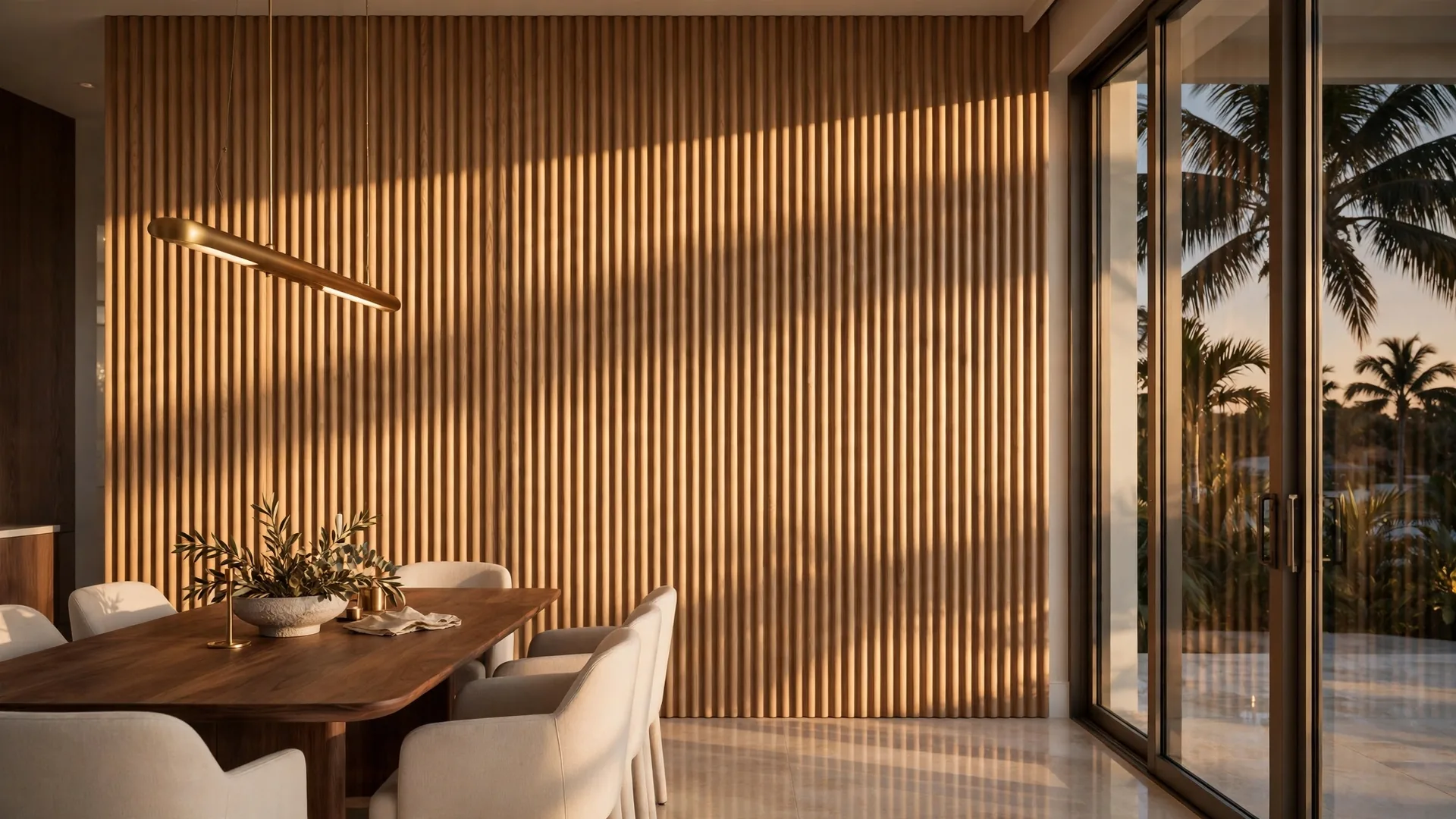
A fluted wall panel is a board whose face runs in a continuous rhythm of rounded ridges and concave grooves (grooves cut in a repeating curve, the way a classical column is carved). It is the softer cousin of the slat wall: same vertical rhythm, no open gaps, no felt showing through. Search results blur the two together, mix them with flat printed sheets, and quote sound numbers that belong to other products. This guide separates them. It covers what the profiles are, what the five common materials actually do in a South Florida home, what a finished wall costs in 2026, and where the maker's own instructions draw the line.
I run a South Florida studio that designs and installs panel walls, and fluted boards sit in my own material library next to the smooth large-format sheets the studio is known for. That gives this guide an installer's bias worth naming: I care less about how a panel photographs on day one and more about what its grooves collect by month six, what its core (the board's inner material) does in August humidity, and what a repair looks like in year three. Where a number comes from a manufacturer or a national cost guide, I name the source. When a figure is my studio's own, I say so and keep its limits attached.
What a fluted wall panel actually is
TL;DR: A fluted panel is one continuous board with a grooved face – rounded ridges separated by curved channels, with no openings through the board. Its mirror image, with convex ribs (ribs that bulge outward) standing proud of the face, is sold as ribbed or reeded. The two profiles look similar in a listing photo and behave differently in light, dust and repair.
Stikwood and Andor Willow describe fluting the classical way: a continuous face of rounded ridges separated by concave grooves, a pattern borrowed from stone columns. Andor Willow, a millwork (factory-made wood trim and paneling) maker, uses the same definition for its paintable range. What matters in the definition is what is missing: there are no gaps. Run a hand across a fluted wall and your fingers ride a wave. Run one across a slat wall and your fingers drop into open slots with felt at the bottom.
That one difference drives everything else in this guide. A closed face sheds less dust into the wall, wipes down with a cloth that follows the wave, and gives a softer, rolling shadow. An open slat wall gives a harder shadow line and a felt layer that can absorb sound, at the price of grooves you clean with a vacuum brush. My earlier comparison of fluted panels and wood slat panels settles the head-to-head choice between the two profiles; this guide goes deeper on fluted alone – its shapes, materials and limits.
One naming trap deserves a sentence of its own. Marketplaces sell at least three different products under the words "fluted wall panel": a genuinely profiled board, a flat sheet with a printed fluted photograph on it, and a felt-backed slat panel photographed at an angle that hides the gaps. The printed sheet has no shadow of its own and looks flat the moment real light hits it. Check a listing for a side-profile photo or a stated board thickness before you price anything; a real profile has depth you can measure.
The profile shelf: shapes and scale
TL;DR: Fluted profiles are sold as round, square (flat-bottomed grooves), V-groove, half-round and beaded shapes (a bead is a tiny rounded bump along the top or bottom of each groove), and there is no industry standard that fixes a groove's width or depth. Scale is the real design decision: narrow flutes read as texture from across a room, wide flutes read as architecture.
Homedit's survey lists the shapes you will meet in catalogs: round flutes with fully curved channels, square profiles with flat-bottomed grooves and sharper ridges, V-grooves that come to a point, half-round ribs, and beaded profiles with a small bead (a tiny rounded bump) running along the top or bottom of each groove. The Panel Hub's profile examples put ridge widths roughly between 15 and 50 mm across common products, and tambour makers (tambour is a flexible sheet of narrow half-round strips on a backing, made to wrap curves) work finer still, with individual strips around 1/2 to 3/4 inch wide.
Because no standard fixes the geometry, two products both called "round fluted" can cast completely different shadows. One maker's shallow 15 mm wave is a quiet texture that disappears under flat midday light. Another's deep 50 mm channel holds a shadow line all day. Samples settle what listings cannot. Hold a sample board at the angle your wall meets your windows and look at it at the time of day you actually use the room.
Scale rules of thumb from install work – practice, not law:
- Narrow flutes (fine rhythm) suit small walls, hallway runs and the wall behind a bed, where you stand close and read the surface as fabric.
- Wide flutes (bold rhythm) suit tall living-room and TV walls read from ten feet or more; up close they can feel like a fence.
- Curved walls and columns need tambour or a flexible-backed board; a rigid sheet will not bend, and forcing one cracks the finish at the ridge tops.
Five materials, with their real limits
TL;DR: Fluted panels come in paintable MDF (pressed wood fiberboard), PVC (polyvinyl chloride, a solid plastic) and WPC plastic composites (wood-plastic composite, wood fiber in a plastic core), wood-veneer boards (a thin slice of real wood over a core board), solid wood tambour, and a thin bamboo-charcoal sheet sold as a premium surface. They share a profile and almost nothing else: their moisture limits, repairability and price bands are different products wearing one name.
Paintable MDF. MDF (medium-density fiberboard, pressed wood fibers) is the budget classic and the most common fluted board in millwork catalogs. Andor Willow sells its paintable fluted MDF in heights of about 44, 94 1/2 and 106 inches, ready to prime (a base coat that helps paint grip) and paint any color. MDF machines into a crisp, even groove, which is why the profile looks so clean in photos. Its limit is water: MDF is not a moisture-resistant material, and the fiber core swells permanently where it drinks. In a dry, conditioned room it is a legitimate panel. Near a shower, a sink splash zone or a damp exterior wall, it is the wrong core, and my guide to wall panels in Florida humidity works through the MDF-versus-PVC comparison in full.
PVC and WPC composites. WPC (wood-plastic composite, wood fiber mixed into a plastic core) is the family my studio's fluted boards come from: narrow boards, in the wider market typically 150 to 195 mm wide and 10 to 30 mm thick, with one manufacturer recipe published at 35% PVC and 60% wood fiber. The plastic content is what buys moisture tolerance – a WPC groove can be washed with water and mild soap where an MDF groove cannot. Read recipes carefully, because two different composites share the WPC label: PVC-based boards are the interior product, while capped HDPE boards (high-density polyethylene, a harder outdoor-grade plastic) are made for exterior cladding (an outside wall covering) and are overkill, in weight and price, for a bedroom wall.
Wood veneer over a core. A thin slice of real oak or walnut veneer glued over MDF or a similar core gives the truest wood figure at a mid-range price. The limit is the skin itself: a dent that breaks the veneer cannot be sanded out the way solid wood can, and the repair is a fill-and-tone job that stays visible in raking light (light that skims across a surface at a low angle and exposes every flaw).
Solid wood and tambour. Solid fluted boards and tambour strips are real wood through their full thickness. They are the only members of the family you can sand and refinish years later, and the only ones that move noticeably with the seasons, so they need acclimation (resting flat in the room before install, 48 hours in the tambour maker Flutto's instructions) and room to expand at the edges. The Wood Veneer Hub's own FAQ for its Flutto tambour is admirably plain about the rest of the spec: dry walls away from the shower and tub only, not a backsplash material (a backsplash is the splash guard wall area behind a sink or stove), no fire rating, and no acoustic properties. Hold every fluted product to that same standard – a maker that states its own exclusions in its own FAQ.
Bamboo-charcoal and other thin sheets. A newer shelf sells large thin sheets – around 1220 by 2440 to 3000 mm at 5 to 8 mm thick – with a fluted or fluted-look face over a bamboo-charcoal core. The format is attractive: a whole wall from a few sheets, few seams. The caution is that seller claims for this young shelf vary widely and no independent test in my sources settles them. One major seller markets its bamboo-charcoal board as waterproof, while other thin decorative sheets elsewhere in the panel market carry explicit not-moisture-resistant warnings. The core specification and the care sheet, not the headline, decide where a given sheet belongs. The humidity section below is where any sheet earns or loses its place.
What fluted wall panels cost in 2026
TL;DR: A professionally installed fluted wall in national cost guides runs from about $800 for a small office wall to about $3,360 for a large living-room wall in paintable MDF, with plastic composite and veneer bands running higher at the top end. Treat per-square-foot bands as planning figures: profile depth, material and how much cutting the wall needs move the real number.
The Panel Hub's April 2026 cost guide prices fluted materials by the square foot: paintable MDF fluted at $7 to $11, PVC and WPC fluted at $7 to $15, with labor at $3 to $10 per square foot for a standard install and $8 to $15 where the work is complex. Its worked examples, materials plus professional install, land at $800 to $2,100 for an 80 to 100 square foot office wall in MDF, $900 to $2,520 for a 90 to 120 square foot bedroom wall, and $1,200 to $3,360 for a 120 to 160 square foot living-room wall.
Angi's general wall paneling page, updated October 30, 2026, anchors the wider market rather than fluted alone: $1,200 to $6,000 per project, $2,800 on average, and $5 to $25 per square foot across paneling types, with hourly labor at $40 to $100. I keep both sources in view because they answer different questions. The Panel Hub tells you what the fluted shelf itself costs. Angi tells you what paneling projects in general close at in practice, including the small-wall minimums that per-foot math hides: a 40 square foot wall does not cost half of an 80 square foot wall, because the trip, the setup and the finishing are the same.
My studio's own figures, labeled as ours: our panel projects start from $850 for a stock design, a fitted design runs $2,200 to $2,700, and a full turnkey project (design, panels, delivery and installation by our own crew) is priced from $9,999, with the exact figure set after a specialist measures the wall. Those are studio project anchors across our panel range, not a fluted-panel price list. A fluted wall in narrow boards is quoted the same way – after the measure visit, not from a photograph. My wall panel cost guide breaks down where project money goes when you want the full picture before any quote.
Three cost traps repeat in fluted quotes:
- Coverage math. Narrow boards are sold by the pack, and pack coverage figures assume no cuts. Corners, outlets and a wall that is not a neat multiple of board width eat into it; order extra for the cuts.
- The finishing nobody prices. MDF fluted arrives ready to paint, which means primer, paint and the labor to spray or roll into every groove sit on top of the board price.
- Edge and corner pieces. A fluted run ends at trims, and outside corners need a solution the flat listing price rarely includes. Ask what the last six inches of your wall cost, not only the middle.
Where fluted walls work, room by room
TL;DR: Fluted panels earn their place where a wall needs rhythm without pattern: TV walls, the wall behind a bed, dining walls and entry runs. They are at their weakest in direct splash zones and on walls that take furniture impact at groove height all day.
TV and media walls. The groove rhythm gives a large black screen a textured field to sit on, and the closed face hides the wall's minor sins behind the mount. Two cautions: a deep profile behind a wall-mounted TV complicates the bracket, which wants a flat landing, and busy narrow flutes can fight the picture in peripheral vision. My living room panel guide covers layout and light for the room as a whole.
Bedroom headboard walls. Fine flutes behind a bed read as upholstery in board form – ordered, calm, and free of the dust ledges an open slat wall grows at pillow height. The bedroom wall panel guide works through sizes and finishes behind the bed in detail.
Dining rooms. A fluted dining wall takes candlelight and low pendants beautifully, because the grooves hold a gradient instead of a glare spot. Chairs are the hazard: chair backs strike at exactly ridge height, and a veneer skin dents where a smooth stone-look panel shrugs. In a tight dining room, run the flutes on a wall that chair backs do not strike.
Entries and hallways. A long fluted run gives a corridor a direction and hides scuffs better than flat paint, and tambour wraps the rounded columns and curved walls that rigid panels cannot. Keep the profile shallow here; deep grooves in a narrow hall read as a tunnel.
Bathrooms, with the exclusions attached. A fluted panel on a dry bathroom wall – the wall behind a vanity mirror, away from splash – can work in a washable WPC. Inside a shower, or as a backsplash behind a tub, the manufacturer exclusions in the materials section answer for me: the common fluted products say no, and a grooved face in a wet zone invites mold, whatever the core. My shower panels versus tile comparison covers what does belong in the wet zone.
The Florida humidity test
TL;DR: Florida indoor air is the deciding exam. The EPA (the US Environmental Protection Agency) puts the safe indoor band below 60% relative humidity, ideally 30 to 50%. Inside a well-conditioned home, most fluted materials pass. On a damp wall, in a bathroom without extraction, or in a house that sits unconditioned for weeks, fiber-core boards such as MDF suffer first and plastic-core WPC tolerates the swing best.
The US Environmental Protection Agency's mold guidance sets the frame every Florida wall lives in: keep indoor relative humidity (the share of moisture the air holds against its maximum at that temperature) below 60%, ideally between 30% and 50%, and dry wet materials within 24 to 48 hours, because mold grows on damp surfaces including the hidden side of paneling. A fluted wall is a system, not just a board – panel, adhesive or fixings, and the wall behind it – which is why the wall's dryness matters as much as the panel's recipe.
Manufacturers write the same caution into their own instructions. Acupanel, the best-known acoustic panel maker, specifies an install envelope of 30 to 55% relative humidity at 60 to 75 degrees Fahrenheit, held for the seven days around installation, and does not recommend its standard panels for bathrooms. That is a conditioned Florida interior on a normal week. It is not a snowbird condo closed up from May to October with the air conditioning set high or off, where indoor humidity can sit above the band for months. In that house, material choice stops being a style question: plastic-core boards tolerate the swing, fiber cores store it.
My studio's measure visit checks the wall itself – flat, dry and sound is the rule my installation guide sets out – and a wall that fails the dryness check gets its moisture problem fixed before any panel, fluted or smooth, goes near it. No finish rescues a wet wall; it only hides the evidence until the smell arrives.
Light: the effect you are actually buying
TL;DR: A fluted wall is a light instrument. Its ridges hold a moving gradient as daylight crosses the room, which is the whole luxury effect – and the same raking light that creates the gradient exposes every wavy board, proud seam and dent. Direction of light matters more than color choice.
Stand in a room with a fluted wall at two times of day and it reads as two different walls. Flat midday light from sliders opposite the wall flattens the profile to a faint texture. Morning or evening light raking along the wall – from windows on the side wall – turns each groove into a shadow line and the wall into the room's main event. This is why fluted walls photograph so well in designers' late-afternoon shots and why some owners feel the installed wall underdelivers at noon: the brochure hour is not the living hour.
What I tell clients in practice:
- Place the drama deliberately. A fluted wall perpendicular to your main windows gets the raking light. A wall facing the glass gets the flat version of itself.
- LED washing works with the grain. A light strip washing down from the ceiling or up from the floor exaggerates depth; the same strip on a smooth panel gives an even glow. Choose which effect the room wants before the electrician arrives.
- Installation tolerance shows. On a smooth wall a 2 mm waviness is invisible. Across forty flute ridges catching side light, it reads as a bent line running the height of the wall. Fluted is the less forgiving finish to install, whatever the listing says about easy fit.
Sound claims, checked
TL;DR: A bare fluted board has no verified sound rating, and texture alone does not absorb meaningful sound. The published numbers in this category – NRC (the 0-to-1 sound absorption scale) 0.5 from one US retailer, up to 0.85 claimed for a seller's tested assembly – belong to felt-backed slat panels or to wall build-ups with insulation behind battens (wooden strips fixed to the wall first). Fluted gives you diffusion (scattering) at best, not absorption you can budget on.
NRC (Noise Reduction Coefficient, the 0-to-1 scale of how much sound a surface absorbs) is the number listings love and the one fluted products rarely hold. My acoustic slat panel guide works through the tested numbers for felt-backed slat panels, where the felt does the absorbing and the slats mostly hold it up. A fluted board has no felt and no cavity; its curved face scatters reflections in slightly different directions, which can soften a harsh flutter echo in a narrow room, and that is the real ceiling of the claim.
Two distinctions protect your money. First, absorption is not soundproofing: a panel that calms echo inside your living room does nothing about the neighbor's music through the shared wall, a point Stikwood states plainly in its own education material. Second, where a fluted product does carry a rating, ask what assembly earned it – Acupanel's top absorption class, for example, belongs to panels screwed over battens with mineral wool (rock-fiber insulation batts) behind them, a wall build-up, not the board alone. If a listing prints "soundproof fluted panels" with no test assembly named, you are reading marketing, not data.
How fluted panels are installed
TL;DR: Fluted boards go up three ways – adhesive straight to a prepared wall, screws or clips into battens (the wooden strips fixed to the wall first), or screws through the board's fixing flange (the flat lip along the board's edge that takes the screws). The non-negotiables are a flat, dry wall, acclimation for wood-based boards, and expansion gaps of about 3 to 5 mm that let plastic and wood cores move.
Manufacturer instructions converge on the same skeleton. Direct adhesive suits light, thin boards on a flat wall. Battens suit heavy boards, uneven walls and any run where you want a service cavity (a hidden space for cables and pipes) behind the panel; WPC makers commonly fix boards with screws or clips at every batten, with batten spacing around 300 to 400 mm, and call for expansion gaps (small spaces left at edges and joints) of about 3 to 5 mm, roughly 5 mm at the perimeter indoors, because the composite grows and shrinks with temperature. Tambour is the outlier: adhesive only, after 48 hours of acclimation, and it will wrap a curve down to a stated minimum bend radius (the tightest curve it can follow without cracking) of about 11.8 inches on the Flutto spec.
Cutting follows the material. A fine-tooth saw across the profile, tape on veneer faces before the cut so the skin does not chip, and cuts planned so a factory edge, not a sawn one, meets the corner trim. Boards are fitted to the size of the wall on site – my studio's panels are full sheets and boards fitted during installation, and we do not sell a separate cutting service; the fitting is part of the install itself.
On install day, fluted work is cleaner than tile and slower than paint. The mess is sawdust at the saw station and trim offcuts, not demolition rubble, as long as the wall behind was sound. A wall that needs flattening, drying or old-finish removal adds its own day before the first board, which is why real timelines start at the measure visit, not the catalog.
Cleaning and repair: life with the grooves
TL;DR: Fluted grooves collect a fraction of the dust an open slat wall does, and a microfiber cloth or a soft duster following the wave handles routine cleaning. Washable WPC can take a damp cloth with mild soap. The repair story is the weak point: a dented ridge or a broken veneer skin is a fill-and-disguise job, and a damaged narrow board in the middle of a run is usually replaced whole.
The closed face is the fluted panel's quiet advantage over its slat cousin. Dust lands on ridge tops, where a duster reaches it, instead of settling on felt at the bottom of open slots. Kitchens test the finish harder than dust does: cooking film settles into the channels near a range, and there the material decides. A WPC or PVC groove wipes clean with water and mild soap in the makers' care instructions, while a painted MDF groove takes a careful damp cloth and no soaking, and a raw bamboo surface wants dry dusting only. My panel care and repair guide covers the full routine by finish.
Repair, by material:
- Painted MDF repairs best of the family: fill, sand, repaint the board, and the groove rhythm hides the patch.
- Veneer repairs worst: the skin is too thin to sand, so damage is filled and toned, visible in raking light forever after.
- WPC boards swap rather than patch: one board out, one board in, if the profile is still in production – a reason to keep a spare board from install day.
- Solid wood can be sanded and refinished like any woodwork, the family's one true repair.
Fluted or smooth: when the grooves are the wrong answer
TL;DR: Choose fluted when the room wants rhythm, shadow play and a crafted, architectural feel at close range. Choose a smooth large-format panel when you want calm, a stone or marble look, a one-pass cleaning routine and a wall that reads as one surface. Both are panel walls; they solve different rooms.
My studio installs both, and the choice genuinely comes down to the room. Fluted wins in media rooms that want texture around a screen, in bedrooms that want softness with structure, and on curved or narrow features where tambour and narrow boards bend and big sheets cannot. Smooth large-format wins where the finish itself is the statement – a travertine-look or marble-look wall reads through its veining, not its shadow lines – and where life is hard on surfaces: family living rooms wiped weekly, dining walls behind chairs, and any wall an owner wants to clean in one pass and forget.
The combination I reach for most often is one the catalog photos rarely show: a smooth stone-look field with one fluted section as the moving part – flutes inside a TV niche, or a fluted return wall beside a flat marble-look run. Two materials, one rhythm change, and each finish does the job it is good at. My wall panel colors and finishes guide covers how to pair finishes without the wall turning into a sample board.
A fluted wall chosen with open eyes – right material for the room's humidity, right scale for its light, grooves you are willing to dust – is a finish that keeps its looks for years. Chosen from a listing photo alone, it is the wall most likely to disappoint by the second summer. The gap between those two outcomes is exactly what a measure visit and a sample board in your own light are for.
Frequently asked questions
Are fluted wall panels still in style in 2026?
Yes, with a shift in how they are used: wrapping all four walls in flutes has faded, and the finish now appears as one deliberate feature – a TV wall, a headboard wall, a fluted section inside a larger smooth panel wall. The profile itself is classical (it comes from stone columns), so a restrained use ages far better than a room wrapped in grooves.
What is the difference between fluted and slat wall panels?
A fluted panel is one continuous board with grooves carved into its face and no openings. A slat panel is separate narrow strips with open gaps between them, usually over a felt backing. Fluted is easier to clean and gives softer shadows; felt-backed slat panels absorb more sound. The full head-to-head is in my fluted-versus-slat comparison article.
Can fluted panels go in a bathroom?
On a dry bathroom wall away from splash, a washable WPC fluted board can work. Inside a shower, behind a tub or as a backsplash, common fluted products exclude themselves in their own instructions – tambour makers specify dry walls away from the shower and tub, and MDF is not moisture resistant. Wet zones belong to tile, stone or purpose-built shower panels.
How much do fluted wall panels cost installed?
National guides put a professionally installed fluted wall at about $800 to $2,100 for a small office wall and $1,200 to $3,360 for a large living-room wall in paintable MDF (The Panel Hub, April 2026), with WPC banded at $7 to $15 per square foot and veneer lines running higher again. Angi's general paneling range is $1,200 to $6,000 per project. My studio quotes its panel projects after a measure visit; project anchors run from $850 for a stock design to fitted designs at $2,200 to $2,700 and full turnkey projects from $9,999.
Do fluted panels make a room quieter?
Only slightly, and not in the way listings claim. A bare fluted board has no verified NRC rating; its curved face scatters sound rather than absorbing it. Real absorption numbers in this category belong to felt-backed slat panels and to assemblies with insulation behind battens. A fluted wall will not soundproof a room against outside noise.
Are fluted panels hard to clean?
Easier than open slat panels, harder than a smooth wall. Dust sits on the ridge tops and comes off with a microfiber cloth or soft duster following the grooves. WPC grooves can be wiped with water and mild soap; painted MDF wants a careful damp cloth; raw wood and bamboo surfaces are dry-dust only.
Can fluted panels wrap a curved wall?
Rigid boards cannot. Tambour – narrow half-round strips on a flexible backing – is made for curves, with one maker stating a minimum bend radius of about 11.8 inches, and it fixes with adhesive only after 48 hours of acclimation in the room.
What size fluted panel should I choose?
Match the flute scale to viewing distance. Fine, narrow flutes suit walls you stand close to – headboard walls, hallways, small rooms. Wide flutes suit tall living-room and TV walls read from across the room. Because no standard fixes groove geometry, judge by a sample board held in your room's light, not by the listing name.
Sources
- Stikwood, panel education material – fluted definition (rounded ridges, concave grooves) and absorption versus soundproofing. stikwood.com
- Andor Willow, paintable fluted MDF range – profile definition and board heights (44.1, 94.5, 106.3 in). andorwillow.com
- Homedit, fluted profile survey – round, square, V-groove, half-round and beaded profiles. homedit.com
- The Panel Hub, fluted panel guides and April 2026 cost guide – ridge width examples, material bands ($7-$11 MDF, $7-$15 PVC/WPC per sq ft), labor bands and worked room examples. thepanelhub.com
- Angi, wall paneling cost page (updated October 30, 2026) – $1,200-$6,000 per project, $2,800 average, $5-$25 per sq ft, labor $40-$100 per hour. angi.com
- US Environmental Protection Agency, mold guidance – indoor relative humidity below 60%, ideally 30-50%; dry wet materials in 24-48 hours. epa.gov
- Acupanel (WoodUpp), installation manual – install envelope RH 30-55% at 60-75 F for 7 days, bathroom non-recommendation, fixing methods, batten-and-mineral-wool absorption assembly. woodupp.com
- The Wood Veneer Hub, Flutto tambour FAQ and spec – adhesive only, 48-hour acclimation, 11.8 in minimum bend radius, dry walls away from shower and tub, no fire rating, no acoustic properties. woodveneerhub.com
- Consmos, WPC fluted board specification – narrow boards 150-195 mm wide, 10-30 mm thick, recipe 35% PVC and 60% wood fiber. consmosgroup.com
- WoodyWalls, acoustic panel data – NRC 0.5 published for felt-backed slat panels. woodywalls.com