
Shiplap Wall in Bathroom: Moisture and Paint (2026)
Shiplap in a bathroom in 2026: which zones hold up, what fiberboard and PVC (polyvinyl chloride) do in steam, paint that works, and costs.
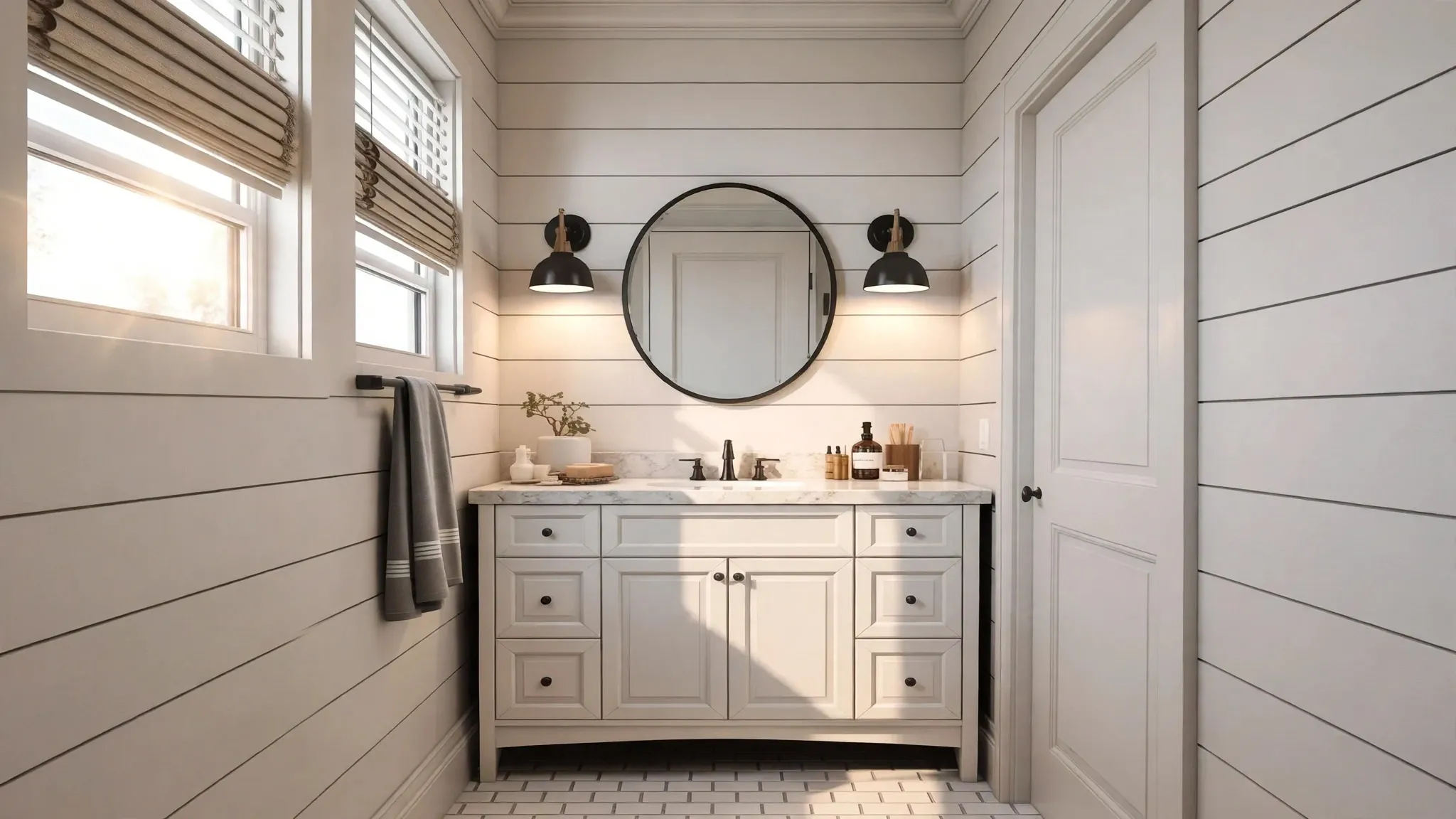
A shiplap wall in bathroom projects looks easy in photos. White boards, clean shadow lines, a mirror above the vanity. The photo never shows the steam, the splash at the sink, or the slow swelling at the floor line. A bathroom is the one room where the material choice decides the result. The same boards that look great in a bedroom can warp, gap, and grow mold in a steamy master bath.
We run a South Florida studio that designs and installs large-format panel walls. We do not sell or install shiplap, and this guide does not pretend otherwise. Our main shiplap guide owns the general verdict on shiplap types, costs and rooms. This article stays inside one room. It maps the bathroom into zones and prices the job from national cost guides. It explains what each material does in humidity, and it says plainly where shiplap works and where tile wins.
The short answer: zones decide everything
TL;DR: A shiplap wall in a bathroom works in a half bath and, in PVC only, on dry-zone walls of a full bath, with sealing and ventilation. Wood and MDF (medium-density fiberboard) shiplap stay out of full bathrooms. PVC (polyvinyl chloride, a plastic board) shiplap is the board option for full-bath walls outside the shower. No shiplap of any material is verified for inside a shower enclosure. Angi puts interior shiplap at $2 to $7 per square foot installed, with a national average project of $1,000 (Oct 2026).
The decision starts with the zone, and the material follows the zone for a shiplap wall in bathroom projects. A bathroom has two zones. The dry zone covers every wall that never takes direct spray: the vanity wall, the wall behind the toilet, the wall facing the tub. Steam and splashes reach those walls. Standing water does not sit on them. The wet zone is the tub or shower enclosure itself, plus walls above a tub with a wall-mounted showerhead.
Code draws the same line. Walls in shower compartments and above bathtubs with a wall-mounted showerhead must carry a finish that does not soak up water. The rule is IRC Section R307.2, from the International Residential Code (IRC), the model building code used in the United States. The finish runs to at least 6 feet above the floor, or 70 inches above the drain, whichever is greater. Tile, solid surface and acrylic meet that rule. Decorative paneling does not replace a shower waterproofing system. Florida jurisdictions layer their own amendments on the IRC, so the local building department has the final word.
The zone table below applies the verdict from our hub guide to each bathroom zone. It is the whole article in one view.
| Zone | Sealed wood | Standard MDF | Moisture-resistant MDF | PVC shiplap |
|---|---|---|---|---|
| Powder room, no shower | Yes | Yes, with care at the floor | Yes | Yes |
| Full bath, dry vanity or accent wall | No | No | No | Yes, best board choice |
| Wall by a freestanding tub or sink splash zone | No | No | No | Yes |
| Shower walls, inside the shower, ceiling above the shower | No | No | No | No, not verified; one DIY waterproofing-board build only |
| Ceiling in a full bath | No | No | No | Yes |
Angi notes a ceiling is less likely to get wet than a wall. The makers' full-bath exclusions still cover it.
One more rule sits above the table. A panel wall is cladding, a surface on a wall, and never a waterproof membrane by itself. That line applies to shiplap boards and to our own studio sheets alike. The waterproof layer behind the finish (the membrane), the wall underneath (the substrate) and the ventilation do the waterproofing, while the boards are only the visible surface.
Half bath vs full bath: the line that matters
TL;DR: A half bath has a toilet and sink, no tub or shower. Wood and MDF shiplap work there, painted or sealed, with good ventilation. A full bath adds a tub or shower. Wood and MDF shiplap stay out of full bathrooms. Makers Wallplanks and TIMELINE exclude wood in writing, and Wallplanks warns above 55 percent humidity. PVC shiplap is the board option for full-bath walls outside the shower. Every full bath needs a fan.
A half bath changes the math completely. No shower means no daily steam load and no standing water on the walls. Painted pine or MDF lives in ordinary room air there. Seal the board ends around the sink splash zone anyway. A splash at the sink is the one wet event a half bath sees, and the board ends are the first place water enters.
A full bath is a different room. Two wood-plank makers exclude it in writing. TIMELINE Wood, for its oak shiplap, calls its product not suitable for high-humidity areas. Wallplanks says its planks should not go in high-humidity areas like saunas and full baths. It warns that humidity above 55 percent could raise the grain and expand the planks. Wallplanks adds that a half bathroom is fine as long as there is no excessive steam. When sellers print limits like that, we believe them over any gallery photo of a steamy master bath wrapped in pine.
Angi, updated July 31, 2026, writes: "Installing shiplap in a bathroom works well when you avoid wet areas like shower walls, where wood can warp, swell, and develop mold from constant water exposure." The guide also warns that wood in a shower wall or ceiling can swell, warp, sag and grow mold and mildew. Angi's own material advice for wet areas points to cedar or PVC as the better choices for resistance to water damage.
UFP-Edge, a large shiplap maker, writes in its FAQ: "Can you use this on the walls in a bathroom? Yes, these boards can be used on walls within a bathroom. We recommend you seal the boards with a wood protector sealant to protect them from moisture." The condition matters as much as the yes. Seal the boards. UFP-Edge install sheets add two more conditions. Let the wood acclimate for several days in the room before install. Expect joints to open slightly as the wood dries. A board that goes up at warehouse moisture moves afterward, on your wall, at your joints.
Wallplanks shows the same tension inside one product page. Its FAQ says its planks are water resistant and can go in a full bathroom, with extra nailing. The same page says the dense fiberboard core (HDF, high-density fiberboard) is made from real wood and will absorb moisture, so the planks are not waterproof.
It also sets a strict install window. Permanent HVAC must hold between 60 and 75 degrees. Relative humidity must stay between 30 and 55 percent for at least 14 days before and during install. The job also needs a quarter-inch expansion space around the perimeter. Water resistant is a real claim with a limit. The shower exclusion stays in both versions: no install inside shower walls or right directly above the shower stall.
Our hub guide states the verdict in one paragraph. Wood and MDF shiplap stay out of full bathrooms, and a half bath without a shower is fine for them. PVC shiplap is the board option for full-bath walls outside the shower itself. No shiplap of any material is verified for inside a shower enclosure. That verdict has held through every source we read for this article, and nothing in the new research moved it.
What steam and splashes do to wood shiplap
TL;DR: Wood moves with humidity. Pine expands and contracts across the grain as moisture changes. On a shiplap wall that movement shows as gaps opening and closing, paint cracking along the joints, and boards cupping. Sealing, priming and painting slow the movement, and the USDA Wood Handbook puts it mostly across the width of the board.
Wood is hygroscopic, as MaisonLy puts it: it takes moisture from the air and gives it back as the air dries. The USDA Forest Products Laboratory Wood Handbook, cited in our hub guide, puts the movement mostly across the width of the board. On a shiplap wall that movement shows in three ways. Gaps open in dry weeks and close in wet ones. Paint lines crack along the joints, and boards cup, curling across their width, when one face stays damper than the other. A bathroom swings between dry and steamy every day, and that swing is the whole problem.
Angi writes:
"Because shiplap is a type of wood paneling, avoid placing it in areas that are frequently exposed to water, such as a shower wall or ceiling. When wood gets wet, it can swell, warp, and sag and develop mold and mildew."
The quote names four failures, swell, warp, sag and mold, and a wet bathroom wall can collect all four.
Acclimation is the first defense, and the install sheets all start with it. UFP-Edge install sheets tell installers to let the wood rest in the room for several days before install. Temperature and moisture differences between storage and the room change the finished look if the product never adjusts. As the wood dries, a slight joint may open up. MaisonLy asks the same question in hours: have you let real wood sit in your home for 48 to 72 hours to acclimate to your home's humidity? Skipping the step means the board goes up at warehouse moisture and moves afterward, on the wall, at the joints.
The nickel gap is part of the look and part of the risk. A nickel gap is the uniform eighth-inch space between nickel-gap boards. UFP-Edge cuts a step into the board edges so the gap stays even. That open line is a shadow line when dry. It is also a line where moisture and dust settle. MaisonLy recommends the eighth-inch nickel gap in bathrooms because it gives moisture fewer wide places to sit. Paint the wall behind the boards a dark color first. An opening joint then reads as a shadow line, and a white flash never shows through.
Cedar earns a partial pass, with a caveat that matters. The USDA rates the heartwood of named cedar species as resistant to decay and dimensionally stable. Sapwood gets no such rating. A commodity cedar board with pale sapwood edges does not inherit the whole rating. Angi lists cedar among the better wet-area choices, at $3 to $7 per square foot. That price buys the heartwood rating only when the boards are actually heartwood.
Pine runs $2 to $4 per square foot, and it is the most common wood shiplap. It takes paint and stain well, and it moves with humidity changes. In a half bath, painted pine is a sound choice, and paint slows the moisture on the wall. In a full bath, the daily steam cycle works the joints, so wood shiplap stays out.
MDF in a bathroom: the sponge problem
TL;DR: Standard MDF swells from humid air alone, edges first, and the swelling never fully reverses. Lab testing under EN 317, the European 24-hour immersion test, shows about 15 percent thickness swell in 24 hours of immersion for 18 mm standard board. Moisture-resistant MDF slows the swelling. It stays a dry-room board. Standard MDF never goes in a bathroom.
Standard MDF is wood fiber bonded with urea-formaldehyde resin. The resin is not water resistant. A USDA Forest Products Laboratory study, cited in our hub guide, confirms the chemistry. Moisture uptake swells the board and opens the fiber structure further, so the next wetting goes deeper. Our hub guide states the result: standard MDF swells from humid air alone, edges first, and the swelling never fully reverses when the board dries.
The lab numbers make the point concrete. MDF Skirting World, citing EN 317 testing, the European standard 24-hour immersion test, gives standard MDF about 15 percent thickness swell on 18 mm board, or 2.7 mm. The data was accessed November 19, 2026. Moisture-resistant MDF gives about 8 percent, or 1.4 mm, and exterior plywood, for comparison, gives about 3 percent. Typical residual swelling after drying runs 2 to 5 percent, so a water-damaged board stays permanently thicker and structurally weaker.
The US standard for MDF, ANSI A208.2, as summarized by Woodworking Advisor, allows standard-grade MDF up to 20 percent thickness swelling and 25 percent water absorption. Tempered grade caps swelling at 15 percent. Those are the limits a board is allowed to meet. They are not a promise that a wet board survives.
Cut edges are the weak point. Exposed fibers act like tiny straws, drawing water deep into the board through capillary action. Standard MDF is 82 to 87 percent wood fiber with 9 to 11 percent urea-formaldehyde resin, a glue that breaks down in water (hydrolysis). The failure starts at the edges and moves inward. A sealed face with raw cut ends is a sealed door with an open window.
Wetting and redrying cycles do permanent damage. Research cited in our wainscoting guide shows that MDF wetting-and-redrying cycles permanently increase thickness. A 2026 review in the MDPI journal Forests measures the strength loss. At 15 to 20 percent moisture content, modulus of rupture, the breaking strength, falls 30 to 50 percent. The glue holding the fibres together inside the board (internal bond) weakens by 60 to 70 percent. That is a board that looks the same and holds far less. ClickBina writes: "Swollen MDF does not shrink back, so the damaged lengths are replaced after the water source is fixed."
Moisture-resistant MDF grades exist under ANSI A208.2 and slow the swelling, but the board stays a dry-room board. The MEDITE MR datasheet gives 24-hour thickness swelling under 8 percent, and under 15 percent after repeated wet-and-dry cycling in the EN 321 test. The board still requires sealing, priming and painting on all surfaces. It is not rated for exterior use. Trish Whitsel, quoted in our wainscoting guide in October 2026, writes:
"Moisture resistance does not mean waterproofing"
Even in approved applications, every surface and edge must be sealed.
Our studio rule for bathrooms follows from all of it. Bathrooms get PVC, wood-plastic composite, or polystyrene fluted panels, never MDF. The material ladder in our wainscoting guide ranks cellular PVC best. Sealed solid wood comes second, if it never sits in standing water and every edge is sealed. MR-MDF is conditional, never near the floor or tub. Standard MDF stays out of bathrooms entirely. One MDF maker prints the same limit on its install sheet: it does not recommend installing in bathrooms or any area with excessive moisture.
MDF shiplap runs $2 to $6 per square foot in Angi's 2026 guide. It is not the cheapest board, and it is the weakest in water. A board that costs less per square foot and fails first costs more in the end. It needs a replacement job with a demolition step.
PVC shiplap: what waterproof does and does not mean
TL;DR: Per AZEK and Angi, PVC shiplap does not absorb water. It resists moisture, rot and swelling, and needs no protective paint to stay water-safe. That makes it the board for full-bath walls outside the shower. Inside the shower, tile wins. PVC is not a tile substitute. AZEK describes its PVC shiplap as moisture-resistant and low-maintenance.
PVC shiplap earns its place in a bathroom on one fact. The board does not absorb water. AZEK states that its PVC does not absorb water and resists moisture, rot and insects. Its catalog describes shiplap boards that slot into each other (tongue-and-groove), made from moisture-resistant, low-maintenance PVC that does not deteriorate or swell. Angi states the same point for the material class. "PVC is waterproof and resists mildew, rot, and swelling without any help from protective paint." No paint, no sealer, no drying cycle changes that fact. The board itself is inert to water.
The wall is a different question. A PVC board that does not absorb water still leaves open joints between boards, and nothing in a shiplap install seals those joints into a membrane. Water that reaches a joint finds the wall behind it. Our hub guide states this as the core test for any board system. No shiplap board is waterproof as a wall system. PVC boards do not absorb water, which makes them the wet-room option.
That distinction sets the use. PVC shiplap belongs on full-bath walls outside the shower: the vanity wall, the wall behind the toilet, the wall facing the tub. Those walls meet steam and splashes, with no direct spray. A PVC shiplap shower is an experiment. We found no manufacturer approval for any shiplap board, wood, MDF or PVC, as the surface inside a shower enclosure under direct, constant water. AZEK markets its shiplap and beadboard as an exterior and porch-ceiling line, with wind-uplift certification for beadboard. It does not market the line as an interior bathroom shiplap system, and it does not market it as a shower membrane.
The trade-offs are honest and small. PVC feels smoother and less woody up close than real wood. It shifts as temperature changes. A PVC wall in a full bath costs $3 to $7 per square foot in Angi's 2026 guide, the same band as cedar. The premium over pine is real. It buys a board that, per AZEK and Angi, does not absorb water and resists moisture, rot and swelling, and needs no protective paint to stay water-safe. For a full-bath wall outside the shower, that is the right trade.
A DIY builder documented a PVC shiplap shower on the Designing Idea site. She built a waterproof system first, then installed the boards. She used AZEK shiplap boards over a Schluter-Kerdi waterproofing board system. She glued the boards with an adhesive made for PVC. She siliconed every seam. She finished with a marine-grade acrylic enamel of the kind used on ships. She could only do about five rows at a time, then wait 24 hours for the silicone to dry.
The shower worked because the waterproofing was the Kerdi system underneath, and the shiplap was a finish on top of it. MaisonLy gives the honest advice for everyone else. Use specific PVC products designed for wet environments and ensure perfect waterproofing behind them, like a Kerdi board system. For most homeowners, MaisonLy recommends a wood-look porcelain tile in the shower.
Inside the shower: why tile wins
TL;DR: Tile over a proper membrane is the proven default in a shower. A rated shower panel system with sealed seams is a legitimate second route. Shiplap of any material is not a shower surface. A shower needs a membrane behind the finish, whatever the finish is. A standard 60-square-foot tile shower runs $3,800 to $7,500 in Dallas-Fort Worth, per elf.repair, November 2026.
A shower is the wettest surface in a house. Water hits it directly, daily, for years. The finish that survives there is the finish with a waterproofing system behind it. Tile over a proper membrane is the proven default. Our shower guide covers the comparison in full. A rated shower panel system is a legitimate second route. Acrylic, PVC, solid surface or a similar product made for inside the shower, with sealed seams, gives far fewer joints to clean. A shower needs a membrane behind the finish, whatever the finish is.
Tile is not inherently waterproof. Schluter, the maker of the Kerdi membrane system, states that tile coverings are not inherently waterproof and must be installed in conjunction with a waterproofing system. Porcelain tile carries a 0.5 percent absorption figure, and that figure describes the tile body only. The membrane behind the field of tile does the waterproofing. Cement board is water-durable, and it is not waterproof, per USG. The Tile Council of North America recommends a waterproof membrane in interior wet areas.
Grout follows the same logic. Cement grout is porous, absorbs water and stains, and requires regular sealing. Epoxy grout is non-porous, highly stain-resistant, and does not usually require sealing, at a higher price and with a fast, demanding install. MAPEI, the grout maker, calls epoxy the better choice for a shower. Grout seals the joints, and the membrane behind the tile keeps water out of the wall.
Rated shower panel systems pass the same test. A continuous waterproof layer sits behind or within the finish, with sealed corners and sealed pipe holes. Palisade requires a waterproof substrate behind its sheets for shower use, unless they cover existing tile, plus sealant in every tongue-and-groove joint. Fibo's waterproofing depends on sealing every joint and exposed edge exactly as its instructions specify, with polymer sealant. Its warranty can be voided if the instructions and recommended products are not followed. Fibo also instructs owners to clean sealant often to prevent mold and to replace damaged sealant, with its warranty at stake. A panel shower trades many small chores for a few important ones.
Covering old tile has its own rule. Some systems allow it over a sound surface. Covering tile whose waterproofing has already failed traps the failure inside the wall. If grout is crumbling, tiles are loose, or the wall smells musty, demolition and drying come first. A musty smell with a clean-looking wall is a leak problem.
The costs show why the choice matters. A standard porcelain shower, 3 by 5 feet with a Schluter Kerdi system, runs $5,500 to $8,500 in New Jersey contractor pricing from 2026, per Custom Kitchens by Lopez. Installed shower tile runs $15 to $50 per square foot for porcelain in Sacramento and Bay Area pricing, per Custom Versatile, updated November 13, 2026. A standard 60-square-foot tile shower in Dallas-Fort Worth runs $3,800 to $7,500 with Kerdi and epoxy grout, per elf.repair, accessed November 19, 2026.
Angi puts a professionally installed shower nationally at $4,448 to $12,374, averaging $8,205, updated October 13, 2026. That is a national figure, and the regional prices above carry their own regions. The point they make together is simple. A shower is a system with a price, and a shiplap wall is a finish with a price. Comparing the two on material cost alone misses the membrane, and the membrane is the shower.
Florida humidity and the fan
TL;DR: The EPA puts indoor humidity below 60 percent, ideally 30 to 50 percent. Code requires 50 CFM (cubic feet per minute, how much air the fan moves each minute) intermittent, 20 CFM continuous. Run the fan 20 to 30 minutes after every shower. HVI (Home Ventilating Institute) adds 1 CFM per square foot up to 100 square feet. The EPA says a wet surface dried within 24 to 48 hours usually grows no mold.
Florida gives a bathroom a thinner margin for error than a dry climate. The EPA mold guide, accessed November 19, 2026, sets the indoor target in one sentence. "Keep indoor humidity low. If possible, keep indoor humidity below 60 percent (ideally between 30 and 50 percent) relative humidity." The EPA adds the time rule that follows from it. "If wet or damp materials or areas are dried 24-48 hours after a leak or spill happens, in most cases mold will not grow." The guide opens with the principle behind both numbers. "The key to mold control is moisture control."
South Florida outdoor air routinely sits above the EPA indoor ceiling. Tip Top Plumbing and Restoration puts outdoor relative humidity in Broward County often between 70 and 90 percent. A quiet morning breeze can carry 80 percent humidity before breakfast, the same guide notes. Weatherhack, comparing Honolulu and Miami on ERA5 data for 2020 to 2024, puts Miami annual mean relative humidity at about 76 percent. The August dew point sits near 75 degrees.
Our hub guide gives the Florida Climate Center and NOAA normals. Miami and West Palm Beach average 82 percent outdoors in the morning and 61 percent in the afternoon. September mornings in Miami average 86 percent. Those are outdoor figures. A well-run air conditioner holds a Florida home near the EPA band all summer. The risk lives in the lapses: an empty house, the AC off or set high, a storm outage, a closed vent, a garage conversion.
The exhaust fan is the second half of the system. Code sets the minimum. The International Residential Code requires 50 CFM intermittent or 20 CFM continuous ventilation, ducted directly outdoors, as AnchorEra summarizes the code. The 2023 Florida Building Code, Mechanical, Table 403.3.2.3, gives the same numbers for bathrooms and toilet rooms. The air must go outside the building envelope. It must not end in an attic, a soffit, a ridge vent or a crawlspace. Venting into the attic is one of the most common code violations. It moves the moisture problem to the roof structure.
Sizing runs above the code minimum in practice. Guidance from HVI, the Home Ventilating Institute, as summarized by JDI Construction, sizes a bathroom by air changes. A bathroom up to 100 square feet gets 1 CFM per square foot, about 8 air changes per hour (summary accessed November 19, 2026). Above 100 square feet, the fixture method applies: 50 CFM each for a toilet, a shower and a tub, 100 CFM for a jetted tub, with 50 CFM as the minimum.
A Boca Raton remodeling contractor makes the point in a 2026 guide our wainscoting article cites. A code-minimum 50 CFM fan is technically compliant, the contractor argues. It is almost certainly not enough to prevent mold in a typical bathroom down here. That is one contractor's opinion. It is not a measured stat, and it is not a studio sizing rule. We publish no fan spec and no room-size formula of our own.
Run time is where the routine usually breaks down. Installers summarizing HVI guidance put the fan run at about 20 minutes after a shower. The Department of Energy Building America guidance, as summarized by JDI Construction, puts the figure at one hour (summary accessed November 19, 2026).
Our studio working routine, published in our wainscoting and shower guides, is a timer set for 20 to 30 minutes after every shower. A timer or a humidity sensor is how the routine actually happens. A fan that a person must remember to switch off gets switched off early. A national average for a bathroom fan install runs $396, from 2,554 verified projects, with most jobs at $120 to $900. The figure comes from Angi data updated September 10, 2026, as summarized by KeepThisHouse.
Hidden mold is the reason the fan matters more than the boards. The EPA warns that mold hides where you cannot see it. "Mold may be hidden in places such as the back side of dry wall, wallpaper, or paneling, the top side of ceiling tiles, the underside of carpets and pads, etc." Shiplap joints and the cavity behind the boards are exactly that hidden geometry. A wall that smells musty while looking clean has a leak behind it. Cleaning the face leaves the leak in place. The sheet comes off, the wall dries, the cause gets fixed, and only then does the finish go back.
Paint: sheen, primer and the film-only limit
TL;DR: Per MaisonLy, MyHomeQuote and FacadeColorizer, bathroom shiplap takes satin or semi-gloss enamel, two coats over a good primer, on every face and edge. Never flat or eggshell, the low-sheen finish between flat and satin, in a bathroom. One exception exists: a bathroom-formulated matte such as Benjamin Moore Aura Bath and Spa. Mold-resistant paint protects the paint film only. Ventilation still does the drying.
Paint works as a system on bathroom shiplap. The sheen, the primer and the coats all decide whether the boards survive steam. The sheen rule is consistent across the guides we read. Satin or semi-gloss enamel, two coats over a good primer, on every face and edge. Never flat or eggshell, the low-sheen finish between flat and satin, in a bathroom. MaisonLy, in its shiplap bathroom guide, warns against flat and matte paint for the same reason: the surface absorbs moisture and is hard to wipe down.
MyHomeQuote, in a best-paint-for-bathroom guide, rates the sheens as a rule of thumb. A satin finish reflects 25 to 35 percent of light and rates very good on moisture resistance. A semi-gloss finish reflects 35 to 70 percent and rates excellent. The hard, glossy surface deflects moisture rather than absorbing it.
One exception exists, and it proves the rule. Benjamin Moore Aura Bath and Spa is a matte-only paint formulated for high-humidity rooms. The maker describes it as a premium bathroom paint for high-humidity environments, with a mold and mildew-resistant coating and exceptional hide. Its technical data, as summarized by FacadeColorizer, lists antimicrobial additives that inhibit mold and mildew growth on the surface of the paint film. Coverage runs 350 to 400 square feet per gallon. The paint is zero VOC (volatile organic compounds, the solvents that evaporate from paint), and the exception works because the paint is formulated for the room.
FacadeColorizer states the film-only limit in one line. "One limit matters more than any brand: the 'mold-resistant' claim covers the paint film itself. It slows mold growing on the paint, it does not kill mold already on the wall, and it does not replace ventilation." The EPA gives the same rule from the other side.
"Do not paint or caulk moldy surfaces. Clean up the mold and dry the surfaces before painting. Paint applied over moldy surfaces is likely to peel."
A mold-resistant coating slows mold on the paint, and mold already on the wall stays put, with the fan still doing the drying.
Named products carry the same limit. FacadeColorizer, summarizing the makers' pages, reports that Sherwin-Williams Duration Home Interior and Emerald Interior both carry antimicrobial agents that inhibit mold and mildew on the paint surface. Duration Home returns to service in as little as two hours. Zinsser Perma-White, a Rust-Oleum product, calls its paint film mold and mildew-proof, with a five-year guarantee on the film only. Near a shower, its instructions say to wait 24 hours before showering and 7 days before scrubbing. The guarantee covers the paint film only. The wall behind the film carries no guarantee. These are the brands the paint guides we read name, and we do not recommend any of them.
AbodeRight, in retail guide prices checked August 26, 2026, puts the premium tier at $75 to $90 per gallon for Benjamin Moore Aura. Sherwin-Williams Emerald runs $75 to $85 per gallon, and mid-tier lines run $55 to $70 per gallon. Those are US retail guide figures, not manufacturer list prices. A gallon covers 350 to 400 square feet at the Aura rate, so one gallon covers a 100-square-foot bathroom wall twice over, with paint to spare.
Primer and sealing decide whether the paint holds. Prime first, especially on MDF edges and cut ends. An oil-based primer is the standard recommendation for MDF in bathrooms. A shellac-base primer soaks into raw MDF fibers and seals them off from moisture, per Woodworking Advisor. Real wood must be sealed on all sides, front, back and edges, before install. Angi advises a mold- and mildew-resistant paint plus a clear wood sealer on top for extra protection, or a clear sealer alone for a natural-wood look. The same guide says to apply protectant to all the shiplap in the bathroom, even on the ceiling, far from water sources.
Caulk placement follows one rule. Silicone goes at the floor line, around the tub, at plumbing penetrations, and at the tile-to-wall junction. Silicone stays flexible and resists mildew. Paintable acrylic or urethane caulk goes at the chair rail, inside corners, nail holes, and any joint that must disappear under paint. The chair rail is the horizontal trim strip at chair height. Silicone under paint is a failure, because paint does not stick to it.
An Ask MetaFilter case our wainscoting guide cites shows semi-gloss peeling in strips at a wall-to-tile line. The peeling stopped only after the joint was sealed with proper primer and a silicone bead at the tile edge. Match the material to the spot. MaisonLy says the corners get caulked to prevent moisture ingress, with a paintable silicone-acrylic hybrid.
Painting is easier before the boards go up. Grooves make painting tricky: too much paint pools in the joint, too little leaves bare patches. UFP-Edge recommends painting the wall behind nickel gaps a dark color first. A painted shiplap wall takes a new color without the boards coming off. Angi lists interior shiplap painting at $2 to $6 per square foot when the color changes. That is a real advantage over any pre-finished sheet, ours included. A damaged pre-finished panel has to come out and be replaced as a whole sheet.
Installation that holds up
TL;DR: Acclimate the boards before you install them. PacTrim asks 48 hours, TIMELINE asks at least 72 hours, and UFP-Edge asks several days. Leave a quarter to half inch gap at the floor and a quarter inch at the ceiling. Fasten into studs, never into drywall alone. Seal every cut end before the boards go on the wall.
A bathroom shiplap install fails at the same five points every time. Acclimation, sealing, the floor gap, the wall behind it, and the joints. Each one has a sourced rule.
Acclimation comes first, with boards resting in the installation room before they go up. UFP-Edge asks for several days, PacTrim requires 48 hours of conditioning for MDF, and TIMELINE asks at least 72 hours for its oak. Keep each figure with its maker, and do not fuse them into one number. The reason is the same in every sheet: a board that goes up at warehouse moisture moves afterward, on the wall.
Paint the back face of every piece before it goes on the wall, and paint every cut end too (back-priming and end-priming). Cut ends are the number one water entry path. Obsessed Woodworking, quoted in our wainscoting guide, writes:
"Five minutes with a brush on the cut ends is the difference between trim that lasts twenty years and trim you replace in six."
Seal all sides of real wood: front, back and edges. Prime MDF edges with an oil-based or shellac-base primer, and paint cut ends with touch-up paint.
Float the bottom off the floor by leaving a quarter to half inch gap under the bottom board. Cover it with a PVC baseboard or shoe molding, the small curved trim at the bottom of the baseboard. The gap stops water from wicking up the wall. A failed caulk line on a floating install is a re-caulk job. On a floor-resting install, it is a rot job. MaisonLy gives the same gap as a quarter to half inch, with PVC baseboard covering it.
Start with a sound wall, fixing leaks, soft spots and old water staining first, and never install over a leaking wall. One inspection case our wainscoting guide cites found wainscot covering an extensive mold colony. The drywall under shiplap must be dry, sound and reasonably flat. Wood boards over drywall still need nails reaching framing or furring. MDF shiplap goes over drywall with construction adhesive in beads at 16-inch spacing or 18-gauge brads, thin nails, into the studs. Never nail through the overlapping pieces. A pinned overlap cannot move, and a board held that tight will cup or split.
Fixing follows the direction of the boards. Horizontal boards nail directly to wall framing. Vertical boards need full-length thin wood battens, called furring strips, fixed to the wall every 24 inches. Fasteners are 15- or 16-gauge trim nails, thicker than brads, long enough for 1-1/4 to 1-1/2 inches of penetration into solid wood. Start horizontal runs at the bottom and work up, with the overlap pointing down. Stagger end joints so seams never line up in a zipper. Work out outlet and trim transitions in the layout, before starting.
Joints get sealed as the work goes. A high-moisture procedure from Duramax, cited in our wainscoting guide, puts a silicone bead inside the tongue-and-groove joints. It also adds drainage holes in the J-shaped trim channel at the bottom. Leave expansion gaps around the perimeter, a quarter inch in the Wallplanks install window. Do not caulk the bottom shut. Give condensation a way out. A sealed void behind panels is a mold trap if moisture gets in. The drying strategy is drainage at the bottom, air gaps around the perimeter, and ventilation that dries the cavity between showers.
A separate vapor barrier behind bathroom paneling is not the move. In tub and shower compartments, code forbids putting water-resistant drywall over a plastic vapor barrier (a Class I or II vapor retarder). The rule is IRC Section R702.3.7. Drainage at the bottom, air gaps around the perimeter, and a fan that runs after every shower do the drying work.
Bathroom shiplap costs by material and size
TL;DR: Bathroom materials run $2.50 to $7 per square foot, with total bathroom projects from $100 to $700. Angi puts interior shiplap at $2 to $7 per square foot installed, with a national average project of $1,000 (Oct 2026). A shower in tile costs $3,800 to $7,500 for 60 square feet, Dallas-Fort Worth pricing per elf.repair, November 2026. Repainting later runs $2 to $6 per square foot.
Angi's shiplap cost guide, updated October 6, 2026, is the anchor for every number in this section. Interior shiplap runs $2 to $7 per square foot installed, with the national average project at $1,000 and most homeowners spending $500 to $1,500. The total project range runs $300 to $5,600. Angi writes: "In 2026, the national average cost to install shiplap is $1,000. Most homeowners spend between $500 and $1,500."
Project size moves the total in a clear band.
| Wall size | Total project cost |
|---|---|
| 100 square feet | $300 to $800 |
| 200 square feet | $500 to $1,550 |
| 400 square feet | $800 to $2,800 |
| 800 square feet | $1,600 to $5,600 |
A bathroom accent wall is usually at the small end of that table. Angi's bathroom page, updated July 31, 2026, puts bathroom shiplap materials at $2.50 to $7 per square foot. Total bathroom projects range from $100 to $700, depending on the space and the wood choice. Note the small difference in the lower bound: $2.50 on the bathroom page, $2.00 on the cost guide, from the same publisher with slightly different framing. We quote the bathroom page for bathroom projects.
Material choice sets the per-square-foot band.
| Material | Cost per square foot |
|---|---|
| Pine | $2 to $4 |
| Cedar | $3 to $7 |
| Hardwood | $1.50 to $6 |
| Plywood | $2 to $3 |
| PVC | $3 to $7 |
| MDF | $2 to $6 |
| Pre-finished boards | $3 to $6 |
All figures are per square foot, from the same Angi guide. Labor runs $35 to $100 per hour, typically included in a professional estimate. Hiring a pro runs $1,000 to $1,500 in Angi's figure for professional install. Stikwood puts pine boards at $0.75 to $2.50 per square foot for material only, with labor at $5 to $15 per square foot. That framing differs from Angi's hourly labor figure, so we keep both labeled by source and never blend them.
Extras sit outside the headline range. Significant demolition or siding removal runs $4 to $17 per square foot when it applies. Interior projects can often go directly over existing drywall. Reclaimed boards add $5 to $7 per square foot over new material. Interior repainting later runs $2 to $6 per square foot. That repaint cost is the one ongoing number a bathroom owner should budget.
One conflicting figure deserves an honest note. Angi's broader wall-paneling guide lists shiplap at $7 to $16 per square foot. That is materially higher than the dedicated shiplap guide, on a page with a different scope that neither page reconciles. We use the dedicated shiplap guide because it prices shiplap projects specifically. The higher figure stays labeled as Angi's paneling-guide figure, and we never merge or average the two.
A small bathroom remodel gives the context for the whole job. Angi's bathroom page puts remodeling a small bathroom at $1,500 to $15,000. Shiplap is a small slice of that range. A full shower rebuild is a different budget entirely. The shower numbers in the section above show it. A standard tiled shower runs $3,800 to $7,500 in Dallas-Fort Worth and $5,500 to $8,500 in New Jersey, depending on region and scope.
No South Florida shiplap bathroom installed price exists in the sources we verified. Angi's numbers are national. South Florida labor will move a real quote inside or outside the band, and we will not invent a Florida price.
Cleaning and care in a bathroom
TL;DR: Clean shiplap once or twice a month, up to weekly in a busy full bath. Dust first, then wipe with a damp cloth and a mild cleaner. Angi's cleaning guide calls the routine that, and it keeps dust and grime from building up. Dry the wall after every wipe. Never soak the boards or the joints.
Cleaning a shiplap wall in bathroom conditions starts with the grooves. Angi's cleaning guide calls shiplap a dust magnet. The grooves between boards are perfect catch-all crevices for dust. The routine is simple. Vacuum the grooves with a brush attachment, then wipe with a microfiber cloth. A slightly damp sponge handles residue.
Plan the routine roughly one to two times a month, up to weekly in dusty homes. Horizontal boards collect more dust, because every groove is a shelf. Vertical boards trap less in their grooves. On a single accent wall, the routine takes ten minutes. On a whole room, it is a standing chore. Allergy households should factor that in before choosing shiplap for a bedroom or a bathroom.
Bathroom cleaning has one hard rule: never paint over mold. The EPA writes: "Do not paint or caulk moldy surfaces. Clean up the mold and dry the surfaces before painting. Paint applied over moldy surfaces is likely to peel." The EPA bathroom tip adds the routine that keeps mold from coming back. Increase ventilation, run the fan or open a window, and clean more frequently. That combination usually prevents mold from recurring, or at least keeps it to a minimum.
A musty smell points to a leak behind the wall. Mold hides behind paneling, where the panel wall is cladding and a membrane does the waterproofing. Our studio takes the sheet off, dries the wall behind it under the EPA 24 to 48 hour rule, fixes the cause, and only then puts the finish back. The same rule applies to a shiplap wall, since cleaning the face leaves a leak behind it untouched.
Our own studio panels follow a different routine, and it belongs here only as a contrast. Hard panel finishes take four steps. Dust with a soft dry cloth, then wipe with warm water and a mild, non-acidic cleaner (pH-neutral) on a microfiber cloth. Rinse with a clean damp cloth and dry the wall immediately.
Abrasive pads, bleach, ammonia sprays, acetone, solvent degreasers and steam cleaners are all banned on hard panels. That routine is for flat factory-finished panels, and our panel care guide gives it in full. It is not a shiplap routine. Shiplap boards take a new coat of paint in place, and a damaged pre-finished panel is a full-sheet replacement.
Our studio sheet in a bathroom
TL;DR: Our bamboo composite sheet belongs on dry-zone bathroom walls only: the vanity wall, the wall behind the toilet, the wall facing the tub. It carries no water or heat rating of its own. It never goes inside a shower. Our price anchors cover panel projects only. They carry no shiplap price. Those are preliminary numbers before measurement. Prices are current as of November 2026.
Our studio sheet is a bamboo composite panel, 48 by 108 inches and 5 mm thick, in marble, travertine, stone, porcelain and real-wood veneer looks. Leather and velvet looks are not bathroom finishes. It belongs on dry-zone walls in a bathroom, with sealed cut edges, a dry sound wall underneath, and a waterproofing plan anywhere splashing is routine. Leave expansion gaps of 3 to 5 mm around the perimeter. Inside the shower enclosure it does not belong, and we will not install it there. The sheet carries no water or heat rating of its own. A look is a surface, and a surface borrows no rating from the material it pictures.
The sheet earns its place in a bathroom on seams. One pre-finished sheet covers a whole wall with few seams, and a shiplap wall has a joint every few inches. Each joint is a line where moisture and dust settle, so fewer seams mean fewer places for moisture to sit. That is the honest comparison, and the sheet is cladding, with the substrate, the sealing and the ventilation still doing the waterproofing.
Prices stay in their separate lanes: the shiplap figures above are Angi's national market data, and our studio's published anchors cover its own panel projects only. A stock design starts from $850, a design fitted to your wall usually runs $2,200 to $2,700, and full custom turnkey projects start from $9,999. Prices are current as of November 2026. Every figure is preliminary, with the exact price confirmed after a specialist measures your wall. Those anchors apply only to our studio's panel work. They carry no shiplap price and no per-square-foot rate, and your room gets a real figure only after measurement.
Free design preview: send us a photo of your wall and see it in a new finish. That is how a bathroom wall starts with us: a photo, a design, a measurement, and a price for the real wall.
FAQ
Can you put shiplap in a bathroom?
Yes, in the right zone. A half bathroom without a shower takes painted pine or MDF in ordinary room air. A full bathroom takes PVC shiplap on walls outside the shower. No shiplap of any material is verified for inside a shower enclosure.
What is the best shiplap material for a bathroom?
PVC, for full-bath walls outside the shower. A PVC board does not absorb water, resists mildew and rot, and needs no protective paint. Sealed pine works in a half bath, with paint or sealer and good ventilation. Standard MDF stays out of bathrooms.
Can shiplap go in a bathroom shower?
No, as a surface on its own. We found no manufacturer approval for any shiplap board, wood, MDF or PVC, as the surface inside a shower enclosure. One documented DIY build worked only because a Schluter-Kerdi waterproofing system sat underneath the PVC boards. Tile over a membrane is the proven default.
What paint should I use on bathroom shiplap?
Satin or semi-gloss enamel, two coats over a good primer, on every face and edge. Never flat or eggshell. The exception is a bathroom-formulated matte such as Benjamin Moore Aura Bath and Spa. Mold-resistant paint protects the paint film only. Ventilation still does the drying.
How much does shiplap cost in a bathroom?
Angi puts bathroom shiplap materials at $2.50 to $7 per square foot, with total bathroom projects from $100 to $700. Interior shiplap nationally runs $2 to $7 per square foot installed, averaging $1,000 per project. Repainting later runs $2 to $6 per square foot.
Does shiplap need ventilation in a bathroom?
Yes. Code requires 50 CFM intermittent or 20 CFM continuous, ducted directly outside. Run the fan 20 to 30 minutes after every shower on a timer. The EPA puts indoor humidity below 60 percent, ideally 30 to 50 percent. The fan and the air conditioner do the moisture work.
Will MDF shiplap swell in a bathroom?
Yes. EN 317 lab testing shows about 15 percent thickness swell in 24 hours of immersion for 18 mm standard board. The swelling never fully reverses. Moisture-resistant MDF slows it to about 8 percent. It stays a dry-room board. Standard MDF has no place in a bathroom.
How do I clean shiplap in a bathroom?
Vacuum the grooves with a brush attachment, then wipe with a microfiber cloth, one to two times a month and up to weekly in dusty homes. Never paint over mold. Clean the mold, dry the wall, fix the leak, then repaint.
Sources
- Angi, "Can You Use Shiplap In A Bathroom?" Updated July 31, 2026. angi.com
- Angi, "How Much Does It Cost to Install Shiplap? [2026 Data]" Updated October 6, 2026. angi.com
- US EPA, "A Brief Guide to Mold, Moisture and Your Home" Accessed November 19, 2026. epa.gov
- UFP-Edge FAQ and installation instructions, via Manualshelf. manualshelf.com
- Wallplanks product-page FAQ. wallplanks.com
- AZEK Exteriors Catalog 2024 (PDF, hosted on a third-party file host). img1.wsimg.com
- Designing Idea, "What Are Popular Shiplap Shower Ideas" Accessed November 19, 2026. designingidea.com
- MDF Skirting World, "Is MDF Waterproof?" (EN 317 data) Accessed November 19, 2026. mdfskirtingworld.co.uk
- Woodworking Advisor, "When Should You Not Use MDF?" and "Does MDF Expand and Contract With Humidity?" Accessed November 19, 2026. woodworkingadvisor.com
- ClickBina, "Paneling Pulling Away From Wall? Swelling and Gap Fixes" Accessed November 19, 2026. clickbina.com
- MaisonLy, "Fresh Shiplap Bathroom Wall Ideas" Updated February 2, 2026. maisonlyinteriordesign.com
- AnchorEra, "Bathroom Ventilation Requirements USA" November 16, 2026. anchorera.com
- JDI Construction, "Bathroom Remodeling Guide: Bathroom Ventilation" Accessed November 19, 2026. jdiconstruction.co
- Tip Top Plumbing and Restoration, "How Humidity Control Prevents Mold in South Florida Homes" September 17, 2025 (hosted on the publisher's Azure storage). southcentralusa.blob.core.windows.net
- Weatherhack, "Honolulu vs Miami" (ERA5 2020-2024) Accessed November 19, 2026. weatherhack.com
- Benjamin Moore, Aura Bath and Spa sell sheet (PDF). media.benjaminmoore.com
- FacadeColorizer, "Mold-Resistant Bathroom Paint Guide" Accessed November 19, 2026. facadecolorizer.com
- AbodeRight, "Best Interior Paint Brands" Prices checked August 26, 2026. aboderight.com
- MyHomeQuote, "Best Paint for Bathroom" Accessed November 19, 2026. myhomequote.com
- Custom Kitchens by Lopez, "Bathroom Tile Shower Cost NJ 2026" April 25, 2026. customkitchensbylopez.co
- Custom Versatile, "Shower Tile Installation Cost 2026" Updated November 13, 2026. customversatile.com
- Angi, "How Much Does Shower Installation Cost in 2026?" Updated October 13, 2026. angi.com
- elf.repair, "Tile Services" (DFW) Accessed November 19, 2026. elf.repair
- KeepThisHouse, "Bathroom Fan, Lighting and Moisture" Updated November 18, 2026. keepthishouse.com
- Stikwood, "What Is Shiplap? Uncover the Pros, Cons, Popular Applications" Accessed November 19, 2026. stikwood.com
- Angi, "5 Tips for Cleaning Shiplap Walls" Updated August 4, 2026. angi.com
- Angi, "How Much Does It Cost to Install a Bathroom Fan? [2026 Data]" Updated September 10, 2026. angi.com
- Angi, "How Much Does It Cost to Install Wall Paneling? [2026 Data]" Updated October 30, 2026. angi.com
- Schluter Systems, Schluter-KERDI waterproofing membrane. schluter.com
- MAPEI, "Choosing the Right Grout: Cement vs Epoxy" October 10, 2024, as documented in our shower guide (the direct MAPEI URL returns 404 as of November 19, 2026). wowwallsstudio.com
- Palisade, PVC shower panel installation guide (via Manualshelf). manualshelf.com
- Fibo, wall panel FAQ and technical data. fibosystemusa.com
- USG, FAQ 564: Durock cement board is water durable but not waterproof; TCNA recommends a waterproof membrane in interior wet areas. assemblies-tools.usg.com
- HVI (Home Ventilating Institute), bathroom ventilation guidance, as summarized by JDI Construction. jdiconstruction.co
- U.S. Department of Energy, Building America, fan run-time guidance, as summarized by JDI Construction (summary accessed November 19, 2026). jdiconstruction.co
- Sherwin-Williams, Duration Home and Emerald Interior, product data as summarized by FacadeColorizer. facadecolorizer.com
- Zinsser (Rust-Oleum), Perma-White, product data as summarized by FacadeColorizer. facadecolorizer.com
- MEDITE MR datasheet (manufacturer datasheet, hosted on a third-party file host). cworkshop.co.uk
- PacTrim, Primed MDF Shiplap Installation Guide (via Manualshelf). manualshelf.com
- Duramax PVC Panels, installation guide (manufacturer). duramaxpvcpanels.com
- TIMELINE Wood, Oak Shiplap Wall Paneling Instructions (via Manualspro). manualspro.net
- MDPI Forests, 2026 review: modulus-of-rupture loss at 15-20% moisture content, internal-bond losses 60-70%. mdpi.com
- MDPI Polymers, 2021: MDF wetting-redrying cycles permanently increase thickness. mdpi.com
- USDA Forest Products Laboratory, Wood Handbook (movement across the grain), as summarized by Wagner Meters. wagnermeters.com
- USDA Forest Products Laboratory, 2003 study of MDF decay: urea-formaldehyde resin is not water resistant. research.fs.usda.gov
- Obsessed Woodworking, "Trim and Molding Choices You'll Regret" Accessed November 19, 2026. obsessedwoodworking.com
- Trish Whitsel, beautifullydone.design, "Wainscoting Ideas" October 2026. beautifullydone.design
- International Residential Code, Sections R307.2 and R702.3.7; 2023 Florida Building Code, Mechanical, Table 403.3.2.3 (code sections cited in the text; no single URL).
- WOW Walls Studio, "Shiplap Wall Panels: Cost, Materials and Florida Reality (2026)" wowwallsstudio.com
- WOW Walls Studio, "Wainscoting in the Bathroom: Waterproofing, Materials and Florida Rules (2026)" wowwallsstudio.com
- WOW Walls Studio, "Shower Wall Panels vs Tile: Cost, Waterproofing and Florida Reality (2026)" wowwallsstudio.com
- WOW Walls Studio, "Wall Panel Care: Cleaning, Repair and Maintenance (2026)" wowwallsstudio.com