
How Long Does a Shiplap Wall Last? Wood, MDF and PVC (2026)
A shiplap wall runs on two clocks: the board and the finish on it. This guide gives the published lifespan for solid wood, MDF and PVC shiplap with the scope each figure was published for, the loads that cut those years down, the habits that protect them, and the sign list that separates a repair from a replacement.
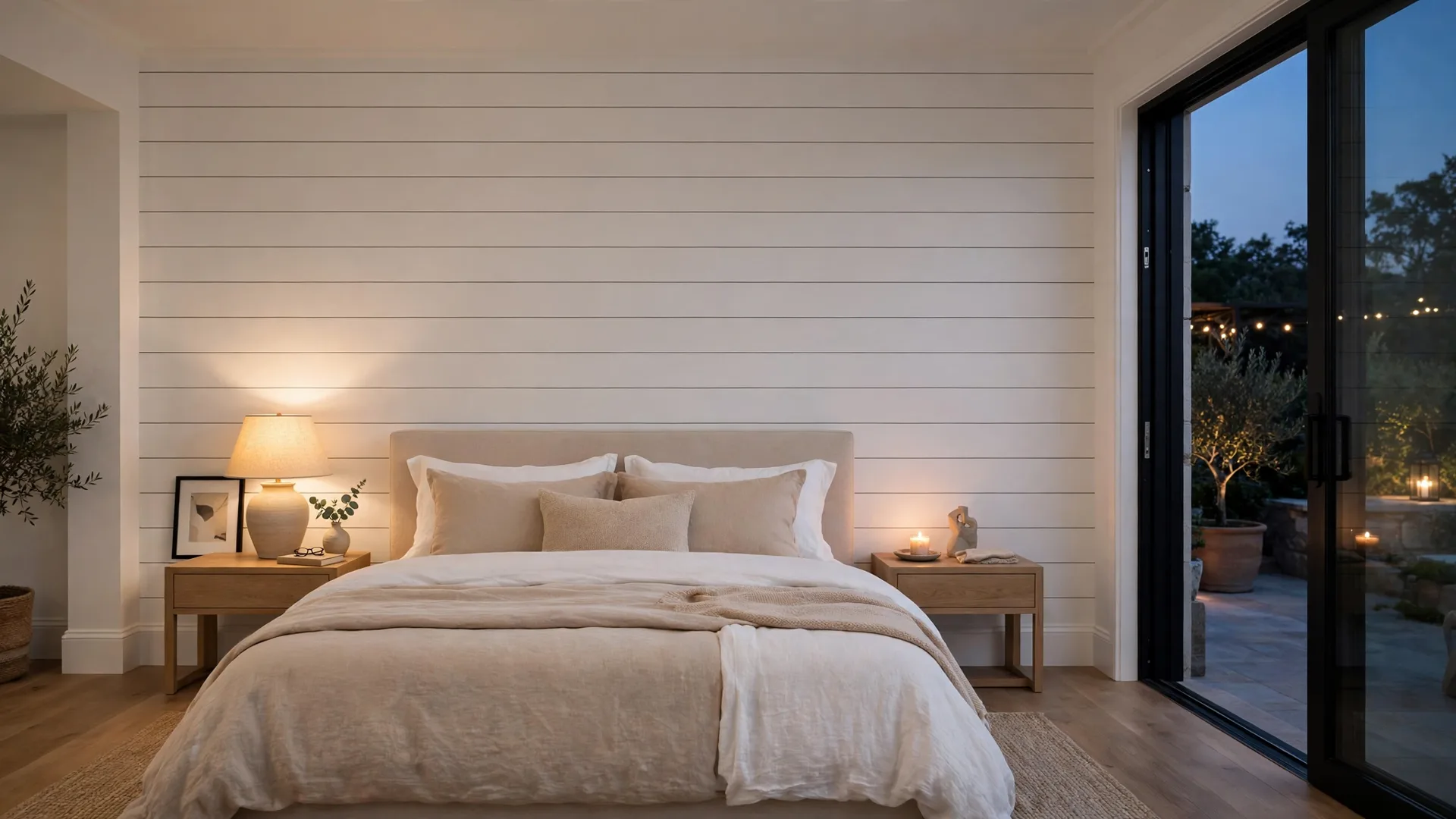
How long a shiplap wall lasts depends on one choice made before the first board goes up. The material decides the ceiling. The room decides how close the wall gets to that ceiling. Solid wood and PVC (polyvinyl chloride) sit at the long end. MDF (medium-density fiberboard) sits at the short end, and moisture moves it fast. Our full shiplap wall guide covers the joint, the pros and cons and the Florida verdict. This article stays on one question. It covers service life only: years by material, what cuts those years down, and the signs the wall is finished.
We are a South Florida studio that designs and installs large-format panel walls. Our studio does not sell or install shiplap, and we say so at the start for a plain reason. A lifespan answer from a seller tends to stretch. Ours has no product behind it. Where a guide or a maker publishes a lifespan figure, we name the source and the scope. Where sources disagree, we print both figures, scopes attached. A board wall also runs on two clocks at once. The board can stay sound for decades while its paint film ages out in a few years. Those clocks run at different speeds.
One boundary before the numbers. This article times interior board walls in lived-in rooms. Exterior siding lives under sun, rain and ground contact, and exterior figures belong to a different scope. The ranges below also assume the wall went up on a dry, sound surface, acclimated first. Our guide to installing a shiplap wall owns the fitting sequence. This article owns what happens after the fitting crew leaves.
The short answer: lifespan by material at a glance
TL;DR: ThePlywood.com, in its 2026 shiplap guide, puts real wood or PVC shiplap at 50+ years if installed correctly and kept dry. The same guide puts MDF shiplap at 10-15 years, especially in humid climates. Panel-system guides put interior PVC wall panels lower, at 15-25 years. Scope explains the gap, and the table keeps each figure with its source.
Read the scope column before the years column. Each row below answers a slightly different question, and honest comparison starts there.
| Material | Published lifespan | Scope | Source |
|---|---|---|---|
| Real wood or PVC shiplap | 50+ years | Installed correctly and kept dry | ThePlywood.com shiplap guide, 2026 |
| Solid hardwood boards | 40-50+ years | 3/4 inch tongue and groove (boards edged to lock into each other) wood panel configuration | BuildMat Insight, Aug 31, 2026 |
| Solid wood, broad | 30+ years | General indoor use, can be refinished repeatedly | Woodworking Advisor |
| Engineered veneer on MDF or plywood core | 20-30 years | Wood panel configuration | BuildMat Insight, Aug 31, 2026 |
| PVC wall panels | 15-25 years | Interior residential, installed correctly | Walls and Floors; Crecso (bathroom scope) |
| MDF shiplap | 10-15 years | Shiplap boards, especially in humid climates | ThePlywood.com shiplap guide, 2026 |
| Standard MDF, sealed | 10-15 years | Indoors with normal use | Woodworking Advisor |
| Moisture-resistant and high-density MDF, sealed | 20-30 years | All faces and edges sealed | Woodworking Advisor |
| MDF with unsealed edges near moisture | 1-3 years | Any grade, edges unsealed | Woodworking Advisor |
Three patterns hold across every row. First, the material sets the range, and the room picks the point inside it. Second, water moves a wall down its range faster than wear does. Third, the finish on the board runs on a shorter clock than the board itself. Those two clocks run separately, and lifespan arguments that mix them reach a number describing neither one.
Two clocks: the board and the finish on it
TL;DR: Structural life is how long the board stays attached, flat and sound. Appearance life is how long the surface still looks like the surface the owner chose. Angi puts a fresh paint coat at three to five years. Hardwax oil on wood runs 5 to 8 years on vertical surfaces per BuildMat Insight, and factory polyurethane runs 15 to 25 years.
A shiplap wall rarely fails all at once. The finish gives up first, in plain sight. The board gives up later, usually at an edge or a joint. Owners who track only the first clock call a sound wall worn out. Owners who track only the second repaint a wall whose edges have already swelled. Both clocks deserve a number.
The paint clock is the shortest one on a painted wall. Angi, updated Jul 31, 2026, states the general cycle plainly. Painted walls need a fresh coat every three to five years, and paint lasts for between three and five years before needing a new coat in most cases. That cycle covers ordinary painted walls, and a painted shiplap wall follows it. The grooves add one burden the flat wall escapes. Paint pools in the joint when a coat goes on heavy, and thin spots show at the gap edges when a coat goes on light. Our shiplap wall guide records that trade in its painting passage. Sheen stretches or shortens the cycle at the margins. Benjamin Moore states the cleaning side of the rule. Generally speaking, the higher the gloss or sheen, the easier it is to clean. Lower sheens like flat, matte and eggshell require a gentler touch. A wall that is cleaned gently needs fewer rescue scrubs, and rescue scrubs are what age a matte film fastest.
Clear finishes on wood run longer than paint and still run shorter than the board. BuildMat Insight, a technical guide published Aug 31, 2026, splits the two common wood finishes by years. Hardwax oil lasts 5 to 8 years on vertical surfaces before requiring a maintenance coat. Factory UV-cured polyurethane (a hard clear finish hardened under ultraviolet light) lasts 15 to 25 years on vertical applications. The gap between those figures is a maintenance choice, made on the day the finish is chosen. Oil asks for a light renewal coat on a short cycle. The factory film asks for nothing for years, then a full refinish when it finally breaks.
Primer deserves its own line, because primed boards are the wall most often left half-finished. A primed board carries a sealer coat made to receive paint. Left unpainted, that coat dulls, and repeated washing thins it further. A primed wall reaches its full service life only after the paint coat lands on it. Until then it runs on its shortest clock with no finish protection at all.
Solid wood shiplap: pine, cedar and the long end of the scale
TL;DR: Solid wood holds the long end of the shiplap scale. ThePlywood.com puts real wood shiplap at 50+ years if installed correctly and kept dry. BuildMat Insight puts solid hardwood panel configurations at 40-50+ years, and Woodworking Advisor puts solid wood at 30+ years with repeat refinishing. The condition attached to every figure is dry room air.
Wood earns its long ranges from one property the other board materials lack. A solid board can be renewed in place. A worn finish sands back, a fresh coat goes on, and the board underneath starts a new appearance clock with its structural clock untouched. Woodworking Advisor states the general figure with that property attached. Solid wood generally lasts 30+ years and can be refinished repeatedly. BuildMat Insight puts the wood wall range at 10 to over 50 years across configurations, with solid hardwood at the top of its matrix. ThePlywood.com gives the shiplap-specific version of the same answer. Real wood shiplap, installed correctly and kept dry, can last for 50+ years.
Pine is the default board, and its life is a paint story. Painted pine in a conditioned room has no moisture enemy left except events: a leak, a flood, a long stretch with the cooling turned off. The board itself moves gently with the seasons. BuildMat Insight gives the moisture band behind that movement. Interior wood in climate-controlled environments typically stabilizes between 6% and 9% EMC (equilibrium moisture content, the point where wood stops trading moisture with room air). Inside that band, gaps open a fraction in dry weeks and close in damp ones, and the paint film flexes with them for years. Outside that band, in a room that sits hot and damp all summer, the movement grows and the film cracks at the joints first. The board usually survives that story. The finish pays for it.
Cedar adds decay resistance to the same frame, with a limit owners need to hear in full. Our shiplap wall guide records the rating carefully. Cedar heartwood (the darker inner wood) resists decay best among the woods. A commodity cedar board with pale sapwood edges does not inherit the whole rating. Sapwood carries little of the protection the heartwood carries. A cedar wall built from heartwood boards has a real advantage in a steamy room. A cedar wall built from mixed boards has that advantage on some boards only, and rot starts where resistance runs out.
Hardwood boards sit at the very top of the published scale and at the top of the price scale as well. BuildMat Insight lists its solid hardwood configuration at 40-50+ years. That figure describes thick tongue and groove hardwood paneling, a heavier build than a typical pine shiplap board. We print it as the top of the wood range, with its configuration named. Both that figure and the shiplap-specific figure carry the same condition. Dry, conditioned room air is the price of the long end, in every source we opened.
MDF shiplap: the shortest clock on the wall
TL;DR: MDF shiplap carries the shortest published life on this wall. ThePlywood.com puts MDF shiplap at 10-15 years, especially in humid climates. Woodworking Advisor puts sealed standard MDF at 10-15 years indoors, sealed moisture-resistant and high-density grades at 20-30 years, and unsealed edges near moisture at 1-3 years for any grade.
MDF (medium-density fiberboard, wood fibers pressed with resin) gives the smoothest paint face on the wall and the weakest moisture story. The mechanism sits in the core. Our shiplap wall guide records it from the hub research. Standard MDF is bonded with urea-formaldehyde resin. A USDA Forest Products Laboratory study states the weakness directly: those resins are not water resistant, and swelling on moisture uptake opens the fiber structure further. Each wetting opens the structure a little more for the next one. That compounding is why MDF ages in steps around water events, while wood ages in a smooth line.
The dry-room figures are respectable, and we print them in full. Woodworking Advisor puts standard MDF at 10 to 15 years indoors with normal use. The same guide raises the ceiling for better grades, fully sealed. Moisture-resistant MDF and high-density fiberboard (HDF) reach 20-30 years when all faces and edges are sealed. EngineerFix offers the optimistic end of the same material. Well-made MDF furniture or millwork in a consistently controlled indoor environment may maintain structural integrity for 20 to 50 years. Read those figures together and the MDF rule writes itself. Sealing and room control decide whether an MDF wall lives at the bottom of its range or near the top.
The wet-room figures fall off a cliff, and the cliff has a shape worth learning. Woodworking Advisor states the floor plainly. Unsealed edges near moisture cut that lifespan to 1-3 years, regardless of grade. Unsealed MDF left near a sink or a window sill can swell and crumble in under two years. ThePlywood.com gives the bathroom version for shiplap boards specifically. In a bathroom, steam will cause the edges to swell and delaminate within a year. The same guide lists the failure trio in its mistakes section: using MDF in bathrooms can lead to swelling, mold, and rot. EngineerFix describes the physical scale of one swelling event. The fibers absorb liquid and swell dramatically. The swelling can result in a thickness increase of three to four times the original size, particularly along the exposed edges.
Movement adds a quieter tax. PacTrim, an MDF shiplap maker, states the exchange in its own instructions. MDF absorbs and desorbs moisture with changes in relative humidity, and some expansion and contraction of MDF shiplap should be expected. On a shiplap wall that movement shows at the gap line. Edges that swell a fraction stand proud of the face, catch light, catch dust, and catch the next splash sooner than a flush edge would. Woodworking Advisor closes the loop on reversibility. Swelling starts within hours of direct contact and is not reversible. The fibers hold their new shape after drying. An MDF edge that has swelled once stays swollen, and every later decision about that wall starts from that fact.
PVC and composite shiplap: the wet-room end of the scale
TL;DR: PVC removes the moisture mechanism that ends wood and MDF walls. AZEK states that its PVC absorbs no moisture. Panel-system guides put interior PVC wall panels at 15-25 years, with Crecso giving the same 15-25 years for a bathroom. ThePlywood.com puts PVC shiplap at the 50+ year end alongside real wood, for a wall installed correctly and kept dry.
Start with the property, because the property explains every figure in this section. PVC (polyvinyl chloride, a synthetic plastic) has no fibers to swell and no resin bond for water to break. Walls and Floors, a UK tile and panel retailer, states the absorption figure for its PVC wall panels. The panels provide non-porous wall protection with water absorption close to 0%. Crecso, in its bathroom panel guide, states the same property in shorter form. PVC is inherently non-porous and has a zero water absorption rate. AZEK, a cellular PVC maker, states the consequence for paint. Since AZEK absorbs no moisture, paint lasts longer on AZEK than on wood. Moisture cycling is a main reason paint fails on wood, and a board that skips the cycling keeps its film longer.
The published service ranges for PVC panel systems sit lower than the shiplap FAQ figure, and the difference is scope. Walls and Floors puts its interior PVC wall panels at service lifespans between 15 and 25 years when installed correctly, without warping, cracking, or color degradation across that span. Crecso puts PVC panels in a bathroom environment at typically 15-25 years with proper installation and basic maintenance, and adds the warranty line beside it. Some premium unplasticized PVC (uPVC) panels carry manufacturer warranties of 10-15 years. A warranty is a floor a maker will stand behind, and a service range is an expectation. The two numbers answer different questions, and we keep them in separate sentences for that reason.
ThePlywood.com places PVC shiplap at the long end beside real wood: 50+ years if installed correctly and kept dry. We print that figure as its source gives it, a shiplap-specific guide answer for the board material in a dry room. The panel-system ranges describe a full wall system in working rooms, bathrooms included, where joints, trims, sealant and printed faces age alongside the board. Both pictures can hold at once, for different walls.
PVC still moves, and its movement runs on temperature rather than moisture. AZEK gives the allowance in its installation guidelines. Allow 1/8 inch per 18 feet of AZEK for expansion and contraction. A long PVC run fitted tight at both ends can bow in a hot room, and a run fitted with its allowance sits flat for decades. The board also keeps one weakness the wood wall lacks. Sunlight ages the face. Walls and Floors states the limit plainly. Extended exposure to direct sunlight can lead to surface fading or yellowing over time. A PVC wall in a sun-flooded room trades its moisture immunity for a slow color clock, and curtains or a UV-stable finish become lifespan tools there. Our wall panels in Florida humidity guide carries the full material duel behind this section.
What shortens the life of a shiplap wall
TL;DR: Four loads take years off a board wall: high humidity, water in the gaps, paint failure, and bathroom steam on the wrong material. The US EPA rule anchors the first one: keep indoor humidity below 60 percent, ideally between 30 and 50 percent.
Humidity comes first because it loads every board on the wall at once. The EPA states the control target in its mold guide. Keep indoor humidity below 60 percent (ideally between 30 and 50 percent) relative humidity. The same guide gives the reason in one line: the key to mold control is moisture control. A Florida room with the cooling running holds that band without effort. A room that sits closed and unconditioned through a summer leaves the band for weeks at a time. Wood swells gently and recovers. MDF swells at its edges and keeps part of the swelling. Mold finds the cavity behind the boards, where no cleaning reaches. The EPA warns about that hiding place directly. Mold may be hidden in places such as the back side of dry wall, wallpaper, or paneling. A wall can look clean on its face while its service life ends behind it.
The gaps come second, because the gap is the open door on this wall. A nickel gap shiplap wall carries a uniform 1/8 inch open space between boards, per our shiplap wall guide. Dust, splash water and steam all use that door. On wood and MDF the board edge behind the gap is the most absorbent surface on the wall. BuildMat Insight quantifies the end-grain side of the same fact. End-grain absorbs and releases moisture up to 15 times faster than face-grain. Water that lands on a face meets paint. Water that enters a gap meets raw edge. That asymmetry explains why shiplap walls age from their lines inward. Our guide to cleaning a shiplap wall owns the routine that follows from it.
Paint failure comes third, because paint is the board's raincoat indoors. A cracked or peeling film lets room moisture and splash water reach the board on every cycle. The board starts aging at outdoor speed in the spots where the film broke. Benjamin Moore names one quiet cause. Strong solvents can damage the finish, and glass cleaner or a heavy-duty household spray cleaner should never be used on a painted wall. Harsh cleaning shortens the paint clock, and a shorter paint clock shortens the board clock behind it. Walls and Floors warns that direct sunlight fades or yellows PVC over time. Sunlight works the same trade on clear wood finishes, which turn amber and break down under strong sun.
Bathroom use comes fourth, and it acts as a multiplier on the first three loads. A full bathroom runs a daily steam cycle, holds the highest humidity in the house, and splashes the bottom boards directly. On PVC that load is the design case. On cedar heartwood it is a managed risk. On pine it ages the paint fast. On MDF it is the failure case the makers exclude in writing for high-humidity rooms.
Bathrooms and wet rooms: where each material ends
TL;DR: A half bathroom without a shower tests paint only, and every material in this article can live there. A full bathroom runs a daily steam cycle. Maker limits exclude wood and MDF from that room in writing. Wallplanks warns that humidity above 55 percent could raise the grain and expand its planks. TIMELINE rates its oak shiplap as not suitable for high humidity areas. PVC is the board built for the room.
The room split matters more than any single product claim. A half bathroom has a sink, a mirror and no steam cycle. Room air there stays close to the rest of the house, and splash stays local. A painted pine or MDF wall lives its normal dry-room life there with one extra habit: seal the board ends around the splash zone. A full bathroom adds a shower or a tub, and with them a daily hour of saturated air. That hour, repeated for years, is the load that separates the materials.
The makers draw their lines at that room, and we print their lines as they wrote them. Our shiplap wall guide records both exclusions in its bathroom section. TIMELINE, an oak shiplap maker, lists its recommended environment as not suitable for high humidity areas and answers its own bathroom question with a flat no. Wallplanks, a wood plank maker, excludes full baths and warns that humidity above 55 percent could raise the grain and expand its planks. Those are wood-maker limits for wood boards. The MDF version is harsher, because the MDF failure needs no years of steam. ThePlywood.com puts bathroom steam damage to MDF shiplap edges inside a single year. Woodworking Advisor puts unsealed MDF near any standing moisture at 1-3 years regardless of grade.
Ventilation decides how much of that steam load the wall actually carries. The EPA gives the bathroom pattern in its mold guide. Increasing ventilation (running a fan or opening a window) and cleaning more frequently will usually prevent mold from recurring. A fan that runs during the shower and after it pulls the room back under the humidity band quickly. The same PVC wall and the same wood wall both live longer behind a working fan, and the wood wall needs the fan most. Inside a shower enclosure, no shiplap board of any material in this article belongs. The joints stay open lines, water runs behind them by design, and a rated shower system is the right wall there.
What extends the life of a shiplap wall
TL;DR: Five habits protect the published ranges: acclimation, edge sealing, a whole paint film, humidity inside the EPA band, and leaks dried inside 24-48 hours. Each habit counters one: humidity, gap water, paint failure, bathroom steam.
Acclimation comes first because it happens once and protects every year after. Boards fitted at the wrong moisture content move against their fasteners as they settle, opening gaps and cracking paint at the joints. ThePlywood.com gives its shiplap rule directly. Boards sit in the room where they will be installed for at least 72 hours. PacTrim gives the MDF version in its own instructions. Condition the boards indoors for 48 hours before installation. Our guide to installing a shiplap wall owns the full sequence around those hours. The lifespan point stands alone. A wall that starts at room moisture starts its life unstressed.
Sealing comes second, and edges matter more than faces. Woodworking Advisor states the reason for MDF in one line: a cut edge is raw fiber, and the fastest path for moisture into the board. EngineerFix gives the sealing method that closes that path. An edge sealer, diluted PVA glue (a common wood glue used thinned as a sealer), or a shellac-based primer (a natural resin sealer) goes onto the cut edges. Together they create a hard, non-porous barrier before the topcoat. The same discipline covers wood board ends, outlet cuts and the bottom edge of the lowest board. BuildMat Insight gives the end-grain figure behind the habit. End-grain trades moisture up to 15 times faster than face-grain, so an unsealed end drinks first and swells first.
Paint care comes third. A whole paint film is a sealed board, and a broken film is an open one. Benjamin Moore adds two working rules. Fresh paint needs cure time: wait at least two weeks for newly painted walls to cure before cleaning them. And a washed wall gets dried at the end, to prevent moisture damage or mildew. Gentle cleaners keep the film whole between repaints, and the repaint itself lands on the Angi cycle of three to five years for painted walls in ordinary use.
Humidity control and fast drying close the list, and both carry EPA numbers. Hold the room inside the band from the mold guide: below 60 percent relative humidity, ideally between 30 and 50 percent. A small humidity meter tells the truth a thermostat hides. Then treat water events on the EPA clock. It is important to dry water-damaged areas and items within 24-48 hours to prevent mold growth. A leak behind a shiplap wall that dries inside that window costs a day of fans. The same leak left for a month costs boards. Our guide to cleaning a shiplap wall covers the routine upkeep between those events. Dry gap dusting, a damp rather than wet face pass, and gaps dried at the end of every wash.
End-of-life signs: how to tell the wall is done
TL;DR: A shiplap wall reports its age at its edges and joints first. Swollen or soft board edges, cupped boards, paint cracked along every joint, and a musty smell that returns after cleaning each mark a different failure. The first two end a board's life. The third ends a paint film. The fourth points behind the wall.
Learn the signs in the order they usually arrive:
- Raised, rough edges at the gaps. On MDF this is the earliest and most common failure sign. Woodworking Advisor names it directly: edge swelling, a puffy ridge along a cut edge. EngineerFix adds the locations: pronounced, localized swelling typically first appears at joints, corners, or the bottom edges of panels. A swollen edge stays raised after the wall dries, because the swelling does not reverse.
- Soft spots under a fingertip. Woodworking Advisor lists soft or spongy spots when pressed with a fingertip as a failure sign. The fiber bond inside the board has broken down at that spot. Paint can hide the look of it for a while. The fingertip test tells the truth the paint hides.
- Cupped or warped boards. A board that curls across its width has a moisture gradient in its history. BuildMat Insight states the mechanism: cupping occurs when the face of the wood panel experiences a different humidity level than the back. One cupped board beside a damp exterior wall tells a local story. Cupping across a whole wall tells a room story, and the room needs fixing before the boards do.
- Paint cracked along the joints. Seasonal movement concentrates stress at the gaps, and an aged, hard film cracks there first. Cracked lines on every joint, with sound flat boards between them, mark the end of a paint clock rather than the end of a wall. That case belongs to repaint work, with the prep our cleaning guide covers.
- Smell or staining that returns. A musty smell at a clean-looking wall, or a stain that comes back after correct cleaning, points at moisture behind the boards. The EPA lists paneling among the places mold may hide. Surface mold on a hard finish yields to the EPA hard-surface method: scrub mold off hard surfaces with detergent and water, and dry completely. Growth behind the boards is a moisture investigation, and it starts with finding the water.
One test separates age from dirt across all five signs. Clean the wall correctly, dry it fully, and look again in raking light (light hitting the wall at a low angle from the side). Dirt leaves. Damage stays, in the same shape, in the same place. A sign that survives a correct clean is damage, not dirt.
Repair or replace: the decision
TL;DR: Repair works when damage stays local and the cause has stopped: one swollen board end, one cupped board, one cracked paint film. Replacement is the honest answer when swelling spreads across boards, when soft spots multiply, or when moisture still sits behind the wall. The cause gets fixed before either choice, or the new work inherits the old failure.
Work through the decision in this order:
- Stop the water first. No repair outlives an active leak, a dead fan or a room that sits unconditioned. Find the source, fix the source, dry the wall. The EPA adds one hard stop at this step: do not paint or caulk moldy surfaces. Paint over mold peels, and caulk over mold seals the problem in.
- Count the damaged boards. One board with a swollen end, cut back and replaced, is an afternoon repair on a board wall, because boards come off one at a time. Damage on most boards, or at most bottom edges, describes a wall at the end of its material life in that room.
- Test the boards that look sound. The fingertip test from the sign list, run along edges and bottom boards, finds soft spots the eye misses. EngineerFix states the limit behind this step: once significant swelling and bond failure occur, the material cannot typically be re-compressed or restored to its initial dimensions. A soft board has no repair that returns its strength. It gets replaced or the wall gets retired.
- Separate the paint case. Cracked joints with sound boards take a repaint, on the prep sequence the cleaning guide owns. A repaint resets the appearance clock at a fraction of replacement cost, and it reseals the boards for the next cycle.
- Price the room change, not only the wall. A bathroom that ended an MDF wall will end its replacement MDF wall on the same schedule. Replacing like with like in a room that caused the failure buys the same lifespan again. Changing the material for that room, PVC for a full bathroom above all, changes the clock itself.
Style runs on its own clock, and we name it plainly so it never hides inside a lifespan figure. A wall can be sound, sealed and clean, and still read dated to its owner. Replacing a healthy wall for style reasons is a design decision with a design budget. The figures in this article describe material life.
The flat-panel alternative, stated honestly
TL;DR: Our studio's own wall is a flat, pre-finished sheet with no open joints. We give it no lifespan number, because no source publishes one for it. We state its facts and its limits in the same breath, and the board-wall figures stand as the honest comparison.
The comparison owners ask us for deserves a straight answer. A grooved board wall asks for gap dusting on a standing routine and ages from its open lines inward. A flat sheet wall wipes clean across its face and has no gap line to swell. Our studio sheets run 48 by 108 inches and 5 mm thick, in bamboo composite. Their finishes run from travertine and marble looks to stone and porcelain looks, real-wood veneer, leather, suede and fabric faces, metal, mirror and gloss solids. The full sheet breakdown lives in our bamboo composite wall panels guide, and the care routine lives in our wall panel care and cleaning guide.
The limits print beside the facts, as our shiplap wall guide prints them. The sheet is cladding, a finish layer over a wall. It carries no water or heat rating of its own. It belongs in conditioned rooms on a dry, sound, flat wall, with its edges sealed, and it does not go inside a shower. It also gives a room no board lines at all. An owner who loves the lines should keep them and keep the upkeep. For owners whose problem is the upkeep, the lifespan sibling is our guide to how long wall panels last. It times flat panels by material with the same source discipline used here.
Prices stay in their separate lanes. The figures in this article are lifespan figures from named guides and makers, and they carry no price at all. Our studio's published anchors cover our own panel projects only: a stock design from $850, a design fitted to your wall usually $2,200 to $2,700, and full custom turnkey projects from $9,999. Every figure is preliminary, with the exact price confirmed after a specialist measures your wall. The full finish library lives on our materials page, and the anchors live on our pricing page.
Frequently asked questions
TL;DR: Wood and PVC shiplap sit at the long end of the published scale, MDF at the short end, and moisture moves every material down its range. Hold indoor humidity below 60 percent, seal the edges, and dry leaks within 24-48 hours.
How long does shiplap last in general?
ThePlywood.com, in its 2026 shiplap guide, puts real wood or PVC shiplap at 50+ years if installed correctly and kept dry. The same guide puts MDF shiplap at 10-15 years, especially in humid climates. Panel-system guides put interior PVC wall panels at 15-25 years. The room and the sealing decide where inside those ranges a given wall lands.
Which shiplap material lasts the longest?
Solid wood and PVC share the long end of the shiplap-specific scale, at 50+ years in a dry, correctly installed wall per ThePlywood.com. BuildMat Insight puts solid hardwood panel configurations at 40-50+ years. PVC holds its advantage in wet rooms, where wood makers set limits and MDF fails early.
How long does MDF shiplap last?
Woodworking Advisor puts sealed standard MDF at 10-15 years indoors, and sealed moisture-resistant and high-density grades at 20-30 years. Unsealed edges near moisture fall to 1-3 years regardless of grade. ThePlywood.com gives the same 10-15 years for MDF shiplap boards, especially in humid climates.
How long does PVC shiplap last in a bathroom?
Crecso puts PVC panels in a bathroom environment at typically 15-25 years with proper installation and basic maintenance, with premium uPVC manufacturer warranties of 10-15 years. Walls and Floors gives the same 15-25 years for interior PVC wall panels installed correctly. The board itself absorbs no water, per AZEK, so joints, trims and sealant age first in that room.
Does paint extend the life of a shiplap wall?
A whole paint film seals the board against room moisture and splash water, and a cracked film lets both reach the board. Angi puts the repaint cycle at three to five years for painted walls. Benjamin Moore adds the working rules. Let fresh paint cure for at least two weeks before cleaning it. Dry a washed wall to prevent moisture damage or mildew.
Can shiplap last in a Florida home?
Yes, in conditioned rooms, with the material matched to the room. The EPA band is the working target: indoor humidity below 60 percent, ideally between 30 and 50 percent. A room that sits unconditioned through a Florida summer loads wood and MDF past that band for weeks, and MDF edges pay first. Our shiplap wall guide gives the room-by-room Florida verdict.
What shortens the life of a shiplap wall the most?
Moisture, in four forms: humidity above the EPA band, splash and steam in the open gaps, a broken paint film, and bathroom steam on wood or MDF. MDF swelling starts within hours of direct water contact and does not reverse, per Woodworking Advisor, so one wet season can set the wall's remaining life.
When should a shiplap wall be replaced rather than repaired?
Replace when damage has spread past local repair: swollen edges on most boards, soft spots that multiply under a fingertip test, or moisture still active behind the wall. EngineerFix states that significantly swollen MDF cannot typically be restored to its initial dimensions. One damaged board and one cracked paint film are repairs. A wall of soft edges is a replacement, with the moisture cause fixed first.
Sources
TL;DR: The lifespan figures in this article rest on the guide, maker and agency sources listed below, each printed with its scope in the text.
- ThePlywood.com – "Shiplap Guide 2026: Cost, Styles & Installation": real wood or PVC shiplap at 50+ years if installed correctly and kept dry. MDF shiplap at 10-15 years. Bathroom steam swells MDF edges within a year. Acclimation of at least 72 hours. theplywood.com
- US EPA – "A Brief Guide to Mold, Moisture and Your Home": humidity below 60 percent, ideally 30 to 50 percent. Dry water-damaged areas within 24-48 hours. Mold may hide behind paneling. Do not paint or caulk moldy surfaces. epa.gov
- Woodworking Advisor – "How Long Does MDF Last?": standard MDF at 10-15 years indoors. Sealed moisture-resistant and high-density grades at 20-30 years. Unsealed edges near moisture at 1-3 years. Swelling is not reversible. woodworkingadvisor.com
- EngineerFix – "How Long Does MDF Last? Factors That Affect Its Lifespan": well-made MDF at 20 to 50 years in a controlled indoor environment. Swelling of three to four times at exposed edges. Edge sealer, diluted PVA or shellac primer as the barrier. engineerfix.com
- Walls and Floors – "PVC Wall Panels" guide: interior PVC wall panels at 15-25 years when installed correctly. Water absorption close to 0%. Sunlight can fade or yellow the face over time. wallsandfloors.co.uk
- Crecso – "Trends in PVC Bathroom Wall Panels": PVC panels at 15-25 years in a bathroom environment. Premium uPVC manufacturer warranties of 10-15 years. blog.crecso.com
- BuildMat Insight – "Wood Panel Accent Wall Durability: Lifespan & Failure Analysis" (Aug 31, 2026): wood wall lifespan from 10 to over 50 years. Solid hardwood at 40-50+ years. Hardwax oil at 5 to 8 years, factory polyurethane at 15 to 25 years on vertical surfaces. buildmatinsight.com
- AZEK Exteriors – PVC Installation Guidelines, reproduced on Vintage Woodworks: AZEK absorbs no moisture, and paint lasts longer on it than on wood. Expansion allowance of 1/8 inch per 18 feet. vintagewoodworks.com
- Benjamin Moore – "How to Clean Walls Without Damaging Paint": higher sheen cleans more easily. Wait at least two weeks before cleaning newly painted walls. Dry walls to prevent moisture damage or mildew. benjaminmoore.com
- Angi – "Wallpaper vs. Paint: Which Is Right for You?" (updated Jul 31, 2026): painted walls need a fresh coat every three to five years. Wallpaper lasts around 15 years with minimal maintenance. angi.com
- PacTrim – "Primed MDF Shiplap" instructions: MDF absorbs and desorbs moisture with changes in relative humidity. Expansion and contraction should be expected. Condition boards indoors 48 hours before installation. images.thdstatic.com
- WOW Walls Studio – "Shiplap Wall in Florida: Pros, Cons, and What Holds Up Better (2026)": nickel gap definition, MDF resin facts and maker humidity limits. Studio sheet facts and price anchors. wowwallsstudio.com