
Shiplap Wall Cost: Materials, Labor and Project Totals (2026)
Shiplap wall cost in 2026 per square foot and per finished wall: materials by type, labor, worked totals, hidden extras, DIY vs pro, and the panel alternative.
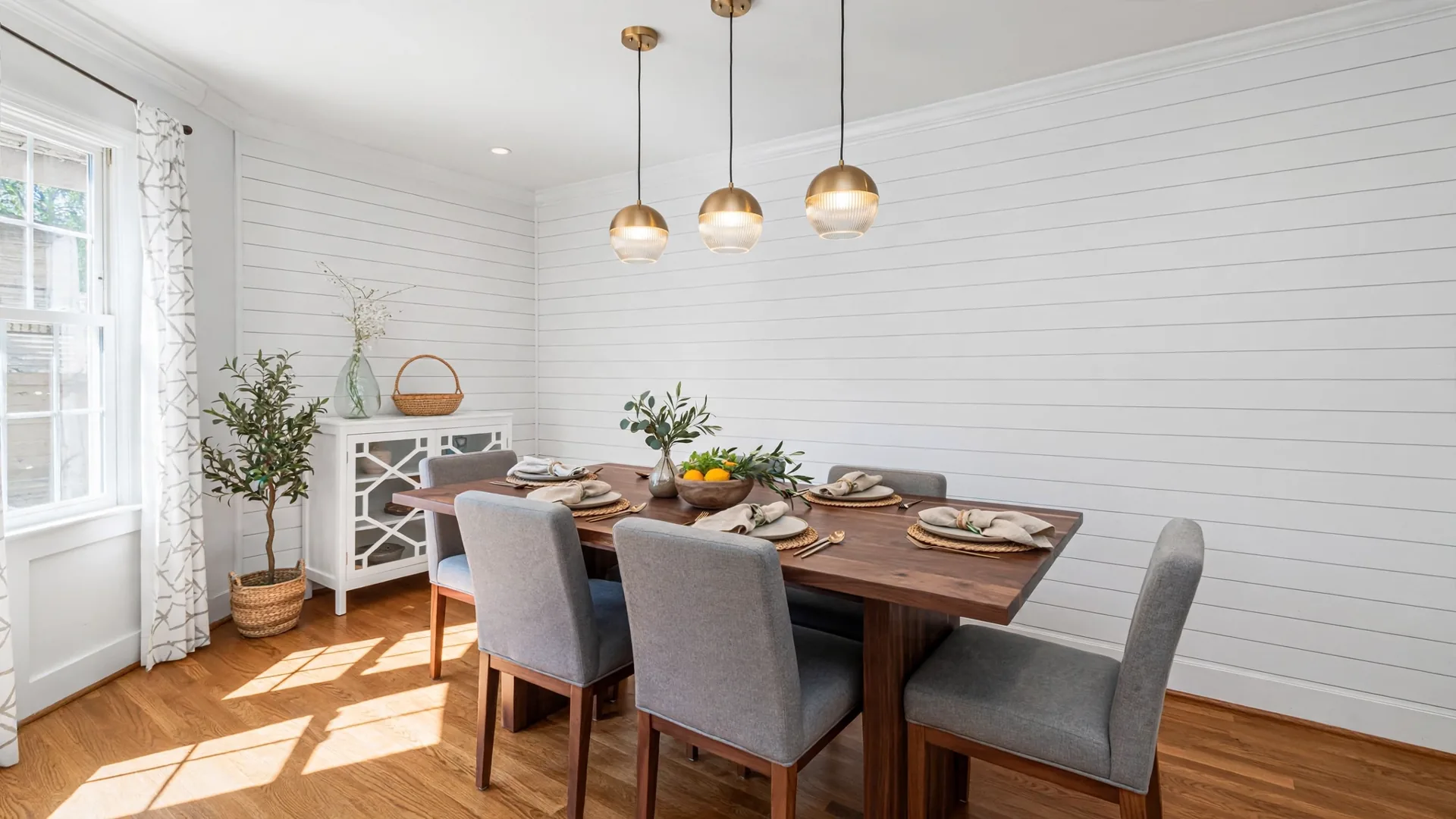
A shiplap wall is a wall covered with long boards that overlap at a stepped joint. Shoppers meet it as a board price, a box price or a per-foot quote. None of those numbers answers the real question: what the finished wall costs. This article answers that question for shiplap only. Materials get priced per square foot by board type. Labor gets its own section. One wall gets priced end to end, with the arithmetic shown.
We are a South Florida studio that designs and installs large-format panel walls. Our studio does not sell or install shiplap. Our general shiplap wall guide covers the product itself: the joint, the pros and cons, and what Florida humidity does to each board. This article covers the money. Our shiplap vs board and batten comparison prices the head-to-head choice. Here, only shiplap gets priced, and every figure comes from a named source with its scope attached.
One warning before the tables. Shiplap pricing mixes three scopes on one page. A per-foot figure can mean materials alone. It can mean materials plus labor. It can mean a retail box with shipping inside it. Each band below carries the scope its source published it for. Read the scope column before you read the number.
The short answer: what a shiplap wall costs per foot and per project
TL;DR: Angi's dedicated shiplap guide, updated October 6, 2026, puts interior shiplap at $2 to $7 per square foot installed. The average project costs $1,000, and most projects land between $500 and $1,500. The Panel Hub's 2026 guide prices shiplap materials alone at $2 to $7 per square foot. Labor, prep and painting sit in their own lines below.
| Shiplap figure | Band | Scope of the figure | Source |
|---|---|---|---|
| Interior shiplap, installed | $2 to $7 per sq ft | Installed, national | Angi shiplap guide, Oct 2026 |
| Exterior shiplap, installed | $3.60 to $11 per sq ft | Installed, national | Angi shiplap guide, Oct 2026 |
| Average shiplap project | $1,000 average, $500 to $1,500 typical | Whole project | Angi shiplap guide, Oct 2026 |
| Shiplap materials alone | $2 to $7 per sq ft | Materials only | The Panel Hub, April 2026 |
| Peel-and-stick HDF shiplap | $8.50 per sq ft | Retail product, material only | Wallplanks Cape Classic |
| Reclaimed peel-and-stick planks | $12.00 per sq ft | Retail product, material only | Timberchic Barnwood |
| Professional labor, panel work | Plus $3 to $10 per sq ft | Standard flat wall | The Panel Hub, April 2026 |
| Studio large-format panel project | Priced per project, from $850 | Design, panels, delivery, own-crew install | WOW Walls Studio anchors |
Read the first two rows together, because they explain most quote confusion. Angi's $2 to $7 band is an installed figure from its dedicated shiplap guide. The Panel Hub's $2 to $7 band is a materials figure from its panel cost guide. The bands match on paper. They describe different purchases. A contractor quoting $7 installed and a retailer quoting $7 for boards alone are $7 apart in real money once labor enters.
One conflict belongs in the open. Angi's broader wall paneling guide, updated October 30, 2026, lists shiplap at $7 to $16 per square foot. The same publisher prints two bands for the same product on two pages. Neither page reconciles the other. We use the dedicated shiplap guide as the headline source in this article. It prices shiplap projects specifically, by size and by material. We keep the paneling guide for the general frame: paneling projects overall run $1,200 to $6,000, averaging about $2,800. When a quote lands near $16 per foot, ask which guide and which scope it follows.
The last row belongs to a different product. Our studio installs large-format smooth panels and prices them by the project. That row sits in the table so you can compare a finished shiplap wall with a finished smooth wall later in this article. It carries no shiplap price. Every studio figure is preliminary until a specialist measures your wall.
Materials by material: pine, cedar, MDF, PVC and the peel-and-stick lines
TL;DR: Angi prices shiplap boards by material. Pine runs $2 to $4 per square foot. Plywood runs $2 to $3, and MDF runs $2 to $6. Hardwood runs $1.50 to $6. Cedar and PVC run $3 to $7, and pre-finished boards run $3 to $6. Retail peel-and-stick lines sit above the table: Wallplanks lists its HDF shiplap at $8.50 per square foot, and Timberchic lists reclaimed planks at $12.00.
Start with the board itself, because the material sets both the price and the room the wall can live in. A shiplap board is a long plank with a rabbet (a stepped cut along each long edge) so boards overlap. The overlap leaves the shadow line the look is known for. Our shiplap wall guide covers the joint and its look-alikes in full. This section keeps the price side of each material.
Pine. Pine is the default board and the cheapest real wood in Angi's table, at $2 to $4 per square foot. It paints well, it cuts easily, and it suits dry, conditioned rooms. Knots can bleed through paint unless they are sealed first. That sealing step belongs in a pine budget even though no table lists it.
Plywood. Plywood boards run $2 to $3 per square foot in Angi's table. Homeowners also rip plywood sheets into strips for the lowest-cost version of the look. The face layer is thin, and the strip edges show the glued layers unless they are covered. The saving is real. The finish ceiling is lower than a milled board gives you.
MDF. MDF (medium-density fiberboard, pressed wood fibers) runs $2 to $6 per square foot. It gives the smoothest paint face in the family because it has no grain. It also carries the weakest moisture story. Standard MDF swells when it takes up moisture, and the swelling starts at the edges. In a cost article the point is simple: the cheapest smooth board can become the most expensive wall in a steamy room, because replacement is the repair.
Hardwood. Hardwood boards run $1.50 to $6 per square foot in Angi's table. The band is wide because the category is wide. Species, grade and board width move a hardwood quote more than brand does. The Panel Hub guide ranks pine as the lightest cost within real wood. It puts oak in the middle. It places walnut at the premium end, and it notes that American walnut is among the most expensive domestic hardwood species.
Cedar. Cedar runs $3 to $7 per square foot. Angi names cedar and PVC as the better choices for a wet area, for their resistance to water damage. Cedar heartwood (the darker inner wood) carries the decay resistance buyers pay for. Pale sapwood edges carry less of it. Ask what part of the tree your board came from before you pay the cedar price.
PVC. PVC (polyvinyl chloride, a synthetic plastic) runs $3 to $7 per square foot. The board keeps the shiplap profile and drops the moisture problem. The trade is feel up close: the surface reads smoother and less woody than a painted pine board. In a full bathroom or a beach condo that sits empty in August, PVC is the version of this wall with the soundest cost story.
Pre-finished boards. Pre-finished shiplap runs $3 to $6 per square foot in Angi's table. The finish arrives on the board, so the painting line later in this article shrinks or disappears. Compare a pre-finished quote against a raw board plus its painting cost. The raw board often stops looking cheaper at that point.
Peel-and-stick retail lines. Two manufacturer listings show where branded convenience products sit. Wallplanks sells its Cape Classic paintable nickel gap shiplap at $8.50 per square foot, $224.40 per box, with 26.4 square feet per box. The board is HDF (high-density fiberboard) made with recycled forest content, and it installs peel-and-stick. Timberchic sells its Barnwood peel-and-stick planks, in reclaimed spruce and fir, at $12.00 per square foot. Both lines price the adhesive backing and the retail packaging inside the per-foot figure. Both sit above Angi's board table for that reason.
Reclaimed boards. Angi prices the reclaimed premium directly: expect to pay $5 to $7 more per square foot for reclaimed shiplap compared with new material. The Timberchic listing shows the same premium from the retail side. Reclaimed wood buys character you can see. It also buys sorting, denailing and color matching time, and those hours live inside the premium.
Labor: what professional installation adds
TL;DR: Angi puts shiplap labor at $35 to $100 per hour, typically included in a professional estimate. The Panel Hub guide adds $3 to $10 per square foot for panel labor on a standard flat wall, rising to $8 to $15 on complex walls. HomeGuide splits its shiplap labor at $1 to $4 per square foot. On a small wall, a minimum charge can matter more than any per-foot rate.
Labor turns a board price into a wall price. Shiplap labor has a forgiving profile compared with tile or stone. Boards are nailed to framing or fixed to a prepared wall. Cuts are straight. There is no grout (filler packed between tiles) and no curing window in the chain. Angi puts the hourly rate at $35 to $100, and it notes that labor is typically included in a professional's project estimate. Hiring a pro through its data runs between $1,000 and $1,500 for the job.
The per-foot view comes from the panel guides. The Panel Hub guide adds $3 to $10 per square foot for standard flat-wall installations. Complex layouts, high ceilings and intricate patterns rise to $8 to $15. Angi's general paneling guide agrees on the standard band, at $3 to $10 per square foot or $40 to $100 per hour. HomeGuide publishes a lower labor split for shiplap specifically, at $1 to $4 per square foot, inside its installed band of $3 to $11. The three sources describe three labor markets: a dedicated shiplap split, a panel-trade band, and a general paneling band. A local quote can honestly land in any of them.
What pushes a shiplap job toward the complex band is the wall itself. Outlets and switches need cutouts. Corners need the last board trimmed to width with its edge finished. A vertical run needs furring strips (thin wood strips fixed to the wall as a nailing base) where the framing runs the wrong way. Height does the rest: a tall wall needs staging (a raised work platform) and a second pair of hands. Each item is ordinary carpentry. Each item is billable time.
Boards also need acclimation (resting flat in the room before install so their moisture settles). A careful installer builds those days into the schedule rather than the invoice. Skipping acclimation saves no money. It moves the cost into opened joints and callbacks later. Our how to install a shiplap wall guide walks through the full sequence, board by board, including the fixing pattern a correct job follows.
Installers set a minimum charge for small jobs. The trip, the setup and the cleanup cost the same on a 60 square foot wall as on a 160 square foot wall. On a small fireplace surround, the per-foot math can say $240 while the booked job says more. The booked job is the real number. The worked examples in the next section use the published bands, so treat their low ends as best cases on small walls.
One wall, priced end to end: a 108 square foot worked example
TL;DR: On one dry living room wall, 12 feet wide and 9 feet high, the published bands produce these totals. Pine boards ordered with waste run about $242 to $484 in materials. The same wall professionally installed lands near $566 to $1,927 by the cited bands. Angi's own size table brackets the wall: 100 square feet at $300 to $800 and 150 square feet at $450 to $1,200. A fitted large-format studio design for the same wall usually runs $2,200 to $2,700 complete.
No source publishes a total for this exact wall, so the table shows its method openly. The wall is 108 square feet. Materials are ordered with a 12 percent waste allowance (extra material for cuts and mistakes), which is 121 square feet ordered. That allowance sits inside the guide's 10 to 15 percent waste range. Labor is charged on the 108 square feet of finished wall. Each total below is a cited band multiplied out by that method, and the arithmetic is ours.
| Option for the 108 sq ft wall | Band used | Wall total |
|---|---|---|
| Pine boards, self-installed (Angi materials) | $2 to $4 per sq ft x 121 sq ft ordered | About $242 to $484 materials |
| MDF boards, self-installed (Angi materials) | $2 to $6 per sq ft x 121 sq ft ordered | About $242 to $726 materials |
| PVC boards, self-installed (Angi materials) | $3 to $7 per sq ft x 121 sq ft ordered | About $363 to $847 materials |
| Pine wall, professionally installed | Materials above plus labor $3 to $10 x 108 sq ft | About $566 to $1,564 total |
| Mid-range boards, professionally installed | $7 per sq ft materials x 121, plus labor $3 to $10 x 108 | About $1,171 to $1,927 total |
| Wallplanks peel-and-stick, self-installed | $224.40 per box, 26.4 sq ft per box; 5 boxes cover 132 sq ft | $1,122 materials |
| Studio large-format panel, fitted design | Project anchor | Usually $2,200 to $2,700 complete |
Start with the box math, because it shows why kit pricing misleads. Five Wallplanks boxes at $224.40 cover 132 square feet, the minimum box quantity that covers this wall with waste, for $1,122 in materials. The same wall in pine boards ordered by the foot runs about $242 to $484. The peel-and-stick line prices its backing, its brand and its packaging inside the box. The pine line prices boards alone. Both totals are honest. They buy different things.
Angi's own published size table brackets this example from both sides. Its table runs 100 square feet at $300 to $800, 150 square feet at $450 to $1,200, 200 square feet at $500 to $1,550, 400 square feet at $800 to $2,800, and 800 square feet at $1,600 to $5,600. Our 108 square foot wall sits just above its smallest row. Its professionally installed totals from the bands above sit above that row, because the band math charges full labor on every foot. Small walls in Angi's table benefit from the minimum-charge reality in reverse: real projects cluster, and the table reflects booked jobs rather than pure multiplication.
Read the studio row differently from the other six. It is a project price for a smooth large-format wall. Design, panels, delivery and installation by our own crew sit inside it. The figure is an anchor, preliminary until a specialist measures your wall. The other rows are market bands for a board product and its trade, before your specific wall adds or removes work. The comparison section near the end puts the two finished walls side by side on upkeep and lifespan as well as price.
What drives the price up and down
TL;DR: Five choices move a shiplap quote more than any negotiation will. The material itself is the largest: pine at the bottom, PVC and cedar at the top of the board table, reclaimed above both. The finish state moves the painting line. Coverage and waste add 10 to 15 percent to the order. Prep on a rough wall can cost more than the boards.
The material. Angi's board table shows the spread inside one product name. Pine lists at $2 to $4 per square foot. PVC and cedar list at $3 to $7. A peel-and-stick retail line lists at $8.50. A reclaimed retail line lists at $12.00. Two quotes priced at $3 and $9 per foot are almost certainly different boards wearing the same shelf name. Compare the material before you compare the number.
The species and grade. Within real wood, the Panel Hub guide ranks pine as the lightest cost and oak in the middle. Walnut sits at the premium end. Grade moves the price inside one species: a clear board with few knots costs more than a knotty board of the same wood. If a wood quote surprises you, ask which species and grade sit behind the finish name before you ask for a discount.
The finish state. Raw boards need primer and paint after they go up. Angi prices interior shiplap painting at $2 to $6 per square foot. Pre-finished boards at $3 to $6 per square foot carry that work inside the board price. The Panel Hub guide adds a materials view for unfinished panels. Finishing materials run at least $1 to $3 per square foot. Labor time adds more when you hire the finishing out. A cheap raw board and a pre-finished board at $2 more per foot can land at the same finished cost.
Coverage and waste. Boards are sold by nominal size (the name on the label), which is larger than the board you receive. Part of each board's width hides inside the overlap. The exposed face (the part you actually see) is what covers your wall. Buy by the exposed face when you count boards. Then add the waste allowance: the Panel Hub guide instructs buyers to add 10 to 15 percent to the measured square footage. On the worked wall in the previous section, that allowance is the difference between ordering 108 square feet and ordering 121. Skipping it risks a second order, a second shipping charge and a batch mismatch.
The wall behind the boards. A flat, sound, dry wall takes boards at the standard labor band. A wall that needs demolition or old siding removed first enters Angi's prep band, at $4 to $17 per square foot when significant removal is required. That band can exceed the board cost on the same wall. A quote that assumes a perfect wall and a quote that includes prep are pricing different projects, even when their board lines match to the dollar.
The extras that hide outside the first quote
TL;DR: The guides list the standard extras plainly. Prep runs $4 to $17 per square foot when demolition is required. Painting runs $2 to $6 per square foot on raw boards. Trim runs $2 to $5 per linear foot in the panel guide, inside Angi's wider trimwork band of $0.50 to $25. Adhesive runs $20 to $60 per wall, samples $20 to $40, and the order carries a 10 to 15 percent waste allowance.
Prep and demolition. Angi budgets prep work between $4 and $17 per square foot when significant demolition or siding removal is required. Interior projects often go directly over existing drywall, which keeps prep near zero. Exterior projects need underlayment, trim work and caulking, and those lines push the exterior band to $3.60 to $11 installed. Ask every quote one question: what state does it assume my wall is in on day one?
Painting and finishing. Raw and primed boards need their finish after install. Angi prices interior painting at $2 to $6 per square foot and exterior painting at $1.50 to $4. The grooves make the work slow: paint pools in the joint when it goes on heavy, and bare patches show when it goes on light. Painting boards before they go up is faster. Either way, the line belongs in the budget from the start.
Trim and edge pieces. Corners, ends and transitions need trim to read as finished carpentry. The Panel Hub guide budgets trim at $2 to $5 per linear foot and tells you to measure your perimeter before ordering. Angi's wider trimwork band runs $0.50 to $25 per linear foot across trim types. A 12 by 9 foot wall has about 30 linear feet of edge once the top and both sides are counted. Trim alone can add $60 to $150 at the panel guide's band.
Adhesive and fixings. The Panel Hub guide budgets adhesive at $8 to $20 per tube. One tube covers roughly 30 to 40 square feet of panel. A standard accent wall needs 2 to 4 tubes and $20 to $60 of adhesive. Nails and brads add a smaller line. Neither figure appears in a per-foot board price.
Baseboard work. A floor-to-ceiling shiplap wall meets the baseboard (the trim board along the floor) along its whole width. The baseboard comes off first and goes back against the board face. As a self-installed task it is a pry bar and a few nails. In a professional quote it is labor time, and it belongs in the quote in writing.
Samples. The Panel Hub guide prices a sample box at $20 to $40 and frames it as insurance against a $2,000 material mismatch. Samples settle the finish question in your own light. A board that reads warm white online can read grey on your wall, and the sample is the cheapest place to learn that.
Self-installed versus professionally installed: where the saving is real
TL;DR: Angi puts typical self-installed paneling materials at $500 to $2,000 per project, with professional paneling totals at $2,200 to $10,000 across paneling in general. For shiplap specifically, Angi's pro hire runs $1,000 to $1,500 and its average project is $1,000. The saving is real on a simple rectangle. It shrinks on complex walls, tall walls and exterior work.
Shiplap suits the home installer better than most wall finishes. The boards arrive ready to cut. The cuts are straight. The fixing is nails into framing or adhesive and brads over drywall. Angi's own guidance for self-installers points at the same easy case: a small, flat accent wall with minimal obstacles, pre-primed boards, and a simple horizontal layout. A handy homeowner with a miter saw (a power saw for angled cuts), a level and a nailer can run that wall in a weekend.
The self-installed budget still needs its own lines. You need the saw, the level and the fasteners. You need the adhesive and trim from the extras section. A first-time installer should also hold one board of slack beyond the waste allowance, because the learning cut happens on a real board. Angi's general figures frame the whole choice: homeowners typically spend $500 to $2,000 on materials for a self-installed paneling project, while professional paneling projects total $2,200 to $10,000. Those totals cover paneling in general, across types far heavier than shiplap, so read them as the outer frame rather than a shiplap quote.
Three situations hand the advantage back to a professional. The first is scale: wrapping a whole room means corners that must align and joints that must stagger cleanly across walls. The second is height: a two-story foyer wall needs staging and a second pair of hands. The third is the exterior: outside work needs underlayment, treated or painted boards and caulking, and Angi prices that world at $3.60 to $11 per square foot installed. Errors outside also meet weather, which forgives nothing.
A flat 12 by 9 rectangle in a living room is the strongest self-installed case in this article. A full exterior elevation in reclaimed boards is the weakest. Price the split honestly for the wall you actually have. Our wall panel installation process guide shows what a professional install day includes, so you can see which hours you are buying and which you are donating.
Cost per year: lifespan and upkeep change the comparison
TL;DR: The Panel Hub guide lists a typical lifespan of 10 to 20 years for shiplap and beadboard. Angi prices the ownership tail for paneling: refinishing or resealing at $100 to $500 every few years, and damage repair at $150 to $600. A cheap board replaced early costs more per year than a sound board that stays on the wall.
The per-foot price is a purchase figure. The per-year figure is an ownership figure, and the two rank boards differently. The Panel Hub guide makes the method plain with its own examples across panel types. A $9 panel replaced at 12 years costs $0.75 per square foot per year. An $18 panel lasting 20 years lands at $0.90. A $30 panel lasting 35 years lands at $0.86. The spread narrows sharply once lifespan enters the math. Apply the same division to shiplap: a $3 pine wall that serves 15 years costs about $0.20 per square foot per year in materials. A $3 MDF wall that swells and comes off at year six costs about $0.50. The board price was identical. The ownership price was not.
Lifespan figures need their scope stated. The 10 to 20 year band in the guide assumes a dry, conditioned room. Florida adds a condition the national guides underplay, and the next section prices that condition. A board that fails early never reaches its listed lifespan, and its cost per year multiplies on the spot.
Upkeep carries a smaller, steadier cost. Painted shiplap needs repainting as the finish ages, at Angi's $2 to $6 per square foot for interior work when the color changes. Angi prices paneling refinishing or resealing at $100 to $500 every few years, and repairing dents, scratches or water damage at $150 to $600. Grooves also collect dust, and the cleaning routine is a vacuum brush pass along every groove on a regular cycle. That routine costs time rather than money, and it belongs in an honest budget all the same.
Budget the decade with three lines: the installed total, a repaint inside Angi's painting band, and a repair allowance inside its $150 to $600 band. The board that wins that ledger is usually the board that fits your room's moisture and your tolerance for upkeep.
The Florida note: humidity reprices the cheap boards
TL;DR: The EPA asks for indoor humidity below 60 percent, ideally 30 to 50 percent. In a conditioned, occupied Florida home, pine shiplap holds its price story. In a room that sits hot and damp, MDF and raw wood boards fail early, and the cheap wall becomes the expensive one. PVC at $3 to $7 per square foot deletes that risk at the board line.
Start with the target. The US EPA's mold guide states the rule in one line: keep indoor humidity below 60 percent if possible, ideally between 30 and 50 percent. Mold needs moisture to grow, and moisture control is the key to mold control. The same guide warns that mold can grow hidden on the back side of paneling. A board wall creates exactly that hidden face.
Florida rooms split into two kinds. An occupied home with the air conditioning running holds near the EPA band all summer, and painted pine lives a normal life there. A snowbird condo with the AC off for a month, a guest room with the vent closed, or a garage conversion drifts toward outdoor moisture within weeks. In that second kind of room, the material ranking in this article flips. MDF swells first and does not recover. Raw pine joints open and close with the swings, and paint lines crack along them. PVC boards do not absorb water, so the drift costs them nothing.
Price the flip before you buy. The difference between MDF at $2 to $6 and PVC at $3 to $7 is about $1 per square foot at the shelf. On the worked 108 square foot wall, that difference is roughly $121 on the ordered quantity. One early replacement of a failed MDF wall costs a full second wall: boards, labor and painting again. The $121 is the cheapest insurance in this entire article. Our shiplap wall guide does the full room-by-room verdict, and our wall panels in Florida humidity guide prices the wider material ladder for damp rooms.
The smoother alternative, priced the same way
TL;DR: Our studio installs large-format smooth panels and prices them by the project. A stock design starts at $850. A design fitted to your wall usually runs $2,200 to $2,700. Full custom turnkey projects start at $9,999. Every figure is preliminary until a specialist measures your wall. The studio wall costs more in cash than the worked shiplap totals. It also closes more of the small lines inside one figure.
The alternative builds the wall out of one continuous surface. In our studio's case the sheet is a bamboo composite sheet (a composite core made with bamboo fiber). It measures 48 by 108 inches and 5 mm thick. Its face carries a finish that looks like travertine, marble, stone or wood veneer. Three sheets cover the worked wall in this article, floor to ceiling, planned in whole sheets only and fitted on site. The full comparison of upkeep and humidity behavior between the two walls lives in our shiplap wall guide. This section keeps only the cost side.
The pricing models differ, and the difference matters more than the headline figures. A shiplap wall is a board price plus a labor price, assembled from boards, adhesive, trim, paint and time. A studio panel wall is one project price with design, panels, delivery and installation by our own crew inside it. The shiplap route exposes you to each line separately. The project route folds those lines into a single figure that a measure visit then confirms.
On the worked 108 square foot wall, the gap is honest. Professionally installed shiplap totals about $566 to $1,927 by the cited bands. Angi's average shiplap project is $1,000. A fitted studio design usually runs $2,200 to $2,700 complete. Self-installed shiplap stays far cheaper in cash: about $242 to $847 in boards depending on material, because your labor is the missing line. Nobody honest can call the studio wall the cheaper wall. What its price buys is a finished project with the design, the fitting and the small lines already closed, in a surface with no grooves to dust.
Two limits on the studio figures belong in a cost article. The anchors cover panel projects only, and they are preliminary. Wall size, the finish you choose, lighting or mounting needs and site conditions move the exact price. A specialist confirms it after measuring your wall. The composite sheet also belongs in dry, conditioned rooms on a dry, flat, sound wall. A humid room or a wall near water belongs to PVC shiplap or tile. We say so in print, even though it talks you out of our own product.
How to budget your shiplap wall without surprises
TL;DR: Measure the wall and add 12 percent for waste. Pick the material before the brand. Write the extras into the budget on day one: prep, painting, trim, adhesive and samples. Get the labor scope in writing, including cutouts, baseboard work and the trimmed final board. Compare finished totals per wall, and keep the per-foot figures for checking the lines inside a quote.
Step 1: measure and add waste. Multiply height by width for each wall. Add 12 percent, the middle of the guide's 10 to 15 percent waste range. Count boards by their exposed face, since part of each board hides in the overlap. That ordered quantity, rather than the bare wall area, is what your material budget multiplies.
Step 2: price the material, then the brand. Choose the material that fits the room first. Pine or MDF suit dry conditioned rooms. Cedar or PVC suit rooms where moisture shows up. Pre-finished boards close the painting line. Then compare brands inside that material on finish state, board width and shipping terms. Brand shopping across materials produces the $3 versus $9 confusion described above.
Step 3: write the extras in. Prep at $4 to $17 per square foot when demolition applies. Painting at $2 to $6 per square foot on raw boards. Trim at $2 to $5 per linear foot of edge. Adhesive at $20 to $60, and $20 to $40 of samples. On the worked wall those lines total roughly $150 to $400 before prep, and a budget that carries them from the start does not grow mid-project.
Step 4: settle the labor scope. Ask whether the quote includes outlet cutouts, baseboard removal and refitting, the trimmed final board and its edge finish, and cleanup. Ask whether a minimum charge applies on a small wall. Ask whether labor is hourly at $35 to $100 or folded into a per-foot figure. A quote that names those lines can be checked against the bands in this article.
Step 5: compare finished walls. Put the self-installed total, the professionally installed total and, where it competes for the same room, the studio project anchor side by side for your exact wall. Our verdict: buy the boards when the room is dry and conditioned, the shadow lines are the point of the room, and the groove dusting fits your house. Choose the smoother wall when you want the same decision to buy a finished project with the upkeep lines already closed. Either way, start from a photo of your wall and a measured width. Plain drywall, for reference, installs at $1.50 to $3 per square foot in Angi's data. Shiplap is a finish upgrade over drywall, and it prices like one.
Frequently asked questions
How much does a shiplap wall cost per square foot in 2026?
Angi's dedicated shiplap guide puts interior installation at $2 to $7 per square foot, updated October 6, 2026. The Panel Hub's 2026 guide prices shiplap materials alone at $2 to $7 per square foot. Angi's material table runs from pine at $2 to $4 up to cedar and PVC at $3 to $7. Retail peel-and-stick lines sit higher: Wallplanks at $8.50 per square foot and Timberchic reclaimed planks at $12.00. Professional labor adds $3 to $10 per square foot in the panel guides.
What does a full shiplap accent wall cost installed?
It depends on wall size and material. Angi puts the average shiplap project at $1,000, with most projects between $500 and $1,500. Its size table runs 100 square feet at $300 to $800, 200 square feet at $500 to $1,550, and 400 square feet at $800 to $2,800. Our own arithmetic for a 108 square foot wall gives about $566 to $1,927 professionally installed, depending on the board. Prep and painting sit outside those totals.
Why do two shiplap quotes for the same wall differ so much?
The scope differs. One quote can price boards alone while another folds in labor, prep and painting. Angi prices prep at $4 to $17 per square foot when demolition is required, and interior painting at $2 to $6. The material alone moves the board line from $2 to $4 for pine to $8.50 or $12.00 for branded peel-and-stick lines. Ask each contractor which lines the quote includes, in writing.
Is it cheaper to install shiplap myself?
On a simple flat wall, yes. You remove the labor line, which runs $35 to $100 per hour with Angi or $3 to $10 per square foot in the panel guides. Angi puts typical self-installed paneling materials at $500 to $2,000 per project. The saving shrinks on whole-room wraps, tall walls and exterior work, where staging, underlayment and precise corner work become skilled hours.
What hidden costs should I add to a shiplap budget?
Add prep at $4 to $17 per square foot when demolition or siding removal applies. Add painting at $2 to $6 per square foot on raw boards. Add trim at $2 to $5 per linear foot of edge, adhesive at $20 to $60 per wall, and samples at $20 to $40. Add a 10 to 15 percent waste allowance on the material order. Baseboard removal and refitting belongs in a professional quote in writing.
Does shiplap cost more than drywall?
Yes. Angi prices drywall installation at $1.50 to $3 per square foot, against shiplap installation at $2 to $7. Shiplap is a finish layer with boards, fasteners and usually paint on top of the wall price. The gap buys texture and shadow lines that drywall and paint alone do not give you. On one accent wall the gap stays small in absolute dollars.
What does a large-format panel wall cost at WOW Walls Studio?
Studio panel projects price by the project. A stock design starts at $850. A design fitted to your wall usually runs $2,200 to $2,700. Full custom turnkey projects start at $9,999. Design, panels, delivery and installation by our own crew are inside those figures, and every figure is preliminary until a specialist measures your wall. Those anchors cover the studio's smooth large-format panels. They are not a price for shiplap, which the studio does not sell.
How long does shiplap last, and what does it cost per year?
The Panel Hub guide lists a typical lifespan of 10 to 20 years for shiplap and beadboard in dry, conditioned rooms. Materials alone at $3 per square foot over 15 years cost about $0.20 per square foot per year. A wall that fails at year six in damp air costs about $0.50 on the same math. Angi adds the ownership tail: refinishing at $100 to $500 every few years and damage repair at $150 to $600.
Sources
- Angi, "How Much Does It Cost to Install Shiplap? [2026 Data]" – installed bands, average project, size table, material table, labor, prep, reclaimed premium, painting and trimwork, updated Oct 6, 2026 angi.com
- Angi, "How Much Does It Cost to Install Wall Paneling? [2026 Data]" – general paneling frame. Conflicting $7 to $16 shiplap band. Labor bands, totals, refinishing, repair and permits. Updated Oct 30, 2026 angi.com
- The Panel Hub, "How Much Do Wall Panels Cost? (2026 Price Guide)" – shiplap materials and lifespan. Labor, waste, adhesive, trim, finishing, samples. Cost-per-year method. Current as of April 2026 thepanelhub.com
- Wallplanks (From the Forest), "Cape Classic Paintable Nickel Gap Shiplap" – peel-and-stick HDF shiplap. $8.50 per square foot, $224.40 per box, 26.4 square feet per box fromtheforest.com
- Timberchic, "Barnwood in Whitewash" – reclaimed peel-and-stick planks at $12.00 per square foot timberchic.com
- HomeGuide, "How Much Does Shiplap Cost?" – installed $3 to $11, materials $2 to $7, labor $1 to $4 per square foot homeguide.com
- US EPA, "A Brief Guide to Mold, Moisture and Your Home" – indoor humidity below 60 percent, ideally 30 to 50 percent epa.gov