
Fluted Wall Panels Cost: Materials, Labor and Totals (2026)
Fluted wall panels cost in 2026 per square foot and per wall: MDF and WPC materials, labor, worked totals, hidden extras, DIY vs pro, and cost per year.
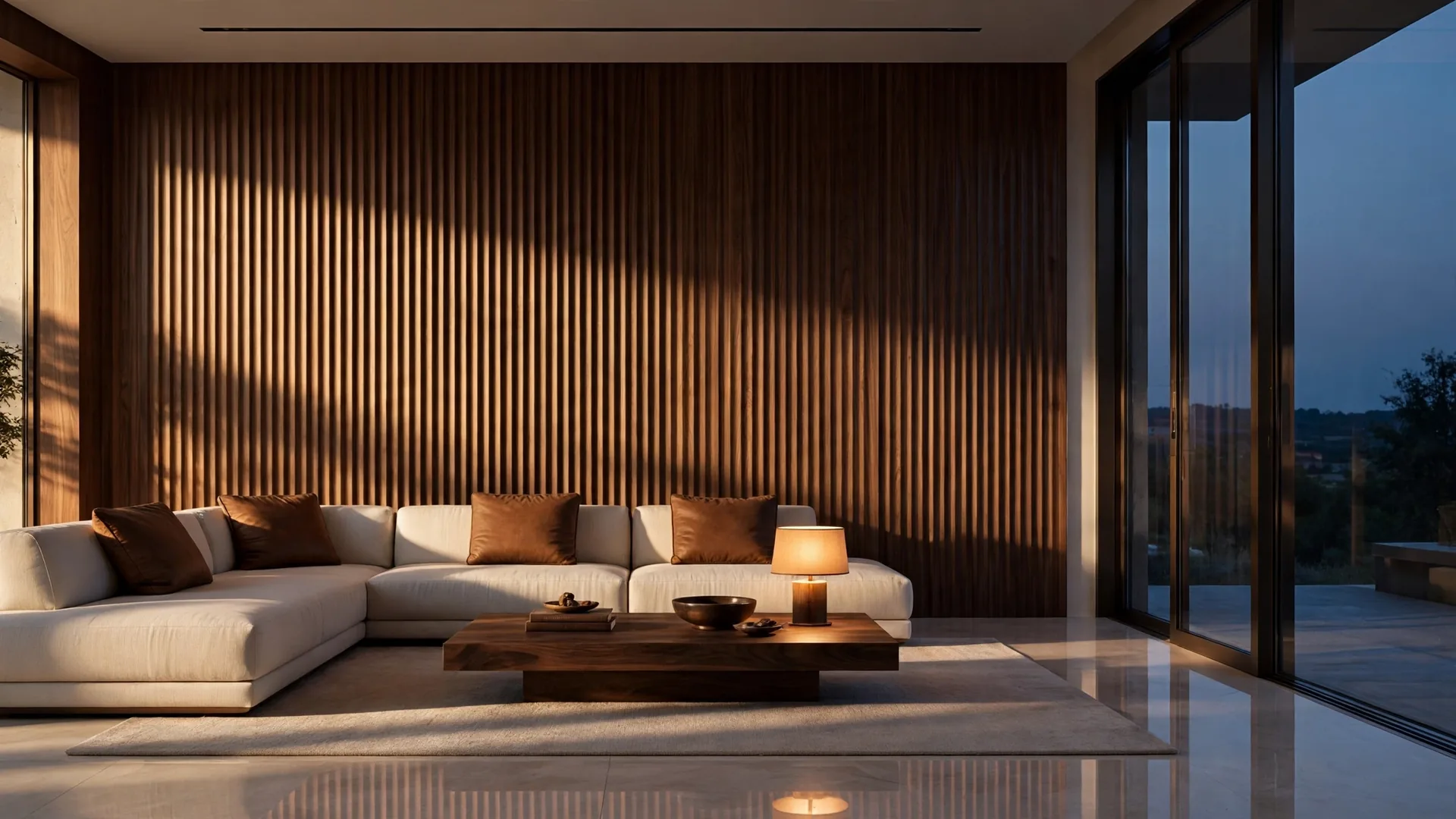
A fluted wall panel is one continuous board with a grooved face: rounded ridges separated by curved channels, with no openings through the board. Shoppers usually meet it as a per-panel price or a box price. Neither number answers the question they actually have: what the finished wall costs. This article answers that question for fluted panels only. Materials get priced per square foot by material. Labor gets its own section. One wall gets priced six ways, with the arithmetic shown.
We are a South Florida studio that designs and installs large-format panel walls. Our general fluted wall panels guide covers the product itself: profiles, materials, humidity rules and honest limits. This article covers the money. Our general wall panels cost guide prices the wider panel market. Here, only fluted panels get priced, and every figure comes from a named source with its scope attached.
One warning before the tables. Fluted pricing mixes four scopes: a per-panel price, a box price, a per-foot band, and an installed total. A $35 panel and a $15 per square foot panel can be the same family at two widths. Each figure below carries its published scope.
The short answer: what fluted panels cost per foot and per wall
TL;DR: Paintable MDF fluted panels run $7 to $11 per square foot for materials in The Panel Hub's 2026 price guide, current as of April 2026. PVC and WPC fluted panels run $7 to $15. Professional labor adds $3 to $10 per square foot on a standard flat wall. A professionally installed MDF fluted wall lands at $800 to $2,100 for a small office wall and $1,200 to $3,360 for a large living room wall, in the guide's own worked tables. Angi publishes no fluted-specific price line at all.
| Fluted wall option | Materials (per sq ft) | Scope of the figure | Source |
|---|---|---|---|
| Paintable MDF fluted | $7 to $11 | US materials guide, needs painting | The Panel Hub, April 2026 |
| PVC and WPC fluted | $7 to $15 | US materials guide | The Panel Hub, April 2026 |
| Decorative wood veneer grooved boards | $12 to $18 | US materials guide, real wood face | The Panel Hub, April 2026 |
| Solid wood planks and cladding | $15 to $40 or more | US materials guide | The Panel Hub, April 2026 |
| Paint-ready MDF fluted, retail box | About $14.18 | Our arithmetic: $549 per box over 38.71 sq ft of coverage | Slats.co, read Nov 2026 |
| Fluted WPC, retail per panel | About $5.87 | Our arithmetic: $35 per panel over about 5.97 sq ft of coverage | AZ Wood Panels, Nov 2026 |
| Professional labor, added to any row | Plus $3 to $10 | Standard flat wall | The Panel Hub, April 2026 |
| Studio large-format panel project | Priced per project, from $850 | Design, panels, delivery, own-crew install | WOW Walls Studio anchors |
Read the table by its third column. The two retail rows look like they contradict the guide bands. Both sit inside their own scope. Slats.co sells a premium paint-ready MDF box, factory-primed, past the top of the MDF band. AZ Wood Panels sells a narrow WPC board by the piece, and the per-foot math lands below the guide band. Section three puts both snapshots under a magnifier.
The last row belongs to a different product. Our studio installs large-format smooth panels and prices them by the project. That row lets you compare a finished fluted wall with a finished smooth wall, priced in a later section. Every studio figure is preliminary until a specialist measures your wall.
Materials by material: five builds, five price levels
TL;DR: The material sets the material price. Paintable MDF fluted sits at $7 to $11 per square foot in the guide. PVC and WPC fluted sits at $7 to $15. A real wood veneer face moves a grooved board to $12 to $18. Solid wood runs $15 to $40 or more. Lifespan moves with the same ladder: 10 to 15 years for MDF, 10 to 20 for the plastic composites, 30 years or more for solid wood, in the guide's table.
Start with the anatomy, because the price follows it. The core (the board's inner material) decides what the grooves cost and how they age. The face decides what you see: bare board waiting for paint, a printed film, a slice of real wood, or wood all the way through. Each change to that recipe moves the price.
Paintable MDF. MDF (medium-density fiberboard, pressed wood fibers) is the budget classic and the most common fluted board in millwork catalogs. The Panel Hub guide prices paintable MDF fluted at $7 to $11 per square foot for materials, with a typical lifespan of 10 to 15 years. The board arrives ready to prime and paint, so the finish belongs in your budget from day one. The extras section below carries the guide's finishing figure. MDF also carries the strictest moisture limit in the family.
PVC and WPC composites. WPC (wood-plastic composite, wood fiber mixed into a plastic core) and PVC (polyvinyl chloride, a solid plastic) form the plastic family. They run $7 to $15 per square foot for materials in the same guide, with a typical lifespan of 10 to 20 years. The guide describes the family as waterproof and lightweight, with a printed wood-look face. Read that as the guide's shelf label for the category. AZ Wood Panels warns its own buyers that water resistance varies by manufacturer and product. The category sheds water far better than MDF. The rating of one specific board still needs its own paperwork.
Wood veneer grooved boards. The guide prices decorative wood veneer at $12 to $18 per square foot, with a lifespan of 15 to 25 years. That row covers veneer-faced grooved boards with no acoustic backing. The premium over MDF buys grain you can feel, and a face that takes stain and oil. It also buys a thin face. A veneer skin cannot be sanded back the way solid wood can.
Solid wood. Solid wood planks and cladding run $15 to $40 or more per square foot in the guide, with a lifespan of 30 years or more. It is the only build with wood all the way through the profile. You can sand it, refinish it and repair a dent locally years later. The price buys that depth. It also buys seasonal movement. Solid wood needs acclimation: rest it flat in the room before install, and leave small expansion gaps.
The thin sheet end of the shelf. The guide notes a wider span for the whole category. Wall panels run from $1 per square foot for basic MDF to $40 or more for solid hardwood. That explains the marketplace puzzle. A search shows fluted-look sheets at prices the fluted bands never reach. A flat printed sheet is a different product from a board with a routed profile. Check a listing for a side-profile photo and a stated thickness. A real profile has depth you can measure.
Two panels that look identical in a product photo can sit $8 apart per square foot. One carries a printed face over a thin core. The other carries real veneer over a dense board. Before you compare two quotes, compare the builds: core, face, finish state, and shipping terms.
Two retail shelves, checked panel by panel
TL;DR: Slats.co sells a paint-ready fluted MDF box at $549 for 38.71 square feet of coverage, about $14.18 per square foot by our arithmetic. AZ Wood Panels lists a fluted WPC board at $35 per panel, about 7.28 inches wide by 118 inches tall, about $5.87 per square foot by our arithmetic. The guide bands and the retail shelves answer different questions, and a sound budget uses both.
Guide bands tell you where a material sits in the national market. A retail page tells you what one box costs today, in one store. We checked two retail shelves, one for MDF and one for WPC, and we show the per-foot math openly.
Slats.co, paint-ready MDF. Slats.co sells its Paint-Ready fluted panel as a box of 4 panels. One box covers 47.20 inches of wall width at 118.11 inches tall, which the page states as 38.71 square feet per box. The box price is $549. Our arithmetic: $549 divided by 38.71 gives about $14.18 per square foot. That sits above the guide's $7 to $11 MDF band, and the build explains the gap. The page describes low-VOC MDF, five coats of primer on the front, and a PVC film on the back. Each panel is 11.80 inches wide. You pay for the factory priming and the thin flexible build. The page limits the product to indoor, dry areas only. Its install steps give the boxes a day lying flat in the room.
AZ Wood Panels, fluted WPC. AZ Wood Panels lists its fluted WPC panel at $35 each, approximately 7.28 inches wide by 118 inches tall. The listed thickness is approximately 0.59 inches. Our arithmetic: one panel covers about 5.97 square feet, so $35 lands at about $5.87 per square foot, below the guide's $7 to $15 WPC band. The page prices its own example the per-piece way: an 8 foot wide wall takes 14 pieces at $35, which is $490 in materials. Its counting method is plain: wall width in inches, divided by the coverage width, rounded up. A 120 inch wall needs seventeen panels before waste, by that method.
The lesson travels further than these two stores. Per-piece pricing rewards narrow boards with small sticker prices. Coverage math reverses the picture. Then check what the price leaves out. The AZ page states its wall estimates exclude waste, edge trim, installation, delivery and taxes. Most retail pages leave the same list out, with less honesty about it.
Labor: what professional installation adds
TL;DR: The Panel Hub guide adds $3 to $10 per square foot for labor on a standard flat wall. Complex walls and high ceilings rise to $8 to $15. Angi's general paneling data agrees on the standard band, at $3 to $10 per square foot or $40 to $100 per hour. Flat MDF sits at the quick end of the trade, at $3 to $5 per square foot in the guide's own FAQ.
Labor is the line that turns a material price into a wall price. The board arrives as one grooved piece. The installer fixes it, works around outlets, and trims the edges. The grooves need alignment across each join, because a profile that steps at a seam shows in raking light. That alignment work is the fluted-specific labor cost.
The Panel Hub guide puts labor at $3 to $10 per square foot for standard flat-wall installations. Complex layouts and high ceilings rise to $8 to $15. Its FAQ narrows the easy end: flat MDF on drywall is the quickest install, at $3 to $5 per square foot. Angi, updated October 30, 2026, agrees: $3 to $10 per square foot, or $40 to $100 per hour. Read Angi with its scope attached. It prices wall paneling in general, at $1,200 to $6,000 installed, averaging about $2,800. It lists no fluted line item.
What pushes a fluted job toward the complex band is the wall itself. Outlets need cutouts, and each cut edge on MDF needs sealing before paint. Corners need the last board trimmed to width, with its edge finished. A run that wraps a column needs flexible stock and slower fixing. Height does the rest: a tall wall needs staging (a raised work platform) and a second pair of hands.
Installers also set a minimum charge for small jobs. Angi notes that minimum fees often apply. Its area table prices an 8 by 10 foot accent wall at $500 to $1,000 on average across paneling types. The trip, setup and cleanup cost the same on a small wall as on a large one. On a small headboard wall, the per-foot math can say $270 while the booked job says more. The booked job is the real number. The worked examples below use the published bands, so treat their low ends as best cases on small walls.
Our guide to installing fluted wall panels walks through the fitting itself. Our wall panel installation process guide covers the project day for large-format panels.
One wall, six budgets: a 108 square foot worked example
TL;DR: On one dry living room wall, 12 feet wide and 9 feet high, the published bands produce these totals. MDF fluted runs about $847 to $1,331 in materials ordered with waste, or about $1,171 to $2,411 with professional labor. WPC fluted runs about $847 to $1,815 in materials, or about $1,171 to $2,895 installed. A fitted large-format studio design for the same wall usually runs $2,200 to $2,700 as a complete project. The per-foot totals are our arithmetic from the cited bands, labeled as such; the studio figure is a project anchor.
No source publishes a total for this exact wall, so the table shows its method openly. The wall is 108 square feet. Materials are ordered with a 12 percent waste allowance, which is 121 square feet ordered, following the guide's own worked method. Labor is charged on the 108 square feet of finished wall. Each total is the cited band multiplied out by that method. The arithmetic is ours.
| Option for the 108 sq ft wall | Band used | Wall total |
|---|---|---|
| Paintable MDF fluted, DIY | $7 to $11 per sq ft x 121 sq ft ordered | About $847 to $1,331 materials |
| Paintable MDF fluted, professionally installed | Materials above plus labor $3 to $10 x 108 sq ft | About $1,171 to $2,411 total |
| WPC fluted, DIY | $7 to $15 per sq ft x 121 sq ft ordered | About $847 to $1,815 materials |
| WPC fluted, professionally installed | Materials above plus labor $3 to $10 x 108 sq ft | About $1,171 to $2,895 total |
| Wood veneer grooved boards, professionally installed | $12 to $18 per sq ft x 121 sq ft ordered, plus labor $3 to $10 x 108 sq ft | About $1,776 to $3,258 total |
| Studio large-format panel, fitted design | Project anchor | Usually $2,200 to $2,700 complete |
The guide's own room tables bracket this example from both sides. Office wall, 80 to 100 square feet: MDF at $560 to $1,100 in materials, or $800 to $2,100 installed. Bedroom wall, 90 to 120 square feet: $630 to $1,320, or $900 to $2,520 installed. Living room wall, 120 to 160 square feet: $840 to $1,760, or $1,200 to $3,360 installed. Our 108 square foot wall sits between the bedroom and living room sizes, and its totals sit between theirs.
The retail shelves price this wall in their own units, and the counts are worth doing once. At Slats.co, a 12 foot wall is 144 inches wide. One box covers 47.20 inches, so the wall takes four boxes at $549: $2,196 in materials, before paint. At AZ Wood Panels, the same width takes twenty panels at $35 each: $700 in materials, before waste, trim and delivery. Both counts use each seller's stated coverage method. Both assume the 118 inch panel covers a 9 foot wall with one trim at the top. The spread for one wall runs from $700 to $2,196 across two honest listings. Build and scope move the total further than brand does.
Read the studio row differently from the other five. It is a project price for a smooth large-format wall. Design, panels, delivery and own-crew installation sit inside it, preliminary until a specialist measures your wall. The other rows are market bands for a fluted product, before your specific wall adds or removes work.
What drives the price up and down
TL;DR: Five choices move a fluted quote more than any negotiation will. The build itself is the largest: real wood over engineered over plastic. Species moves real-wood prices, with walnut at the premium end. Unfinished panels shift $1 to $3 per square foot of finishing cost onto you. Coverage and waste add 10 to 15 percent to the order. Profile depth and board width decide how many pieces, joins and trims the wall needs.
The build. The guide names material construction as the biggest cost driver in the category. The short-answer table shows the spread: MDF at $7 to $11, plastic composites to $15, veneer to $18, solid wood to $40 or more. Two panels priced at $8 and $18 per square foot are almost certainly different materials wearing the same product name.
The species. Within real wood, the guide ranks pine as the lightest cost and oak in the middle. Walnut sits at the premium end. American walnut is among the most expensive domestic hardwood species. A species change on the same build can move a quote more than a brand change does. If a quote surprises you, ask which species sits behind the finish name before you ask for a discount.
The finish state. Pre-finished panels arrive ready to install. Unfinished panels, which include most MDF lines, need finishing after installation. The guide puts finishing materials at $1 to $3 per square foot at minimum, plus labor time when you hire it out. A cheap unfinished panel and a pre-finished panel at $2 more per foot can land at the same finished cost. Paint-ready stock narrows the gap: the Slats.co box carries five coats of factory primer, and only trimmed edges and nail holes need priming at home.
Coverage and waste. Wide panels cost less to handle: fewer joins, fewer pieces to level. The guide instructs buyers to add 10 to 15 percent to the measured square footage for waste. On the worked wall, that is the difference between ordering 108 square feet and ordering 121. Skipping it risks a second order, a second shipping charge and a batch mismatch.
The acoustic premium that does not belong here. The guide prices a felt acoustic backing at $2 to $5 more per square foot. That premium belongs to slat panels, where felt sits behind open gaps. A fluted board has a closed face and no felt layer. A seller who charges a fluted buyer for acoustic backing owes you test data for that exact board. AZ Wood Panels states the same caution: decorative WPC carries no assumed acoustic performance without tested data. Our slat wall panels cost guide prices the felt premium where it applies.
The extras that hide outside the first quote
TL;DR: The Panel Hub guide lists the standard extras plainly. Adhesive runs $20 to $60 per accent wall. Trim runs $2 to $5 per linear foot. Paint and primer for an MDF wall run $50 to $100 in finishing materials. Samples run $20 to $40, and the order carries a 10 to 15 percent waste allowance. Together the small lines add roughly $170 to $400 to a typical single wall, by our arithmetic from the guide's figures.
Adhesive and fixings. The guide budgets adhesive at $8 to $20 per tube. One tube covers roughly 30 to 40 square feet. A standard accent wall needs 2 to 4 tubes: $20 to $60. Pins and screws are the other fixing route. Neither figure appears in a per-foot panel price.
Trim and edge pieces. Corners and top and bottom trim give the wall its finished edge. The guide budgets trim at $2 to $5 per linear foot. A 12 by 9 foot wall has about 30 linear feet of edge, so trim alone can add $60 to $150, by our arithmetic. Fluted runs need one more decision here. The last board at each end rarely lands on a full profile. The trim has to hide that partial groove gracefully.
Paint and primer on MDF. Unfinished MDF needs one coat of primer and two coats of paint, in the guide's accounting. It budgets $50 to $100 in finishing materials per accent wall. A liter of quality primer runs $15 to $25 in its figures, and a liter of wall paint $20 to $40. Paint-ready stock moves part of this line into the box price. Raw trimmed edges still need primer either way.
Baseboard work. A floor-to-ceiling wall meets the baseboard (the trim board along the floor) along its whole width. The guide notes that the baseboard comes off first and goes back against the panel face. As a DIY task it is a pry bar and a few nails. In a professional quote it is labor time, in writing.
Samples and delivery. The guide budgets samples at $20 to $40, against a $2,000 material mismatch. Fluted profiles justify the sample: groove depth reads differently in your light than in a listing photo. Delivery sits outside most per-foot prices too. A second order for a missed board carries a second delivery charge.
Permits, in the rare cases. Angi puts permit fees at $50 to $300 for structural work, fire-rated panels or commercial spaces. It also states that most paneling projects need no permit without a structural change. A decorative fluted wall sits in that majority. Work that moves wiring follows your local rules.
DIY versus professional: where the saving is real
TL;DR: On a simple flat wall, self-installing saves real money. The Panel Hub guide puts the saving on a $2,000 materials project at $300 to $800. Angi puts typical do-it-yourself paneling materials at $500 to $2,000 per project, with labor at zero. The saving shrinks on multi-wall rooms, complex cuts and solid wood, where preparation and fitting become skilled work.
The guide's DIY case rests on the easy end of the trade. Flat MDF on drywall is the quickest install in its FAQ, at $3 to $5 per square foot of labor value. Fluted MDF on a flat rectangle follows the same logic. The tools are ordinary: adhesive, a level, a saw, and fixings driven into the low point of the profile.
Angi's general paneling table frames the same choice at project scale. Its do-it-yourself row runs $500 to $2,000 in materials, labor at $0. Its professional row totals $2,200 to $10,000. Those rows cover paneling in general. They show the shape of the trade: labor is the larger half of most professional totals.
Three situations hand the advantage back to a professional. Full-room work multiplies alignment decisions at every corner. A profile step at one corner repeats in every raking-light hour afterward. Solid wood needs careful acclimation, expansion gaps and precise fitting. Real walls are rarely flat. Complex walls – stairwells, vaulted ceilings, dense outlet runs – multiply trimming time, and each error costs a board. The guide makes the same three calls in its section on professional installation.
One cost hides inside the DIY column: your error budget. The waste allowance covers ordinary trims. A board ruined at the last outlet cutout costs a replacement plus delivery. Order the allowance, keep one spare board past the end of the job, and the DIY math holds.
Cost per year: lifespan changes the comparison
TL;DR: The Panel Hub guide lists typical lifespans by material. Paintable MDF fluted sits at 10 to 15 years. PVC and WPC sit at 10 to 20 years, veneer-faced boards at 15 to 25 years, and solid wood at 30 years or more. Its cost-per-year examples land close together: $0.75 per square foot per year for a $9 MDF panel replaced at 12 years. A $30 solid wood panel lasting 35 years lands at $0.86. Angi adds the ownership tail: refinishing at $100 to $500 every few years, and damage repair at $150 to $600.
Spread over the years each material serves, the per-foot gap narrows hard. The guide works the arithmetic for three panels. A $9 MDF panel replaced in 12 years costs $0.75 per square foot per year. An $18 wood veneer acoustic panel lasting 20 years costs $0.90. A $30 solid wood panel lasting 35 years costs $0.86. The veneer figure comes from the guide's slat example, labelled as such. The other two map straight onto fluted boards.
Lifespan figures are planning estimates from a retailer's guide. Angi's general data lands nearby: high-quality panels typically last 15 to 40 years. Room conditions move any single wall inside those bands. A steamy bathroom shortens every run, and it shortens MDF first. That is why the humidity section below belongs in a cost article.
Ownership costs continue after the install day. Angi prices refinishing for wood paneling at $100 to $500 every few years. It prices damage repair at $150 to $600. Painted MDF carries the friendliest tail: a repaint refreshes the whole wall at paint cost. Veneer and printed faces carry the harder version: a damaged section usually means replacing a board. Our guide to cleaning fluted wall panels covers the care that keeps those bills rare.
Read the lifespan ladder as a room-matching tool. A bedroom you plan to repaint in five years can carry MDF at the lowest entry price. A living room wall you want to leave alone for two decades rewards the veneer or solid wood step. The per-year math already closed most of the gap.
The Florida humidity line in the budget
TL;DR: Humidity decides which fluted material is cheap and which one only looks cheap. The US EPA advises keeping indoor relative humidity below 60 percent, ideally between 30 and 50 percent. MDF drinks moisture at its trimmed edges and swells. WPC sheds water far better as a category, and each board's rating still needs its own paperwork, as AZ Wood Panels warns its own buyers.
Florida adds a line to every fluted budget: the cost of a material failing early in damp air. The EPA's mold course sets the indoor target plainly. Indoor relative humidity should stay below 60 percent, ideally between 30 and 50 percent. A conditioned South Florida home can hold that band. A room closed and unconditioned through August often cannot. The wall material feels the difference first at its edges.
MDF is the exposed material in that room. Every trimmed edge and outlet cutout opens the fiber core. Slats.co makes the point from the retail side: a trimmed edge is raw MDF, and the page instructs buyers to prime it before painting. Its panels carry a dry-areas-only limit. Angi's type table adds the general warning for wood and MDF paneling: it may warp in humidity. An MDF wall that swells at its joins in year three costs a replacement wall.
WPC answers that risk as a category, and the category answer still needs a per-product check. The guide describes PVC and WPC panels as waterproof in its materials table. AZ Wood Panels tells its buyers that wet-location suitability varies by product, and warns against assuming a shower or fire rating. Pay the WPC step for damp-prone rooms. Spend ten minutes on the specific board's documents first. Our guide to wall panels in Florida humidity works through the evidence for this climate.
The studio's own fluted boards come from the WPC family: narrow boards in the studio material library, chosen for this climate. Humidity rarely changes the labor line. It changes the lifespan line, and the lifespan line is where Florida fluted budgets are won or lost.
Fluted or smooth: the alternative, priced the same way
TL;DR: Our studio installs large-format smooth panels and prices them by the project. A stock design starts at $850. A design fitted to your wall usually runs $2,200 to $2,700. Full custom turnkey projects start at $9,999. Every figure is preliminary until a specialist measures your wall. Set against the worked fluted totals for the same 108 square foot wall, a fitted smooth wall overlaps the professionally installed fluted bands.
Most fluted shoppers are buying an effect: rhythm, shadow and a finished material face. A smooth large-format wall delivers a calmer version of that effect. The two walls also age differently. Grooves collect dust along every channel. A smooth face wipes clean in one pass. Where chair backs strike the wall, a smooth stone-look face shrugs off contact that dents a veneer groove.
The studio sheet format sets the installation shape. Our panels are large-format sheets of 48 by 108 inches, 5 mm thick, supplied as whole sheets only and fitted to your wall by our own crew. One wall takes a handful of sheets and very few seams. A fluted wall in narrow boards takes dozens of pieces, each aligned by hand. That is why the studio prices per project, while the fluted market prices per piece and per foot.
The studio anchors, with their scope kept attached: a stock design starts at $850. A fitted design usually runs $2,200 to $2,700. A full turnkey project starts at $9,999. Every figure is preliminary until a specialist measures your wall. Those anchors cover studio panel projects. They price a different product from the fluted boards in the tables above. The worked example already placed the fitted row beside the fluted totals, so you can see the overlap directly.
The honest verdict follows the room. Fluted wins where the groove rhythm is the design itself: a headboard wall, a media wall in raking light. Smooth large-format wins where the wall takes contact, dust or damp air. Our comparison of fluted panels and wood slat panels settles the neighboring choice, between the two grooved profiles.
How to read three fluted quotes without surprises
TL;DR: Convert every quote to price per covered square foot, with the scope written beside it. Check the waste allowance, the trim and finishing lines, the labor band and the minimum charge. Ask what the last board at each end costs, and get the baseboard and cutout work in writing before you compare totals.
Step 1 – Normalize the units. Per-panel, per-box and per-foot prices describe the same wall in three currencies. Divide each material total by the covered square feet, using the seller's own coverage figures. The retail section worked two conversions openly: about $14.18 and about $5.87 per square foot. Your three quotes deserve the same treatment before any ranking.
Step 2 – Check the order quantity. A quote built on the bare wall area has quietly deleted the waste allowance. The guide's method adds 12 percent, inside its 10 to 15 percent range. On the worked wall, that is 108 against 121 square feet. Ask which quantity each total uses, and whether a spare board stays with you.
Step 3 – Read the extras as separate lines. Adhesive at $20 to $60 per wall. Trim at $2 to $5 per linear foot. Paint and primer at $50 to $100 on MDF. Samples at $20 to $40. A quote missing these lines has deferred them to your card during the job. The cheapest first quote often wins by omission.
Step 4 – Pin the labor scope. Standard flat-wall labor runs $3 to $10 per square foot in both sources. Complex work rises to $8 to $15 in the guide. Ask which band your wall was priced at, and what sits inside it. Ask about the minimum charge on a small wall, where Angi notes minimum fees often apply.
Step 5 – Compare finished totals. Compare full wall totals after steps 1 to 4. Compare cost per year when materials differ in lifespan class. Paint runs $200 to $500 per room including labor in the guide's comparison. Wallpaper runs $3 to $12 per square foot plus $3 to $7 for installation. Custom millwork runs $50 to $150 per square foot installed. A fluted total sits far above paint, beside good wallpaper, and far below a carpenter-built wall.
Frequently asked questions
How much do fluted wall panels cost per square foot in 2026?
Paintable MDF fluted panels run $7 to $11 per square foot for materials in The Panel Hub's 2026 guide, current as of April 2026. PVC and WPC run $7 to $15. Veneer grooved boards run $12 to $18, and solid wood $15 to $40 or more. Retail snapshots scatter wider. A paint-ready MDF box at Slats.co works out to about $14.18 per square foot. A narrow WPC board at AZ Wood Panels works out to about $5.87. Labor adds $3 to $10 per square foot.
What does a full fluted accent wall cost installed?
It depends on wall size and material. The Panel Hub guide puts an MDF office wall of 80 to 100 square feet at $800 to $2,100 installed. A bedroom wall sits at $900 to $2,520, and a living room wall at $1,200 to $3,360. Our arithmetic for a 108 square foot wall gives about $1,171 to $2,411 installed in MDF, and about $1,171 to $2,895 in WPC. Angi publishes no fluted-specific figure. Its $1,200 to $6,000 band covers paneling in general.
Why do two fluted panels with the same look cost $8 apart per foot?
The build differs. One panel can carry a printed face over a thin core. The other carries real veneer over a dense board, or a factory-primed face. The Panel Hub guide ranks the builds directly: MDF and plastic share the $7 floor, veneer reaches $18, and solid wood reaches $40 or more. Species, finish state and shipping move the rest.
Is it cheaper to install fluted panels myself?
On a simple flat wall, yes. The Panel Hub guide puts the labor saving on a $2,000 materials project at $300 to $800. It prices flat MDF labor at $3 to $5 per square foot, the quickest install in its FAQ. Angi puts typical do-it-yourself paneling materials at $500 to $2,000 per project. The saving shrinks on multi-wall rooms, complex cuts and solid wood, where wall preparation, alignment and fitting become skilled work.
What hidden costs should I add to a fluted wall budget?
Add adhesive at $20 to $60 per wall. Add trim at $2 to $5 per linear foot. Add paint and primer at $50 to $100 on MDF, plus finishing at $1 to $3 per square foot on unfinished stock. Add samples at $20 to $40, plus a 10 to 15 percent waste allowance. Baseboard work belongs in a professional quote in writing. Together the small lines add roughly $170 to $400.
Do WPC fluted panels cost more than MDF fluted panels?
At the guide level, they share a floor and differ at the ceiling. MDF fluted sits at $7 to $11 per square foot, and PVC and WPC at $7 to $15. Retail can reverse the order on a specific shelf. The AZ Wood Panels WPC board works out to about $5.87 per square foot. The Slats.co paint-ready MDF box works out to about $14.18. Compare builds and coverage first.
What does a large-format panel wall cost at WOW Walls Studio?
Studio panel projects price by the project. A stock design starts at $850. A fitted design usually runs $2,200 to $2,700. Full custom turnkey projects start at $9,999. Design, panels, delivery and own-crew installation are inside those figures. Every figure is preliminary until a specialist measures your wall. Those anchors cover the studio's smooth large-format panels, supplied as whole sheets only.
How long do fluted panels last, and what do they cost per year?
The Panel Hub guide lists typical lifespans by material, in dry conditioned rooms. Paintable MDF fluted sits at 10 to 15 years. PVC and WPC sit at 10 to 20 years. Veneer-faced boards sit at 15 to 25 years, and solid wood at 30 years or more. Its cost-per-year examples land at $0.75 per square foot per year for a $9 MDF panel replaced at 12 years. A $30 solid wood panel lasting 35 years lands at $0.86. Angi adds refinishing at $100 to $500 every few years and damage repair at $150 to $600 for wood paneling.
Sources
- The Panel Hub, How Much Do Wall Panels Cost? (2026 Price Guide), April 2026 – fluted material bands, labor bands, worked room tables, hidden costs. thepanelhub.com
- Angi, How Much Does It Cost to Install Wall Paneling? (2026 Data), updated October 30, 2026 – general wall paneling projects $1,200-$6,000, average $2,800; labor $3-$10 per sq ft or $40-$100 per hour; permits, upkeep and DIY totals, labelled general in the article. angi.com
- Slats.co, Slat Paint-Ready Fluted Wall Panel product page, read November 14, 2026 – $549 per box of 4 panels, 38.71 sq ft coverage per box, 11.80 in panel width, primed MDF build, dry-areas limit. slats.co
- AZ Wood Panels, WPC vs Acoustic Slat Wall Panels – Phoenix Price Guide, November 1, 2026 – fluted WPC at $35 per panel, wall-count method, rating caution. azwoodpanels.com
- US EPA, Mold Course Chapter 2 – indoor relative humidity below 60 percent, ideally between 30 and 50 percent. epa.gov