Comparison guide · South Florida
Fluted Panels vs Wood Slat Panels: Which to Choose (2026)
Fluted panels vs wood slat panels, compared: look, price, install, humidity, acoustics, upkeep – and which fits a South Florida home in 2026.
A general guide. WOW Walls Studio’s own walls use the large-format composite sheets and fluted boards in its material library; the studio does not supply wood slat or acoustic slat panels.
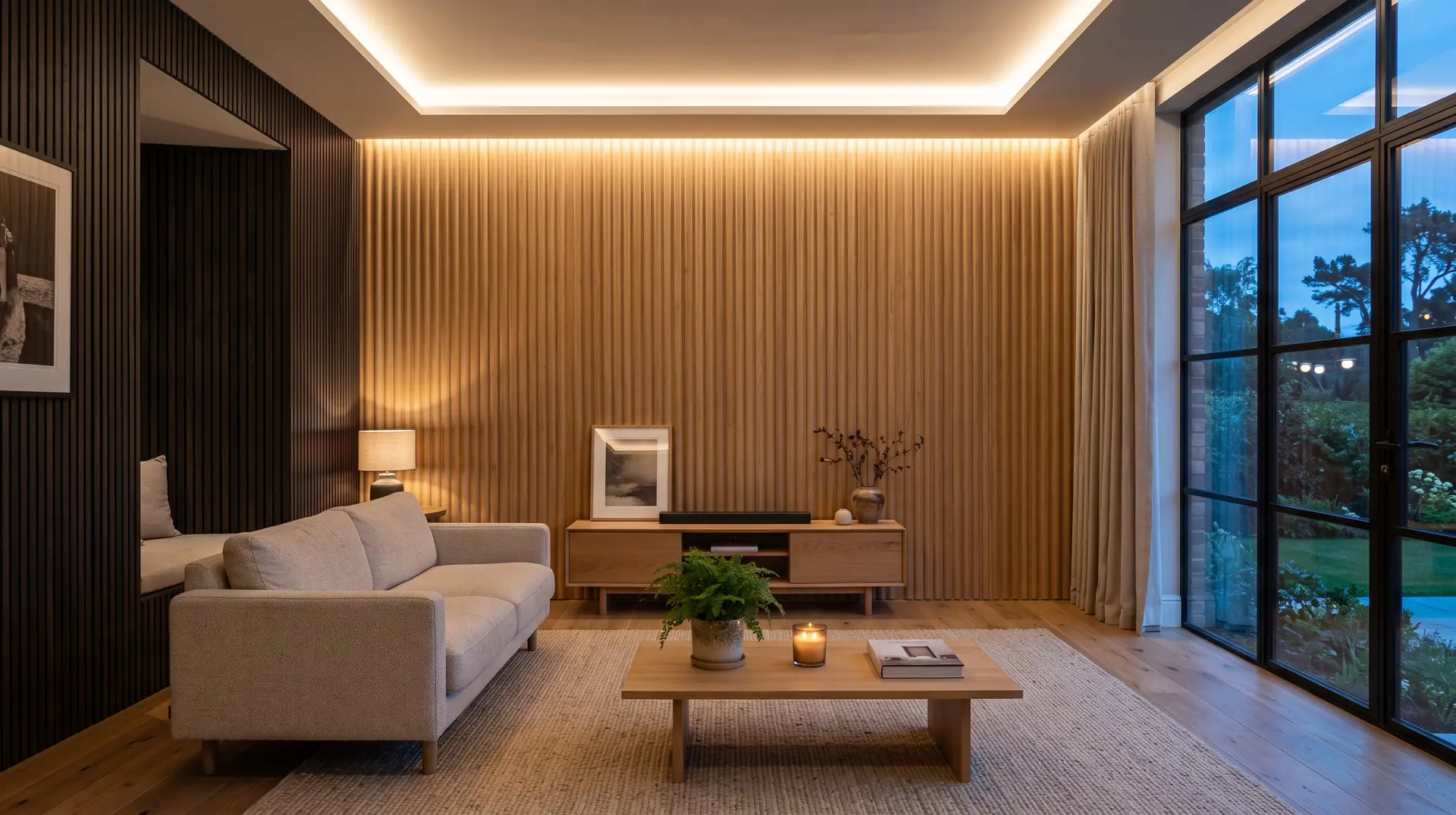
Shop for an accent wall panel in 2026 and you meet two styles everywhere. Wood slat panels—the vertical strips over dark felt that took over Instagram a few years ago. And fluted panels—the newer wave, with soft rounded ridges that look like corduroy for walls. They get mixed up constantly, listings use the words interchangeably, and the prices span from under two dollars to eighty dollars a square foot. So here they are, side by side: what each one is, what it costs, how it installs, how it handles Florida humidity, and where each one belongs.
What fluted panels and wood slat panels actually are
TL;DR: Wood slat panels are flat, narrow MDF (medium-density fiberboard, pressed wood fibers) strips glued to a dark felt backing with an open gap between strips. Fluted panels are one-piece panels carved or molded into rounded ridges and grooves, and they come in five very different materials: MDF, PVC, WPC (wood-plastic composite), polystyrene, and solid wood. The profile is the style; the material decides how the panel behaves.
A wood slat panel is a standardized product. Flat strips of MDF (medium-density fiberboard, pressed wood fibers), about 25 to 30 mm wide, bonded to recycled PET felt—the dark fabric backing visible in the gaps between strips. Full panels run 94 to 118 inches tall and 23 to 25 inches wide. The face is a wood-look laminate, PVC wrap, or real veneer—oak, walnut, teak. The felt is almost always black or grey. When you see slat walls online, this is the panel, and the acoustic claims attached to it belong to the whole assembly: strips plus felt plus the air gap behind.
Fluted panels are a different animal. “Fluted” describes only the shape: repeating convex-concave channels, rounded or squared ridges separated by narrow grooves, almost always vertical. The industry comparison site Accio draws the line this way: fluted profiles have concave grooves that create soft, rolling shadows, while louver or slat profiles have convex fins that create sharp, high-contrast shadow lines. Because fluted is only a profile, the material underneath varies wildly: CNC-milled MDF (often pre-primed for paint or wrapped in a film), foamed PVC tiles, WPC interlocking strips, thin polystyrene moldings, or traditional solid wood. A $1.88-per-square-foot PVC tile and a $5.50 WPC panel can both be “fluted”—the word describes the shape, never the material’s quality.
The look: rolling shadows vs crisp lines
TL;DR: Slats read crisp and linear, like Scandinavian architecture with hard shadow lines in the gaps. Flutes read softer and more sculptural, with rolling gradients of light and shadow. Vertical lines in either style make ceilings feel taller, but the visual energy is different enough that they suit different rooms.
Slats are the graphic option. Flat strips over dark felt give a strict rhythm, and as Residence Supply puts it, the look “reads as architecture, not decoration.” The black gaps do the heavy lifting: they make the strips float and give the wall a tailored feel, crisp as a well-cut suit.
Flutes are the softer option. The concave channels catch light in gradients instead of hard lines, so the wall looks carved instead of assembled. That curved feel runs slightly more formal—think library, bedroom headboard wall, elegant dining room.
Trend-wise, fluting is having its comeback moment. Designer Jade Joyner, quoted in The Spruce’s April 2026 trend piece, describes the paneling return as “fluted walls, tongue-and-groove ceilings, and stained oak accents that wrap a room,” a move away from “stark white everything.” A 2026 Dutch living-room ranking still puts oak slat acoustic panels at number one for living rooms, so slats are not going anywhere commercially. But there is backlash in the air: one 2026 TikTok designer posted “Are you tired of fluted panels? Here are 4 best alternatives,” and a Mumsnet thread from May 2025 has homeowners calling wall panelling “already dated.” My honest take: anything fashionable raises the question of dating, so pick the profile that matches your room and your furniture, not the one the feed is pushing this month. A slat wall behind mid-century pieces or a fluted wall in a formal bedroom will outlive either trend cycle.
What each one costs
TL;DR: DIY wood slat panels run about $3 to $8.50 per square foot for materials alone (October 2026 US listings). WPC fluted panels run about $5.10 to $5.55 per square foot; budget PVC fluted tiles cost as little as $1.88. Custom-installed millwork is a different tier at $30 to $80 per square foot installed (thehealthyattitude.com, 2026). For an 80-square-foot accent wall, expect roughly $240 to $700 in materials if you DIY, plus installer labor of $1.00 to $2.70 per square foot if you hire out (HomeGuide).
Prices below are snapshots from live US listings on October 4, 2026. Retail prices move, so date-stamp anything you compare against.
| Panel | Material price (materials only) | Install level |
|---|---|---|
| Wood slat acoustic (MDF on felt) | ~$3.00–$8.50/sq ft (e.g. Art3d 31 sq ft from $93.47; COMFORTHOMI 2-pack $69–$156.92) | DIY-friendly |
| WPC fluted (waterproof strips) | ~$5.10–$5.55/sq ft (Art3d 8-pack 33.38 sq ft, $170–$185) | DIY-friendly |
| PVC fluted tiles (glue-on) | ~$1.88/sq ft (Art3d 12-pack 32 sq ft, $59.99) | Easiest DIY |
| Custom pro millwork (any profile) | $30–$80/sq ft installed | Pro only |
Labor benchmarks from HomeGuide: installer labor $1.00 to $2.70 per square foot, handyman rates $50 to $80 per hour. One gap in the data: nobody publishes a per-square-foot price for a specific fluted-or-slat accent wall with lighting, outlet work, and trim from any contractor, so treat any exact internet number for that scope with suspicion. A real quote accounts for wall size, material, zones, and the room it goes in.
Which one survives Florida humidity
TL;DR: PVC, WPC, and polystyrene fluted panels are waterproof per manufacturer datasheets, which makes fluted the safer pick for humid spots. Standard MDF—in either profile—is not moisture-resistant and belongs only in continuously air-conditioned rooms. Manufacturers ask for 40–60% relative humidity during install and 24–48 hours of acclimation in the room.
This is the section that matters most in South Florida—here is how the research stacks up.
Waterproof per datasheet: PVC, WPC, and polystyrene fluted panels. Art3d lists its WPC fluted as “100% waterproof”; Pro Materials describes its WPC as waterproof and termite-proof with a 20-year warranty. These are the panels sources point at for bathrooms, steamy kitchens, and any spot that is not always air-conditioned.
Not moisture-resistant: standard MDF, fluted or slatted. Deyipstech, a fluted-MDF maker, states it plainly: “Standard MDF, in its raw form, is not moisture-resistant and tends to swell or warp in high-humidity environments like bathrooms or kitchens.” Art3d’s own MDF slat listing says to avoid high-moisture areas. A professional forum puts it more bluntly: MDF swelling is effectively one-way, since humidity disrupts the bonding between the pressed particles.
The documented failure: Livingetc’s Lilith Hudson DIYed MDF paneling in her kitchen in 2025 and watched the panels by the kettle bubble from steam exposure—she had used a waterproof-rated board but finished it with non-waterproof matte paint. Every layer has to be moisture-rated: substrate, finish, and the cut edges, which are always the weak point.
The manufacturers agree on install conditions: install between 15–25 °C at 40–60% relative humidity, acclimate the panels flat in the room for 24 to 48 hours first, and never in areas subject to moisture. A South Florida room without steady AC easily climbs past 60% indoor humidity in summer—outside the 40–60% install range manufacturers specify. So the rule is simple: MDF-core panels of either type go only in lived-in, air-conditioned rooms. For bathrooms, lanais, garages, or seasonal homes, the sources’ stated answer is PVC, WPC, or polystyrene fluted.
Acoustics: what you actually get
TL;DR: Wood slat panels carry manufacturer-measured NRC ratings (noise reduction coefficient—the share of sound a panel absorbs rather than bounces back) of 0.8 to 0.90 (PanelDecorHub, WINEGO, Art3d), and one hands-on test measured a 5–6 dB drop in mid-range frequencies (vintagevinylnews, Sept 2026). I found no verified acoustic rating for any fluted panel—only qualitative claims about diffusion. Either way, these panels calm in-room echo; they do not soundproof anything.
Slats win the acoustic section by a mile, because they are the only type with measured claims. PanelDecorHub claims NRC 0.90 (noise reduction coefficient—the share of sound a panel absorbs rather than bouncing back) tested to EN ISO 354:2003. The factory listing for WINEGO slats claims 0.85. Art3d’s MDF slats list NRC 0.8. A September 2026 hands-on test by vintagevinylnews measured a 5–6 dB drop in mid-range frequencies after installing slats.
For fluted panels, nobody publishes a number. The claims I found are qualitative: flutes “aid sound diffusion and slight acoustic enhancement,” grooves “help break up sound waves, reducing echo.” No test data. If echo control is your actual goal, slats have evidence and flutes do not.
One caveat both types share, sourced from utterlyhome: the felt and the grooves are “fantastic for sound dampening… However, they will not completely block out heavy construction or loud neighbors through shared walls.” Absorption (NRC) and blocking (STC, the sound-blocking rating) are different standards. Any listing calling either panel “soundproof” is overstating it. And the healthyattitude buyer’s guide adds the frequency limit: slats handle mid-to-high frequencies—voices, TV dialogue—but not low bass or traffic rumble. The batten-mounted method with 45 mm of mineral wool between battens is the sourced route to better performance.
Installation: DIY-friendly or pro job
TL;DR: Slat panels install three ways—glue, hidden screws through the felt gaps, or screws into battens—all DIY-friendly. Fluted panels follow their material: PVC tiles glue on, polystyrene strips glue or tape, WPC strips clip, MDF glues and nails. Plan for outlet box extenders before you order, and know that glued panels are hard to remove cleanly.
Wood slat panels give you three documented methods. Glue is fastest: construction adhesive in a wave pattern, press firmly. Screws through the felt are invisible in the slat gaps—PanelDecorHub specifies a minimum of 9 screws per panel into studs, the original Akupanel manual uses 15 screws of 35 mm per panel. Battens plus screws flatten uneven walls and create a cavity that hides speaker cable or LED strips behind a media wall. Sellers market glue-on fluted panels as a one-day project and full-height batten-mounted slat walls as a weekend project—both timings are seller marketing, not independently verified. Tools are basic: tape, fine-tooth saw, level, drill, cut from the back with the veneer face down so it does not chip.
For fluted panels, the method follows the material: PVC tiles go up with liquid nails and cut with shears or a tile saw; polystyrene strips glue on or double-side-tape and cut with a utility knife; WPC strips use metal clips plus screws or interlocking click systems; MDF fluted glues and nails, cut with a fine-tooth saw while wearing a dust mask.
The catches people discover too late, all sourced: panels sit about 21 mm proud of the wall, so outlets need box extenders—plan that before ordering. Long panels crack if lifted by the ends—one Wayfair reviewer advises ordering a spare, and 96-inch panels need two people to position. Glued panels do not come down cleanly: a Mumsnet commenter warns adhesive “takes down half the wall when removing it,” which renters should read twice. Expect some initial odor for 3–5 days and real dust while cutting.
Durability and upkeep
TL;DR: Wood and veneer panels repair gracefully—a scratch sands out, a dent steams out. PVC scratches are permanent. WPC fluted is marketed as scratch and dent resistant with 20-year warranties. Grooves and gaps in both profiles collect dust and need a soft duster along the direction of the profile.
For durability, Residence Supply draws the sharpest contrast: “Wood repairs: a scratch sands out, a dent steams out. Scratched PVC is scratched forever.” Thin polystyrene moldings are decorative, not impact-resistant—damage gets patched cosmetically with paintable silicone or wood filler, then painted. WPC sits at the durable end of the synthetic options with its 20-year warranties and scratch-resistance claims.
Cleaning is the same chore either way, just in different geometry. Dust settles in slat gaps and flute grooves. The sources converge on one method: a dry microfiber duster weekly, used in the direction of the ridges, plus a vacuum with a soft brush attachment run vertically down the felt every few months for slats. As furnitureinfashion puts it: “Dust settles in the grooves, particularly on horizontal surfaces and at the base of each flute. A soft paintbrush or a microfibre duster used in the direction of the ridges keeps it under control. It is not difficult, but it takes a little longer than wiping a flat door.” One September 2026 Wayfair reviewer puts it reassuringly: “I was worried I would need to dust them constantly, but I don’t.”
Where each one should not go
TL;DR: Bathrooms get PVC, WPC, or polystyrene fluted only—never MDF. Keep wood and MDF panels 18–24 inches from the cooktop. No source endorses MDF or wood panels against a real firebox; near electric fireplaces, follow that unit’s clearances and prefer spec-sheet-rated WPC or PVC. For ceilings, slats need screw fixing while lightweight PVC and polystyrene tiles glue up easily.
| Spot | Pick | Why |
|---|---|---|
| Bathroom | PVC / WPC / PS fluted only | Waterproof per datasheets; MDF slats are “not recommended for high-moisture areas” |
| Kitchen, near cooktop | Fluted PVC/WPC; no wood/MDF within 18–24 in | 2026 kitchen guide excludes wood/MDF near the cooktop; steam is the documented failure case |
| Real fireplace | Neither—no source endorses MDF or wood panels against a real firebox | Check with the fireplace manufacturer first |
| Electric fireplace media wall | Either, with rated WPC/PVC preferred near heat | MagikFlame: keep flammables 3 ft from the front, 1.5 ft from sides, “never put any combustible materials behind them”; framing follows the fireplace manual |
| TV wall | Both | Dark slats “hide the black rectangle”; dark matte flutes read cinematic; keep the texture calm so it does not fight the screen |
| Home office | Slats | Echo control for calls is their documented strength |
| Ceiling | Lightweight fluted tiles (glue); slats (screws) | PS/PVC tiles glue up easily; heavier slats need mechanical fixing |
Fire ratings deserve one careful paragraph, because spec sheets love the phrase “Class A” (the standard US fire-spread rating). Ratings attach to a specific tested product, never to a material category. PanelDecorHub cites fire test report AJFS2308006994FF (dated 2023-08-16) for its slats; Art3d lists “Class A Fire-rated” on its WPC fluted; a polystyrene maker offers B1-level fireproofing only as an option. Treat each as a per-product claim worth verifying for the exact panel you buy. Do not assume the whole material category carries the same rating.
How to decide in ten minutes
TL;DR: Pick slats if you want measured echo control, a crisp linear look, or a home office; pick fluted if you want softer sculptural texture, a waterproof option for wet rooms, or easier one-day installation. If both appeal to you, let the room decide: humidity and sound goals rule out one of them in under a minute.
Five questions settle it:
- Is the room humid or not always air-conditioned? If yes—bathroom, lanai, seasonal home—MDF is out in either profile. Fluted in PVC, WPC, or polystyrene is the answer.
- Do you need echo control? Home office, media room, bedroom that echoes. Slats carry measured NRC ratings; flutes have none.
- Which geometry fits your furniture? Crisp linear modern pieces pair with slats; softer, curved, or formal interiors pair with flutes.
- DIY or pro? PVC and polystyrene fluted tiles are the easiest glue-on project. Full-height slat walls with battens are a weekend. Either way, a pro install buys you perfect seams and hidden wiring.
- How long do you need to love it? Trend-driven picks carry dating risk—the backlash voices are real. The timeless picks in our lineup: a light oak slat panel for the classic look, a dark fluted profile in walnut tones for more drama, and clean metal trims at the seams.
If you are still torn between the two, that is exactly what a consultation is for. Bring photos of the room and we will narrow it to one profile and one material before anything gets ordered.
Sources
Definitions: Slat dimensions (25–30 mm slats, 12–16 mm deep, 13–20 mm gaps, PET felt)—Etsy LameoPanels and TheCarventer listings; B&Q DecorAndDecor listing (diy.com). Fluted profile distinction (concave grooves vs convex fins) and material matrix—Accio, “Louver Panel vs Fluted Panel” (accio.com). Fluted MDF construction, PVC film backing, moisture warning—Deyipstech fluted MDF guide (deyipstech.com).
Look and trends: Slats “read as architecture, not decoration”—Residence Supply, “How to Choose Wall Panels for Living Rooms” (~Sept 2026) (residencesupply.com). Designer Jade Joyner on the paneling comeback—The Spruce, “8 Design Trends Designers Think Are Finally Back in 2026” (Apr 2026) (thespruce.com). Fluted/ribbed/reeded panels “particularly favoured”—Indulgexpress (26 Apr 2026) (indulgexpress.com). Oak slat panels ranked #1 for living rooms—ABNewswire (29 Jun 2026). Fluted backlash—TikTok “Architect Brendan & Ruffa” (2026); panelling “already dated” voices—Mumsnet, May 2025 (mumsnet.com).
Pricing: Wood slat listings and per-sq-ft math—wayfair.com, observed Oct 4, 2026 (COMFORTHOMI 2-pack $69–$156.92; Art3d 4-pack from $93.47). WPC fluted 8-pack $170.05–$185.44 (33.38 sq ft) and Class A listing claim—wayfair.com, observed Oct 4, 2026. PVC fluted 12-tile pack $59.99 (32 sq ft)—amazon.com (B0BX6CWJJ5), observed Oct 4, 2026. Art3d 2-pack $66 (deal Sep 16, 2026; verified Sep 27, 2026)—dealnews.com. Premium installed tier $30–$80/sq ft—thehealthyattitude.com (2026). Labor benchmarks—HomeGuide shiplap/wainscoting cost guides (homeguide.com). Wholesale context $12–$25/sq m factory-direct—LinkedIn WPC 2026 guides.
Installation: Three slat methods, 9 screws/panel minimum—PanelDecorHub install guide PDF (Oct 2025) (paneldecorhub.com). Battens, 15 screws of 35 mm, 45 mm mineral wool option—WOOD Akupanel manual (manualslib.com). Outlet box extenders, odor 3–5 days, 5–6 dB mid-range drop test—vintagevinylnews.com (Sept 2026). Adhesive removal damage (“takes down half the wall”)—Mumsnet, May 2025. Long panels crack if lifted by ends; two-person positioning—Wayfair buyer reviews (2026). PVC 3 mm perimeter expansion gaps—Residence Supply PVC bathroom guide. 48h room acclimation—Residence Supply; 24h flat acclimation—Woodspace Acouwood guidelines.
Humidity: PVC/WPC/PS waterproof claims—Art3d WPC (Wayfair), Pro Materials WPC datasheets (promaterials.ca), LUXWORLD PS (luxworld.net.au). “Standard MDF, in its raw form, is not moisture-resistant and tends to swell or warp in high-humidity environments like bathrooms or kitchens”—Deyipstech. “Avoid high-moisture areas”—Art3d MDF slat listing (Wayfair). Steam-bubbling failure with non-rated finish—Livingetc (Nov 2025) (livingetc.com). Install at 15–25 °C, 40–60% RH—Woodspace Acouwood guidelines. “Moisture sensitivity is real… Bathrooms and kitchens with constant steam exposure can warp wood or compromise the acoustic core”—thehealthyattitude.com (2026).
Acoustics: NRC 0.90 claim (EN ISO 354:2003)—PanelDecorHub guide. NRC 0.85—WINEGO factory listing (ecer.com). NRC 0.8—Art3d MDF slats (Wayfair). 5–6 dB mid-range drop—vintagevinylnews.com (Sept 2026). Fluted diffusion claims, qualitative only—Medium (RichVaugh, Jun 2026), californiaobserver.com. Mid/high-frequency limit—thehealthyattitude.com (2026). Dampening-vs-proofing caveat: felt “fantastic for sound dampening… However, they will not completely block out heavy construction or loud neighbors through shared walls”—utterlyhome.com (2026).
Fire: Class A claim, report ref AJFS2308006994FF (2023-08-16)—PanelDecorHub guide. “Class A Fire-rated”—Art3d WPC (Wayfair). Class A PVC claims—Accio. B1 optional for PS—made-in-china.com listing FAQ. Fireplace clearances (3 ft front, 1.5 ft sides, “never put any combustible materials behind them”)—magikflame.com. Electric-fireplace framing follows unit clearances—Medium DIY media-wall guide (Feb 2026).
Durability and upkeep: “Wood repairs: a scratch sands out, a dent steams out. Scratched PVC is scratched forever”—Residence Supply. WPC 20-year warranty—Pro Materials. PS repair with paintable silicone or filler—trade guidance. Cleaning routines—utterlyhome.com, thehealthyattitude.com, Wayfair buyer review (Sept 2026). “Dust settles in the grooves, particularly on horizontal surfaces and at the base of each flute”—furnitureinfashion.net (~Sept 2026).
Use cases: TV wall guidance (dark slats hide the black rectangle; calm texture rule)—Residence Supply. Fluted TV backdrop glare note—stockpile.lk. Bedroom/office guidance—Medium e3acp (Aug 2026); vintagevinylnews.com. Kitchen zone rules (18–24 in from cooktop)—istcabinets.com, “Kitchen Accent Wall Ideas: A 2026 Guide.”