Veneer Wall Panels: Real Wood, Honest Limits (2026)
Veneer wall panels: a thin slice of real wood on a stable core – cuts, grain matching, where veneer wins and fails, and care in Florida homes.
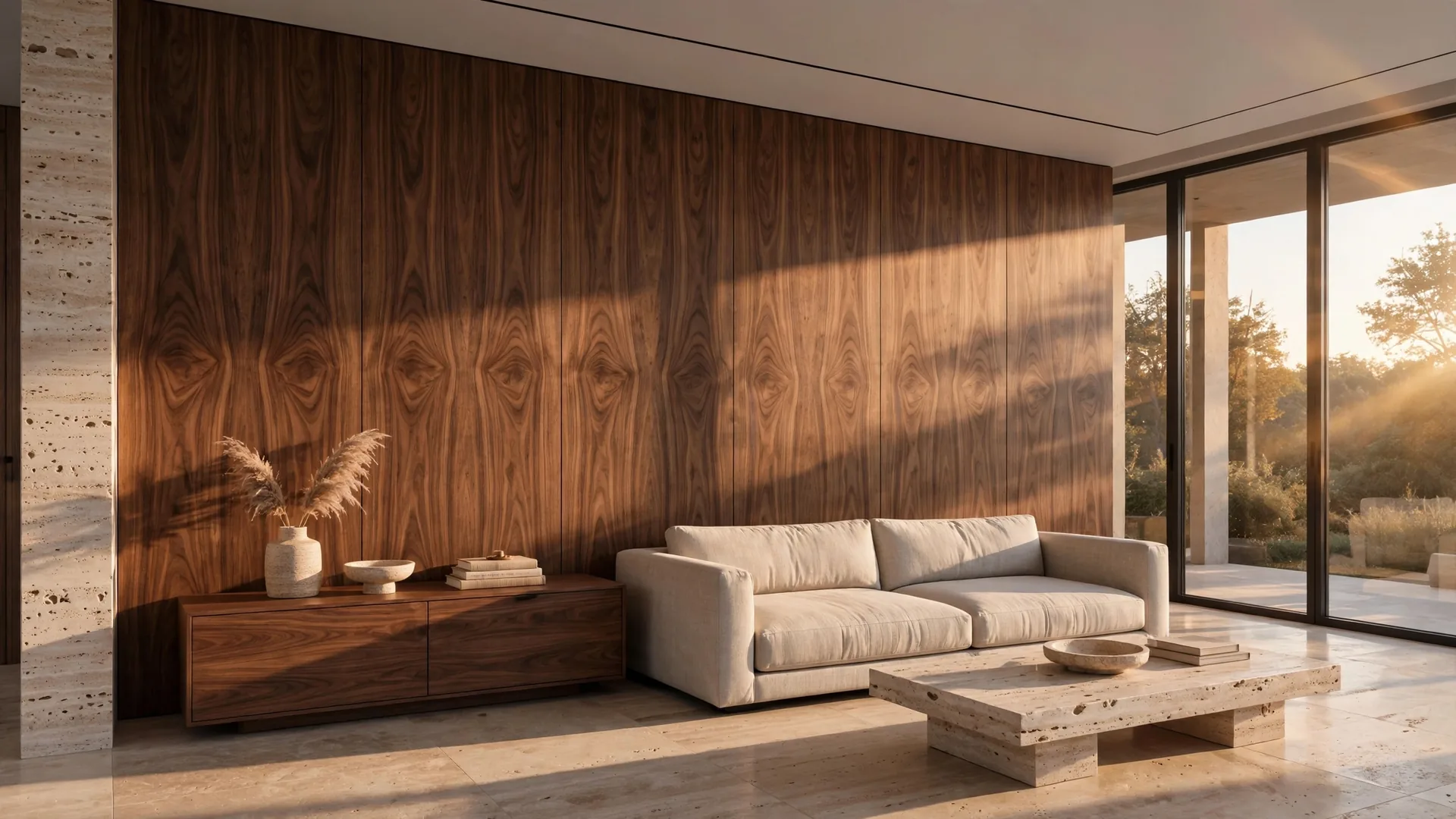
Veneer confuses people at the sample table. A client picks up a walnut panel, turns it over, knocks on it, and asks me if it is real wood or a picture of wood. The honest answer takes about a minute, and it decides whether veneer is the right call for their wall or the wrong one. I install veneer wall panels for WOW Walls Studio here in South Florida, and this is the version of that minute I give on real jobs, stretched out to cover the questions that follow it.
This guide covers the full picture. What veneer actually is, and what sits under the wood face. How the cut of the log and the way leaves are matched decide why two walnut walls can look like different species. How veneer compares with solid wood and with laminate-look panels. Where veneer genuinely wins on a wall. Where it honestly fails – the thin face, repairs, sun and water. How to care for it in a Florida home. And what drives the price, without invented numbers.
What veneer actually is
TL;DR: Veneer is a thin layer of real wood, sliced or peeled from a log and bonded to a stable core such as MDF (medium-density fiberboard), plywood or particleboard (Oakwood Veneer; Coowin). Typical face thickness runs 0.5 to 1.5 mm (Oakwood Veneer), and that thin real-wood face is the whole point: you get genuine grain and warmth on a panel that stays flat.
Start with the log. Instead of sawing a log into thick boards, a veneer mill slices or peels it into thin leaves of wood (Oakwood Veneer; Coowin). Each leaf keeps the real grain, the real pore structure and the real color variation of that log. The leaf is then bonded under pressure to a core – MDF, plywood or particleboard – and the core does the structural work (Coowin). When you knock on a veneer panel and it feels solid, you are feeling the core. When you run your hand across it and it feels like wood, that is because the surface is wood.
Thickness is the number to hold onto. A typical veneer face runs 0.5 to 1.5 mm thick (Oakwood Veneer). Across the wider market the range stretches from about 0.3 to 6 mm, and thickness changes what the panel can survive later: thin veneer has almost no sanding tolerance, while veneer around 3 mm can take a light refinishing (Coowin). Keep that in mind for the limits section below. Most wall panels live at the thin end of that range, which is fine for a wall and demanding for a tabletop. A wall takes hands, bags and the occasional chair back. It rarely takes a belt sander, and it should never need one.
Yield is the quiet argument under all of this. Slicing spreads one log across far more surface than sawing boards from it: about 1 cubic metre of log yields roughly 1,000 sq m of veneer (Timber Veneer Association Australia). Rare and figured logs (wood with wavy or burled grain patterns) go furthest as veneer, and that is why species and figures that would be impractical as solid wall boards show up on panels at all.
The panels I install are large-format composite sheets with a range of finishes, and veneer is the real-wood option in that range, sitting alongside stone looks such as the surfaces in my travertine accent wall panels guide. The sheet format matters for veneer in particular, and the matching section below explains why.
Cuts and grain: why two walnut walls look different
TL;DR: The cut decides the grain figure. Plain sliced veneer (also called flat sliced) shows the arched cathedral pattern most people picture as wood grain; quarter sliced veneer shows straight grain with ray figures across it (Spiegato). Same species, same log, different cut – and the two walls read as different materials across a room.
Clients show me two photos of walnut walls and ask why one looks calm and the other looks busy. Nine times out of ten the species is identical and the cut is the difference. A log can be sliced several ways, and each way exposes a different face of the growth rings (Spiegato).
| Cut | Grain look | Best use |
|---|---|---|
| Plain sliced (flat sliced) | Cathedral arches, flowing figure | Warm feature walls, living rooms, anywhere you want the classic wood look |
| Quarter sliced | Straight, even grain with ray flecks | Modern and minimal walls, offices, long runs where calm lines matter |
| Rotary peeled | Wide, bold, sweeping figure | Large casual surfaces; the boldest look, used least on quiet feature walls |
| Rift sliced | Tight straight grain, minimal fleck | Paired doors and panels where two fields must read as one |
The cathedral pattern comes from plain slicing across the growth rings, so the rings appear as nested arches (Spiegato). Quarter slicing cuts at an angle that presents the rings as straight lines, with medullary rays (the natural ribbon-like figures that run across the grain in some species) showing as flecks (Spiegato). Neither cut is better. They are different drawings taken from the same tree, and a sample board only shows you one of them.
My working rule on jobs: choose the cut before you choose the exact color. Color can shift a shade with finish and light. The figure is structural. A cathedral walnut behind a TV will draw the eye for years, while a quarter sliced field of the same walnut sits calm and lets the room lead. Decide which job the wall has, then pick the cut that does it. Sample boards help, with one catch I repeat to every client: a sample shows one leaf. Your wall will show many, and how those leaves are sequenced is a separate decision, covered next.
The composite build under our finishes has its own grain-free logic, covered in my bamboo composite wall panels guide. With veneer, the wood face is the design, so the sequencing decision carries real weight.
Book matching on a large wall
TL;DR: Book matching flips every second veneer leaf, the way you open a book, so neighboring leaves mirror each other and the grain forms a repeating wave across the wall; slip matching joins leaves in sequence with no flipping, so the grain runs on in one direction (Spiegato). On a large-format wall, book matching is the technique that makes separate sheets read as one carved surface.
Veneer leaves come off the log in sequence, and they stay in sequence in a bundle called a flitch. How the installer sequences those leaves across your wall decides whether the grain flows, mirrors or jumps. Book matching takes consecutive leaves and flips alternate ones, so the face of one leaf meets the back of the next and the grain mirrors at every joint (Spiegato). Slip matching keeps every leaf facing the same way and joins them in order, which keeps the grain running consistently across the field (Spiegato).
On a small cabinet door, matching is a detail. On a floor-to-ceiling living room wall, it is the design. A book matched walnut field gives you a rhythm of mirrored waves that your eye reads as intentional from across the room. It also hides the joints, because your eye follows the mirrored figure instead of hunting for seams. Slip matching reads quieter and more architectural, and I reach for it on long, low runs and on quarter sliced material, where a mirror figure would fight the straight grain.
Two honest cautions from the install side. First, book matching shows a light effect called barber pole in some species: flipped leaves reflect light differently, so one leaf can read slightly darker than its mirror twin under side light. It is a known behavior of real wood, visible in showrooms too, and clients should see it on a sample pair before they commit. Second, matching is planned at the drawing stage. The leaf sequence runs across the whole field, so a late change to panel sizes reshuffles the pattern. We fix the layout, number the panels in sequence, and install them in that order.
The bedroom is where clients most often ask for the mirrored look, usually as a headboard wall; the layout logic pairs well with the field planning in my bedroom wall panels guide.
Veneer vs solid wood vs laminate-look
TL;DR: Veneer gives you a real wood surface on a stable, flat panel. Solid wood gives you thickness and refinish depth, with more movement and more weight. Laminate-look gives you a printed or synthetic imitation of wood: durable and consistent, with no real grain and no refinishing option (Coowin; TY Fine Furniture comparison table).
This is the comparison I walk through at the sample table, because the three options share photos online and behave very differently on a wall.
| Veneer panels | Solid wood boards | Laminate-look panels | |
|---|---|---|---|
| Surface | Real wood, thin face on a stable core | Real wood through the full thickness | Printed or synthetic imitation of wood |
| Grain | Real grain and figure, matched across leaves | Real grain, varies board to board | Printed pattern, repeats across sheets |
| Refinishing | Thin faces have almost no sanding tolerance; about 3 mm can be lightly refinished (Coowin) | Can be sanded and refinished repeatedly | Cannot be refinished (Coowin) |
| Movement | Core keeps the panel flat and stable | Swells and shrinks with moisture changes | Stable, synthetic surface |
| Feel over time | Real wood feel, warmer to the touch, develops a patina (Coowin; TY Fine Furniture) | Real wood feel, develops a patina | Stays as printed; no patina |
The laminate point deserves plain words. Laminate is a printed or synthetic imitation, and a good one can look convincing in a photo (Coowin). In a room, two things give it away: the pattern repeats if you look across several sheets, and the surface feels uniform in a way wood never does. Veneer feels warmer and develops a patina (a soft sheen and depth that real wood gains with age and light) as the years pass (Coowin; TY Fine Furniture comparison table). Laminate stays exactly as printed, which some clients count as a plus. Name it honestly and choose with open eyes.
Solid wood is the romantic option, and on a wall it carries real costs that have nothing to do with price. Boards move with humidity, they weigh more per square foot, and matching figure across a wide field means sorting through a great deal of lumber. For furniture, that trade is often worth it. For a flat, floor-to-ceiling wall field, the panel format usually serves the design better, which is the subject of the next section.
A middle option worth knowing: marble-look and stone-look composite panels give you the stone read with panel stability, and I compare those styles in my marble-look wall panels guide. Clients often land on a pairing – a stone field with one veneer return – and that pairing works because each material does the job it is good at.
Where veneer wins on a wall
TL;DR: Veneer wins on a wall in three places: stability, because the face rides on an engineered core that stays flat; format, because large sheets cover a field with few joints; and consistency, because sequenced leaves from one log keep color and figure coherent across the whole wall.
Stability first. A thin wood face bonded to a stable core moves far less than a solid board of the same species (Coowin). The core carries the panel, and the panel stays flat against the wall through seasonal humidity swings that would open joints in board work. In South Florida, where indoor humidity rides the air conditioning cycle all year, flatness is the difference between a wall that looks installed and a wall that looks repaired. I make the full climate case in my Florida humidity guide.
Format second. Large-format sheets mean a floor-to-ceiling field goes up with a handful of vertical joints instead of dozens of board seams. Fewer joints read calmer, collect less dust, and keep the grain figure continuous – which is what makes book matching across a whole wall possible in the first place.
Consistency third. Leaves from one flitch share color and figure in a way boards from several trees never will. When a client falls for a particular walnut tone, veneer lets me hold that tone across ten feet of wall. With solid boards, the same request becomes a sorting exercise with an uncertain end.
There is also the yield point from the first section: veneer spreads rare logs across far more homes (Timber Veneer Association Australia). A figured or uncommon species on a wall is usually veneer, simply because the solid version would consume the log on a handful of projects.
Honest limits: thin face, repair, sun and water
TL;DR: The face is thin – typically 0.5 to 1.5 mm (Oakwood Veneer) – so deep scratches and dents can cut through to the core, and thin veneer has almost no sanding tolerance (Coowin). Direct sun fades and can crack the face over time, and standing water is an enemy: care guidance says to keep veneer away from direct sunlight and vents, and to wipe spills immediately (LaCour care guide; Manuals.plus / Humble Nature).
Every material section in this series has a part where I talk clients out of easy assumptions, and veneer earns a longer one than most. The same thinness that makes veneer efficient makes it unforgiving in specific ways. Learn them before you buy, and none of them will surprise you later.
The thin face. A scratch you could sand out of a solid board can pass straight through a 0.5 mm face and show the core. Thin veneer has almost no sanding tolerance (Coowin), so the usual wood repair – sand, fill, refinish – shrinks to gentler work: touch-up markers, wax fill, and careful color blending for small marks. A veneer face around 3 mm can be lightly refinished (Coowin); the typical wall panel face cannot. Damage that crosses the face usually means replacing that panel, which is one more reason panels are numbered and sequenced on my jobs: a single sheet can come out and a matched replacement can go in.
Sun. Direct sunlight fades wood, and veneer care guidance is explicit: keep panels away from direct sunlight and from vents, to prevent fading and cracking (LaCour care guide). A south-facing glass wall that pours afternoon sun across a walnut field will lighten the exposed leaves unevenly over the years. Blinds, sheer curtains or a UV-filtering window film solve most of it, and the layout conversation should happen before installation, while the field can still move to a calmer wall.
Water. Veneer is real wood on a wood-based core, so standing water swells edges and lifts finish. Spills get wiped immediately, and abrasive cleaners stay out of the room (Manuals.plus / Humble Nature). A feature wall in a dry living room or bedroom is home ground for veneer. A wall inside a shower zone or directly behind a soaking tub belongs to other materials, and I will say so on the estimate visit rather than after a failure.
None of this makes veneer fragile. It makes veneer specific. Treat it like the real wood it is – respect sun and water, expect gentle repairs – and it holds up for years. Treat it like plastic, and the thin face will correct you once, visibly.
Care in a Florida home
TL;DR: Dust with a soft lint-free cloth, wipe with a slightly damp cloth and dry right away, keep the panels out of direct sun, and hold indoor humidity in the 40 to 60 percent range (LaCour care guide). That range sits comfortably inside the wider EPA guidance used across this series: indoor humidity below 60 percent, ideally 30 to 50 percent.
Routine care is short, and the LaCour care guide covers the core of it: dust with a soft lint-free cloth; for marks, use a slightly damp cloth and dry the surface immediately afterward; keep the wall away from direct sunlight and heating or cooling vents to prevent fading and cracking; and maintain indoor humidity between 40 and 60 percent (LaCour care guide). Spills get wiped immediately, and abrasive cleaners are off the list (Manuals.plus / Humble Nature). That is the whole weekly routine. Veneer asks for consistency, and it repays it.
Florida adds two local wrinkles. The first is air conditioning. A vent blowing straight across a veneer field dries that strip of wall harder than the rest, and over seasons the strip can fade or micro-crack ahead of its neighbors. During layout I check where the vents point, and a deflector or a shifted field solves it on paper. The second wrinkle is the humidity swing between a sealed, air-conditioned house and a house opened up during a cool spell. The 40 to 60 percent care range (LaCour care guide) and the EPA guidance – below 60 percent, ideally 30 to 50 percent – describe the same safe territory from two directions. A small hygrometer (a gauge that reads indoor humidity) in the room costs little and settles arguments about whether the house is in range.
Sun deserves a second mention in this state, because Florida light is strong for most of the year. Sheers on the glass closest to the panel wall, plus a habit of closing them during the hardest afternoon hours, protect the finish more than any product you can apply later.
What drives the price of a veneer wall
TL;DR: Four drivers: the species and figure of the veneer, the matching work the design needs, the size of the field, and the number of cuts and interruptions in it. A plain sliced oak field and a book matched figured walnut wall are both "a veneer wall" – and they are different projects with different labor inside them.
Species and figure first. Common species in plain cuts sit at one end of the range; figured, burled or rare species sit at the other, because the log itself is scarce and the yield math from the first section works in your favor only so far (Timber Veneer Association Australia). The cut matters too: quarter sliced and rift work costs more to produce than plain sliced leaves of the same tree.
Matching second. Book matching is skilled layout time – sequencing leaves, pairing mirrors, numbering panels – and a wide field multiplies that time. Slip matching runs simpler. A design with a veneer return (the panel wrapping around a corner onto the next wall) adds cutting and alignment work a flat field avoids.
Field size third, and it behaves the way it does across this whole series: the estimate follows the drawing, so width and height set the sheet count. Interruptions fourth: every outlet, switch, sconce (a wall-mounted light) and niche is a cut and a fitting inside a real wood face, and veneer cuts demand more care than cuts in a printed surface, because a chipped edge shows real layers.
That is why I quote a veneer wall from a drawing and a chosen species, never from a photo alone. Send the photo, tell me the wood you are drawn to and the wall dimensions, and the layout comes first – the number follows from it honestly.
Questions I get about veneer panels
TL;DR: The short answers: yes, the surface is real wood; typical faces run 0.5 to 1.5 mm; thin faces cannot be sanded back, while veneer around 3 mm can be lightly refinished; book matching mirrors the grain across a wall; and care in Florida means soft cloths, no standing water, shade from hard sun, and humidity in range.
Are veneer wall panels real wood?
The surface is. Veneer is a thin layer of real wood sliced or peeled from a log, bonded to a stable core such as MDF, plywood or particleboard (Oakwood Veneer; Coowin). The core gives the panel its flatness and strength; the face you see and touch is genuine wood with real grain.
How thick is the wood layer on a veneer panel?
A typical veneer face runs 0.5 to 1.5 mm (Oakwood Veneer). The broader market range runs about 0.3 to 6 mm, and thickness decides your repair options later (Coowin).
What is the difference between veneer and laminate?
Laminate is a printed or synthetic imitation of wood. Veneer is real wood: it feels warmer, shows genuine grain that varies from leaf to leaf, and develops a patina over time, while laminate cannot be refinished and its printed pattern repeats (Coowin; TY Fine Furniture comparison table).
Can veneer wall panels be refinished?
A thin face has almost no sanding tolerance, so a standard sand-and-refinish is off the table. Veneer around 3 mm thick can be lightly refinished (Coowin). For typical wall panels, small marks are handled with touch-up and color blending, and a badly damaged sheet is replaced.
What does book matching mean?
Book matching flips every second veneer leaf, so consecutive leaves mirror each other and the grain forms a repeating wave across the wall. Slip matching joins leaves in sequence with no flipping, so the grain runs on in one direction (Spiegato).
Why do two walnut veneer walls look so different?
Usually the cut. Plain sliced veneer shows cathedral arches; quarter sliced veneer shows straight grain with ray figures (Spiegato). Same species, different cut, different drawing on the wall. Finish and light shift the color a shade on top of that.
How do I care for veneer panels in Florida?
Dust with a soft lint-free cloth, wipe marks with a slightly damp cloth and dry immediately, wipe spills right away, and keep abrasive cleaners away (LaCour care guide; Manuals.plus / Humble Nature). Keep the wall out of direct sunlight and away from vents, and hold indoor humidity at 40 to 60 percent (LaCour care guide).
My verdict on veneer for South Florida walls
TL;DR: Choose veneer when you want a real wood surface with real grain, matched across a large flat field, and when the wall lives a dry indoor life away from hard direct sun. Respect the thin face, plan the matching on paper, keep humidity in range, and veneer gives you the warmest wall I install.
Here is how I see it on real jobs across Palm Beach, Broward, and Miami-Dade. Veneer is the honest middle of the wall world. It gives up the refinish depth of solid boards, and it gives up the carefree surface of a synthetic panel. In exchange it delivers the one thing neither rival can copy: genuine wood figure, sequenced by hand across a whole wall, on panels that stay flat in Florida air. The living rooms and bedrooms where I have installed it share a pattern – a dry wall, managed light, owners who wanted wood and understood it as wood.
What I will never tell you: that a thin face can be sanded back after deep damage; that a printed laminate is the same product wearing a cheaper coat; that sun on a south wall is a detail to sort out later; or that a price exists before the species and the layout are chosen. Send the photo, name the wood tone you keep coming back to, and the drawing comes first – the cut, the matching and the number all follow from it.
Sources
- Oakwood Veneer (veneer is a thin layer of real wood sliced or peeled from a log and bonded to a core; typical face thickness 0.5-1.5 mm).
- Coowin (cores include MDF, plywood and particleboard; thickness range about 0.3-6 mm; thin veneer has almost no sanding tolerance; veneer around 3 mm can be lightly refinished; laminate is a printed or synthetic imitation and cannot be refinished; veneer feels warmer and develops a patina).
- TY Fine Furniture comparison table (veneer vs laminate comparison points, warmth and patina).
- Spiegato (plain sliced veneer shows a cathedral pattern; quarter sliced shows straight grain and rays; book matching flips alternate leaves for a mirror image; slip matching joins leaves in sequence without flipping).
- Timber Veneer Association Australia (about 1 cubic metre of log yields roughly 1,000 sq m of veneer).
- LaCour care guide (dust with a soft lint-free cloth; slightly damp cloth, then dry immediately; keep away from direct sunlight and vents to prevent fading and cracking; maintain humidity 40-60 percent).
- Manuals.plus / Humble Nature (spills wiped immediately; no abrasive cleaners).
- EPA indoor humidity guidance, as reported in prior articles in this series (keep indoor humidity below 60 percent, ideally between 30 and 50 percent).
- WOW Walls Studio, Bamboo Composite Wall Panels: What They Are and Why They Last (2026).
- WOW Walls Studio, Travertine Accent Wall Panels: Real Stone vs Composite (2026).
- WOW Walls Studio, Marble-Look Wall Panels: Calacatta Styles, Honest 2026 Guide.
- WOW Walls Studio, Wall Panels in Florida Humidity: MDF vs PVC (2026).
- WOW Walls Studio, Bedroom Wall Panels Behind the Bed (2026).