Acoustic Slat Wall Panels: NRC, Echo & Honest Truth (2026)
Do acoustic slat wall panels actually work? What NRC ratings really mean, why mounting decides the result, and an installer's honest expectations.
A general guide. WOW Walls Studio’s own walls use the large-format composite sheets and fluted boards in its material library; the studio does not supply wood slat or acoustic slat panels.
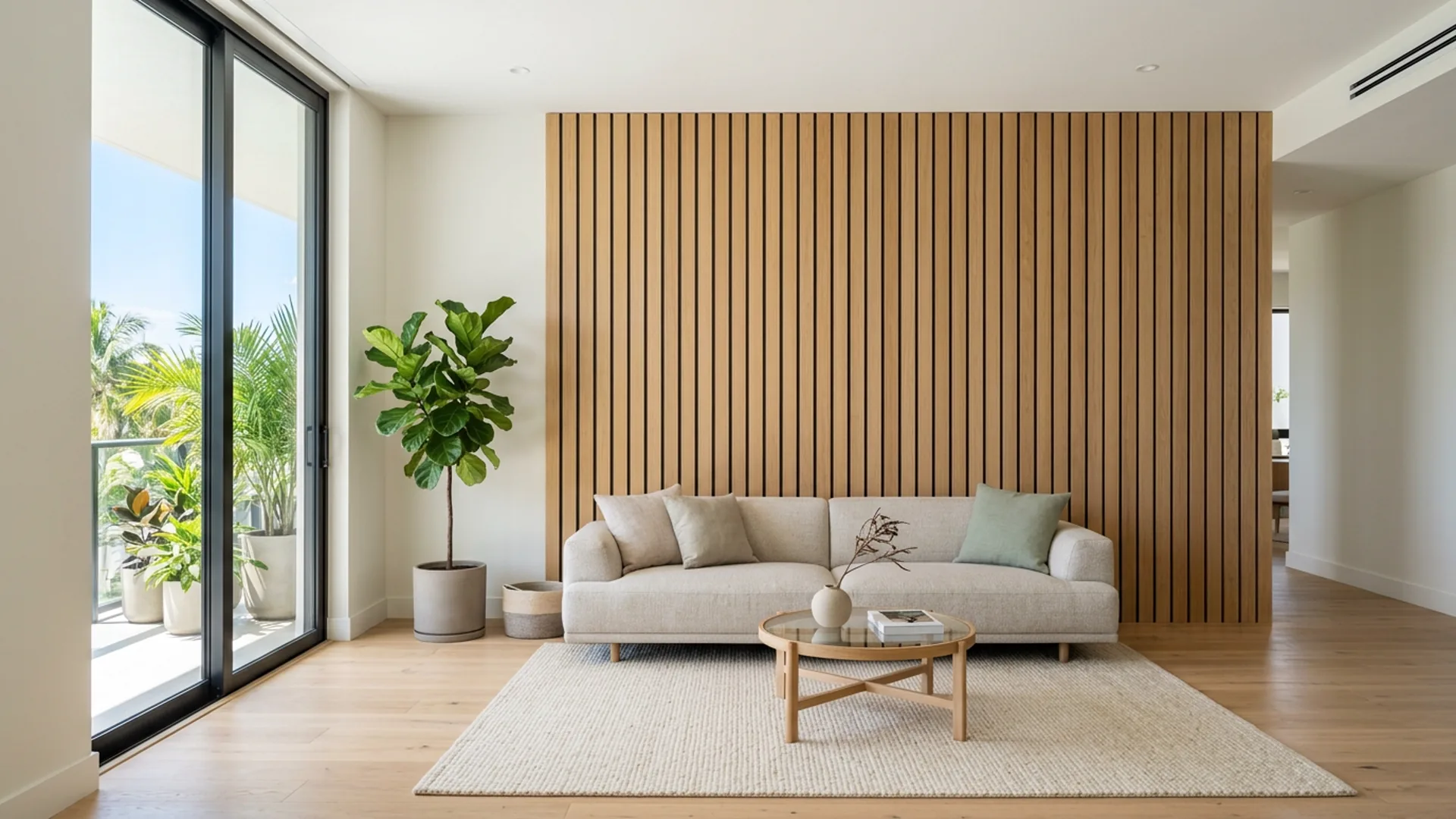
An acoustic slat panel is a grid of narrow wood strips – usually MDF, about 25 to 30 mm wide – bonded to a dark recycled PET felt backing (PET is the polyester plastic used in recycled bottles), sold as a full panel roughly 94 by 23 inches. The question I get on almost every quote: do they actually work, or am I buying a look with a story attached?
Short answer: they work, but only for the job they were designed for – calming echo inside your room. They do not soundproof anything. And the NRC number on the listing, the 0.80 or 0.90 that sold you, belongs to the lab setup as much as to the panel. Mount the same panel flat with glue and you will not get the sticker number. Mount it on battens with air behind it and you might.
Here is the full walk-through below: what NRC measures and what it ignores, where the sound actually goes in a slat panel, an honest NRC ladder from real lab data, the mounting trick behind big numbers, three questions that unmask a marketing rating, my order of what matters (coverage first, sticker number last), the echo-vs-soundproofing line, realistic expectations for a living room or home office, install-day details, when panels are not worth it, and the five-question checklist I give clients before they order.
What NRC actually measures (and what it ignores)
TL;DR: NRC (Noise Reduction Coefficient) is a single number, from 0 to 1, that summarizes how much sound a material soaks up in the speech range – 250 to 2000 Hz. It is measured in a lab reverberation room per ASTM C423 and rounded to the nearest 0.05. It says nothing about bass and nothing about blocking sound.
NRC is an average, not a magic score. Technicians measure how much sound a material absorbs at four midrange frequencies – 250, 500, 1000, and 2000 Hz. They test in a reverberation room, on a specimen of about 72 square feet, per the ASTM C423 standard. Those four bands were chosen because they cover human speech. Sound Seal, an acoustic-products manufacturer, puts it plainly: NRC is basically a simplified number for how well a material absorbs the human voice, and it gets shaky with substantial low-frequency energy like amplified music or machinery.
The scale is simple: 0 means the surface reflects everything (like a mirror), 1 means it absorbs everything (like an open window). Union Acoustic's rule of thumb: 0.00-0.29 is low absorption, 0.30-0.69 medium, 0.70-1.00 high – so a material with NRC 0.60 absorbs about 60% of the sound energy that hits it.
Three things NRC does not tell you. First, low frequencies: a slat panel can carry an NRC of 0.90 while absorbing only 0.29 at 125 Hz (a real lab result I cite below), and the single NRC hides that bass weakness. Second, NRC is not STC. As de-walls puts it: "A high NRC rating does not mean a conference room is soundproof, and a high STC rating does not mean the room sounds good inside." NRC is about sound absorbed inside your room; STC is about sound blocked through walls. Third, Europe uses absorption classes A through E under ISO 11654 instead of NRC – roughly, class A/B lines up with NRC above 0.75 and class E with below 0.5. Same idea, different label.
Where the sound actually goes: the felt does the work
TL;DR: In a slat panel, the recycled PET felt backing is the absorber. The wood slats are the face. Sound passes through the gaps between slats and the felt turns it into heat. The standard backing is about 9 mm of recycled PET; denser and thicker felt (15 mm at 1500 g/m2) does measurably more.
Here is the mechanism – and it explains everything else. Burton Acoustix, in their 2026 guide, writes: "Sound waves pass through the gaps between the wood slats and hit the backing material. That backing absorbs a large portion of the sound energy instead of letting it bounce straight back into the room." Their mental model: "picture a decorative wooden screen mounted in front of a standard acoustic panel. The screen provides the look; the backing behind it does all the acoustic work."
The wood itself barely participates. In a 2025 impedance-tube test Burton cites, an 11 mm fir board absorbed just 9% of sound at 1500 Hz. The standard slat geometry is about 27 mm of slat and 13 mm of gap (per the Akupanel spec sheet) over roughly 9 mm of PET polyester felt. PET is porous: as one felt manufacturer (Deco Sound Panel) explains it, sound waves bounce between the fibers and air pockets, and friction turns the energy into heat. That is also why felt density matters: The Panel Hub notes that a premium 15 mm felt at 1500 grams per square meter (g/m2), versus ~9 mm at 1100 g/m2 on mass-market panels, is "the single biggest reason a genuinely acoustic panel outperforms a decorative one that's marketed as 'acoustic'."
The slats do contribute one small thing: vertical slats break up flat wall reflections and reduce flutter echo – the ringing harshness bouncing between parallel hard surfaces. But acoustically, the gaps are windows and the slats are frames. Burton's red flag is the one I repeat to clients: "If a listing won't name the backing material or an NRC rating, assume it's decorative and buy a different treatment."
The honest NRC ladder: what slat panels really deliver
TL;DR: Honest numbers for standard felt-backed slat panels cluster around 0.50-0.65 on real walls. Premium 15 mm felt can reach 0.85 in lab conditions. Claims of 0.90 and above are almost always stories about the mounting – air cavity and extra insulation behind the panel – not the panel alone.
Here is the ladder from real data, low to high, with who measured it:
- 0.50: WoodyWalls rates all its acoustic slat panels at NRC 0.5, with the felt backing targeting the mid-range frequencies of speech, TV, and everyday noise. A fair, believable number for standard construction.
- 0.55: Felt Right states: "Wood slat wall panels carry a Noise Reduction Coefficient of 0.55, so the panel absorbs about 55 percent of the sound that reaches it. That reduces echo and excess noise in a room while adding a warm architectural finish." For higher absorption overhead, their ceiling panels reach 0.85. Honest framing – different product, different number.
- 0.80: The Acupanel marketing sheet claims: "These panels achieve a Noise Reduction Coefficient (NRC) rating of 0.80, and have a great impact on sound absorption." The sheet names no lab and no mounting for that line. Note that the brand's own UK store page says 0.75 "when mounted on 45mm battens, from independent laboratory measurement to EN ISO 354" – same brand, different number, because mounting is part of the number.
- 0.85: The Panel Hub's SoundPanel is rated NRC 0.85, "verified by SGS under recognised acoustic testing standards," on 15 mm recycled PET at 1500 g/m2. At least it names an independent lab. Note the construction difference: this is premium felt, not the standard 9 mm.
- 0.90: Riverbank Acoustical Laboratories (NVLAP-accredited, ASTM C423-22) tested Primacoustic's ECOScapes slat wall: "SAA = 0.88 ... NRC = 0.90" (SAA is the Sound Absorption Average, a wider-band cousin of NRC), with absorption coefficients from 0.29 at 125 Hz up to 0.98 at 500 Hz. Read the condition, though: "Test specimen was mounted on 25 mm thick wood furring strips ... produced a 25 mm thick cavity ... filled with TELAFILL PET felt panels." (Furring strips are thin timber battens that hold the panel off the wall, creating the cavity.) The panel's own felt was only 9.21 mm. The 0.90 required the extra 25 mm of PET behind it in a filled cavity. Mount the same panel flat and that number evaporates.
And the claims I flag: Mollywell lists "NRC 0.95" and says the panels "effectively blocks sound transmission between rooms" – a two-for-one violation, an implausible number plus confusing absorption (NRC) with blocking (STC). VEVOR claims "NRC 0.85" with "SGS acoustic certification" but publishes no report and no mounting. A made-in-China B2B listing claims "NRC=0.8" on 9 mm felt. Compare with Impact Acoustic's real felt data: 12 mm PET with no air gap scores αw = 0.30 (αw is Europe's weighted absorption coefficient, a close cousin of NRC); their 24 mm format goes 0.55 with no gap, 0.65 at 50 mm, 0.90 at 100 mm, 0.95 at 200 mm. The pattern is consistent: thickness and air gap are the number, not the sticker.
The mounting trick behind the big numbers
TL;DR: Lab NRCs are measured with air behind the panel. Glue the same panel flat to your wall and it scores far lower. When you read a listing, you are reading a number that belongs to the test rig as much as to the product.
Most buyers never see this part of the industry – and it is fully documented. Under ASTM E795, the mounting condition is part of the test: Type A means mounted directly on the surface; other mounting types add an airspace behind the panel. A Canadian felt maker, The Quiet Room, tested the same PET felt three ways at Riverbank Labs: direct-mounted = 0.40 NRC; 1 inch off the wall = 0.65; as a baffle = 0.85. Same material, three numbers – the only variable was air.
Right against a rigid wall, sound barely moves the air, so an absorber pressed flat against it does little; an air gap moves the absorber into air that moves more, which makes it more effective. That is also why the Riverbank 0.90 above needed its filled 25 mm cavity, and why The Panel Hub's premium 0.85 sits on 15 mm felt – thickness plus gap.
Kirei USA, an acoustic-products manufacturer, warns specifiers outright: suppliers sometimes incorporate air space during NRC testing to raise their ratings, so check how much air space was used at the test and compare it to your own project conditions – a big test cavity is not what you get with glue-on installation. That is the sentence to carry into every product page. A detailed test excerpt for the original-style panel references DS/EN ISO 354:2003 with Mounting Type E – a 100 mm back cavity – while the same sheet's marketing line quotes the 0.80 with no mounting named. I read it as a caution, not a fraud claim: the number is real, but it was earned in a condition your wall probably will not replicate.
Three questions that unmask a marketing NRC
TL;DR: Ask (1) tested to which standard – ASTM C423 or EN ISO 354? (2) At what mounting – direct, or with what air cavity? (3) Tested by whom – an independent lab or in-house? If the seller cannot answer, treat the number as decoration.
1. Which standard? Real answers sound like "ASTM C423" or "EN ISO 354," sometimes with a report number and date. Vague answers sound like "lab-tested" or "certified acoustic." A report worth trusting shows the frequency-band table, not just the single NRC – slats that absorb well at 1-2 kHz can do little at 250 Hz, and if your room sounds boomy you need to know that.
2. What mounting? This is the question that separates honest numbers from marketing numbers. "Direct to drywall" (ASTM E795 Type A) is what most buyers will actually do. "On battens with insulation" is what earns the big numbers. If the listing's 0.90 was measured over a filled cavity and you plan to glue the panels flat, you are not buying 0.90.
3. Who tested? Independent labs – Riverbank, SGS, Intertek – sign their names and dates. In-house "testing" with no report is a claim. And watch two specific red flags Burton names: citing one single high-frequency absorption figure is not a legitimate NRC rating, and a "soundproof" claim paired with no NRC at all is a marker of a decorative panel.
The good news: honest sellers exist. The Panel Hub names SGS and the felt spec; Felt Right publishes a modest 0.55 and says exactly what it does. The honest answer is rarely the biggest number.
What makes them work: the installer's order of importance
TL;DR: Ask any installer and you get a hierarchy, not a number: (1) how much wall you treat, (2) the air gap behind the panels, (3) the felt's thickness and density, (4) slat spacing, (5) finish. A tenth of an NRC point on the sticker matters less than any of the first three.
1. Coverage area. NRC is a per-area rating; absorption is total. A whole wall of panels is a different product than a decorative patch. Coverage guidance from published sources: The Panel Hub suggests roughly 20-30% of a room's hard surfaces, noting that a 10 by 8 ft home-office wall takes about 5-6 standard panels (94.5 by 23.6 in). PackSound suggests 15-25% of wall area as a starting point, adjusted per goal. And a hands-on reviewer on Medium (@freshreviews) warns: a 10-foot-wide by 8-foot-high wall is 80 square feet before doors and windows, and "you'd need considerably more than one two-pack to cover it" – a two-pack covers about 15.5 square feet. Do the coverage math before you buy.
2. Air gap behind the panels. The cheapest performance upgrade there is. Sound passes through the slats, the felt absorbs part of it, the rest reflects off the wall behind and passes through the felt again. Mounting on battens instead of gluing flat is the difference between the 0.40 and the 0.65 in the Quiet Room test – same felt, different gap. EngineerFix notes that even a small intentional air gap between the felt and the wall enhances lower-frequency absorption. The Slatpanel install manual goes further, recommending furring strips "at least 1.77 in thick" plus "an acoustically rated insulation behind the panels."
3. Felt thickness and density. Standard is ~9 mm recycled PET. Premium panels run 15 mm at 1500 g/m2 and publish correspondingly higher NRCs. A thin decorative mat that merely looks like felt does far less – and Burton warns that cheap knock-offs use thin craft felt that looks similar but absorbs far less.
4. Slat spacing. The gaps are how sound gets through. Wide-open gaps expose more felt; tight slats reflect more. On the standard product (27 mm slat, 13 mm gap – roughly one-third open) this is already decided for you. Custom spacing is a design choice that also moves the needle.
5. Finish. Laminate versus veneer versus paint changes high-frequency reflection a little and changes the look a lot. It is the least important acoustic variable. If you are choosing between slat profiles for a room where sound matters, I compared the two main profiles head to head in our fluted vs wood slat guide.
Echo treatment vs soundproofing – the line that matters
TL;DR: Slat panels treat the room you are in: echo, reverberation, the harshness that makes calls tiring. They cannot block sound moving between rooms. Blocking needs mass, decoupling, and sealed air gaps – a construction scope, not a surface product sold off the shelf.
This is the misunderstanding that costs people the most money. When someone asks me to "soundproof the bedroom with slat panels," I tell them the panels will make the bedroom sound calmer inside, and the neighbor's TV will sound exactly the same. As PackSound puts it: "Panels absorb in-room echo; soundproofing blocks sound transfer between rooms using mass and sealing." And Burton is blunt: "No. Soundproofing requires mass, mechanical damping, and airtight sealing – none of which surface treatments provide."
Bass is the hard limit. Slat panels work in the mid and high frequencies – voices, TV dialogue, the slap of a clap. The Riverbank band table shows it plainly: 0.98 at 500 Hz, 0.29 at 125 Hz. Low frequencies pass through lightweight porous treatments; blocking them takes mass-loaded barriers, decoupled framing, and sealed construction. A forum regular on TalkBass says it the way tradespeople do: panels will not reduce the audible sound of the room – for that you need construction; panels are for making the room sound better inside.
So: buying panels to fix echo on video calls, hollow TV dialogue, or a dining room where everyone keeps talking louder – right product. Buying them to silence upstairs footsteps, a barking dog, or street rumble – wrong product, wrong trade.
What to expect in a real living room or home office
TL;DR: One full accent wall in a normal living room: slap echo drops, the metallic ring on loud claps softens, conversation and calls get clearer. Your neighbor hears no difference. Expect a calmer room, not a recording studio. It is the biggest single audible improvement most rooms get.
Reverberation time – RT60 – is the plain way to think about this. Soundfield Acoustics defines it: "Reverberation time, often reported as RT60, is the time it takes sound to decay by 60 dB after the source stops." Long reverberation smears syllables and hurts speech intelligibility; shorter reverb makes voices clearer. A practical test from HillPoint: clap once and count the tail – past one second and you probably have a problem worth looking at. Reference targets: a home office wants around 0.5 seconds per HillPoint's open-office guidance, a podcast corner wants under 0.3; meeting rooms sit around 0.4-0.6 (the WELL standard requires under 0.6 for conference rooms); a concert hall runs up to 2.2 seconds – because music wants what speech hates.
Now, what one accent wall gets you. The jump from bare drywall (NRC 0.05) to a felt-backed slat panel (~0.50) is immediately audible: slap echo drops, the metallic ring on loud claps softens, conversation gets clearer. Burton phrases the ceiling honestly: "slat panels won't turn a lively living room into a dead recording room" – and for most living spaces, keeping some natural acoustic energy is the point. These panels are, as Burton puts it, "engineered for living rooms where you need acoustic improvement without the studio look – not for critical control rooms where every decibel of absorption counts."
A third-party verdict that matches my experience: @freshreviews, reviewing Art3d slat panels on Medium in January 2026, wrote: "Overall, Art3d gets the balance between aesthetics and acoustic treatment right. It's not the cheapest way to decorate a wall and it won't soundproof your room, but if you want that expensive-looking wood-slat aesthetic while also reducing some echo, it's one of the more practical DIY options." Note the piece carries an Amazon Associates affiliate disclosure – it is a monetized review, not a lab test. Still, the conclusion is the honest one, and it is not theirs alone.
Install-day details that change the result
TL;DR: Screw panels to furring strips instead of gluing flat – the air cavity is free performance. Keep adhesive to dabs or a wave pattern so the felt can breathe. Treat one continuous field, not scattered patches. Seal cut edges against Florida humidity.
Battens are free NRC. Screwing panels to 2-inch timber battens (furring strips) instead of gluing flat creates the air cavity I described above for the price of lumber. The Ozarke install PDF lists screwing into 2-inch timber battens as the "optimum sound absorption" method – their words, and a vendor claim I treat as directionally right. The Wood Veneer Hub's Slatpanel manual recommends furring strips "at least 1.77 in thick" plus "an acoustically rated insulation behind the panels" to improve acoustic properties. Installers get side benefits the acoustics guides skip: battens flatten wavy walls and the cavity hides LED strips and speaker cable – exactly what a media wall needs anyway.
Adhesive belongs in dabs, not beds. With glue installs, the felt side goes to the wall and the adhesive goes in dabs or a wave pattern on the felt. A full-coverage glue bed seals the felt's pores and steals absorption. The WVH manual's wave-pattern instruction is there for a reason.
One continuous field, not scattered patches. An unbroken run of panels performs evenly; scattering a few panels across three walls leaves live zones that still slap echo back. Plan the treated area as one field – ideally the wall you face when you talk or watch, since first reflections dominate what you hear. The industry piece on NRC and installation notes the same: fragmented installs create dead zones and echo areas.
Perimeter sealing is for looks, not acoustics. Caulk around the panel edges keeps the install clean and stops dust getting behind the panels – but on a thin slat panel it does not meaningfully change the room's absorption. Do not let anyone sell it as an acoustic upgrade.
Cut edges are the weak point. Cutting a panel exposes raw MDF on every cut slat end, and MDF drinks moisture through cut edges fastest – the 4specs specifier forum documents the rate of water intake rising with every exposure. The cabinetmaker's fix is to seal them: edge banding, paint, or even thinned PVA sizing. Put factory edges where eyes land. And the catches from our earlier guides still apply: panels sit about 21 mm proud of the wall, so plan outlet box extenders before install day; long panels need two people and crack if lifted by the ends; glued panels do not come down cleanly.
South Florida humidity intersects here. Standard MDF-core slat panels live only in continuously air-conditioned rooms – the same rule I published in our Florida humidity guide: manufacturer install window 15-25 degrees Celsius at 40-60% relative humidity, acclimate panels 48-72 hours, leave 3-5 mm perimeter gaps. The acoustic wrinkle: the PET felt is polyester, so it will not rot like a cellulose mat, but it is fibrous and holds humidity against the MDF core – and the core is what swells. Never spec MDF slats for bathrooms, pool-adjacent walls, lanais, or garages. If you need waterproof and acoustic in one wall, that is a custom assembly, not an off-the-shelf panel – talk to us before you order.
When slat panels are not worth it
TL;DR: Not for blocking neighbors or street noise. Not a 4-square-foot patch behind the TV expecting the room to change. Not a fully hard room with nothing soft in it. Not anywhere humid or unconditioned. A realistic panel project needs treated square footage, not just a look.
You want isolation from neighbors or the street. Panels absorb reflections inside your room; they add almost no mass and no decoupling. Upstairs footsteps, a barking dog, traffic rumble – that scope is drywall, insulation, and door seals. A different trade, a different budget.
A tiny feature patch. The classic: four square feet behind the TV, bought for the look, expected to change the room's sound. Below a meaningful fraction of the room's reflective surface, the audible change is small. Buy it for the look – it is a good look – and do not expect the room to sound different.
A hard room with nothing soft in it. Tile floors, bare drywall, glass, leather – one slat wall cannot carry the whole acoustic load of an echo chamber. Panels are one instrument; rugs, curtains, and upholstery are the rest of the band. In a fully hard room, panels alone will disappoint. South Florida homes with tile throughout and high ceilings are exactly this room – treat the floors and windows too.
A bathroom, lanai, garage, or seasonal home closed up without AC. Standard MDF-core panels do not belong there, and the felt backing does not exempt them. For what actually survives Florida humidity, the material ladder lives in the humidity guide – and if you are budgeting a full wall, the numbers live in the cost guide.
Before you order: the installer's five questions
TL;DR: (1) Which standard and mounting were used for the NRC? (2) What is the backing – material and density? (3) What is the slat core, and are cut edges sealed? (4) Is there a fire rating for the exact SKU, if your room needs one? (5) Do the panel dimensions fit your wall without a 2-inch sliver at the corner?
1. Test conditions. Which standard (ASTM C423 / EN ISO 354) and which mounting (direct or with what cavity)? Bonus: ask for the frequency-band table, not just the single NRC.
2. Backing material and density. PET felt thickness – 9 mm is the common standard, 12-15 mm exists – or is the panel sold without meaningful backing? Some cheap "slat look" panels are MDF strips on thin nonwoven. Mostly decoration.
3. Slat core and edges. MDF (standard), moisture-rated MDF, or solid wood – and are the cut edges sealed? The humidity article established MDF plus moisture as the failure pair; cut edges are where it starts.
4. Fire rating, only if the room needs one. Ratings attach to the exact tested SKU, never to "MDF slats" as a category. What a real spec sheet looks like: Interlam's Akupanel specifying sheet lists the PET backer at Flame Spread Index 0 / smoke 350 and the MDF at FSI 15 / smoke 5, and notes Class A means FSI 0-25. A listing that says "fireproof" or "Class A" without a report number for the exact panel is a claim, not a rating.
5. Dimensions against your wall. Standard panels run about 2400 by 600 mm (94.5 by 23.6 in). Plan the layout so you do not end with a 2-inch sliver at the corner – offcuts at the ends are where DIY jobs visibly fail.
The two sentences I would leave you with: that NRC 0.90 on the listing was likely measured with inches of air behind the panel in a lab – your wall is not a lab. Buy panels for the echo you hear in your room, in the size of your wall, not for the number on the listing. Coverage and an air gap beat a tenth of an NRC point every time.
Sources
Standards and definitions
- Wikipedia, "Noise reduction coefficient" – NRC = single-number rating (average of 250/500/1000/2000 Hz, rounded to 0.05) per ASTM C423 on ~72 sq ft specimen; values above 1.0 are reverberation-room artifacts; NRC (absorbed in-room) vs STC (transmission loss through walls) (paraphrase). en.wikipedia.org
- Sound Seal, "Acoustical Testing" PDF – NRC bands represent human speech; limited for low-frequency energy like amplified music or machinery (paraphrase). soundseal.com
- Gustafs Scandinavia, "About sound absorption and reverberation times" – ISO 11654 classes A (αw 0.90-1.00) through E (0.15-0.25) (paraphrase). gustafs.com
- Union Acoustic – NRC bands 0.00-0.29 low / 0.30-0.69 medium / 0.70-1.00 high; "a material with an NRC of 0.60 will absorb 60% of the sound energy that hits it" (paraphrase). unionacoustic.com.sg
- Massform, "ASTM Lab Test Results" – NRC measured via ASTM C423; ASTM E795 defines mounting types (Type A = direct to surface) (paraphrase). massform.com
Lab data and manufacturer numbers
- Riverbank Acoustical Laboratories, report RAL-A23-086 (2023-04-10), via Primacoustic – "SAA = 0.88 ... NRC = 0.90" with coefficients 0.29@125Hz, 0.55@250Hz, 0.98@500Hz, 1.06@1000Hz, 0.92@2000Hz (verbatim); "Type C-25 Mounting: Test specimen was mounted on 25 mm (1 in.) thick wood furring strips ... produced a 25 mm (1 in.) thick cavity ... filled with TELAFILL PET felt panels that had a 25.11 mm (0.9885 in.) uncompressed thickness" (verbatim). Panel's own felt: 9.21 mm. primacoustic.com
- The Quiet Room – same PET felt: 0.40 NRC direct-mounted, 0.65 at 1 in off the wall, 0.85 as baffle (paraphrase). thequietroom.ca
- Impact Acoustic ARCHISONIC (via ArchDaily) – "At 12 mm with no air gap, the panels achieve αw = 0.30 per DIN ISO 11654. The 24 mm format delivers substantially higher absorption: αw = 0.55 with no air gap, rising to αw = 0.65 at 50 mm, αw = 0.90 at 100 mm, and αw = 0.95 at 200 mm or greater air gap." (verbatim, manufacturer data). archdaily.com
- Acupanel technical sheet (via thewoodveneerhub.co.uk) – "These panels achieve a Noise Reduction Coefficient (NRC) rating of 0.80, and have a great impact on sound absorption." (verbatim, no lab or mounting named on the marketing line). cdn.shopify.com
- The Wood Veneer Hub – "Our slat ranges, Acupanel® Contemporary, Wrapped, Colour, Metal and Fire-Rated, measure a Noise Reduction Coefficient of 0.75 when mounted on 45mm battens, from independent laboratory measurement to EN ISO 354." (verbatim). thewoodveneerhub.co.uk
- The Panel Hub, "Acoustic Wood Slat Wall Panels: The Complete Guide" – SoundPanel NRC 0.85 verified by SGS; 15 mm / 1500 g/m2 recycled PET vs ~9 mm / 1100 g/m2 mass-market; 20-30% of hard surfaces coverage guidance (paraphrase). thepanelhub.com
- Felt Right – "Wood slat wall panels carry a Noise Reduction Coefficient of 0.55, so the panel absorbs about 55 percent of the sound that reaches it. That reduces echo and excess noise in a room while adding a warm architectural finish." (verbatim). feltright.com
- WoodyWalls – all acoustic slat panels rated NRC 0.5; felt targets mid-range speech/TV frequencies (paraphrase). woodywalls.com
- Kirei USA, "Specifying Acoustics" – suppliers sometimes incorporate air space during NRC testing to raise ratings; check test air space against project conditions (paraphrase). kireiusa.com
- Interlam Akupanel spec sheet – slat 27 mm / 13 mm gap; 9 mm PET felt; MDF strips 11 mm thick (per Interlam sheet); panel 2400x600 mm; PET backer FSI 0 / smoke 350, MDF FSI 15 / smoke 5, Class A = FSI 0-25 (per-product numbers) (paraphrase). assets-global.website-files.com
Mechanism, myth-busting, reverberation
- Burton Acoustix, "Do Acoustic Slat Panels Work? Complete Guide [2026]" – "Sound waves pass through the gaps between the wood slats and hit the backing material. That backing absorbs a large portion of the sound energy instead of letting it bounce straight back into the room." (verbatim); "picture a decorative wooden screen mounted in front of a standard acoustic panel. The screen provides the look; the backing behind it does all the acoustic work." (verbatim); 11 mm fir board absorbed 9% at 1500 Hz in a 2025 tube test (paraphrase); "No. Soundproofing requires mass, mechanical damping, and airtight sealing – none of which surface treatments provide." (verbatim); "If a listing won't name the backing material or an NRC rating, assume it's decorative and buy a different treatment." (verbatim). blog.burtonacoustix.com
- de-walls.com, "Conference Room Soundproofing" – "A high NRC rating does not mean a conference room is soundproof, and a high STC rating does not mean the room sounds good inside." (verbatim). de-walls.com
- PackSound, "Acoustic Wall Panels FAQ" – "Panels absorb in-room echo; soundproofing blocks sound transfer between rooms using mass and sealing." (verbatim); "Solid wood alone barely absorbs sound; acoustic wood panels work because of the hidden backing, not the timber." (verbatim); 15-25% of wall area as coverage starting point (paraphrase). packsound.in
- Soundfield Acoustics, "What Is Reverberation Time?" – "Reverberation time, often reported as RT60, is the time it takes sound to decay by 60 dB after the source stops." (verbatim). soundfieldacoustics.ca
- HillPoint Global (LinkedIn) – targets: meeting room 0.4-0.5 s, conference 0.5-0.6 s (WELL <0.6), classrooms <0.6 s (ANSI S12.60), auditoriums 0.8-1.2 s, concert halls up to 2.2 s; clap-test rule "past one second and you probably have a problem" (paraphrase). linkedin.com
- Medium @foreeyes007, "Stop Reverb!" (2026) – podcast/home-recording target RT60 under 0.3 s (paraphrase). medium.com
- Olgoffice, "What NRC Really Tells You About AcoustIQ Performance" – air gap moves the absorber to where particle velocity is higher, making it more effective (paraphrase). olgoffice.com
- Deco Sound Panel – PET felt is porous; sound waves bounce between fibers and air pockets, and friction turns the energy into heat (paraphrase). decosoundpanel.com
- TalkBass forum – user kevorargh: "panels will not reduce the audible sound of the room" – for blocking noise you need construction, not panels (paraphrase, community report). talkbass.com
Install methods and trade practice
- EngineerFix – furring strips at 2-ft intervals with mineral wool for "maximum acoustic performance"; a small intentional air gap enhances lower-frequency absorption (paraphrase). engineerfix.com
- The Wood Veneer Hub Slatpanel manual (manuals.plus) – furring strips "at least 1.77 in thick" plus "an acoustically rated insulation behind the panels" improve acoustic properties; wave-pattern adhesive on the felt (paraphrase). manuals.plus
- Ozarke/Trepanel install PDF (manufacturer) – screwing into 2-inch timber battens is the "optimum sound absorption" method (paraphrase). cdn.shopify.com
- PromoteProject, "Acoustic Wood Panels: NRC Ratings & Installation Insights" – NRC drivers: perforation pattern, thickness, backing type, air cavity; fragmented installs leave echo areas; mounting errors undercut panel potential (paraphrase). promoteproject.com
- 4specs specifier forum – Anne Whitacre (FCSI CCS): the rate at which MDF "inhales" water increases with every exposure (paraphrase, community report). discus.4specs.com
Hands-on review
- Medium @freshreviews, "Got our room sound proofed by these" (Jan 20, 2026) – Art3d slat panels (2-pack ≈ 15.5 sq ft): "The wood-look slats sit over a polyester acoustic backing, so they can help reduce some room reflections and echo. Just don't confuse that with true soundproofing." (verbatim); "These are acoustic treatment panels, not soundproofing panels. If your goal is to stop your neighbors from hearing your gaming setup, or to prevent outside noise from entering your room, this isn't the right solution." (verbatim); "For example, a 10-foot-wide by 8-foot-high wall is 80 square feet before accounting for doors, windows or other interruptions. You'd need considerably more than one two-pack to cover it." (verbatim); "Overall, Art3d gets the balance between aesthetics and acoustic treatment right. It's not the cheapest way to decorate a wall and it won't soundproof your room, but if you want that expensive-looking wood-slat aesthetic while also reducing some echo, it's one of the more practical DIY options." (verbatim). Carries an Amazon Associates affiliate disclosure. medium.com
Studio continuity (already published)
- WOW Walls Studio, "Wall Panels in Florida Humidity: MDF vs PVC – What Actually Survives (2026)" – MDF-core panels only in continuously AC rooms; 15-25°C / 40-60% RH install window; 48-72 h acclimation; 3-5 mm gaps; bathrooms = PVC/WPC/PS, never MDF (paraphrase).
- WOW Walls Studio, "Fluted Panels vs Wood Slat Panels" – slat panels calm echo, do not soundproof; NRC ≠ STC; mid-to-high frequency handling (paraphrase).