
TV Wall Panels Cost: Sizing, Materials and Labor (2026)
TV wall panels cost in 2026: panel field prices by material, mount and electrical line items, labor, and worked totals for 55, 65 and 85 inch TVs.
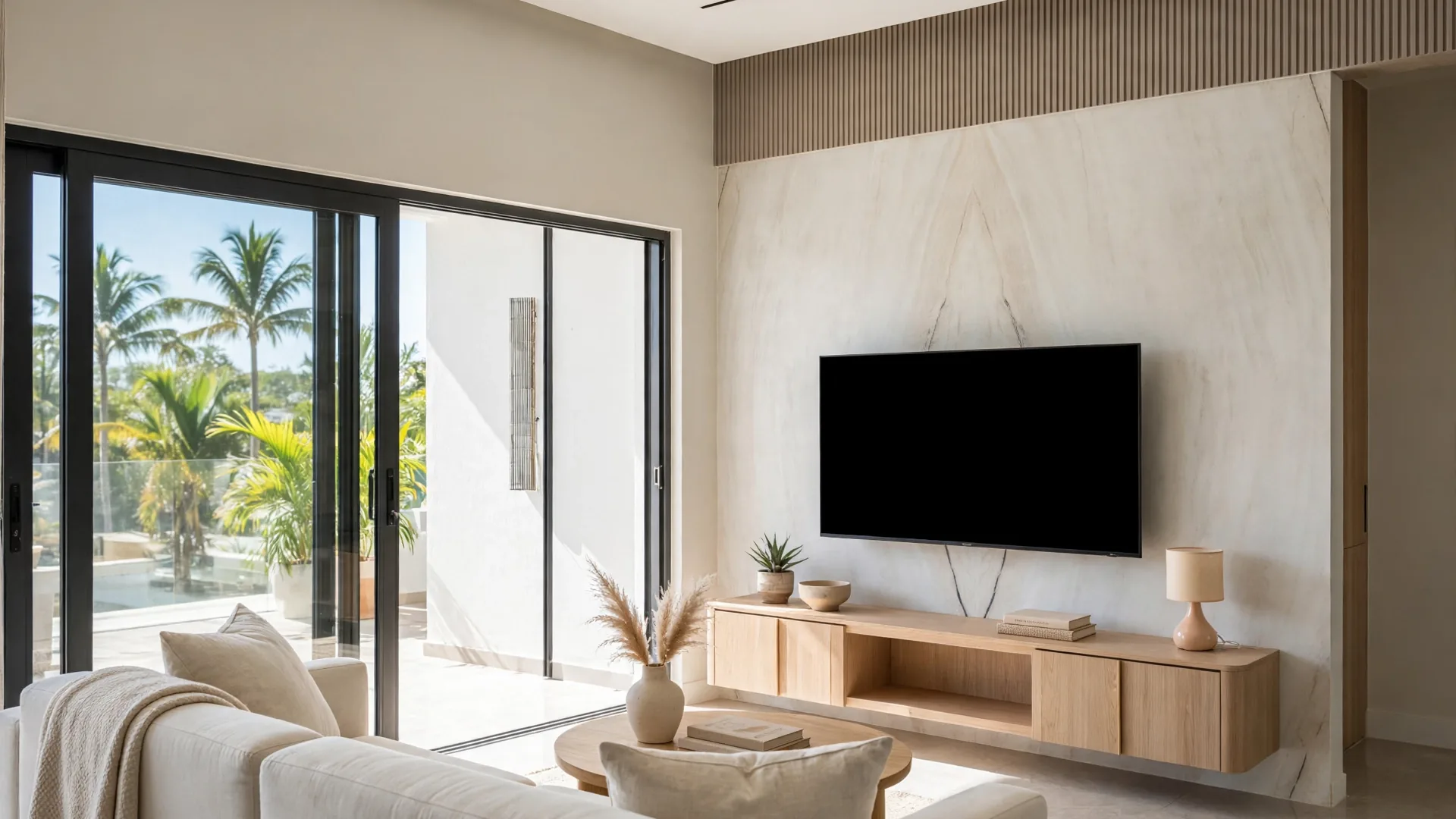
A TV wall has two budgets hiding inside one project. The first is the panel field: the finished surface that surrounds the screen. The second is everything the screen itself needs: a mount, power in the right place, and cables that stay out of sight. This article keeps them apart.
We are a South Florida studio that designs and installs large-format panel walls. Our general TV wall panels guide covers the design side: how to size the field, where cables run, and how to choose a material. This article covers the money side of the same wall. Our general wall panels cost guide prices the wider panel market. Here, every figure answers the TV wall panels cost question directly, with its source and scope attached.
One warning before the tables. TV wall pricing mixes three scopes: a per square foot panel price, a flat mounting price by screen size, and hourly trade rates for electrical work. Each section below prices one scope at a time.
The short answer: what a TV panel wall costs in 2026
TL;DR: The panel field runs $6 to $14 per square foot for stone-look composite panels. PVC and WPC panels run $7 to $15 in The Panel Hub's 2026 price guide, current as of April 2026. Panel labor adds $3 to $10 per square foot. Angi prices professional TV mounting at $180 to $300 for a 41 to 60 inch TV. A 61 inch TV and above runs $250 to $600. Concealed wiring adds $75 to $300. Three worked totals land at about $957 to $2,454 for a 55 inch wall. A 65 inch wall lands at about $1,302 to $3,315, and an 85 inch wall at about $2,101 to $4,158, by our arithmetic.
| TV wall line item | Published band | Scope of the figure | Source |
|---|---|---|---|
| Stone-look composite panel field | $6 to $14 per sq ft, materials | US materials guide | The Panel Hub, April 2026 |
| PVC and WPC panel field | $7 to $15 per sq ft, materials | US materials guide | The Panel Hub, April 2026 |
| Paintable MDF panel field | $7 to $11 per sq ft, materials | US materials guide, needs painting | The Panel Hub, April 2026 |
| Wood veneer panel field | $12 to $18 per sq ft, materials | US materials guide, real wood face | The Panel Hub, April 2026 |
| Panel installation labor | Plus $3 to $10 per sq ft | Standard flat wall | The Panel Hub, April 2026 |
| TV mounting, 41 to 60 inch TV | $180 to $300 total | Professional mounting service | Angi, Sep 2026 |
| TV mounting, 61 inch and above | $250 to $600 total | Professional mounting service | Angi, Sep 2026 |
| Concealed wiring | $75 to $300 | Power and signal cables inside the wall | Angi, Sep 2026 |
| Studio large-format panel project | Priced per project, from $850 | Design, panels, delivery, own-crew install | WOW Walls Studio anchors |
Read the table by its third column. The panel rows price a surface. The mounting rows price a service visit with a screen size attached. The wiring row prices a hidden extra that most panel quotes leave out. A finished TV wall pays all three scopes at once, and the worked totals near the end add them together openly.
The last row belongs to a different way of buying the same wall. Our studio prices the panel project as one project, priced in a later section. Every studio figure is preliminary until a specialist measures your wall.
The panel field: material prices for the surface around the screen
TL;DR: The Panel Hub guide prices faux stone and textured panels at $6 to $14 per square foot for materials, with a typical lifespan of 10 to 15 years. PVC and WPC panels run $7 to $15, at 10 to 20 years. Paintable MDF runs $7 to $11, wood veneer $12 to $18, and solid wood $15 to $40 or more. Angi's general paneling table overlaps at $5 to $25 per square foot across types. The guide also warns that the whole category spans $1 per square foot for basic MDF to $40 or more for solid hardwood.
The panel field (the paneled area that frames the TV) is the largest material line on the wall. Its price follows the build. The core (the inner material of the panel) sets the base cost and the moisture behavior. The face sets what you see: a printed stone pattern, a slice of real wood, or a painted surface. Each step up that ladder moves the price.
Stone-look composite. The guide prices faux stone and textured panels at $6 to $14 per square foot for materials. The row describes a lightweight composite with a stone-look finish and a typical lifespan of 10 to 15 years. This is the closest published band to the pale stone walls that sit behind most large TVs in current living rooms. The face carries the stone pattern, so the panel stays light enough for a standard wall.
PVC and WPC composites. WPC (wood-plastic composite, wood fiber in a plastic core) and PVC (polyvinyl chloride, a solid plastic) run $7 to $15 per square foot. The guide gives the family a lifespan of 10 to 20 years. The guide describes the family as waterproof and lightweight, with a printed wood-look face. Angi's general table prices PVC panels at $7 to $20 per square foot and calls the material moisture resistant and easy to clean. The two sources overlap on the floor and differ at the ceiling, which is normal for a category sold under many brand names.
Paintable MDF. MDF (medium-density fiberboard, pressed wood fibers) runs $7 to $11 per square foot in the guide, with a lifespan of 10 to 15 years. The board arrives ready to prime and paint, so finishing belongs in the budget from the start. MDF also carries the strictest moisture limit in this list, which matters in the Florida section.
Wood veneer. The guide prices decorative wood veneer at $12 to $18 per square foot, with a lifespan of 15 to 25 years. The premium over the composites buys real grain on the face. It also buys a thin face, so a deep scratch still shows.
Solid wood. Solid wood planks and cladding run $15 to $40 or more per square foot in the guide, with a lifespan of 30 years or more. Wood runs through the full thickness here. You can sand it and refinish it years later. The price buys that depth, plus the weight.
Two fields that look alike in a listing photo can sit far apart in price. Before you compare two panel quotes, compare the builds: core, face, finish state, and what the price leaves out.
Sizing the field: how TV size and wall width set the area you pay for
TL;DR: Samsung puts the comfortable viewing distance at about 1.2 times the screen size, based on a 40-degree field of view. Its bands pair 43 to 55 inch TVs with 1.5 to 2.0 meters, 55 to 65 inch TVs with 2.0 to 2.5 meters, and 85 inch TVs with 3.0 meters or more. A 16:9 screen measures about 0.87 times its diagonal in width, so a 65 inch TV is about 57 inches wide. The worked totals in this article price fields of 72, 90 and 108 square feet, at 9 feet high and 8, 10 and 12 feet wide.
Panels sell by area, so the field size decides the material bill before any brand enters the chat. Two measurements set that area: the width of wall you choose to cover, and the height. Most TV walls in this article use a 9 foot height, floor to ceiling. A field that stops short of the ceiling reads as a patch on the wall.
Start with the screen. Samsung's guidance ties screen size to seat distance: about 1.2 times the screen size for comfortable, immersive viewing. A 65 inch TV sits at about 2.0 meters in its table, and a 75 inch TV at about 2.3 meters.
Screen sizes are diagonals. For a standard 16:9 screen, width runs at about 0.87 times the diagonal, by plain geometry. A 55 inch TV measures about 48 inches wide. A 65 inch TV measures about 57 inches wide. A 75 inch TV measures about 65 inches wide. An 85 inch TV measures about 74 inches wide. Those widths are our arithmetic from the diagonal.
The field usually extends past the screen on both sides. The three worked examples later in this article use fields of 8, 10 and 12 feet wide for 55, 65 and 85 inch TVs. Each field leaves roughly two to three feet of panel beside the screen. Our TV wall panels guide works through the sizing method itself. Readers with a compact room will find the layout version in our guide to TV walls in small living rooms, linked from the hub.
Height does quieter work in the budget. A move from an 8 foot ceiling to a 9 foot ceiling adds an eighth to the field area. A 10 foot wide field grows from 80 to 90 square feet on that one decision.
The mount and hardware: a flat line that grows with the screen
TL;DR: Angi, updated September 28, 2026, prices professional TV mounting at $153 to $353 on average, with a national average range of $149 to $346. Mount hardware itself runs $20 to $500 by type: fixed $20 to $80, tilting $30 to $100, full-motion $70 to $250, and specialty mounts $150 to $500. By screen size, mounting runs $120 to $200 under 40 inches, $180 to $300 at 41 to 60 inches, and $250 to $600 at 61 inches and above.
The mount (the bracket that holds the TV to the wall) is a small line with a wide spread. Angi prices the hardware from $20 to $500, and the type explains the spread. A fixed mount holds the TV flat and still. A tilting mount adds vertical tilt for screens placed above eye level. A full-motion mount swings out and swivels, which suits corner seating. A specialty mount covers motorized and corner work at the top of the range.
The mounting service is a separate figure from the hardware. Angi's size table prices the service by screen: $120 to $200 for a TV under 40 inches, $180 to $300 for 41 to 60 inches, and $250 to $600 for 61 inches and above. Larger screens need stronger mounts and often two installers for safe handling. Angi notes that mounting an 85 inch TV often means additional bracing or wall reinforcement. Its prep table prices wall reinforcement or patching at $50 to $200.
Labor rates explain the rest of the service spread. Angi puts TV mounting labor at $50 to $200 per hour. A handyman or general installer charges $50 to $100 per hour, or $100 to $300 as a flat fee per TV. An AV specialist (a technician who sets up audio and video equipment) charges $100 to $200 per hour.
Two hardware extras belong in this section. A soundbar bracket (a small mount that hangs a soundbar under the TV) runs $30 to $100 in Angi's table. Cable covers (surface channels that hide cords on the wall face) run $10 to $50.
A panel field changes one part of this section. The mount fixes through the panel into the structure behind it, so the panel order and the mount choice need to agree before either one ships. Reinforcement sits at $50 to $200 in Angi's prep table when the wall needs it.
Electrical and cable lines: the hidden work, priced on its own
TL;DR: Angi prices concealed wiring at $75 to $300, for power and signal cables run inside the wall. Electrical prep for a new outlet and cable runs also sits at $75 to $300. An in-wall power kit runs $40 to $120, cable management runs $20 to $150, and an electrician charges $65 to $150 per hour. Angi's summary line bundles concealed wiring, soundbar brackets or fireplace mounting at an added $150 to $300. Permits apply only to electrical work or structural changes, at $30 to $100 in its mounting guide.
A TV wall hides its cables, and hidden cables cost money. This section prices that work as cost lines only. The routing choices themselves, including outlet placement and cable paths, live in our guide to LED backlit wall panels and wiring. Here, the question is simpler: what does each hidden line add to the total?
Concealed wiring. Angi prices concealed wiring at $75 to $300. The line covers power and signal cables run inside the wall, so no cords cross the panel face. It is often missing from panel-only quotes.
Power at the screen. A TV needs an outlet behind it. Angi prices electrical prep, described as a new outlet and running cables, at $75 to $300. An in-wall power kit (a boxed kit that moves power behind the TV within the wall) runs $40 to $120 as hardware. A quote should carry one route or the other, with the scope written down.
The trades. An electrician charges $65 to $150 per hour in Angi's mounting guide. An AV specialist charges $100 to $200 per hour. A handyman charges $50 to $100 per hour. The hourly spread explains why two wiring quotes for the same wall can differ by a factor of two.
Cable management on the surface. Where cables stay on the wall face, Angi prices cable management at $20 to $150. Surface covers cost less than concealed runs and stay visible as a channel across the finish, so most TV wall budgets carry the concealed line instead.
Fireplace walls. Angi prices fireplace mounting at $100 to $300, for installations above fireplaces or on masonry. A TV wall over a fireplace pays this line on top of the standard mounting band.
Permits. Angi's mounting guide states that permits are required only for electrical work or structural changes, with fees from $30 to $100. Its paneling guide puts permit fees at $50 to $300 for structural work, fire-rated panels or commercial spaces. It also states that most paneling projects need no permit without a structural change. A decorative panel field with one new outlet sits at the light end of that picture. Your local rules still govern your wall.
Panel labor: what fitting the field adds
TL;DR: The Panel Hub guide adds $3 to $10 per square foot for panel labor on a standard flat wall, rising to $8 to $15 for complex layouts and high ceilings. Angi's general paneling data agrees on the standard band, at $3 to $10 per square foot or $40 to $100 per hour. On the 90 square foot field in the worked totals, standard labor alone runs $270 to $900.
Panel labor turns a material price into a wall price. The installer fixes each panel, keeps seams level across the field, and works around the outlet and mount points the TV needs.
The Panel Hub guide puts labor at $3 to $10 per square foot for standard flat-wall installations. Complex layouts and high ceilings rise to $8 to $15. Angi, updated October 30, 2026, agrees on the standard band: $3 to $10 per square foot, or $40 to $100 per hour. Read Angi with its scope attached. It prices wall paneling in general, at $1,200 to $6,000 installed, averaging about $2,800. Its area table prices an 8 by 10 foot accent wall at $500 to $1,000 and a 16 by 20 foot living room at $3,500 to $6,000, across paneling types.
What pushes a TV wall toward the complex band is interruption. Each outlet needs an opening in the panel, with its edge finished. The mount zone needs solid fixing. Height adds staging (a raised work platform) and a second pair of hands.
Installers also set a minimum charge for small jobs, and Angi notes that minimum fees often apply on its paneling page. On a small field behind a 43 inch TV, the per square foot math can promise a low labor line while the booked job lands higher. The booked job is the real number. The worked totals below use the published standard band, so treat their low ends as best cases.
Our TV wall panels guide covers how the panel work and the screen work sequence on the day. Our wall panel installation process guide covers the project day for large-format panels in general.
Three worked totals: 55, 65 and 85 inch walls, priced line by line
TL;DR: No source publishes a total for these exact walls, so each total below shows its method. A 55 inch TV on an 8 foot stone-look field lands at about $957 to $2,454. A 65 inch TV on a 10 foot WPC field lands at about $1,302 to $3,315. An 85 inch TV on a 12 foot veneer field lands at about $2,101 to $4,158. Each total adds panel materials ordered with waste, panel labor, the Angi mounting band for that screen size, and concealed wiring. The arithmetic is ours, from the cited bands.
The method stays constant across all three walls. The field height is 9 feet. Materials are ordered with a 12 percent waste allowance, following the guide's own worked method. That puts the order quantity at 81, 101 and 121 square feet. Panel labor is charged on the finished field area of 72, 90 and 108 square feet.
| Line item | 55 inch TV, 8 ft field | 65 inch TV, 10 ft field | 85 inch TV, 12 ft field |
|---|---|---|---|
| Panel field | Stone-look composite, 72 sq ft | WPC composite, 90 sq ft | Wood veneer, 108 sq ft |
| Materials, ordered with 12% waste | 81 sq ft x $6 to $14 = about $486 to $1,134 | 101 sq ft x $7 to $15 = about $707 to $1,515 | 121 sq ft x $12 to $18 = about $1,452 to $2,178 |
| Panel labor, standard band | 72 sq ft x $3 to $10 = $216 to $720 | 90 sq ft x $3 to $10 = $270 to $900 | 108 sq ft x $3 to $10 = $324 to $1,080 |
| TV mounting service | $180 to $300 (41 to 60 inch band) | $250 to $600 (61 inch and above) | $250 to $600 (61 inch and above) |
| Concealed wiring | $75 to $300 | $75 to $300 | $75 to $300 |
| Finished total, by our arithmetic | About $957 to $2,454 | About $1,302 to $3,315 | About $2,101 to $4,158 |
Read the spread inside each column before you read across. The 55 inch wall spans about $1,500 from low to high. Most of that spread sits in two lines: the material band and the labor band.
The general market brackets these totals from outside. Angi's paneling projects run $1,200 to $6,000 in general, and its living room row runs $3,500 to $6,000 for a 16 by 20 foot room. The worked TV walls sit inside the general project band at their low ends. They sit below the big living room row, since a TV field covers one wall rather than a room. The Panel Hub room tables land nearby as well: its living room feature wall of 120 to 160 square feet runs $1,200 to $3,360 installed in paintable MDF.
One swap shows how fast the total moves. Price the 65 inch wall with a stone-look field at $6 to $14 instead of WPC, and materials move to about $606 to $1,414 on the same 101 square foot order. The total moves to about $1,201 to $3,214. The screen, the mount and the wiring stay identical. On a TV wall, the finish choice moves the budget further than the screen choice does.
The extras that hide outside the first quote
TL;DR: The Panel Hub guide lists the standard panel extras plainly. Adhesive runs $20 to $60 per accent wall. Trim runs $2 to $5 per linear foot. Paint and primer for an MDF wall run $50 to $100 in finishing materials, and unfinished panels add $1 to $3 per square foot in finishing materials. Samples run $20 to $40. Angi adds its own TV-side extras: a soundbar bracket at $30 to $100 and cable covers at $10 to $50.
Adhesive and fixings. The guide budgets adhesive at $8 to $20 per tube. One tube covers roughly 30 to 40 square feet. A standard accent wall needs 2 to 4 tubes: $20 to $60. A 108 square foot field needs more tubes than a small accent wall, so scale this line with your field area rather than copying the accent wall figure.
Trim and edge pieces. Corners and the top edge give the field its finished border. The guide budgets trim at $2 to $5 per linear foot. A 10 foot wide, 9 foot high field exposes about 28 linear feet of edge at the top and sides, so trim adds about $56 to $140 by our arithmetic. The floor line usually meets the baseboard (the trim board along the floor), which the guide notes comes off first and goes back against the panel face.
Paint and primer on MDF. Unfinished MDF needs one coat of primer and two coats of paint in the guide's accounting. It budgets $50 to $100 in finishing materials per accent wall. A liter of quality primer runs $15 to $25 in its figures, and a liter of wall paint $20 to $40. The guide also puts finishing materials at $1 to $3 per square foot at minimum for unfinished panels, plus labor time when you hire the finishing out.
TV-side extras. Angi's mounting tables add a soundbar bracket at $30 to $100 and cable covers at $10 to $50. A floating console belongs to furniture pricing rather than panel pricing. Ask whether your quote carries it, and under which line.
Samples and delivery. The guide budgets samples at $20 to $40, against a $2,000 material mismatch. A stone-look face justifies the sample: the pattern scale reads differently at 10 feet wide than in a listing photo. Delivery sits outside most per square foot prices too.
Waste. The guide instructs buyers to add 10 to 15 percent to the measured square footage for waste. The worked totals used 12 percent. Skipping the allowance risks a second order and a batch mismatch on a wall where every panel sits in full view.
Doing it yourself versus hiring it out, on a TV wall
TL;DR: The Panel Hub guide puts the labor saving on a $2,000 materials project at $300 to $800. Angi puts do-it-yourself TV mounting at $50 to $350 and professional mounting at $120 to $600. Angi's general paneling table puts typical do-it-yourself materials at $500 to $2,000 per project, with labor at zero. On a TV wall, the panel work and the screen work split cleanly. Confident hands save real money on the field. Heavy screens and new outlets repay professional rates.
The saving on a TV wall comes in two parts. Flat panels on a flat wall form the easy end of the trade, and skipping professional panel labor on a $2,000 materials project saves $300 to $800 in the guide's example.
The screen part has its own table. Angi puts do-it-yourself mounting at $50 to $350, covering the mount, basic tools and extra hardware. Professional mounting runs $120 to $600 in the same table. The gap between those rows is the price of safe handling, and a mistake costs a screen rather than a panel.
Three situations hand the advantage back to professionals. A new outlet behind the TV is electrical work, priced at an electrician's $65 to $150 per hour. A screen at 85 inches often needs bracing or reinforcement, at $50 to $200 in Angi's prep table. A field with many interruptions multiplies the slow work where errors show.
One cost hides inside the do-it-yourself column: your error budget. A panel ruined at the last outlet opening costs a replacement plus delivery. Order the allowance, keep one spare panel past the end of the job, and the savings math holds.
Cost per year, and the Florida humidity line
TL;DR: The Panel Hub guide lists typical lifespans by material. Stone-look composite sits at 10 to 15 years, PVC and WPC at 10 to 20 years, veneer at 15 to 25 years, and solid wood at 30 years or more. Its cost per year examples land at $0.75 per square foot per year for a $9 MDF panel replaced at 12 years, and $0.86 for a $30 solid wood panel lasting 35 years. The US EPA advises keeping indoor relative humidity below 60 percent, ideally between 30 and 50 percent.
Spread over the years each material serves, the per square foot gap narrows. The guide works the arithmetic for three panels. A $9 MDF panel replaced in 12 years costs $0.75 per square foot per year. An $18 wood veneer acoustic panel lasting 20 years costs $0.90. A $30 solid wood panel lasting 35 years costs $0.86. The veneer figure comes from the guide's acoustic example, labeled as such. The pattern still holds for a TV field: the cheapest entry price rarely stays cheapest across two decades.
Angi's general data lands nearby on lifespan. It states that high-quality panels typically last 15 to 40 years. It prices refinishing for wood paneling at $100 to $500 every few years, and damage repair at $150 to $600. A painted MDF field carries the friendliest repair tail. A printed or veneer face carries the harder version: a damaged section usually means replacing a panel.
Florida adds a line to that math: the cost of a material failing early in damp air. The EPA's mold course sets the indoor target plainly. Indoor relative humidity should stay below 60 percent, ideally between 30 and 50 percent. A room closed and unconditioned through August often cannot hold that band.
MDF is the exposed material in that room. Every trimmed edge and outlet opening exposes the fiber core. Angi's type table adds the general warning for wood and MDF paneling: it may warp in humidity. An MDF field that swells at its seams in year three costs a replacement field, and the per year math collapses. The composite families answer that risk as a category. The guide describes PVC and WPC panels as waterproof in its materials table, and Angi calls PVC moisture resistant. Pay the composite step for damp-prone rooms. Our guide to wall panels in Florida humidity works through the evidence for this climate.
Humidity rarely changes the labor line or the mount line. It changes the lifespan line, and the lifespan line decides what a Florida TV wall really costs.
The studio alternative: a large-format TV wall, priced as one project
TL;DR: Our studio installs large-format smooth panels and prices them by the project. A stock design starts at $850. A design fitted to your wall size usually runs $2,200 to $2,700. Full custom turnkey projects start at $9,999. Every figure is preliminary until a specialist measures your wall. Set against the worked totals above, a fitted studio project overlaps the upper half of the 65 inch market-built range and sits inside the 85 inch range.
Most TV wall shoppers are buying an effect: a calm, finished surface that makes the screen look placed rather than parked. A large-format wall delivers that effect with very few seams. A smooth face also wipes clean in one pass, and dust has no channels to settle into beside the screen.
The studio sheet format sets the installation shape. Our panels are large-format sheets of 48 by 108 inches, 5 mm thick, supplied as whole sheets only and fitted to your wall by our own crew. One TV wall takes a handful of sheets. A small-format field takes dozens of pieces, each aligned by hand. That is why the studio prices per project, while the open market prices per piece, per foot and per visit.
The studio anchors, with their scope kept attached: a stock design starts at $850. A fitted design usually runs $2,200 to $2,700. A full turnkey project starts at $9,999. Design, panels, delivery and own-crew installation sit inside those project figures. Every figure is preliminary until a specialist measures your wall. Those anchors cover studio panel projects. They price the panel wall itself. A TV mounting service and any new electrical work sit outside the panel project. The exception is a project scope that states them in writing. Ask for that scope before you compare a studio total with a market-built total.
The honest verdict follows the room. A textured small-format field wins where the texture is the design itself. A smooth large-format wall wins where the wall takes contact, dust or damp air, and where you want one project price instead of five market lines. Our TV wall panels guide shows the design range for both routes.
How to read three TV wall quotes without surprises
TL;DR: Separate every quote into the same five lines: panel materials, panel labor, mounting, electrical work, and extras. Check the order quantity against the waste allowance, check which mounting band the screen drew, and check whether concealed wiring appears at all. Compare finished totals, then compare cost per year when materials sit in different lifespan classes.
Step 1 – Split the scopes. A single total hides three different pricing logics. Ask each quoter to show panel materials, panel labor, the mounting line, the electrical line, and extras as separate lines. The worked totals in this article show the shape.
Step 2 – Check the order quantity. A quote built on the bare field area has quietly deleted the waste allowance. The guide's method adds 12 percent, inside its 10 to 15 percent range. On the 65 inch wall, that is 90 against 101 square feet. Ask which quantity each material total uses, and whether a spare panel stays with you.
Step 3 – Pin the screen lines. Angi's mounting bands jump at 61 inches: $180 to $300 below that line, $250 to $600 at and above it. Check which band your screen drew. Check whether the mount hardware sits inside the service line or beside it, since hardware alone runs $20 to $500 by type.
Step 4 – Find the wiring line. Concealed wiring runs $75 to $300 in Angi's table, and electrical prep for a new outlet runs $75 to $300 as well. A quote missing both lines has deferred the hidden work to your card during the job. Ask which trade does the electrical work, and at what hourly rate.
Step 5 – Compare finished totals. Compare full wall totals after steps 1 to 4, then cost per year when materials differ in lifespan class. Paint runs $200 to $500 per room including labor in the guide's comparison. Wallpaper runs $3 to $12 per square foot plus $3 to $7 for installation. Custom millwork runs $50 to $150 per square foot installed. A TV panel wall sits far above paint, beside good wallpaper, and far below a carpenter-built wall.
Frequently asked questions
How much do TV wall panels cost per square foot in 2026?
The Panel Hub's 2026 guide, current as of April 2026, prices stone-look composite panels at $6 to $14 per square foot for materials. PVC and WPC panels run $7 to $15, paintable MDF $7 to $11, wood veneer $12 to $18, and solid wood $15 to $40 or more. Panel labor adds $3 to $10 per square foot on a standard flat wall. Angi's general paneling table overlaps at $5 to $25 per square foot across types.
What does a complete TV panel wall cost installed?
It depends on screen size, field size and material. By our arithmetic from the published bands, a 55 inch TV on an 8 foot stone-look field lands at about $957 to $2,454 finished. A 65 inch TV on a 10 foot WPC field lands at about $1,302 to $3,315. An 85 inch TV on a 12 foot veneer field lands at about $2,101 to $4,158. Each total covers panel materials with waste, panel labor, professional mounting and concealed wiring. Angi's general paneling projects run $1,200 to $6,000.
How much does TV mounting add to a panel wall budget?
Angi, updated September 28, 2026, prices professional mounting at $120 to $200 for a TV under 40 inches, $180 to $300 at 41 to 60 inches, and $250 to $600 at 61 inches and above. Mount hardware adds $20 to $500 by type: fixed $20 to $80, tilting $30 to $100, full-motion $70 to $250. Larger screens can also need wall reinforcement at $50 to $200.
What does it cost to hide the cables behind a TV panel wall?
Angi prices concealed wiring at $75 to $300, for power and signal cables run inside the wall. Electrical prep for a new outlet and cable runs also sits at $75 to $300. An in-wall power kit runs $40 to $120 as hardware, and surface cable management runs $20 to $150. An electrician charges $65 to $150 per hour. Permits apply only to electrical work or structural changes, at $30 to $100 in Angi's mounting guide.
Does a bigger TV always mean a much more expensive panel wall?
The screen lines grow in steps, while the panel lines grow with area. Angi's mounting band jumps once, at 61 inches, from $180 to $300 to $250 to $600. The panel field grows with the wall width you choose: the worked walls in this article move from 72 to 90 to 108 square feet. In the worked totals, the finish choice moves the budget further than the screen choice. A stone-look field on the 65 inch wall prices about $100 lower at each end than the WPC field.
Can I install a TV panel wall myself?
Partly, for most homeowners. The Panel Hub guide puts the labor saving on a $2,000 materials project at $300 to $800, and flat panels on a flat wall form the easy end of the trade. Angi puts do-it-yourself mounting at $50 to $350 against $120 to $600 for professional mounting. A new outlet is electrical work for a licensed trade in most places, and an 85 inch screen often needs bracing or reinforcement. Many owners fit the field, then hire the screen and the outlet.
What hidden costs should I add to a TV wall budget?
Add adhesive at $20 to $60 per wall. Add trim at $2 to $5 per linear foot. Add paint and primer at $50 to $100 on MDF, plus finishing at $1 to $3 per square foot on unfinished stock. Add samples at $20 to $40, plus a 10 to 15 percent waste allowance. Add the TV-side extras: a soundbar bracket at $30 to $100 and cable covers at $10 to $50. Ask whether a floating console sits inside your quote or outside it.
What does a large-format TV panel wall cost at WOW Walls Studio?
Studio panel projects price by the project. A stock design starts at $850. A fitted design usually runs $2,200 to $2,700. Full custom turnkey projects start at $9,999. Design, panels, delivery and own-crew installation are inside those figures. Every figure is preliminary until a specialist measures your wall. Those anchors cover the studio's smooth large-format panels, supplied as whole sheets only. TV mounting and new electrical work sit outside the panel project unless the project scope states them in writing.
Sources
- Angi, How Much Does It Cost to Mount a TV? (2026 Data), updated September 28, 2026 – mount hardware bands, mounting totals by TV size, trade labor rates, electrical prep, concealed wiring, power kit, soundbar and cable lines. angi.com
- Angi, How Much Does It Cost to Install Wall Paneling? (2026 Data), updated October 30, 2026 – general wall paneling projects $1,200-$6,000, average $2,800; labor $3-$10 per sq ft or $40-$100 per hour; permits, upkeep and DIY totals, labeled general in the article. angi.com
- The Panel Hub, How Much Do Wall Panels Cost? (2026 Price Guide), April 2026 – panel material bands including faux stone, labor bands, waste method, hidden costs, DIY saving, cost per year. thepanelhub.com
- Samsung Newsroom, Finding the Perfect TV: A Guide to Samsung TVs – viewing distance about 1.2 times the screen size; size bands by distance. news.samsung.com
- US EPA, Mold Course Chapter 2 – indoor relative humidity below 60 percent, ideally between 30 and 50 percent. epa.gov