Leather and Velvet Wall Panels: Soft Luxury, Honest Care (2026)
Leather and velvet wall panels: what the soft finishes really are, where each one wins, honest limits on sun and water, and care in Florida homes.
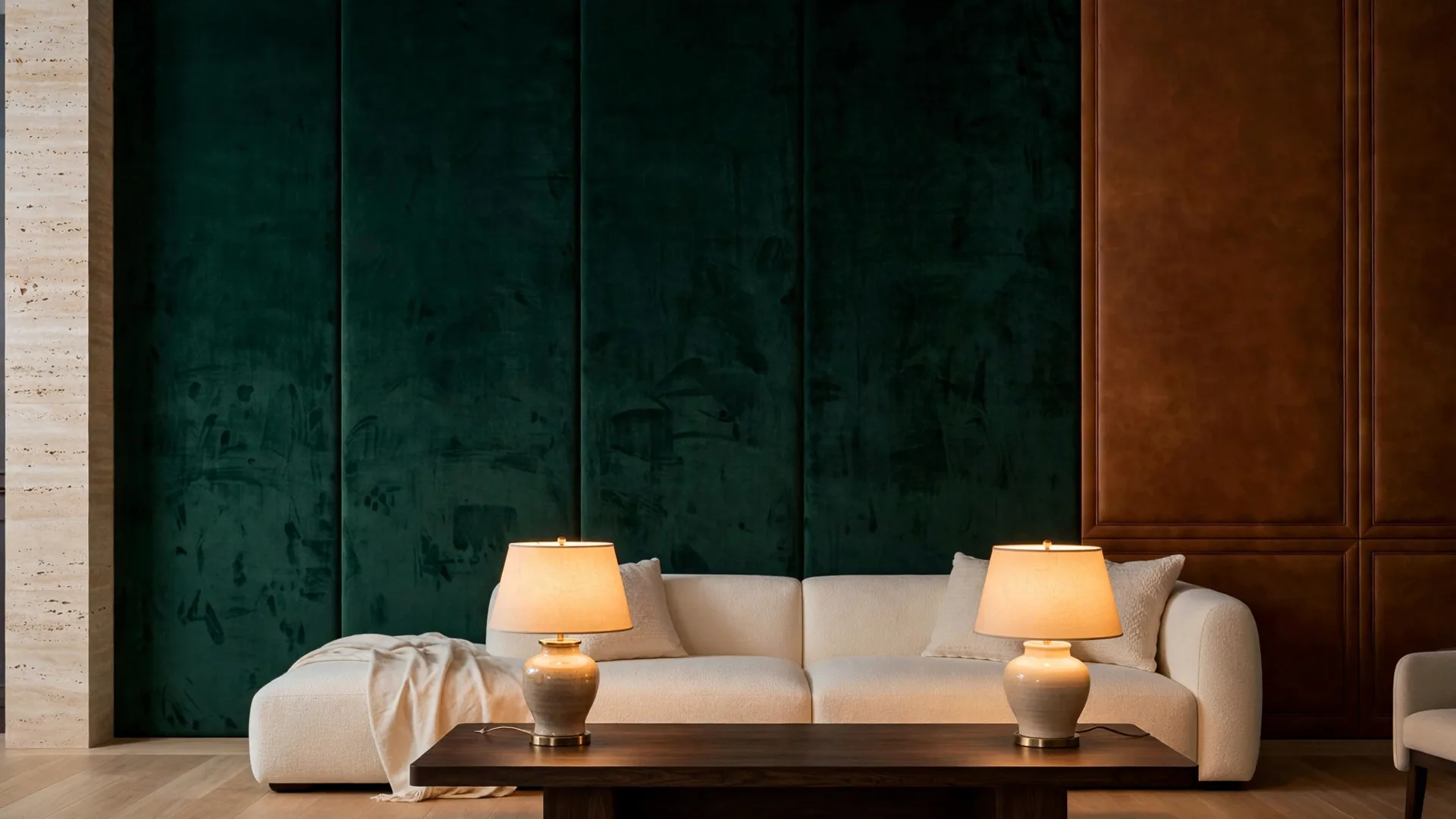
Every hard finish in this series gets the same first question about cost. The soft finishes get a different one. A client runs a hand across a leather panel, then across a velvet one, and asks me whether a wall you can sink your fingers into can survive a real house – kids, sun, a Florida summer. That is the right question, and it deserves a longer answer than a sample board can give. I install leather and velvet wall panels for WOW Walls Studio here in South Florida, and this guide gives that answer in full.
This is what the guide covers. What these panels actually are, in plain material terms. How to tell genuine leather from the bonded and faux products that borrow its name. Why velvet changes shade as you walk past it, and why that is physics rather than a defect. Where soft panels genuinely beat stone and wood, and where they honestly lose. How to pair a soft finish with a hard one without overloading the room. And what care looks like in a Florida home, week to week.
What leather and velvet panels actually are
TL;DR: A leather panel carries a thin hide or leather-look surface over the panel body, and architectural leathers for wall panels run about 0.9 to 1.0 mm thick (Spinneybeck). A velvet panel carries a woven fabric with a dense cut pile (the short upright fibers that give velvet its soft feel) over its body. Both are soft finishes on a structured panel, and the finish decides the care.
Start with what your hand already knows. Stone and veneer finishes feel hard and cool. Leather feels warm and slightly yielding, with a grain you can read with your fingertips. Velvet feels soft in one direction and rougher when stroked the other way, because the pile leans. On my jobs, both finishes sit on the same large-format panel system as the stone looks in my travertine accent wall panels guide: whole sheets, fitted and trimmed on site, so a soft wall keeps the clean geometry of a hard one – full height, few joints, no patchwork of small tiles.
The leather number is worth remembering early. Architectural leathers sold for wall panels and upholstery run about 0.9 to 1.0 mm thick, from hides of 50 to 55 sq ft (Spinneybeck product pages for its Alaska and Espana lines). That is a real hide surface, and a thin one, closer to the veneer face in my veneer wall panels guide than to a saddle or a belt. A wall is a kind duty for it: vertical, touched by hands, rarely scraped by anything heavy.
Velvet is a structure before it is a color. Velvet is a woven tufted fabric in which the cut threads are evenly distributed, giving it a dense pile with a distinctive soft feel (textile care sources). It was historically made from silk, and today it is also woven from cotton, polyester and nylon. The fiber choice changes durability and care more than the color does – a point the velvet section below takes apart. The panel body under the fabric gives the wall its flatness; the pile gives it the light behavior everyone notices first.
One clarification I make at every estimate: soft panels are a finish decision, not a construction shortcut. The wall behind them still has to be sound, dry and flat, and the layout gets drawn before anything is cut. What changes is the surface your room wears – and how you will look after it.
Leather: genuine, finished, aniline, bonded and faux
TL;DR: Genuine leather is crafted from whole sheets of animal hide, while bonded leather is made from shredded leather scraps and synthetic materials bonded with adhesive, and faux leather contains no leather at all – a plastic base coated to look like hide (Love Your Leather; Angi). The label decides durability, so read it before you fall for a color.
The word leather covers at least four different products, and the price gaps between quotes usually live in this section. Here is the honest sorting I do at the sample table.
| Type | What it is | How it ages on a wall |
|---|---|---|
| Genuine finished leather | Whole hide with a protective finish on the surface (Spinneybeck) | Most forgiving leather option; wipes clean, suits higher-traffic walls |
| Genuine aniline leather | Whole hide dyed through with little surface finish (Spinneybeck) | Shows grain and patina (the soft sheen and deepening color leather gains with age and touch) most richly; marks more easily, needs gentler handling |
| Bonded leather | Shredded leather scraps and synthetics bonded with adhesive (Love Your Leather) | Prone to cracking and peeling over time (Love Your Leather) |
| Faux leather | Plastic base coated with wax, dye or polyurethane, no actual leather (Angi) | Low maintenance and stain resistant (Angi); the surface stays as made and develops no patina |
Genuine leather is crafted from whole sheets of animal hide, fully natural, with the unique texture and variation of that hide (Love Your Leather). Within genuine leather, the finish is what matters. Finished leather carries a breathable protective finish and suits high-traffic areas (Spinneybeck). Aniline, or naked, leather has the least protective finish, patinas over time, and needs stains removed quickly to prevent discoloration (Spinneybeck). On a wall behind a dining table, I steer families to finished. On a quiet primary bedroom wall, aniline gives you the deepest grain in the range.
Bonded leather is where quotes get slippery. It is made from shredded leather scraps and synthetic materials, bonded with adhesive (Love Your Leather), and Angi puts its actual leather content at only about 20 percent, with a finish that can strip off with cleaners. It looks convincing on day one and is less durable than real leather, prone to cracking and peeling over time (Love Your Leather). Faux leather goes one step further: it does not contain any actual leather – it is a plastic base coated with wax, dye or polyurethane to create a leather finish (Angi). That can be a legitimate budget choice when it is named plainly. It becomes a problem only when a quote lets you believe you bought hide.
My working rule: ask which of the four you are being sold, in those words, before you discuss color. A supplier who answers clearly is selling you a material. A supplier who changes the subject is selling you a photograph of one.
Velvet: pile, fiber and why the color moves
TL;DR: Velvet gets its look from a short, dense pile: evenly cut fibers standing upright, which reflect light differently depending on the viewing angle (velvet care sources). Fiber decides behavior – polyester velvet resists stains and crushing better, cotton velvet watermarks more easily, and silk velvet has very low resistance to abrasion and sunlight (EngineerFix).
Walk past a velvet wall and it changes shade as you go. Clients point at this on sample boards and ask if the panels are mismatched. They are watching pile physics. Velvet has a short, dense pile, and the fibers are cut evenly to create a smooth nap, which reacts differently to light depending on the viewing angle (velvet care guide). Brush the pile one way and it catches light; brush it back and the same panel reads a shade deeper. A good installer uses this rather than fighting it: every panel in a field gets its pile running the same direction, so the wall shades evenly, the way a mown lawn shows stripes.
Fiber is the decision under the color. Polyester velvet offers superior stain resistance, and its fibers are less prone to marking or crushing than many natural counterparts (EngineerFix). Cotton velvet is breathable and matte, and more susceptible to watermarking (EngineerFix). Silk velvet delivers the richest sheen, with extremely low resistance to abrasion and sunlight, which makes it a poor candidate for a working family wall (EngineerFix). Mohair velvet sits at the durable end, resisting crushing and dirt, at the highest cost in the family (EngineerFix). For most South Florida homes I land on polyester or a polyester blend: the look clients want, with the most forgiving behavior behind it.
Pile direction also decides where velvet belongs in a layout. A headboard wall seen from the doorway shows one even shade. A long hallway wall viewed at a raking angle throws the shading at its strongest, which some clients love as depth and others take as unevenness. This is a taste call I settle with a full-size sample on the actual wall, in the room's own light, before the field is ordered – never from a swatch under showroom spots.
The bedroom is where velvet earns its keep most often, usually as the wall behind the bed; the field sizing in my bedroom wall panels guide applies to soft finishes with no changes.
Where soft panels win: sound, warmth and contrast
TL;DR: Soft panels win in three places: sound, because fabric and padding absorb reflections that hard walls bounce back; touch, because the room gains a warm surface in a field of hard ones; and contrast, because a soft field makes the stone and wood beside it read richer.
Sound first, with honest limits. Fabric-covered acoustic panels work because sound passes through the breathable fabric and is absorbed by a dense core, commonly mineral wool or high-performance foam, so echo drops and speech gets clearer (Northern Insight Magazine). Upholstered panels dampen sound and reduce echoes inside the room (Powell Renovations). Hold the boundary I draw in my acoustic panels guide: absorbing echo inside a room is a different job from blocking sound between rooms, and a soft feature wall does the first job. In a living room with tile floors, glass and a stone TV wall, one velvet field can take the ring out of conversation. In a home office it calms video calls, which is why soft finishes pair so well with the layouts in my home office wall panels guide.
Touch second. Every other finish in this series is hard. A room built entirely from hard surfaces reads cool and sounds bright, and Florida homes already lean that way – tile, glass, stone counters. A leather or velvet field is the one surface that gives warmth back. Clients notice it most in the evening, when lamplight rakes across pile or grain and the wall stops reflecting the room and starts absorbing it.
Contrast third. Soft finishes make hard finishes look better. A cognac leather field beside a travertine return gives you two kinds of luxury in one view: the stone reads crisper because the leather next to it is matte and warm, and the leather reads richer because the stone keeps the composition architectural. That pairing logic gets its own section next, because it is also where projects go wrong.
Pairing soft finishes with stone and wood
TL;DR: Pair one soft finish with one hard finish and let a thin metal or LED accent do the joining. Two soft finishes in one field fight each other, and a third main material on top of the pair overloads the wall.
My rule for combinations in this studio is a maximum of two to three main materials in one composition, with a thin brass or metal insert and LED light counting as accents rather than materials. Soft panels obey the same rule, with one stricter limit: only one of the main materials should be soft. Velvet next to leather gives you two matte, light-absorbing surfaces with no contrast in how they behave, and the wall reads heavy. Velvet against travertine, or leather against book-matched veneer, gives you the contrast that makes each material legible.
Three pairings I install repeatedly. Deep green or navy velvet as the main field, with a travertine-look return on the side wall – the stone keeps the room grounded while the velvet carries the color. Cognac or espresso leather as a headboard field, with pale oak-tone veneer on the returns – warm on warm, separated by texture rather than tone. And a leather TV surround with marble-look panels in the center field, following the style logic in my marble-look wall panels guide – the leather frames, the stone performs.
What I avoid: soft panels wrapping a corner. Pile and hide both dislike a folded edge – the pile crushes at the fold line and the leather creases – so soft fields stop at a clean inside edge or a metal trim, and the return wall takes a hard finish. It reads as intentional, because it is drawn that way from the start.
Honest limits: sun, water, crushing and stains
TL;DR: All leather fades in UV light, and high temperature and humidity can grow mold in its fibers (Leather UK). Velvet pile crushes under sustained pressure and watermarks when soaked (EngineerFix; velvet care sources). Standing water is an enemy for both finishes, and a shower wall belongs to other materials.
This is the section that decides whether soft panels are right for your house, so I will be plain about each way they can fail.
Sun. All leather fades in UV light to a greater or lesser extent, and Leather UK advises keeping leather out of direct sunlight where possible. Velvet dyes fade under the same exposure, and silk velvet has very low resistance to sunlight (EngineerFix). A soft field on a wall that takes three hours of direct afternoon sun will age unevenly, panel by panel, depending on where the mullions throw shade. Sheers, a UV film or choosing the calmer wall solves it at the drawing stage. After installation, none of that helps.
Water. Leather fibers can grow mold when heat and humidity stay high (Leather UK), and velvet pile mats when it is saturated – care guidance for velvet panels says to blot with diluted soap and avoid saturation (InterioMasters). Neither finish belongs inside a shower zone, behind a soaking tub or on a wall with a known leak history. A dry living room, bedroom or office wall is home ground. A steam bathroom is not, and I will say so on the estimate visit.
Crushing and pressure. Velvet pile is sensitive to pressure, and crushed pile does not realign uniformly (velvet care guide). On a wall this failure is narrower than on a sofa – nobody sits on a wall – and it shows up where furniture presses: a headboard edge, a bench back, a coat rack mounted through the panel. The layout fix is simple and belongs on the drawing: keep contact furniture off the soft field, or accept a wear line where it touches.
Stains and marks. Aniline leather, with the least protective finish, discolors if soiling sits on it (Spinneybeck). Bonded leather can peel where its surface finish fails (Love Your Leather). Cotton velvet watermarks (EngineerFix). None of these are surprises if you heard them before you bought. All of them feel like defects if you hear them after.
Care in a Florida home
TL;DR: Leather gets a wipe with a cool, damp cloth and pH-balanced soap for tougher soiling, and never saddle soap or harsh household cleaners (Spinneybeck). Velvet gets a weekly vacuum with an upholstery brush and blotting rather than rubbing (InterioMasters). Both live best at indoor humidity below 60 percent, ideally 30 to 50 percent (EPA).
The weekly routine is short for both finishes. Dust leather with a soft cloth, and wipe it with a cool, damp cloth; for tougher soiling, use a pH-balanced soap and rinse (Spinneybeck). Vacuum velvet weekly with an upholstery brush to lift dust and prevent matting, and lift pet hair with a soft lint roller (InterioMasters). That is the standing routine. Everything else is occasional.
Leather has two rules that guard against the expensive mistakes. First, cleaner choice: Spinneybeck directs users never to use saddle soap or household cleaners that may contain harsh chemicals, alcohol or ink removers, and recommends occasional water-based leather cleaner, conditioner and protector. Second, technique on aniline: wipe the entire surface with a soft cloth and cool water to even out marks – do not spot rub, because spot rubbing darkens only that area (Spinneybeck). In humid climates, conditioning every few months also helps leather keep its flexibility (Fibrenew).
Velvet has its own two rules. Blot stains with diluted mild soap on a microfiber cloth and avoid saturating the pile (InterioMasters). And keep steam and abrasives away from it – direct steam and abrasive cleaning damage the pile (InterioMasters). Rubbing is the instinct to unlearn: it crushes wet pile into a shiny patch that outlives the stain.
Florida adds the climate layer both finishes share. The EPA guidance used across this series says to keep indoor humidity below 60 percent, ideally between 30 and 50 percent. Leather care in tropical climates points the same way: a climate-controlled room, with air conditioning and dehumidifiers holding humidity down, and breathable rather than plastic protection, because plastic traps moisture and promotes mold (Fibrenew). My full climate case sits in my Florida humidity guide. For a soft wall, add one habit: a small hygrometer (a gauge that reads indoor humidity) in the room, checked when the house has been closed up after a trip. Soft finishes forgive a humid week. They keep score over a whole season.
What drives the price of a soft panel wall
TL;DR: Four drivers: which leather or velvet fiber you are actually buying, the size of the field, how much of the wall the soft finish covers versus a hard pairing, and the number of cuts and interruptions in the field. A genuine aniline field and a faux field can share a photograph and share nothing else.
Material identity first, and this section is why the leather table earlier matters commercially. Genuine finished leather, genuine aniline, bonded and faux sit in different cost bands because they are different goods (Love Your Leather; Angi). Velvet splits the same way by fiber: mohair at the durable top, polyester as the practical middle, silk as the delicate outlier (EngineerFix). A quote that only says leather-look or velvet-style has skipped the line item that decides the price – and the lifespan.
Coverage second. Soft finishes often work hardest as a partial field: a headboard width, a TV surround, one bay of a long wall, with a hard finish carrying the rest. The drawing sets the split, and the split sets the sheet count of each material. A full-height, full-width soft field is a legitimate choice – it is simply the largest version of the project, and it should be priced openly as one.
Interruptions third. Every outlet, switch, sconce (a wall-mounted light) and niche is a cut in a surface that shows its layers – hide grain on one side, pile on the other. Soft finishes forgive less at a cut edge than a stone look does, so each interruption takes longer to fit, and the estimate should show that rather than hide it.
That is why I quote a soft panel wall from a drawing and a named material, never from a photo and a color name. Send the photo, name the finish honestly – genuine, bonded, velvet fiber – and the layout comes first. The number follows from it.
Questions I get about leather and velvet panels
TL;DR: The short answers: genuine leather is whole hide, bonded is about 20 percent leather (Angi), and faux is none; velvet shading is pile physics; soft panels absorb echo inside the room rather than blocking sound between rooms; and Florida care means shade, dry air and gentle cleaning.
Are leather wall panels real leather?
Some are. Genuine leather is crafted from whole sheets of animal hide (Love Your Leather). Bonded leather is shredded scraps and synthetics bonded with adhesive, at only about 20 percent actual leather (Love Your Leather; Angi), and faux leather contains no leather at all (Angi). Ask which type a quote uses, in those words.
What is the difference between bonded and genuine leather?
Genuine leather is one whole hide with its natural grain and variation. Bonded leather is ground leather scraps mixed with synthetic materials and adhesive, pressed into a new surface (Love Your Leather). Genuine ages into a patina; bonded is prone to cracking and peeling over time (Love Your Leather).
Why does velvet change color across the wall?
Pile direction. Velvet fibers are cut evenly into a dense, upright pile, and the nap reflects light differently depending on the viewing angle (velvet care guide). Panels installed with the pile running one way shade evenly; the shift you see as you walk past is the material working as woven.
Do soft wall panels reduce noise?
They reduce echo inside the room. Sound passes through breathable fabric and is absorbed by a dense core, so reflections drop and speech clears (Northern Insight Magazine). They do not soundproof a room against noise from the next room – absorption and blocking are different jobs, covered in my acoustic panels guide.
How do you clean velvet wall panels?
Vacuum weekly with an upholstery brush, and blot stains with diluted mild soap on a microfiber cloth without saturating the pile (InterioMasters). Avoid direct steam and abrasive cleaners, and groom the pile back into line while it dries.
Can leather panels handle Florida humidity?
Yes, on a dry indoor wall with the climate controlled. Keep indoor humidity below 60 percent, ideally 30 to 50 percent (EPA), keep the wall out of direct sunlight because all leather fades in UV (Leather UK), and condition genuine leather every few months in a humid climate (Fibrenew). A shower or steam room wall is a different job and belongs to hard finishes.
How do you clean leather wall panels?
Wipe with a cool, damp cloth, and use a pH-balanced soap for tougher soiling (Spinneybeck). Never use saddle soap or household cleaners with harsh chemicals or alcohol (Spinneybeck). On aniline leather, wipe the whole surface rather than spot rubbing, which darkens only the rubbed area (Spinneybeck).
My verdict on soft panels for South Florida walls
TL;DR: Choose leather or velvet when the room needs warmth and quiet as much as it needs a finish, when the wall lives a dry indoor life away from hard direct sun, and when you buy the material by its real name – genuine, bonded, faux, polyester, mohair. Respect sun and water, and a soft wall gives you the calmest room in the house.
Here is how I see it on real jobs across Palm Beach, Broward, and Miami-Dade. Hard finishes built this series – travertine, marble looks, veneer – because they carry a room visually and forgive a busy life. Soft finishes earn their place for the opposite reason: they quiet a room down. The living rooms where I have specified velvet shared a pattern – tile floors, tall glass, voices bouncing – and the panel field fixed both the sound and the look. The leather walls came from a different pattern: owners who wanted one warm, tactile surface in a house of cool ones, and who understood hide the way veneer owners understand wood.
What I will never tell you: that bonded leather is genuine leather at a friendlier price; that a velvet field can be soaked and scrubbed like tile; that direct sun on a south wall is a detail for later; or that a price exists before the material has been named honestly. Send the photo, tell me the mood you want the room to land in, and the drawing comes first – the material, the pairing and the number all follow from it.
Sources
- Spinneybeck product pages and maintenance guidance (architectural leathers for wall panels at 0.9-1.0 mm from 50-55 sq ft hides; finished leather suits high traffic; aniline has the least finish and patinas; wipe with a cool, damp cloth, pH-balanced soap for tougher soiling; never saddle soap or harsh household cleaners; do not spot rub aniline).
- Love Your Leather, bonded leather guide (genuine leather is crafted from whole sheets of animal hide; bonded leather is shredded leather scraps and synthetic materials bonded with adhesive; bonded is less durable and prone to cracking and peeling).
- Angi, best leather for furniture (bonded leather is only about 20 percent actual leather and its finish can strip with cleaners; faux leather contains no actual leather – a plastic base coated with wax, dye or polyurethane).
- Leather UK care guidance (all leather fades in UV light; keep leather out of direct sunlight where possible; high temperatures and humidity can cause mold growth in the fibers).
- Fibrenew, leather care in tropical climates (climate-controlled environment, air conditioning and dehumidifiers; breathable protection, avoid plastic; condition every few months).
- Velvet textile care sources (velvet is a woven tufted fabric in which the cut threads are evenly distributed, giving a dense pile; fibers include silk, cotton, polyester and nylon).
- Velvet care guide (velvet has a short, dense pile of evenly cut fibers; the nap reacts differently to light depending on viewing angle; pile is sensitive to pressure, moisture and friction, and crushed pile does not realign uniformly).
- EngineerFix, best velvet fabric for upholstery (polyester velvet resists stains and crushing better; cotton velvet is susceptible to watermarking; silk velvet has very low resistance to abrasion and sunlight; mohair velvet resists crushing and dirt).
- InterioMasters, velvet wall panels care (vacuum weekly with an upholstery brush; spot-clean by blotting diluted mild soap, avoiding saturation; avoid direct steam or abrasives; dehumidifiers in humid areas; soft lint roller for pet hair).
- Neufutur, velvet care guide (groom the pile after wet work to reset its direction while it dries; vacuum with a soft brush in the direction of the pile; velvet fading follows dye breakdown under UV exposure).
- Northern Insight Magazine, acoustic fabric wall panels (sound passes through breathable fabric and is absorbed by a dense core such as mineral wool or high-performance foam, reducing echo and improving clarity).
- Powell Renovations, upholstered wall panels (soft absorbent material dampens sound and reduces echoes inside the room).
- EPA indoor humidity guidance (keep indoor humidity below 60 percent, ideally between 30 and 50 percent).
- WOW Walls Studio, Veneer Wall Panels: Real Wood, Honest Limits (2026).
- WOW Walls Studio, Travertine Accent Wall Panels: Real Stone vs Composite (2026).
- WOW Walls Studio, Marble-Look Wall Panels: Calacatta Styles, Honest 2026 Guide.
- WOW Walls Studio, Bedroom Wall Panels Behind the Bed (2026).
- WOW Walls Studio, Home Office Wall Panels: Background, Sound and Light (2026).
- WOW Walls Studio, Acoustic Slat Wall Panels: NRC, Echo and Honest Truth (2026).
- WOW Walls Studio, Wall Panels in Florida Humidity: MDF vs PVC (2026).