
How Long Do Slat Wall Panels Last? Lifespan (2026)
How long do slat wall panels last in 2026? Lifespan by material: veneer on medium-density fiberboard (MDF), solid wood, WPC, bamboo-charcoal, Florida care.
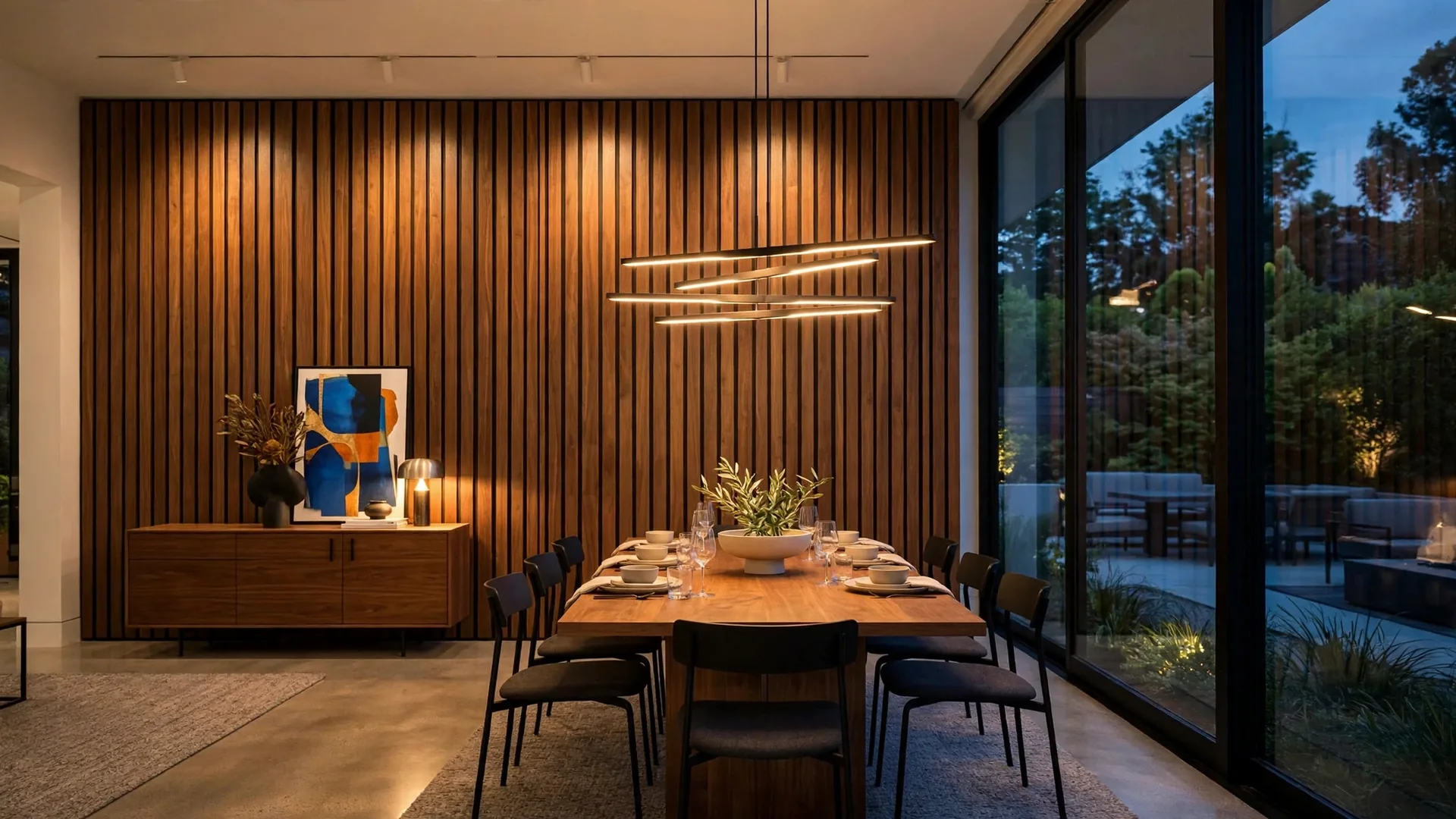
A slat wall looks simple from the sofa. Thin wood strips, dark gaps, a calm rhythm across the wall. The question of how long do slat wall panels last is less simple. The strips are wood, the core is fiberboard, the backing is felt, and the glue holds all three together. Each layer has its own clock, and the wall lasts as long as its weakest layer.
Slat panels have been a mass-market product for about five to seven years. No panel sold today has been watched in a home for 25 or 50 years. Every long figure in this guide is a planning range from a maker or a retailer guide, an extrapolation from material properties, or a warranty term. None of them is a field observation, and this guide says which number comes from whom, and what scope it carries.
TL;DR: Slat wall panels last 15 to 25 years in the most-cited retail guide for the veneer on medium-density fiberboard (MDF) build on felt. Solid wood reaches 30 to 50 years. Plastic slat-look lines split between 10 to 20 years and a retailer claim of up to 50 years. Every figure is a planning range, not a field test. The Panel Hub prices the acoustic slat at $14 to $22 per square foot in April 2026. In Florida, humidity decides whether a panel reaches the top or the bottom.
We run a South Florida studio that designs and installs large-format panel walls. We do not sell or install slat panels, and this guide does not pretend otherwise. Our main slat guide owns the general verdict on slat types, costs and rooms. Our lifespan guide for smooth panels owns the same framework for a different product. This article stays inside one question: how long a slat wall lasts, by material, and what moves the number.
The short answer: lifespan by material
TL;DR: The common veneer-on-MDF acoustic slat runs 15 to 25 years in The Panel Hub guide from April 2026. Solid wood slats run 30 to 50 years and beyond in the same guide and in BuildMat Insight. Plain MDF slats run about 10 years. WPC and PVC slats run 10 to 20 years indoors, against a retailer claim of up to 50 years. Bamboo-charcoal panels run 10 to 15 years.
| Build | Planning range | Source |
|---|---|---|
| Veneer on MDF, on felt, acoustic | 15 to 25 years | The Panel Hub, April 2026 |
| Veneer on MDF, decorative, no felt claim | 15 to 25 years | The Panel Hub, April 2026 |
| Solid wood slats | 30 to 50 years and beyond | The Panel Hub; BuildMat Insight, August 2026 |
| MDF slats, foil-wrapped or paintable | About 10 years | Tile Merchant; The Panel Hub, 10 to 15 years |
| WPC or PVC slats, indoor | 10 to 20 years; retailer claim up to 50 years | The Panel Hub; Tile Merchant |
| Bamboo-charcoal panels | 10 to 15 years | Kosmos; Dreamhouse |
The table above is the whole answer in one place. The rest of this guide explains why the ranges are wide, which layer fails first, and what a Florida room does to each number. Read the source column first and the years second, because a figure without its source is a rumor with a number attached. Our hub guide to slat wall panels covers types, costs, and rooms in full, for readers choosing a build before they weigh its lifespan.
Three facts shape every row. First, the product is young. The product reached the mass market about five to seven years ago. Second, the figures come from guides that sell the product or from makers that warrant it. Third, a slat panel is a system of layers. Wood, fiberboard, felt and glue age at different speeds, and the system clock stops at the first failure among them.
Two clocks: structural life and appearance life
TL;DR: A slat wall runs on two clocks. Structural life is how long the panel stays attached and sound. Appearance life is how long the finish still looks like the finish chosen. A panel can stay attached at year 18 and still be replaced because the veneer faded. The Panel Hub guide and the maker guides use appearance as the usual end point.
Our lifespan guide for smooth panels uses two clocks, and this guide keeps them. Structural life means the panel stays on the wall, flat, attached, and sound. Appearance life means the finish still looks like the finish you chose, and the two clocks rarely stop together.
A veneer panel can be structurally sound at year 18 and look faded enough to replace. The wood is fine and the glue holds, while the face has lost its color unevenly across the slats. Most published lifespan figures use appearance as the end point: they mean the wall still looks acceptable and stays attached. This guide follows that meaning and says so where it matters.
Scope decides the number as much as material does. A dry living room, a steamy bathroom-adjacent wall, a south-facing wall in full sun, and a seasonal home closed for the summer are four different scopes. A guide that gives one number for all four is giving a number for none of them. Every figure in this guide carries its scope in the same sentence or in the table beside it.
Veneer on MDF, on felt: the mainstream build
TL;DR: The mainstream slat panel is a thin wood veneer, 0.5 to 1 mm, on a fiberboard core, glued to recycled felt about 9 mm deep. The Panel Hub guide gives it 15 to 25 years. Three clocks run inside it: the fiberboard swells and never fully shrinks back, the veneer lifts when the core swells under it, and the felt loads with dust. Coowin gives wood-slat acoustic panels 10 to 20 years and more.
The panel most people buy is a sandwich. Narrow fiberboard strips, faced with real wood veneer, mounted on a backing of recycled PET felt. PET felt is a polyester felt, and it shows as the dark surface in the gaps. The standard panel from Naturewall measures 27 mm wide slats by 12 mm deep, with a 13 mm gap between slats and felt 9 mm deep. Acupanel gives the same build in inches: felt 0.35 inches deep, slats 1.06 inches wide by 0.43 inches deep. Its gaps sit 0.52 inches apart, and one panel usually covers about 15.5 square feet.
The veneer is a thin slice of actual timber, 0.5 to 1 mm thick, bonded to the core. Premium panels wrap veneer around three sides of each slat. Many budget panels veneer only the front face and leave raw dark fiberboard core visible at the gap edges from any angle other than dead-on. The felt does two jobs. It gives the gaps their dark finished look, and it absorbs sound. The wood face itself absorbs almost nothing, because wood is reflective, and the felt does the absorbing work in the gaps.
Three clocks run inside this one panel. The fiberboard clock is moisture. Standard fiberboard absorbs water through cut ends, gap edges, and any unsealed face. It swells, and it keeps part of the swelling after the room dries. A peer-reviewed study in MDPI Polymers from 2021 found that water-induced swelling is largely reversible for solid wood, while fiberboards keep part of the swelling after drying. The Panel Hub guide says this about standard fiberboard in humid settings: it absorbs moisture over time, swells, and causes the veneer to lift or peel.
The veneer clock is thinness. At 0.5 to 1 mm, the face has almost no sanding tolerance. A deep scratch or chip reaches the fiberboard core through the veneer. It cannot be sanded back the way solid wood can. Once the veneer is cut through, replacement of that slat or panel section is the practical repair. The veneer also moves a little with the core and can lift or peel when the core swells under it. The failure forms are a lifted edge, a widened shadow line, and peeling across the face of the slat.
The felt clock is dust and glue. Felt breathes freely and holds dust and damp air against the wall. It cannot be wet-washed. Dust packed into felt degrades the absorber's job, and a maker link in our cleaning guide ties a clean wall to maintained acoustic performance.
The glue line is the third risk. A wood-slat acoustic panel is a set of straight veneered slats bonded to a continuous felt sheet, and that single glue line carries everything. The panel has no perimeter frame, so no rail holds the ends of the slats. The felt is the only continuous element that ties the slats into a single sheet. A slat that loses adhesion over part of its length has nothing else restraining it. The released end can rotate slightly away from the felt, open a hairline shadow at the slat edge, and progress along the slat as the felt peels. NFDecor's delamination repair guide describes the same progression from the released end of a slat.
Coowin, a maker guide updated in November 2026, gives wood-slat acoustic panels 10 to 20 years and more in a dry, stable indoor space. Aesthedge gives the same build 15 to 25 years. The Panel Hub guide gives 15 to 25 years for both decorative veneer slats and acoustic slats. The three guides agree on the band, with only the edges differing between Coowin, Aesthedge, and The Panel Hub. That agreement is the reason this guide uses 15 to 25 years as the headline range for the mainstream build.
Solid wood slats: the longest clock, and the finish cycles
TL;DR: Solid wood slats run 30 to 50 years and beyond in The Panel Hub guide and in BuildMat Insight from August 2026. The face can be sanded and refinished repeatedly, which is why the range is wide. The finish itself runs on a shorter cycle. Hardwax oil lasts 5 to 8 years on vertical surfaces before a maintenance coat. Factory UV-cured polyurethane lasts 15 to 25 years.
Solid wood slats are ash, oak or walnut all the way through. They are the only slat face that can be sanded and refinished repeatedly. That renewability is the reason the lifespan range is so wide. A wood wall can be renewed in place with a fresh coat of oil or finish. The material clock runs long, the finish clock runs short, and the owner resets the finish clock with each new coat.
BuildMat Insight, published August 31, 2026, gives solid hardwood at 40 to 50 years and beyond. Its figure covers 3/4-inch tongue and groove, a joint where a ridge on one board fits a slot on the next. The Panel Hub guide gives solid wood planks and cladding 30 years and beyond. Wood Panel Wall, a trade guide from 2024, gives solid wood 20 to 50 years, often exceeding 50 years with proper care. The three sources converge on the same band. This guide uses 30 to 50 years and beyond as the headline range for solid wood slats in a dry indoor room.
The finish cycles sit inside that life. BuildMat Insight gives hardwax oils 5 to 8 years on vertical surfaces before a maintenance coat. Factory UV-cured polyurethane with aluminum oxide lasts 15 to 25 years on vertical applications. These are finish lifespans, separate from the panel lifespans in the ranges above. A solid wood slat that needs a fresh oil coat at year 7 has reached a maintenance point in its finish cycle.
Solid wood moves with the seasons. It needs acclimation and expansion gaps, and it is sold at a clear premium over veneer lines. The premium buys two things: a face that can be renewed, and a material that does not depend on a fiberboard core. The felt and glue question stays open even for solid wood. A solid-wood slat on felt backing can still fail at the felt or glue line before the wood itself ages out. The system is only as durable as its weakest layer. A solid wood face on a felt back is a long material clock inside a shorter system clock.
WPC and PVC slat-look: waterproof face, printed grain, the 50-year conflict
TL;DR: WPC and PVC slat-look panels run 10 to 20 years indoors in The Panel Hub guide from April 2026. Tile Merchant claims WPC can last up to 50 years. WPC sellers claim 25 to 30 years. No independent test settles the conflict. The plastic core will not swell like fiberboard. The printed wood grain ages, fades, and cannot be refinished.
WPC is wood-plastic composite. PVC is polyvinyl chloride, a plastic board. Both appear as slat-look panels with a printed wood grain, no felt, and no wood face. They are the one slat family that can be wiped down with water. The plastic core will not warp or swell the way a fiberboard core does, and that water resistance is the family's main advantage.
The lifespan figures disagree more here than anywhere else in this guide. The Panel Hub guide gives PVC and WPC panels 10 to 20 years indoors. Tile Merchant claims WPC can last up to 50 years. Yuheng, a WPC seller, gives an interior system 25 to 30 years with proper maintenance. Pansen, a seller blog, gives high-quality WPC 25 to 30 years outdoors. Zhongxiu gives an outdoor service life of 18 to 25 years, citing xenon-arc aging tests (laboratory tests using xenon light to simulate years of sun). The Panel Hub guide gives WPC outdoor cladding 20 to 25 years, a separate outdoor scope from the indoor band above.
No independent test adjudicates this conflict. This guide uses The Panel Hub figure of 10 to 20 years as the conservative indoor anchor. It cites Tile Merchant only as a retailer claim of up to 50 years. The 50-year figure is a retailer claim with no test cited behind it. A reader who sees 50 years in a listing should ask what test produced it, and the listing itself gives no answer.
The failure mode is different from wood. The printed grain is the weak layer. Sunlight fades printed grain. A hard point impact marks hollow PVC more easily than a solid face. The face cannot be sanded or refinished. Severe damage means replacing that panel. The plastic core outlives the printed face in most rooms, so the panel is replaced for its faded look while the core is still sound.
Outdoor WPC is a separate scope. The outdoor band of 18 to 30 years comes from seller sources, and it converges across them. Each band stays inside its own scope, with different exposures, different UV loads, and different water loads, so this guide keeps the indoor and outdoor bands apart.
Bamboo-charcoal panels: 10 to 15 years, and the outlier
TL;DR: Bamboo-charcoal panels run 10 to 15 years in the two most specific distributor sources, Kosmos and Dreamhouse, and in the Dai Viet Plastic product spec. One source claims 25 to 40 years with no test cited. This guide uses 10 to 15 years as the anchor and treats the higher figure as a conflicting claim.
Bamboo-charcoal panels are a newer board in the slat family. The most specific sources agree on a short life. Kosmos, a distributor, gives a lifespan of 10 to 15 years, and adds maintenance every 3 to 6 months to prolong it. Dreamhouse gives a functional lifespan of 10 to 15 years under normal indoor conditions. Dai Viet Plastic gives durability of 10 to 15 years for its 8 mm panel, with gloss and color stability up to 15 years.
One source disagrees. WPCSPC claims 25 to 40 years for bamboo-charcoal veneer, with over 95 percent of original quality after 30 years in luxury residential settings. WPCSPC cites no test and gives no methodology, so this guide mentions its figure only as a conflicting claim. The anchor stays at 10 to 15 years, where three specific sources agree with each other.
The board is a composite face on a core, and the face ages before the core does, in the same pattern as the veneer build above. Kosmos notes thickness expansion of 0.4 percent after a 24-hour soak, measured under the Vietnamese standard TCVN 12445:2018. The same distributor states the product carries no warranty. Maintenance every 3 to 6 months is the distributor's own condition for reaching the top of its range.
What shortens life in Florida: humidity, sun, and the glue line
TL;DR: Florida shortens slat life through humidity, with heat on the glue line second. The EPA puts indoor humidity below 60 percent, ideally 30 to 50 percent. Acupanel requires 30 to 55 percent humidity and 60 to 75 degrees Fahrenheit for 7 days around install. WoodyWalls gives real wood 48 to 72 hours of acclimation. Glue can fail above 140 degrees Fahrenheit, per BuildMat Insight. No source quantifies a Florida discount in years.
Florida is the hardest test a slat wall faces in a home. The attack comes through humidity, sun, and the glue line, in that order. No source found quantifies a Florida discount in years. The Florida section of this guide adjusts maintenance intervals and material choices, and it leaves the published year figures unchanged.
Humidity is the first attack. The EPA guide on mold and moisture states the rule:
"Keep indoor humidity low. If possible, keep indoor humidity below 60 percent (ideally between 30 and 50 percent) relative humidity."
The same guide adds the second rule: "The key to mold control is moisture control." Dry water-damaged areas within 24 to 48 hours to prevent mold growth. Mold can hide behind paneling. The EPA lists the back side of paneling among hidden mold sites, and a panel wall is cladding with no waterproofing function of its own.
Acupanel, the maker of the most-installed acoustic slat, sets a tighter envelope in its user manual:
"HVAC must be on with the temperature maintained between 60°-75°F with a relative humidity of 30-55% for at least 7 days prior to installation, as well as during and after installation. We do not recommend installing in bathrooms or any area with excessive moisture or cold temperatures (less than 60 degrees Fahrenheit)."
Acupanel asks for 24 to 48 hours of acclimation before install in high-humidity environments. WoodyWalls asks for 48 to 72 hours for real wood. The two windows differ because the makers differ, so this guide cites one source per claim and keeps the two windows separate.
Miami outdoor air averages 82 percent humidity in the morning and 61 percent in the afternoon across the year, per Florida Climate Center figures. September mornings average 86 percent. A slat wall lives in the gap between outdoor air and the EPA indoor band. The cooling system holds the gap open. A room that lives above the line for weeks is outside the product's stated conditions. Seasonal homes are the first trap. A home closed for summer weeks at a high setback lets humidity climb toward outdoor levels and stay there week after week. Hold the empty home below 60 percent humidity while away, and keep the cooling running on its normal cycle through the closed weeks.
The mechanism inside the wall is layer by layer. Fiberboard takes up moisture slowly through cut ends, gap edges, and any unsealed face. It swells, and it keeps part of the swelling after drying. The veneer lifts when the core swells under it. The felt breathes freely and holds dust and damp air against the wall. Polyester fiber itself resists rot and keeps its shape in humid air. The risk is the partnership: dust loads the felt with organic material, humid air supplies moisture, and a cool wall behind slows drying. A cooled exterior wall can collect condensation on its inner face, and the panel run hides that condensation from view.
Sun is the second attack. The Panel Hub maintenance guide, updated August 29, 2026, states:
"Prolonged direct sun causes wood finishes to fade. UV-filtering window film or window treatments help protect panels in south-facing rooms."
WoodenWallDesign, updated October 31, 2026, gives a time scale: wood in strong direct sunlight for long periods can gradually lighten over 1 to 3 years. HouseDigest, from July 2025, explains the mechanism: UV rays break down lignin, the polymer holding wood fibers together. The effect is significant on any natural wood, and harder on veneer, which is typically only a thin layer. Maple and oak may lighten. Cherry often grows darker. Sources publish the mechanism and the lightening window, and they stop short of a years-lost figure for sun fading. This guide records the mechanism and the 1 to 3 year lightening window, and it leaves the discount unquantified.
Heat attacks the glue line. BuildMat Insight notes that the hot-melt adhesives binding veneer to felt can crystallize and fail under direct, sustained solar heat, with surface temperatures above 140 degrees Fahrenheit. Colorbo notes that traditional binders degrade under UV light or temperature shifts, and that changes in humidity weaken the adhesive bond quickly. The panels slowly peel away from the drywall. No source gives adhesive life in years. The failure is described qualitatively only, and this guide leaves it that way.
Room by room, the verdicts from our humidity guide still hold. A living room interior wall is the strongest fit. A bedroom interior wall is a strong fit. A wall shared with a shower is a weak fit. Inside a bathroom or shower, the maker manual rules slats out. An entry wall deserves caution, because door-opening humidity blasts and splash water age bottom edges first. A seasonal home closed for summer weeks is a weak fit. Every strong fit shares three traits, starting with an interior wall or a verified dry exterior wall. Cooling runs long enough to dry the air, and owners keep a light cleaning routine through the year.
Care that adds years: the monthly baseline
TL;DR: Care adds years to a slat wall, and neglect takes them away. WoodyWalls prescribes a monthly pass to keep its panels clean. The Panel Hub guide prescribes monthly dusting, a quarterly damp wipe, and an annual oil or wax coat if the finish requires it. Felt gets vacuum only, with wet wipes kept off the felt surface. Cleaning removes surface dirt, while swelling, felt stains, and a cut veneer face stay beyond its reach.
The care routine is the cheapest lifespan lever in this guide. Our wall panel care guide sets out the same monthly cycle for smooth panels, and the rhythm transfers to slats. It costs nothing but time, and it decides whether the panel reaches the top or the bottom of its range.
The makers agree on the rhythm. WoodyWalls prescribes a monthly pass to keep its panels clean and maintain acoustic performance. The Panel Hub maintenance guide, updated August 29, 2026, prescribes monthly dusting in bedrooms and living rooms. It adds a quarterly damp wipe with a check for loose slats. It adds an annual oil or wax coat if the surface finish requires it. Gessolane gives dusting every 2 to 4 weeks, and Acupanel asks for dusting or vacuuming regularly to prevent dust buildup.
The order matters. Dust faces dry first, following the grain. Vacuum every groove top to bottom, groove by groove, with a soft brush attachment on low suction. Vacuum ledges and the floor line. Spot-wipe faces only where marks remain, with a barely damp cloth, dry at once, and keep water off the felt entirely.
Felt gets vacuum only, on low suction with a long soft brush, and lint and pet hair roll off with a lint roller. Blot a splash dry at once, and keep scrubbing, soaking, steam, and rubbed-in cleaner away from the felt. WoodyWalls states it directly in its installation guide: avoid using wet cloths on the felt backing. The Nankarrow care sheet allows a single careful blot with mild detergent and warm water for PET felt. Press it in and blot it out with a dry clean cloth, once, without scrubbing. If color remains after that single attempt, it is likely permanent, because felt holds pigment in its fibers and cannot be rinsed.
The banned list is short and absolute. Bleach, ammonia, and solvent cleaners strip the surface finish and cause permanent discoloration. Abrasive pads, powders, and steel wool scratch and dull a veneer under 1 mm thick, with no depth to polish back. Steam cleaners drive heat and moisture into felt, fiberboard edges, and the veneer bond in one pass. Wax and oil-heavy furniture polish leave a dust-trapping film in groove corners, and oils darken felt permanently. Vinegar is an acid cleaner, and all-purpose sprays commonly carry solvents or ammonia, so keep both away from the wall surface.
Cleaning has a hard boundary, and the boundary is the lifespan boundary. Cleaning removes what sits on a surface. Color soaked into felt fibers stays put, a veneer face cut through by a scuff stays cut, and a swollen fiberboard core stays swollen. The remaining options are to live with the mark, replace the damaged slat or panel section, or replace the wall.
Our Florida cleaning notes add two rules. Sand grit rides in through sliders and on shoes, and a damp cloth turns that grit into sandpaper against the veneer face. The routine starts dry every time, and pollen in season vacuums out cleanly while it is dry. Wiping damp first turns pollen into paste in the groove corners, so humidity governs every damp decision on a Florida wall. In a humid week or an unconditioned room, skip the damp spot-wipe and clean dry.
Warranty years and lifespan years: read the table
TL;DR: A warranty states how long the maker's promise runs. It states the conditions, the exclusions, and the remedy. WoodyWalls publishes a 10-year durability warranty on its veneer and solid wood slats. Woodspace gives 5 years plus 10 years for major faults. EnviroBuild gives 25 years residential and 15 years commercial on outdoor composite cladding. Floor and Decor gives 1 year. Naturepanel gives 30 years on waterproof panels that are not slats.
Warranty years and lifespan years sit in different columns. A warranty defines the obligations of the manufacturer under specific conditions. A longer warranty gives a longer promise window on its own, while durability still follows the material and the conditions. That framing comes from Protex Flooring, quoted in our lifespan guide for smooth panels, and it holds for slats too.
| Brand and product | Warranty published | What it covers |
|---|---|---|
| WoodyWalls, veneer slat panels | 10-year durability warranty | Durability, per product page and FAQ |
| WoodyWalls, solid wood slat panels | 10-year durability warranty | Durability, per FAQ |
| WoodyWalls, WPC exterior slat panels | 10-year warranty | Waterproof, UV-resistant, per seller |
| Woodspace Acouwood, Australia | 5-year warranty, plus 10-year cover for major faults | Will not warp, separate or delaminate; excludes fading and natural timber change |
| EnviroBuild Hyperion Slatted, outdoor cladding | 25 years residential, 15 years commercial | No split, splinter or rot; fade no more than 5 Delta E (Delta E is a measured unit of color difference) |
| Floor and Decor, acoustic wall panel | 1-year limited warranty | Manufacturing defects only; excludes bathrooms and high-humidity rooms |
| Naturepanel, waterproof panels | 30-year product warranty | No crack, craze, blister or delaminate; remain watertight |
| Acupanel | No published warranty term found | FAQ covers returns and damage reporting only |
| Naturewall | No published warranty term found | Search returned reviews and trend roundups only |
Three traps sit in this table. The first is Naturepanel. Naturepanel is a waterproof panel positioned as an alternative to traditional slat walls. Its 30-year warranty belongs to Grant Westfield waterproof panels, a different product from slats and from Naturewall. The names sound alike, while the products are different, so the 30-year figure belongs to waterproof panels and stays out of slat lifespan figures.
The second trap is the solid wood line. WoodyWalls gives its solid wood slats the same 10-year durability warranty as its veneer slats. The guides give solid wood an expected life of 30 to 50 years and beyond. The warranty window is far shorter than the expected life, because the warranty is the maker's promise and the lifespan is the expectation built from the guides. The two numbers answer different questions about the same wall, one about obligation and one about durability.
The third trap is the outdoor line. EnviroBuild gives 25 years residential and 15 years commercial on Hyperion slatted composite cladding. That figure covers outdoor composite cladding, and this guide uses it as a composite-material anchor only. The same warranty states:
"No material is fade proof when exposed to years of UV exposure and the elements."
The Panel and Paper Company, a UK seller guide on acoustic panel warranties, puts the rule in one sentence:
"A warranty period of one year, two years or ten years tells you how long the supplier's own promise runs. It does not tell you how long your legal rights run, because those are a separate matter."
The Panel Hub reports a 5-year warranty against warping and finish failure for its own SoundPanel acoustic slats. The report sits in an OpenPR press release from October 31, 2026, in which the company ranks itself first. This guide cites it at that level, as a press-release report from the company about its own product.
Cost per year: what a year of slat wall costs
TL;DR: The Panel Hub guide from April 2026 prices acoustic slats at $14 to $22 per square foot in materials, with a 15 to 25 year life. Its own math puts a $9 panel replaced in 12 years at $0.75 per year. An $18 veneer acoustic panel lasting 20 years costs $0.90. A $30 solid wood panel lasting 35 years costs $0.86. Spread over its life, a cheap panel can cost more per year.
Price per year spreads the square-foot price across the years the wall lasts, and The Panel Hub guide from April 2026 gives both figures. Its own worked math runs as follows:
"A $9/sqft MDF panel that needs replacement in 12 years costs $0.75/sqft/year. A $18/sqft wood veneer acoustic panel that lasts 20 years costs $0.90/sqft/year. A $30/sqft solid wood panel that lasts 35 years costs $0.86/sqft/year."
The guide's own price and lifespan table runs as follows. Paintable MDF, fluted or ribbed, costs $7 to $11 per square foot with a 10 to 15 year life. PVC and WPC panels cost $7 to $15 per square foot with a 10 to 20 year life. Wood veneer slats, decorative, cost $12 to $18 per square foot with a 15 to 25 year life. Acoustic slat panels cost $14 to $22 per square foot with a 15 to 25 year life. Solid wood planks and cladding cost $15 to $40 and more per square foot with a 30 year and beyond life. WPC outdoor cladding costs $10 to $18 per square foot with a 20 to 25 year life.
| Material | Price per square foot | Planning life |
|---|---|---|
| Paintable MDF, fluted or ribbed | $7 to $11 | 10 to 15 years |
| PVC and WPC panels | $7 to $15 | 10 to 20 years |
| Wood veneer slats, decorative | $12 to $18 | 15 to 25 years |
| Acoustic slat panels | $14 to $22 | 15 to 25 years |
| Solid wood planks and cladding | $15 to $40 and more | 30 years and beyond |
| WPC outdoor cladding | $10 to $18 | 20 to 25 years |
Labor adds $3 to $10 per square foot on a standard flat wall, and $8 to $15 where ceilings are high or the wall is complex. Adhesive adds $20 to $60 per accent wall. Trim adds $2 to $5 per linear foot. Waste allowance runs 10 to 15 percent for cuts. A living-room feature wall of 120 to 160 square feet in acoustic slats costs $1,680 to $3,520 in materials, or $2,040 to $5,120 professionally installed. Our slat wall living room guide shows that wall in a real room. A bedroom headboard wall of 90 to 120 square feet costs $1,260 to $2,640 in materials, or $1,530 to $3,840 installed.
Derived from the guide's own bands, an acoustic slat living-room wall costs about $67 to $235 per year in materials alone. Installed, it costs about $82 to $341 per year. The low end divides the lowest materials cost by the longest life. The high end divides the highest materials cost by the shortest life. These are derived figures, labeled as derived from the guide's own price and lifespan bands.
For comparison, repainting the same living-room wall every 7 years at the guide's $200 to $500 per room repaint, including labor, costs about $29 to $71 per year. Paint is cheaper per year, and it gives a flat painted surface with no acoustic benefit and no texture. The guide's own framing is that the two products solve different problems for the same wall.
Angi gives the national context. A professional paneling project runs $1,200 to $6,000 installed, averaging about $2,800, per Angi, updated October 30, 2026. Angi does not list wood slat or acoustic slat panels as their own line item. The figure confirms only the general price neighborhood for paneling, and it gives no slat-specific number of its own.
The Panel Hub sells the panels it prices. Its cost-per-year math is internally consistent retailer math. This guide labels it as retailer math wherever those figures appear in the sections above.
When to repair, when to replace
TL;DR: Repair means replacing the damaged slat or panel section, because a deep scratch through 0.5 to 1 mm of veneer cannot be sanded back. Solid wood slats are the exception and can be sanded and refinished. Unsealed fiberboard edges near moisture last 1 to 3 years, per Woodworking Advisor. Angi gives the replacement rule: replace at widespread damage, moisture or mold issues, or a repair cost above 50 percent of replacement price.
A slat wall fails one section at a time. A slat loses adhesion at one end. A veneer edge lifts over a swollen core. A groove fills with dust that routine cleaning no longer lifts, and the repair ladder has three rungs, the first two cheap.
Rung one is a proper clean, and rung two is a touch-up or a re-adhered slat. The Panel Hub maintenance guide gives the re-adhere method: use the original adhesive type, after cleaning both surfaces, and allow curing time. Rung three is replacing the damaged slat or panel section, while the rest of the wall stays in place.
Replacement has a matching problem. A replacement slat must match a batch, a finish, and a felt tone on a wall that has been fading gently since install. Sun fading works slat by slat, groove by groove. A replacement slat will not match its neighbours exactly. The mismatch is the reason to keep a spare from the same lot, and the reason to plan seams for the repair ladder at install time.
Angi gives the replacement rule, published October 30, 2026. Replace when damage is widespread, paneling is outdated, or there are moisture or mold issues. Invest in new paneling when repair cost exceeds 50 percent of replacement price. Single-section damage on a slat wall is handled one slat section at a time, with the rest of the wall left in place.
Four signs mean the wall is at the end of its appearance life. Veneer lifts or peels over a swollen core. Felt holds color that no vacuum or blot lifts. A slat section works loose repeatedly after re-adhesion. The wall looks tired in raking light after a full routine clean. Any one of them starts a replacement conversation, and two together mean the wall has reached the end of its appearance life.
Our studio sheet in a lifespan conversation
TL;DR: Our studio sheet is a bamboo composite panel, 48 by 108 inches and 5 mm thick, fitted as whole sheets floor to ceiling. No independent lifespan figure exists for it. Vendor claims for the class run from 10 to 15 years or longer to 30 years. Named-line warranties run 3 years and 5 years. The studio gives no lifespan guarantee for any product, including its own. Prices are current as of November 2026.
The studio sheet is the alternative in this conversation, and its limits belong in the same breath as its strengths. It is a large-format bamboo composite sheet, 48 by 108 inches and 5 mm thick, run floor to ceiling with minimal seams. Finishes look like travertine, marble, stone, and wood veneer. The wall keeps to two finishes at most, three counting a thin metal inlay as an accent.
The sheet is cladding, a finish layer over a wall. It carries no water or heat rating of its own. It belongs in conditioned rooms on a dry, sound, flat wall, with cut edges sealed. Its care is a one-pass wipe, with no grooves and no felt to load with dust. That is the trade against slats: a smooth face that cleans in one pass, against a rhythmic face that absorbs sound and collects dust.
No independent lifespan figure exists for the studio sheet. Vendor claims for the wider bamboo-composite class run from 10 to 15 years or longer to 30 years. Named-line warranties run 3 years on E-Well travertine lines and 5 years on the Consmos metallic line. The studio gives no lifespan guarantee for any product, including its own. Studio warranty terms live in project paperwork, so this article states no studio warranty length.
Our slat wall panels hub sets out where slats earn their place, and this section sets out the sheet we install instead. Our studio prices finished panel projects only: design, panels, delivery, and installation by our own crew. A stock design starts at $850. A semi-custom design fitted to your wall size usually runs $2,200 to $2,700. A full turnkey project starts at $9,999. Every figure is preliminary until a specialist measures your wall. Those prices cover our studio's panel projects, a different product from a slat wall. Prices are current as of November 2026. We publish no per-square-foot studio price, no panels-only price, no repair price, and no studio cost-per-year figure.
FAQ
How long do slat wall panels last?
The common veneer-on-MDF acoustic slat lasts 15 to 25 years in The Panel Hub guide from April 2026. Solid wood slats last 30 to 50 years and beyond. Plain MDF slats last about 10 years. WPC and PVC slats last 10 to 20 years indoors, against a retailer claim of up to 50 years. Bamboo-charcoal panels last 10 to 15 years. Every figure is a planning range from a maker or retailer guide.
Do slat wall panels last longer than paint or wallpaper?
Yes, on the published figures. Paint runs 5 to 10 years before touch-ups in the FacilitiesNet planning range, and 3 to 5 years before a fresh coat in Angi's rule of thumb. Traditional wallpaper runs around 15 years. Veneer acoustic slats run 15 to 25 years. Tile runs far longer, with ceramic wall tile at a 75-year reference service life in the Daltile EPD (Environmental Product Declaration). Slats sit between wallpaper and tile.
What is the warranty on slat wall panels?
It depends on the brand. WoodyWalls publishes a 10-year durability warranty on its veneer and solid wood slats. Woodspace gives 5 years plus 10 years for major faults. EnviroBuild gives 25 years residential and 15 years commercial on outdoor composite cladding. Floor and Decor gives 1 year. Acupanel and Naturewall publish no warranty term found in this research. A warranty states how long the maker's promise runs, and the lifespan expectation for each brand sits in the warranty table above.
Do slat wall panels last in Florida humidity?
They last when the room holds the maker's humidity envelope. The EPA puts indoor humidity below 60 percent, ideally 30 to 50 percent. Acupanel requires 30 to 55 percent humidity and 60 to 75 degrees Fahrenheit. A room that lives above the line for weeks is outside the product's stated conditions. No source quantifies a Florida discount in years. Florida changes the ranking and the maintenance intervals, and the published year figures stay as the guides printed them.
What makes slat wall panels fail early?
Moisture swelling of the fiberboard core, veneer peeling at the slat-to-felt bond, UV fading, and felt degradation. The wood slats themselves can outlast the glue and the felt. Unsealed edges near moisture fail fastest. Unsealed fiberboard near moisture lasts 1 to 3 years regardless of grade. That figure comes from Woodworking Advisor, cited in our lifespan guide for smooth panels.
Can you repair a damaged slat wall panel?
Repair means replacing the damaged slat or panel section. A deep scratch through 0.5 to 1 mm of veneer cannot be sanded back. Solid wood slats are the exception and can be sanded and refinished. A loose slat can be re-adhered with the original adhesive type after cleaning both surfaces. Angi gives the rule: invest in new paneling when repair cost exceeds 50 percent of replacement price.
How much does a slat wall cost per year?
The Panel Hub guide prices acoustic slats at $14 to $22 per square foot in materials, with a 15 to 25 year life. Its own math puts an $18 veneer acoustic panel lasting 20 years at $0.90 per square foot per year. A living-room wall of 120 to 160 square feet costs $1,680 to $3,520 in materials, or about $67 to $235 per year in materials alone. Repainting the same wall every 7 years costs about $29 to $71 per year, and paint adds no acoustic benefit to the room.
How long will the studio composite sheet last?
No independent lifespan figure exists for the studio sheet, a whole sheet at 48 by 108 inches and 5 mm with a bamboo-composite core. Vendor claims for the wider class run from 10 to 15 years or longer to 30 years. Named-line warranties run 3 years and 5 years. The studio gives no lifespan guarantee for any product, including its own.
Sources
- The Panel Hub, "How Much Do Wall Panels Cost? (2026 Price Guide)" Prices current as of April 2026. thepanelhub.com
- The Panel Hub, "Wood Wall Panel Maintenance: How to Clean and Care for Your Panels" Published May 1, 2026, updated August 29, 2026. thepanelhub.com
- Acupanel, "Acoustic Wooden Wall Slat Panel User Manual" Published December 20, 2025, updated December 21, 2025. manuals.plus
- US EPA, "A Brief Guide to Mold, Moisture and Your Home" Accessed November 19, 2026. epa.gov
- Tile Merchant, "WPC Panel vs. MDF Wood Wall Panelling: 8 Key Comparisons" Accessed November 19, 2026. tilemerchant.ie
- WoodyWalls, FAQ. Accessed November 19, 2026. woodywalls.com
- Woodspace, Warranty (Acouwood). Accessed November 19, 2026. woodspace.com.au
- EnviroBuild, "Composite Cladding Warranty" (Hyperion Slatted). Accessed November 19, 2026. envirobuild.com
- Naturepanel, "30 Year Product Warranty" (Grant Westfield) Issued September 15, 2025. naturepanel.co.uk
- Floor and Decor, "Acoustic Wall Panel Installation and Manufacturer's Limited Warranty" Dated April 1, 2024. flooranddecor.a.bigcontent.io
- The Panel and Paper Company, "Acoustic Panel Warranty: What It Covers and How to Claim" Accessed November 19, 2026. thepanelandpapercompany.com
- BuildMat Insight, "Wood Panel Accent Wall Lifespan and Durability" Published August 31, 2026. buildmatinsight.com
- Aesthedge, "How Long Can the Acoustic Panel Be Used?" Accessed November 19, 2026. aesthedgewallpanel.com
- Coowin, "How Long Do Acoustic Panels Last?" Updated November 2026. coowinwpc.com
- Yuheng WPC, "WPC Wall Panel Maintenance" Accessed November 19, 2026. yuhengwpc.com
- Pansen, "How Long Do Exterior Wall Panels Last?" Accessed November 19, 2026. pansendecor.com
- Zhongxiu Decor, "Is WPC Slat Grille Waterproof?" Accessed November 19, 2026. zhongxiudecor.com
- Kosmos, "Bamboo Charcoal Panels" Accessed November 19, 2026. kosmos.vn
- Dreamhouse Panel, "Bamboo Charcoal Wall Panel Benefits and Installation Guide" Published June 18, 2026. dreamhouse-panel.com
- Dai Viet Plastic, "Why 8mm Bamboo Charcoal Wall Panel Is Popular" Published November 24, 2025, updated January 24, 2026. daivietplastic.com
- WPCSPC, "How Long Do 3D Wall Panels Last?" Published December 3, 2024. wpcspc.com
- HouseDigest, "Don't Make This Huge Mistake With Your Wood Furniture" Published July 15, 2025. housedigest.com
- WoodenWallDesign, "Real Wood Wall Panels: Care and Lifespan" Updated October 31, 2026. woodenwalldesign.com
- NFDecor, "Wood Slat Acoustic Panel Slat-Felt Delamination Repair" Accessed November 19, 2026. nfdecor.com
- Colorbo, "Acoustic Felt Wall Panels for High-Traffic Offices" Accessed November 19, 2026. colorbo.com
- FacilitiesNet, "Determining a Paint Project's Lifespan" February 23, 2024. facilitiesnet.com
- Angi, "Wallpaper vs Paint" Updated July 31, 2026. angi.com
- Daltile, EPD EPD10191 (NSF Certified, ceramic wall tile, reference service life 75 years) Issued May 24, 2019. info.nsf.org
- Gessolane, "How to Maintain and Clean Wood Slat Acoustic Wall Panels" Accessed November 19, 2026. gessolane.com
- OpenPR, "The Panel Hub's NRC 0.85 Panels Set the Bar for Bedroom" October 31, 2026. openpr.com
- Wood Panel Wall, "Maximize the Lifespan of Wood Paneling" October 15, 2024. woodpanelwall.com
- MDPI Polymers, 2021 study on wetting-and-redrying of fiberboard (swelling not reversible for fiberboards). mdpi.com
- Florida Climate Center, Miami humidity averages (82 percent morning, 61 percent afternoon; September mornings 86 percent), as documented in our humidity guide. wowwallsstudio.com
- WOW Walls Studio, "Slat Wall Panels in Florida: Pros, Cons, Honest Verdict (2026)" (hub). wowwallsstudio.com
- WOW Walls Studio, "How Long Do Wall Panels Last? Lifespan by Material (2026)" (sister article). wowwallsstudio.com
- WOW Walls Studio, "How to Clean Slat Wall Panels" (cleaning guide). wowwallsstudio.com
- WOW Walls Studio, "Slat Wall Panels and Florida Humidity" (humidity guide). wowwallsstudio.com
- WOW Walls Studio, "Wall Panel Care, Cleaning and Repair" (care hub). wowwallsstudio.com