
Slat Wall Panels: Honest Downsides and Smoother Alternatives (2026)
Slat wall panels explained honestly: dust in the grooves, real sound numbers, Florida humidity limits, 2026 costs, and smoother alternatives.
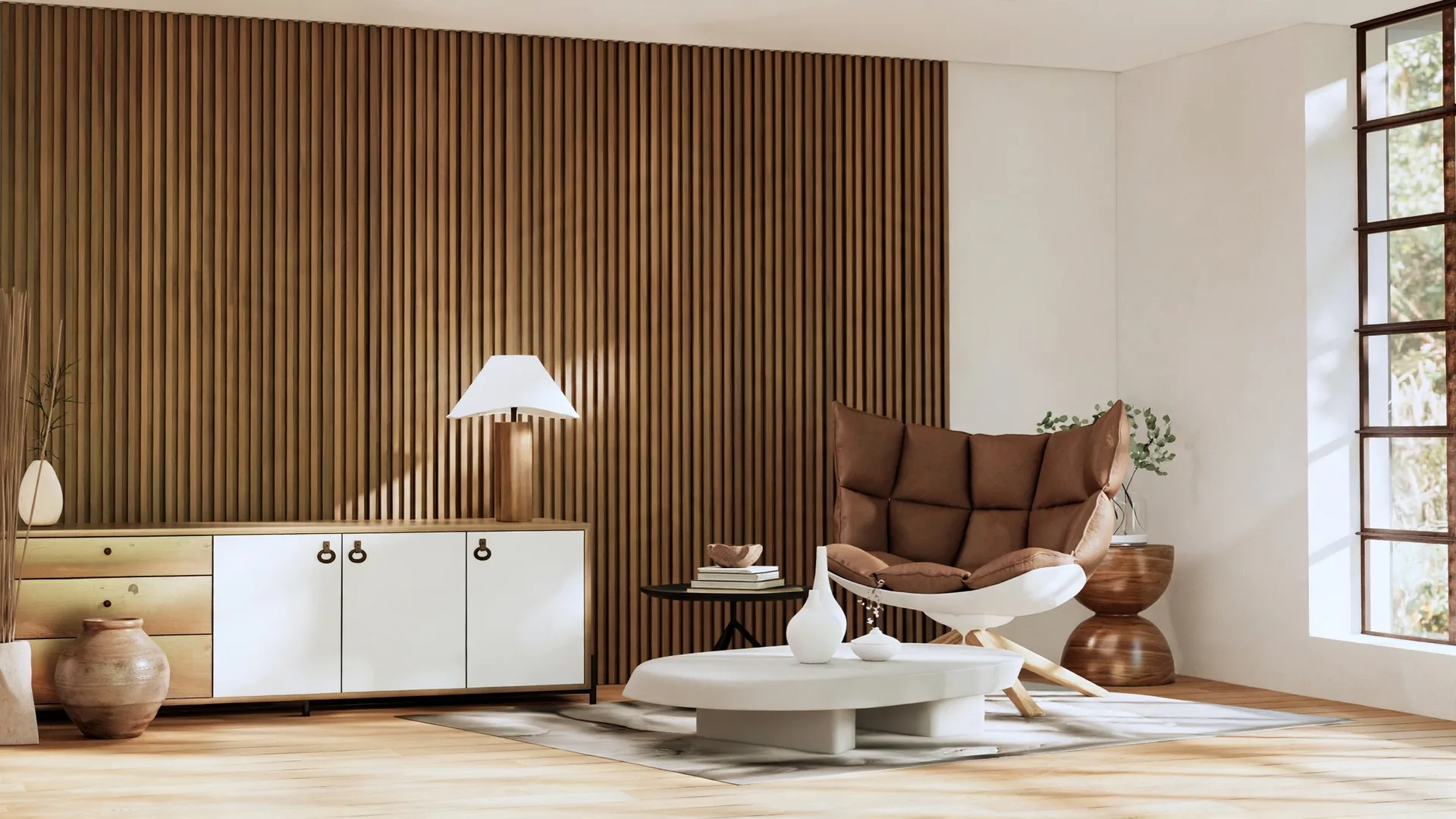
A slat wall panel is a ready-made panel of narrow vertical strips with open gaps between them, sold as a fast route to a textured accent wall. It is also the most photographed wall finish of the last few years, which is exactly why it deserves a slower look before you order one. Photographs show the rhythm of the lines. They leave out the dusting schedule, the humidity limits printed in the maker's own manual, and the gap between the sound numbers in marketplace listings and the ones manufacturers publish themselves. This guide covers the living room and the bedroom, the two rooms where slat walls get ordered most, and it prices a real wall in each.
I run a South Florida studio that designs and installs large-format panel walls. My studio does not sell or install slat panels, and this guide does not pretend otherwise. That distance is useful here: I can tell you where a slat wall is a good wall, where it becomes a maintenance subscription, and where a smoother finish does the same visual job with less upkeep, and the rooms where I would talk a client out of my own panels too. Where a number comes from a manufacturer or a national guide, I name it. Where a figure is my studio's own, I label it and keep its limits with it.
What a slat wall panel actually is
TL;DR: The standard product is a set of narrow slats (vertical strips, about 27 mm wide) made of MDF (medium-density fiberboard, pressed wood fibers) faced with real wood veneer (a thin slice of real wood glued on top), mounted on a 9 mm backing of recycled PET felt (polyester felt, visible as the dark surface in the gaps). One panel is usually about 94 1/2 by 23 5/8 inches and covers about 15.5 square feet. Solid wood, printed-plastic and do-it-yourself batten versions share the shelf name and behave differently.
WoodUpp, one of the best-known makers, describes its acoustic panels plainly: MDF slats finished with real wood veneer or laminate, mounted on an acoustic felt backing. Naturewall publishes the anatomy in numbers on its sample page: slat width 27 mm, slat depth 12 mm, felt backing 9 mm deep, gap between slats 13 mm on the standard panel and 10 mm on its Grand version, total thickness about 21 mm. Acupanel's manual gives the same build in inches – 0.35 inch felt, slats 1.06 inches wide, gaps 0.52 inches – so the recipe is consistent across brands even when the marketing names differ.
Four products share the name, and the differences decide how your wall ages.
Veneer-on-MDF slats on felt. The mainstream panel above. The wood you see is a slice of veneer 0.5 to 1 mm thick, per The Panel Hub's guide – less than a millimeter of real wood over a fiberboard core. The felt behind does two jobs: it gives the gaps their dark, finished look, and it is the part that absorbs sound (Section 4).
Solid wood slats. Ash, oak or walnut all the way through. WoodyWalls, a US retailer, sells these at a clear premium over its veneer lines. Solid wood is the only member of the family you can sand and refinish years later, and it moves with the seasons, so it needs acclimation (resting flat in the room before install) and expansion gaps (small spaces left at the edges for the wood to expand into).
Grooved sheets and plastic slat-look panels. Some products skip separate slats entirely: a sheet of veneer laminated to felt with the grooves cut into it, or a WPC or PVC panel (wood-plastic composite and polyvinyl chloride, plastic-based boards) with a printed wood grain. The Wood Veneer Hub's waterproof Hydro line is a polystyrene core wrapped in PVC with a printed grain, and its product page says so plainly. It sells precisely because the standard veneer panel cannot take water.
Individual battens, screwed up one by one. The original carpentry route: separate strips of wood or ripped plywood over a dark painted wall. It gives the deepest, most custom result and the most labor, and every strip is a separate line to level, fill and paint.
One more distinction matters before price enters the picture. A slat panel is a wall of lines with open gaps. A fluted panel is a single grooved board with no openings and no felt. The two get confused in listings, and my comparison of the two profiles covers the choice between them; this guide stays with true slat panels.
The honest pros: why the wall keeps winning rooms
TL;DR: Slat panels are fast, forgiving and genuinely warm to look at. A pre-made panel screws or glues up in hours, the vertical rhythm adds height and texture that flat paint cannot copy, and the felt-backed versions take a real bite out of echo in hard-surfaced rooms. In a dry, conditioned room that you are happy to dust, this is a legitimate wall.
The install is genuinely simple. The panel arrives finished. You cut it to height, fix it through the felt with screws or adhesive, and the wall is done. The Panel Hub's 2026 cost guide puts a standard accent wall at two to three hours for a handy homeowner, and the makers' own instructions assume ordinary tools. Next to a plaster, tile or millwork (custom-built wood trim and cabinets) project, that speed is real.
The rhythm does visual work. A run of even vertical lines makes a ceiling feel taller and gives a plain box of a room a grain direction. Designers who criticize the trend still concede the appeal: Home Stratosphere, in a piece about renovation choices designers skip, notes that slat walls read as calming because the brain likes rhythmic, repeating patterns.
It covers a tired wall. Like the board finishes in my wall paneling guide, a slat panel bridges minor drywall sins – patches, slight waviness, old texture – that paint would advertise. The wall behind still has to be dry and sound, but it does not have to be pretty.
The echo softening is real, within limits. A felt-backed panel absorbs part of the sound energy that hits it instead of bouncing it back into the room, and in a living room with tile floors, sliders and a high ceiling you can hear the difference in speech and TV dialogue. Section 4 gives the tested numbers for that claim, because the claim is also where the marketing runs furthest ahead of the product.
Downside one: every groove is a dust shelf
TL;DR: The gaps that make the look also make the chore. Sellers themselves prescribe a monthly pass with a vacuum's soft brush attachment plus a microfiber duster on the faces, and the felt in the gaps can never be wet-wiped the way a flat wall can. Budget the cleaning before you budget the panels.
WoodyWalls answers the dust question in its own FAQ without flinching: dust settles between slats over time, and a monthly pass with a soft brush vacuum attachment or a microfiber duster keeps the panels clean and maintains their acoustic performance. The Home Depot use-and-care sheet for indoor slat panels says the same thing in retailer language: use a soft brush to clean textured grooves, keep the panels in dry areas, and wipe spills quickly. Slats.co's care instructions add the limits – vacuum the grooves on low with a soft brush head, dust following the grain, and skip solvents, wax and steam.
Read those three sources together and the real routine emerges. The faces dust like any textured surface. The grooves need the vacuum brush, strip by strip, because a cloth cannot follow them. The felt at the back of each gap collects what the brush misses and cannot be washed. Home Stratosphere's designer roundup describes the lived version: every groove is a dust shelf, the top edges grow a gray film by spring, and the felt behind collects lint. Their verdict line is quoted often because owners recognize it: it photographs beautifully and lives terribly.
Balance matters here. A DIY owner at Simply Aligned Home reports barely cleaning her plywood slat wall at all in a low-dust room, with one vacuum-brush pass when she tested it. Dust load is a property of your house – pets, open windows, nearby construction, and how hard your air conditioning circulates air all move the number. What does not change is the shape of the task: a grooved wall always takes longer to clean than the same wall flat, and the bedroom and living room sections below look at what that means in each room. My care and cleaning guide covers the flat-panel side of the comparison: a smooth sheet is a one-pass wipe.
Downside two: the sound story, in the makers' own numbers
TL;DR: Felt-backed slats soften echo inside the room you are sitting in. They do not soundproof anything, and the manufacturers say so themselves. WoodyWalls, a US retailer, publishes NRC 0.5 (a rating where about half the sound energy hitting the panel is absorbed) for all of its lines; Burton Acoustix, an independent acoustics source, puts legitimate felt-backed slats at 0.40 to 0.65 on real walls. The 0.85-plus figures in listings assume premium thick felt or a build-up with insulation behind the panel.
NRC (noise reduction coefficient) is a single number from 0 to 1 describing how much sound a material absorbs rather than reflects, averaged across the frequencies of speech. Bare drywall sits near 0.05. So a panel at 0.5 is a genuine, audible improvement for echo and dialogue clarity in a hard room – that part of the claim survives checking.
The spread is where the numbers part company. WoodyWalls publishes NRC 0.5 for every acoustic line it sells, and notes that the recycled felt backing does most of the acoustic work. Burton Acoustix, an acoustics source with nothing to sell you here, puts most legitimate felt-backed slat panels at 0.40 to 0.65 tested as a complete system, and points out that the wood face itself absorbs almost nothing – wood is a reflective surface; the felt is the absorber. For its premium panel, The Panel Hub claims 0.85 and says the figure was verified by SGS, an independent testing company. The recipe behind numbers like that, from the same guide, is the felt: 15 mm thick at 1,500 grams per square meter, compared with the 9 mm, 1,100-gram felt on mass-market panels. The same guide also warns that many panels sold online list NRC figures that were never independently tested.
Then there is the mounting trick, which the makers disclose if you read far enough. Acupanel's FAQ states that Class A sound absorption (the top rating class) comes from installing the panels on battens with mineral wool or other insulation in the cavity behind them. Screwed flat to drywall, the same panel performs lower. Coverage matters just as much: The Panel Hub's guide puts the useful threshold at roughly 20 to 30 percent of a room's hard surface area, so one panel behind a TV will barely change how the room sounds. Treat it as decoration and expect only a mild softening.
And the boundary every buyer should hear before paying: absorption is not blocking. Targwall, a manufacturer, writes it on its own product page – these panels manage sound within the room rather than block sound passing through walls, floors or ceilings. That confusion produces real disappointment – The Panel Hub calls it one of the most common sources of disappointment, from buyers expecting panels to stop a neighbor's television. If your problem is a bedroom wall shared with a loud room, slat panels are the wrong tool at any NRC. My acoustic slat panel guide goes through the full ratings ladder, the mounting types and the questions that unmask a marketing number; this section is the short version a living-room buyer needs.
Downside three: Florida humidity, and what the manual actually requires
TL;DR: Acupanel's own manual requires the room to sit at 30 to 55 percent relative humidity (the share of moisture the air holds), with the air conditioning running, for at least seven days before installation and during and after it. The EPA puts the healthy indoor target below 60 percent and ideally between 30 and 50 – a range a continuously conditioned Florida living room can hold. A room that runs humid, a home left closed for the summer, or any wall near water sits outside the maker's own conditions for a standard MDF-core panel.
Start with the yardstick. The US Environmental Protection Agency's mold course states that indoor relative humidity should be kept below 60 percent, ideally between 30 and 50 percent if possible. Hold that next to the slat maker's paperwork. Acupanel's installation manual asks for two things before a panel goes up. Panels acclimate in the room for 24 to 48 hours in high-humidity environments. And the HVAC (heating, ventilation and air conditioning) must run with temperature held between 60 and 75 degrees Fahrenheit and relative humidity at 30 to 55 percent for at least seven days before installation, and through the installation and after it. The manual also states plainly that the brand does not recommend installing in bathrooms or any area with excessive moisture. Naturewall steers buyers the same way: its standard panels belong in dry, low-humidity areas, and it recommends its waterproof line anywhere humidity or water contact is expected. Slats.co is blunter still – none of its panels are waterproof.
The reason is the core. Standard MDF drinks moisture from the air. One seller's guide describes the failure in its own pages: The Panel Hub writes that standard MDF acts like a sponge in humid environments – it names kitchens, bathrooms and coastal climates – absorbing moisture over time, swelling, and causing the veneer to lift or peel. A 2026 study in the journal Forests (MDPI) explains why the damage does not reverse: after accelerated aging cycles, MDF kept a permanent residual thickness swelling of 5.43 percent and retained only 30 percent of its internal bond strength. That study used exterior-grade board under harsh test cycles, so read it as a picture of how the damage happens; it is not a prediction for your wall. Wetting and re-drying leave the board thicker than it started, because compressed fibers spring back and bonding points progressively fail. A living-room panel will not see test-lab cycles; it will see years of small humidity swings, plus the Florida specials – an AC outage in August, a snowbird home sealed for months, a wall that shares plumbing.
The verdict is narrow. In a South Florida room that is air-conditioned year-round and holds the EPA's range, a standard veneer-MDF slat panel is inside its maker's specification and should hold up. The risk concentrates exactly where the makers point: humid rooms, water contact, and homes where the air conditioning goes off. Where the air is wet, the slat family itself offers the plastic answer. WPC or PVC slat-look panels trade the real veneer face for a printed one and lose nothing to moisture, because they do not absorb it. My Florida humidity guide walks the full material ladder for this climate.
Downside four: a millimeter of wood, and what damage means
TL;DR: The real wood on a veneer slat is 0.5 to 1 mm thick. A chip or a deep scratch goes through it into the MDF core, and there is no depth of wood to sand back – repair means replacing the damaged slat or panel section. Budget panels add a second weakness: veneer on the front face only, with raw dark core showing at every gap when you view the wall at an angle.
The Panel Hub's guide gives the veneer thickness directly – a thin slice of actual timber, 0.5 to 1 mm, bonded to the core. Everything about repair follows from that number. Solid wood forgives: George Panel's comparison guide notes that solid wood can be repeatedly sanded and refinished to remove deep scratches or dents. A sub-millimeter skin forgives nothing. Sanding through damage means sanding through the veneer itself, so the fix for a gouged veneer slat is replacement, and replacement means matching a batch, a finish and a felt tone on a wall that has been fading gently since the day it was installed.
The same seller guide flags the budget version of the problem. Premium panels wrap the veneer around three sides of each slat. Many budget panels veneer only the front face, leaving the MDF core exposed on the sides – from any angle other than dead-on, you see raw dark material between every slat, on day one, before any damage happens. Cutting is the other weak point: Slats.co's install guide tells you to run painter's tape along the cut line or the veneer will chip, and to plan cuts so the exposed ends land behind baseboard, ceiling or a corner.
Sunlight finishes the durability picture for Florida rooms. The Home Depot care sheet for indoor slat panels instructs owners to avoid direct sunlight to prevent fading, and Naturewall sells its oiled finish partly as protection against UV fading – a mitigation offered because the risk is standard. A slat wall behind south-facing sliders will not fade evenly like a flat wall; it fades slat by slat and groove by groove, and a replacement slat will not match its neighbors.
Compare the repair logic, because this is where the alternative in Section 10 earns its place. A flat large-format panel has no grooves to chip and no felt to tear; its own repair limits are printed in that section, alongside its advantages. For general repair routes across finishes, the care, cleaning and repair guide is the hub.
What slat wall panels actually cost in 2026
TL;DR: Materials for veneer acoustic slat panels run about $10 to $13 per square foot at WoodyWalls and $14 to $22 in The Panel Hub's 2026 guide; professional labor adds roughly $3 to $10 per square foot on a simple wall. Its worked example puts a 120 to 160 square foot living-room feature wall at $1,680 to $3,520 in materials for acoustic slats. Angi publishes no slat-specific price line, and any source that gives you one without showing its math deserves suspicion.
The pricing here rests on two US sources, and I keep them labeled because they do not fully agree – which is normal for a product sold as kits, boxes and panels rather than by the square foot.
WoodyWalls, a US retailer, prices its wood veneer slat panels at $139 to $179 per box, about $10 to $13 per square foot, and its solid wood slat panels at $169 to $559 per box, about $14 to $19 per square foot; its own summary line is to expect $10 to $19 per square foot depending on material. The Panel Hub's 2026 price guide, current as of April 2026, puts acoustic slat panels at $14 to $22 per square foot for materials, and decorative veneer slat panels without the acoustic backing at $12 to $18. The plastic and solid lines sit apart: PVC and WPC panels at $7 to $15, and solid wood planks at $15 to $40 or more. Labor, from the same guide, adds $3 to $10 per square foot on a standard flat wall and $8 to $15 where ceilings are high or the wall is complex. Extras the guide lists and quotes often skip: adhesive at $20 to $60 per accent wall, trim at $2 to $5 per linear foot, and a 10 to 15 percent waste allowance for cuts.
The worked examples from that guide, for the two rooms in this article: a living-room feature wall of 120 to 160 square feet runs $1,680 to $3,520 in materials for acoustic slats, or $2,040 to $5,120 with professional installation; a bedroom headboard wall (the wall the bed stands against) of 90 to 120 square feet runs $1,260 to $2,640 in materials, or $1,530 to $3,840 installed. Every one of those numbers climbs with solid wood; the plastic slat-look lines move the materials number down and give you a printed face.
Angi's wall paneling cost page, updated October 30, 2026, is the independent benchmark and it needs a careful label: Angi prices wall paneling in general at $1,200 to $6,000 installed, averaging about $2,800, and it does not list wood slat or acoustic slat panels as their own line item at all. Angi confirms only the general price neighborhood. It gives no slat-specific figure. The same page prices the later costs of owning wood paneling: refinishing or resealing at $100 to $500 every few years, and repairing dents, scratches or water damage at $150 to $600. For the wider cost picture across panel types, my wall panel cost guide prices a room end to end.
One pricing habit to refuse: a single per-square-foot number with no source, no date and no statement of whether labor is inside it. Slat pricing online mixes kit prices, box prices, promotional prices and installed prices on the same search results page.
Downside five: the trend risk is real, and it has a specific shape
TL;DR: Designers quoted in 2025 and 2026 trend coverage have started calling the identical thin-rib slat wall a copy-paste finish that time-stamps a room, and sellers answer that slats remain in style. Both can be true: the risk concentrates in the most repeated application – thin ribs behind every TV – while the material itself, used once and chosen deliberately, is a smaller bet.
House Digest, in a September 2025 piece on wall trends designers are tired of (updated September 2026), quotes designer Anastasiia Amani on the slat wall directly: she calls it the cookie-cutter slat wall – identical thin wooden ribs behind every TV unit on Instagram – and says the repeated version rarely adds anything beyond looking like a quick trend copy. Her suggested direction in the same piece is real millwork with a function, or ribbed texture painted the same color as the wall so the relief is tactile rather than shouting. A 2026 editorial at Our Wabi Sabi Life goes further, listing vertical slat feature walls among home features designers fear will look outdated by 2030, calling them dusty, overused and office-lobby-coded when misapplied. I cite that piece as opinion – a roundup of designer views.
The counterpoint deserves its sentence. WoodyWalls, which sells slat panels, answers the style question in its FAQ by saying wood slat walls are still in style in 2026, pointing to the mid-century roots of the look and its range from Scandinavian light oak to dark walnut contemporary. Sellers would say that. It also happens that a profile with mid-century ancestry is harder to write off than a pure social-media invention.
My read, as someone who sells a competing wall: the exposure is not slats, it is sameness. The shiplap article on this site makes the same point about its own subject – a finish becomes a resale and taste risk when a whole home, or a whole feed, wears the identical version of it. One slat wall, in a wood tone chosen for your light and your furniture, in a room where you accept the dusting, is a design decision. The default thin-rib panel, ordered because it was the first image in the search results, is a timestamp.
In the living room: where slats earn it, and where they charge you
TL;DR: The living room is the slat wall's best case and its most public failure mode at once. Echo softening genuinely helps hard-surfaced Florida living rooms, and the texture warms a big blank wall. The charges: the largest dusting surface in the house, raking light (low light grazing across the surface, showing every speck of texture and dust) across the grooves, sun exposure through sliders, and the trend risk of the exact TV-wall application the designers are criticizing.
The case for slats is strongest here. South Florida living rooms stack hard surfaces – tile or stone floors, drywall, glass sliders, high ceilings – and that is precisely the room where moving from bare drywall at roughly 0.05 NRC to a felted wall at around 0.5 improves speech and TV dialogue. If the wall also carries the television, my TV accent wall guide covers the wiring, mounting and backlight questions this guide deliberately leaves to it.
The charges are equally room-specific. This wall is usually the biggest slat surface in the home, so the monthly groove routine from Section 3 takes longest here. Light does the rest: sun raking (grazing light that reveals surface texture) across a ribbed wall from side sliders shows dust and felt lint that a frontal photograph hides, and the same exposure drives the uneven fading the care sheets warn about. And it is this room, in this exact configuration – thin ribs behind a large TV – that the designer quotes in Section 8 are about.
Practical middle positions exist. A partial-width slat run, framed by flat wall on both sides, cuts the dusting surface and avoids the copy-paste look. A deeper, wider slat profile reads as millwork rather than kit. And if what you actually want from the wall is calm and scale rather than rhythm, the living room is where the smooth alternative in Section 10 is strongest; my living room panel guide covers layout, glare and which wall to choose once you are deciding between smooth finishes.
In the bedroom: the headboard wall question
TL;DR: Behind the bed, a slat wall puts its two weakest properties at pillow height: grooves and felt that collect dust and lint where you breathe all night, and a surface you cannot wipe down. It also puts its texture exactly where a headboard wall wants warmth. The deciding questions are how dusty your room runs and whether you will vacuum grooves behind and above the bed on schedule.
The appeal is easy to see. A headboard wall in vertical wood tones gives a bedroom a focal point without furniture, and the ribbed texture reads warm in low evening light. Panel Hub's worked example prices that wall – 90 to 120 square feet – at $1,260 to $2,640 in acoustic slat materials, so it is also the cheapest full slat wall in the house.
Now the room's specifics. Dust settles where air slows, and the felt-backed grooves behind your pillows are a lint trap positioned at breathing height, in the room where the bed itself sheds fibers daily. Cleaning that wall means working the vacuum's brush attachment around and above the bed, on the monthly schedule the sellers prescribe – a chore that is easy to quietly abandon, after which the grooves hold what they hold. Allergies are a personal fact I cannot price for you; if dust matters in your household, this is the room where the slat trade-off is at its worst.
There is also a scale point. A bedroom wall is seen from one position, lying down, at close range, for years. Every installation sin – a gap that widens, a slat that fades faster than its neighbor, a cut edge left visible – sits in that fixed view. If you keep the slats, keep them to the width of the bed plus a margin, in the warmest tone in the range, and treat the rest of the wall as flat. If the texture is what you love but the upkeep math fails, the behind-bed layouts, widths and finish choices in my bedroom wall panel guide were written for exactly this wall in smooth materials.
The smoother alternative: one surface instead of a hundred lines
TL;DR: A large-format panel builds the wall out of surface rather than lines: one pre-finished sheet, in my studio's case a bamboo-composite sheet (a composite core made with bamboo fiber) 48 by 108 inches and 5 mm thick, carrying a finish that looks like travertine, marble, stone or real-wood veneer. It runs floor to ceiling with minimal seams and wipes down in minutes. Its limits come with its advantages: no grooves, so it gives you calm instead of rhythm, and it belongs in conditioned rooms on a dry, flat, sound wall.
The maintenance comparison is the headline. A flat sheet has no grooves to vacuum, no felt to hold lint, and no sub-millimeter veneer ribs to chip one by one; a damp cloth and a dry one are the whole routine. In a humid week, the sheet's composite core is a different build from MDF slats on felt. Do not let me oversell that either: the sheet is cladding (a finish layer over a wall), it carries no water or heat rating of its own, and my studio installs it in conditioned rooms on walls that pass the same test any finish needs – dry, sound and flat, with cut edges sealed. The full account of what the sheet is made of, including its own humidity limits, is in my bamboo composite panel guide.
The swap trades rhythm for scale. One stone-look or veneer-look surface, floor to ceiling, makes a living room feel larger and quieter. My studio rule is to keep the wall to two finishes at most, three counting a thin metal inlay as an accent, and the colors and finishes guide shows how to choose among the smooth finishes under your own light. What the sheet cannot do is imitate the slat wall's shadow play. If the lines themselves are the thing you love, a flat panel will always feel like the absence of your idea, and you should buy the slats with open eyes and a vacuum brush.
Pricing, with its scope stated in the same breath: these figures are my studio's, for its own panel projects only, and they are not a slat-wall price. The studio publishes three anchors, covering panel projects only: a stock design from $850, a design fitted to your wall usually $2,200 to $2,700, and full custom turnkey projects from $9,999, every figure preliminary, with the exact price confirmed after a specialist measures your wall. Set beside Section 7's slat numbers, a fitted smooth wall and a professionally installed acoustic slat wall land in overlapping territory. Decide on upkeep, sound needs and taste; a headline price settles none of those.
Who should still buy the slats
TL;DR: Buy slat panels if your room is dry and conditioned year-round, you genuinely love the ribbed look, a softer echo matters to you, and the monthly groove routine fits your housekeeping. Choose the smoother wall if dust, humidity control, sun exposure or a five-year taste horizon is doing the deciding.
The slat wall passes its own test in a specific house: air conditioning that runs, a room away from water, no heavy sun raking across the wall, and an owner who hears the echo difference and values it. In that house, order the version with three-sided veneer, check whether the published sound number belongs to the panel alone or to the panel mounted on battens with insulation behind it, and confirm the felt thickness before you compare prices between two panels that look identical in photos.
It fails the test where any one of its conditions fails: the vacation home that sits closed and humid, the bedroom of a dust-sensitive sleeper, the living room wall of sliders in full afternoon sun, the buyer who actually needs sound blocked between rooms. In those rooms the honest move is to solve the real problem – plastic slat-look where water is the issue, real acoustic treatment where noise is the issue, and a smooth large-format wall where the goal was a calm, finished room with the least upkeep the finish allows.
Frequently asked questions
Do slat wall panels really reduce noise?
They reduce echo inside the room. The felt backing absorbs part of the sound energy that hits the wall – a mainstream US retailer publishes NRC 0.5 for its acoustic slat lines, and an independent acoustics source puts legitimate felt-backed panels at 0.40 to 0.65 – so speech and TV dialogue get clearer in a hard-surfaced room. They do not block sound between rooms: Targwall, one manufacturer, says on its product page that its panels manage sound within a room and stop nothing that passes through walls, floors or ceilings.
How do you clean a slat wall?
The sellers' own routine: a monthly pass with a vacuum's soft brush attachment or a microfiber duster, per WoodyWalls' FAQ, with a soft brush for the textured grooves per the Home Depot care sheet. Dust the faces following the grain, vacuum the grooves on low, and avoid solvents, wax, steam and soaking. The felt between the slats cannot be wet-wiped.
Can slat wall panels handle Florida humidity?
The standard veneer-on-MDF panel can, inside its maker's stated conditions. Acupanel's manual requires 30 to 55 percent relative humidity with air conditioning running for at least seven days before, during and after installation, and does not recommend the panels for bathrooms or areas of excessive moisture. The EPA's indoor target is below 60 percent, ideally 30 to 50. Homes that sit closed and humid, or rooms near water, fall outside those conditions; the makers themselves steer those buyers to waterproof lines.
How much does a slat accent wall cost?
From The Panel Hub's 2026 price guide, current as of April 2026: a living-room feature wall of 120 to 160 square feet runs $1,680 to $3,520 in acoustic slat panels, or $2,040 to $5,120 professionally installed; a bedroom headboard wall of 90 to 120 square feet runs $1,260 to $2,640 in materials, or $1,530 to $3,840 installed. WoodyWalls prices veneer slat panels at about $10 to $13 per square foot and solid wood at about $14 to $19. Angi's 2026 paneling data covers wall paneling in general and has no slat-specific line.
Are slat walls going out of style?
Opinions have split, which is itself the signal to weigh. A designer quoted by House Digest in 2025 calls the identical thin-rib slat wall a cookie-cutter finish, and a 2026 editorial lists vertical slat feature walls among features designers fear will date by 2030. WoodyWalls, a seller, answers that slat walls remain in style in 2026, citing their mid-century roots. The risk concentrates in the most repeated application: the standard thin-rib panel behind the TV.
Can you repair a damaged slat?
Usually you replace the damaged slat or panel section. The real wood on a veneer slat is a slice 0.5 to 1 mm thick over an MDF core, so a deep scratch or chip reaches the core and cannot be sanded back the way solid wood can. George Panel's comparison guide makes the same point for plastic panels: severe damage means replacing that panel. Solid wood slats are the exception – they can be sanded and refinished repeatedly.
Do slat panels work behind a bed?
They work visually, and they charge for it at pillow height: the grooves and felt collect dust and bed lint where you breathe all night, and cleaning means working a vacuum brush around and above the bed on a monthly schedule. In a low-dust, conditioned room with an owner who keeps that schedule, the look holds up. Dust-sensitive sleepers are the household most likely to regret this specific wall.
What is the best alternative to a slat wall?
For the same rooms, a large-format smooth panel: one pre-finished sheet – my studio's is a bamboo-composite sheet 48 by 108 inches and 5 mm thick – with a finish that looks like travertine, marble, stone or wood veneer, run floor to ceiling with minimal seams. It wipes clean in one pass and carries no grooves, felt or rib edges to maintain. It gives you a calm surface in place of rhythm – the trade to decide on.
Sources
- WoodUpp, Acoustic panels – sound absorption in your home (panel construction; standard panel 94 1/2 x 23 5/8 in, 15.5 sq ft): woodupp.co.uk
- Naturewall, SlatWall Acoustic sample (slat 27 x 12 mm, gap 13 mm, felt 9 mm; oiled finish and UV): naturewall.com
- Acupanel user manual via Manuals.plus (construction in inches; acclimation; HVAC and 30-55% relative humidity for 7 days before, during and after install; no bathrooms): manuals.plus
- Acupanel, Frequently asked questions (panel size 240 x 60 cm; Class A absorption with battens and mineral wool): acupanel.com
- The Panel Hub, Acoustic wood slat wall panels – the complete guide (veneer 0.5-1 mm; NRC 0.85 premium claim, SGS-verified per the seller; budget felt comparison; MDF in coastal climates; not soundproofing; coverage 20-30%): thepanelhub.com
- The Panel Hub, How much do wall panels cost – 2026 price guide, current as of April 2026 (materials ranges by type; labor $3-$10 per sq ft; living-room and bedroom worked examples; extras): thepanelhub.com
- WoodyWalls, Acoustic slat wood wall panels (box and per-sq-ft prices; NRC 0.5 for all lines; monthly dusting FAQ; still in style in 2026): woodywalls.com
- Burton Acoustix, Do acoustic slat panels work (legitimate felt-backed slats at NRC 0.40-0.65; the wood face absorbs almost nothing; absorption is not soundproofing): blog.burtonacoustix.com
- Targwall, Acoustic wall panels (panel dimensions; acoustic treatment versus soundproofing, in the maker's words): targwall.co.uk
- US EPA, Mold course chapter 2 (indoor relative humidity below 60 percent, ideally 30-50 percent): epa.gov
- MDPI Forests (2026), Dimensional stability and mechanical performance of exterior-grade particleboard and MDF after accelerated aging (permanent residual thickness swelling 5.43%; internal bond retention 30%): mdpi.com
- George Panel, Wall panel comparison guide – MDF vs WPC vs solid wood vs VJ (solid wood sanded and refinished; WPC replaced, not repaired; WPC and moisture): georgepanel.com
- Home Depot, Use and care instructions PDF (soft brush for textured grooves; dry areas only; avoid direct sunlight to prevent fading): images.thdstatic.com
- Slats.co, How to install slat wall panels (grooved-sheet and solid variants; tape cut lines or veneer chips; care: vacuum grooves on low, no solvents, wax or steam): slats.co
- House Digest, Outdated wall trends interior designers are sick of seeing (designer Anastasiia Amani on the cookie-cutter slat wall; September 2025, updated September 2026): housedigest.com
- Our Wabi Sabi Life, 8 home features designers fear will look completely outdated by 2030 (vertical slat feature walls; cited as editorial opinion): ourwabisabilife.com
- Home Stratosphere, Interior designers say these popular renovation choices are ones they would skip (grooves as dust shelves; slat walls and rhythmic patterns): homestratosphere.com
- Simply Aligned Home, Affordable wood slat wall – frequently asked questions (DIY batten build; low-dust owner report; vacuum brush cleaning): simplyalignedhome.com
- The Wood Veneer Hub, Slatpanel Hydro gray oak waterproof wall panels (polystyrene core, PVC wrap, printed grain; cut edges sealed): thewoodveneerhub.com
- Angi, How much does it cost to install wall paneling – 2026 data, updated October 30, 2026 (general paneling $1,200-$6,000 installed, average about $2,800; refinishing $100-$500; damage repair $150-$600; no slat-specific line item): angi.com