
How Long Do Wall Panels Last? Lifespan by Material (2026)
How long wall panels last by material: PVC, composite, MDF, wood, porcelain and stone, plus the Florida factors that cut years off each one.
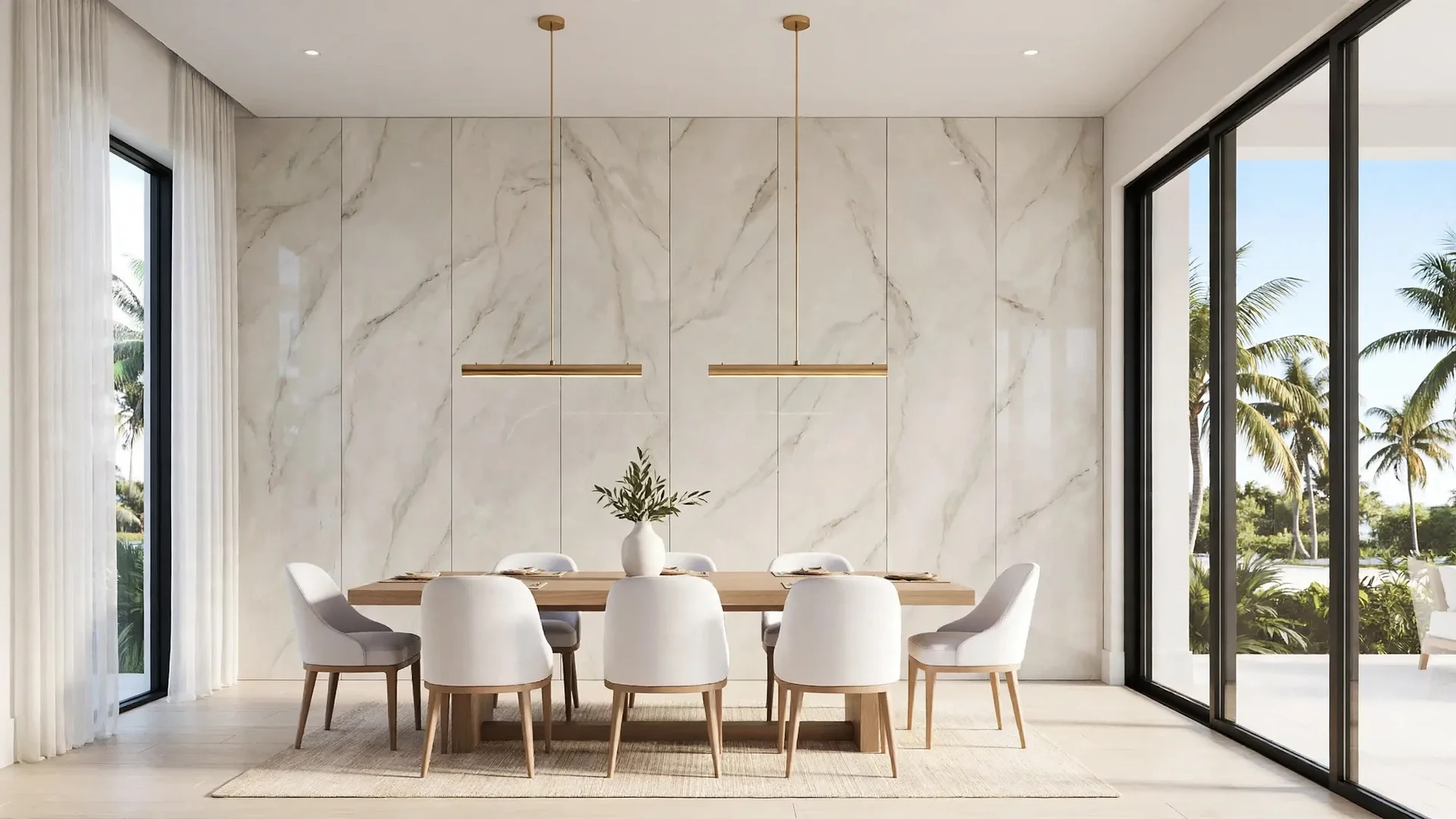
We are a South Florida studio that designs and installs large-format panel walls. The question we hear most often is the hardest to answer honestly: how long will this wall last? Our full wall paneling guide covers types, costs and rooms. This article covers lifespan only.
Published lifespans disagree because their scopes differ. One source describes a panel in a dry living room. Another describes a panel in a wet bathroom. A third is the maker selling the panel. A fourth is a warranty document with conditions attached. So every figure below carries its source and its scope. We also separate two clocks. The first, structural life, is how long a panel stays attached and sound. The second, appearance life, is how long the finish still looks like the finish you chose. Protex Flooring makes this point for SPC (stone-plastic composite, a rigid mineral-filled plastic panel). A panel may stay securely attached and structurally sound while its decorative surface develops visible scratches and changes in gloss. Where no independent data exists, we say so in plain words. That matters most for the composite sheet we install ourselves.
The short answer: lifespan by material at a glance
TL;DR: Angi, updated Oct 30, 2026, puts high-quality panels at 15 to 40 years before replacement. The ranges below start at 1 to 3 years for unsealed MDF near moisture. They reach a 75 year estimated useful life for porcelain and ceramic in a commercial flooring trade study.
Read the Scope column first and the years second.
| Material | Published lifespan | Scope | Source |
|---|---|---|---|
| Panels, broad group | 15 to 40 years | High-quality panels, routine care | Angi, Oct 30, 2026 |
| PVC | 10 to 25 years | Interior, grade split below | Walls and Floors; OrganizerTone; Diversinet; Crecso |
| WPC and composite | 15 to 30 years | Maker and retailer claims | HSCS Decor; Senyu WPC; ArtFasad; Suzhongli |
| SPC | 10 to 25 years | Retailer guide | Protex Flooring |
| MDF, standard | 10 to 15 years | Indoors, sealed, normal use | Woodworking Advisor |
| MDF, moisture-resistant | 15 to 20 years | Sealed, wax-treated core | Woodworking Advisor |
| MDF, high-density HDF | 20 to 30 years | Sealed | Woodworking Advisor |
| MDF, unsealed near moisture | 1 to 3 years | Unsealed edges, any grade | Woodworking Advisor |
| Laminate wet-wall | 20 to 30 years | Branded ranges, bathroom scope | Crecso |
| Solid hardwood | 40 to 50 years and beyond | 3/4 inch tongue and groove (a ridge fitting a groove) | BuildMat Insight, Aug 31, 2026 |
| Engineered veneer | 20 to 30 years | Veneer (a thin slice of real wood) on MDF or plywood core | BuildMat Insight, Aug 31, 2026 |
| Solid wood, broad | 20 to 50 years | Living rooms, bedrooms, offices | Wood Panel Wall, Dec 4, 2024 |
| Porcelain | 50 to 100 years and beyond | Dense, low-porosity, stable substrate (the wall surface panels fix to) | Flooring Clarity, Sep 4, 2025 |
| Ceramic | 20 to 50 years | Glaze-dependent | Flooring Clarity, Sep 4, 2025 |
| Porcelain and ceramic, trade study | 75 years | Estimated useful life, commercial flooring | TCNA, 2023 |
| Marble and travertine | Over 100 years | Properly installed stone | Atlas Natural Stones Academy, Oct 2, 2026 |
| Wallpaper | Around 15 years | Minimal maintenance, dry rooms best | Angi, Jul 31, 2026 |
| Paint, cosmetic cycle | 3 to 5 years | Fresh coat cycle | Angi, Jul 31, 2026 |
Water decides more than marketing does, and MDF falls steepest when water reaches an unsealed edge. The longest numbers belong to porcelain and stone, with shorter cycles for grout (the filler packed between tiles) and sealant (the flexible filler in corners and joints).
PVC panels: a wide band with fine print
TL;DR: Published PVC ranges span 10 to 25 years by grade. General guides sit at 10 to 20 years. Premium bathroom guides reach 15 to 25 years. Crecso cites premium manufacturer warranties of 10 to 15 years.
PVC (polyvinyl chloride, a rigid plastic) earns its wet-room reputation from one property. Walls and Floors states that PVC wall panels provide nonporous wall protection with water absorption close to 0 percent. Cellular PVC will not rot or swell in standing water or high humidity.
Walls and Floors puts correctly installed PVC at 15 to 25 years for interior residential and light-commercial use, without warping, cracking or color degradation. OrganizerTone and Diversinet sit lower, at 10 to 20 years under normal indoor conditions and 10 to 15 years as an average with proper installation and care. Crecso splits by grade: budget PVC at 10 to 15 years in normal use. Premium uPVC (unplasticized PVC, a harder form of the plastic) sits at 15 to 25 years in a bathroom. Its manufacturer warranties run 10 to 15 years for premium products.
Crecso adds that the waterproofing itself holds with age, while the finish ages. Gloss whites can yellow in strong sunlight. Walls and Floors warns that prolonged ultraviolet exposure (the part of sunlight that fades surfaces) accelerates fading in finishes without UV stabilization. Crecso states that a dropped shower head marks a hollow PVC board more easily than a laminate board. The fitting sequence is in the wall panel installation process, and the material duel is in wall panels in Florida humidity: MDF vs PVC. Extrutech's P2400 is 100 percent virgin PVC, nonporous and waterproof, with a 10 year warranty.
Composite and WPC panels: strong claims, thin field data
TL;DR: WPC and composite makers claim 15 to 30 years with warranties from 5 to 25 years by line. No independent long-term field data was found for this class, so every year figure here stays labeled as a maker or retailer claim.
WPC means wood-plastic composite, wood particles held in a plastic matrix. George Panel explains the mechanism: the plastic matrix encapsulates the wood particles, which is why WPC resists water instead of drinking it. The lifespan figures are where the evidence thins out.
HSCS Decor, a seller, states that a WPC wall panel can easily last for 25 years or more, with warranties from 10 to 25 years. Senyu WPC, also a maker, gives 15 to 25 years by tier and exposure, with warranties of 10 to 25 years. The split runs between standard cladding (panels used as a wall covering) and co-extruded capped cladding. The warranty table below shows the capped form's protective shell, fused on during manufacture.
SPC sits closest to the sheets clients ask us about. Protex Flooring puts the typical SPC lifespan at 10 to 25 years. Trioflor, a maker, reports common SPC warranties of 5 to 15 years by use case and brand, conditional on substrate, installation and maintenance. It stresses correct sealing of edges, corners and penetrations against moisture behind the panels. Protex adds: a longer warranty alone does not guarantee greater durability, because actual service life depends on product quality, installation, use and maintenance.
Now the sheet we sell and install. Our studio sheet is a whole sheet at 48 x 108 in and 5 mm thick, with a bamboo-composite core and a finished look face. A look is only a surface, and it carries no water rating and no heat rating of its own. The panel system is cladding, a finish layer fixed over the wall, with no waterproofing function of its own. Details are in our guide to bamboo composite wall panels. It belongs in conditioned living spaces on a dry, sound wall, and inside a shower it does not belong.
No independent lifespan figure exists for this exact sheet, and no independent long-term United States field data for this panel class was found. Bamboo-composite service-life figures are vendor claims: 30 years indoors from Chanta, 30 years in the Consmos metallic FAQ. 25 years or more in an Ecer roundup. 10 to 15 years or longer in a WPCSPC installation guide. 20 years or more for generic WPC from Coowin. The enforceable promises on named lines are far shorter: a 3 year warranty on the E-Well travertine lines and a 5 year warranty on the Consmos metallic line. Studio warranty terms live in project paperwork, so this article states no studio warranty length. We give no lifespan guarantee for any product here, including our own.
Our repair ladder runs one sheet at a time. Surface marks are cleaning. Shallow scratches take a touch-up marker or wax fill stick. And damage through the finish means replacing that single numbered sheet. The rest of the wall stays in place. Panels go in as whole sheets, and the studio does not cut panels to size as a product. So seams are planned on day one with that swap in mind. We tell buyers to keep a spare piece from the same lot, so the pattern matches.
MDF panels: the steepest drop is water
TL;DR: Woodworking Advisor puts sealed standard MDF at 10 to 15 years indoors. It puts moisture-resistant MDF at 15 to 20 years and high-density board at 20 to 30 years. Unsealed MDF near moisture falls to 1 to 3 years regardless of grade.
MDF means medium-density fiberboard, wood fibers pressed and glued into a flat board. Its lifespan turns on one variable: whether water reaches the core, above all through a cut edge.
Standard MDF lasts 10 to 15 years indoors with normal use, as resin bonds and fibers break down gradually, and heat and humidity speed up that breakdown. Moisture-resistant MDF, a wax-treated core, lasts 15 to 20 years. High-density HDF (high-density fiberboard, a denser cousin) lasts 20 to 30 years. Every figure assumes the board is sealed. EngineerFix offers the optimistic ceiling: in a consistently controlled indoor environment, well-made MDF furniture or millwork may maintain structural integrity for 20 to 50 years.
Woodworking Advisor states that unsealed edges near moisture cut lifespan to 1 to 3 years regardless of grade. Unsealed MDF near a sink or window sill can swell and crumble in under two years. Standard interior MDF in standing water typically shows visible swelling within 1 to 4 hours, and the board does not shrink back once it dries. EngineerFix describes the mechanism: fibers absorb moisture, resin bonds break down, and the swollen board cannot be restored.
The edge is the whole story, in the words of Woodworking Advisor. A cut edge is raw fiber, the fastest path for moisture into the board. That is why edge banding and edge sealer matter more than face finish. The fixes named begin with sealing every face and cut edge with edge sealer. Diluted PVA (a common wood glue used thinned as a sealer) or shellac-based primer goes on before the topcoat. On our walls, paint and primer slow the process and do not stop it. Site cuts at outlets and corners are where we look first on a failing wall.
Real wood: the finish gives up before the board does
TL;DR: BuildMat Insight, published Aug 31, 2026, puts solid hardwood at 40 to 50 years and beyond. It puts engineered veneer at 20 to 30 years. The finish inside that life runs shorter: 5 to 8 years for hardwax oil and 15 to 25 years for factory polyurethane on vertical surfaces.
A wood panel wall can be renewed in place with a fresh coat of oil or finish, and that renewability explains its long ranges. It breathes, expanding and contracting as humidity changes, so it needs regular sealing and upkeep.
BuildMat Insight, an independent technical guide published Aug 31, 2026, lists solid hardwood in 3/4 inch tongue and groove (a ridge fitting a groove) at 40 to 50 years and beyond. It lists engineered veneer (a thin slice of real wood) on an MDF or plywood core at 20 to 30 years. It also lists polyester felt-backed wood slats. The studio does not sell slat walls.
Hardwax oil lasts 5 to 8 years on vertical surfaces before a maintenance coat. Factory UV-cured polyurethane (a hard clear finish hardened under ultraviolet light) lasts 15 to 25 years on vertical applications. BuildMat Insight is the source for both figures. The full picture is in our guide to veneer wall panels, and the renewal comparison with a painted wall is in wall panels vs paint. Thin veneer faces have almost no sanding tolerance, so we never sand a mark out of one.
Porcelain, ceramic and stone: the long end of the scale
TL;DR: Flooring Clarity, published Sep 4, 2025, puts porcelain at 50 to 100 years and beyond. It puts ceramic at 20 to 50 years. The TCNA 2023 analysis assigns porcelain and ceramic a 75 year estimated useful life in commercial flooring. Grout inside those walls runs shorter. EngineerFix puts cement grout at 5 to 15 years and epoxy grout at 30 years or more. HomeJobCosts puts shower grout at 8 to 15 years and epoxy at 15 to 25 years.
Flooring Clarity, an independent guide published Sep 4, 2025, lists porcelain at 50 to 100 years and beyond, and notes porcelain floors commonly last 50 years or more on a stable substrate. EngineerFix agrees on porcelain, often exceeding 50 years when installed correctly and maintained minimally, and generalizes ceramic at 20 to 40 years against the Flooring Clarity range of 20 to 50 years. We record both ceramic ranges.
The strongest single document is the trade life-cycle study. The Tile Council of North America commissioned a Life-Cycle Cost Analysis in 2023. It assigned a 75 year estimated useful life to quarry tile, ceramic tile and porcelain tile. It also assigned that life to limestone, travertine and solid wood in that flooring study. Estimated cost per year came out at $0.98 per square foot for porcelain, $0.97 for ceramic and $1.36 for travertine and limestone. Scope: flooring in commercial buildings, 2020 costs, at a 3 percent real discount rate. We use it as a longevity anchor for the materials. It is a flooring study, so it is not a wall-panel service-life figure.
Atlas Natural Stones Academy, updated Oct 2, 2026, states that properly installed marble and travertine can last over 100 years. Angi puts properly installed and maintained travertine at 75 to 100 years, while Better Homes and Gardens gives over 25 years with consistent care.
HomeJobCosts, in a 2026 grout guide, states that grout in a shower lasts 8 to 15 years before it is ground out and replaced. Epoxy sits at the top of the range at 15 to 25 years. A correctly waterproofed tile shower lasts 20 to 30 years, so a cement-grouted shower typically sees 1 to 3 full regrouts before the tile is replaced. EngineerFix disagrees on epoxy, putting cementitious grout (cement-based grout) at 5 to 15 years and epoxy grout at 30 years or more. Daltile states that sealing is not recommended for glazed porcelain, while cementitious grout should be sealed after installation.
Stone sealing runs on a similar short cycle. YDL Stone lists marble re-application at 1 to 3 years in high-traffic areas and travertine at 1 to 2 years, noting that sealing does not prevent acid etching on marble or onyx. The full material picture is in large-format porcelain wall panels, and the wet-room upkeep contract is in shower wall panels vs tile. Rose Restoration puts most natural stone resealing at every 1 to 3 years.
Wallpaper and paint: the baselines
TL;DR: Angi, updated Jul 31, 2026, puts wallpaper at around 15 years with minimal maintenance. It puts painted walls on a fresh-coat cycle of 3 to 5 years. So wallpaper lasts roughly three times as long as a paint finish in that comparison.
Paint and wallpaper are the finishes a panel wall usually replaces, and their cycles are the best documented numbers here. Our wall panels vs wallpaper comparison states the asymmetry in words we still stand behind. Manufacturers claim PVC lasts 10 to 12 years and WPC 15 years or more. Those are manufacturer claims, and no independent lifespan data for panels was found. The wallpaper figure is well documented.
Angi, updated Jul 31, 2026, states that wallpaper lasts around 15 years with minimal maintenance, while painted walls need a fresh coat every 3 to 5 years. Three independent sources, EngineerFix, BVL Painting and Carpentry and Wallhub, put traditional wallpaper at 10 to 15 years in a dry, stable room. Peel-and-stick lasts 2 to 5 years typically, up to 7 years in a dry, stable room.
Paint runs on a cosmetic cycle, the repaint cycle. Painter guidance from Colin Can Help splits the repaint cycle by room, and the head-to-head versions live in wall panels vs wallpaper and wall panels vs paint. Living rooms and bedrooms sit at 5 to 7 years. Hallways and entries sit at 2 to 3 years. Kitchens and bathrooms sit at 3 to 4 years.
What actually kills a panel wall early
TL;DR: The U.S. EPA states that the key to mold control is moisture control. It advises drying damp materials within 24 to 48 hours. The early killers rank with moisture and hidden water first, then joint failures, impact, harsh cleaning, poor installation and sunlight.
Panel walls usually fail from events in a repeating order: the wall behind the panel first. Then come unsealed cut edges and the bottom edge, the joints, the finish, and the core last.
The U.S. EPA, last updated Sep 8, 2026, states that the way to control indoor mold growth is to control moisture. The EPA also states that there is no practical way to eliminate all mold spores indoors. The EPA advises reducing indoor humidity to 30 to 60 percent to decrease mold growth. Its Mold Course prevention chapter tightens the target. Maintain low indoor humidity below 60 percent relative humidity, ideally 30 to 50 percent. Humidity above 60 percent is likely to result in condensation and mold growth. The EPA also advises cleaning and drying damp or wet materials within 24 to 48 hours to prevent mold growth.
Hidden moisture can grow behind a face that still looks perfect. The back side of paneling is one of the hidden mold sites we warn clients about. A panel wall is cladding, a finish layer over the wall, with no waterproofing function of its own. A musty smell with a clean-looking wall is a leak problem.
Cement grout is porous, absorbs water and stains, and requires regular sealing. Epoxy grout is nonporous and highly stain-resistant. It does not usually require sealing, per MAPEI. In panel shower systems, the sealant inherits the maintenance: Fibo instructs owners to clean sealant often and replace damaged sealant, or the warranty can be voided.
Crecso names point impact as the weakness of hollow PVC, and a hard point impact can end a single sheet on the day it happens.
Angi, updated Oct 30, 2026, recommends replacement when damage is widespread, paneling is outdated, or there are moisture or mold issues. It advises that if repair cost exceeds 50 percent of replacement price, investing in new paneling makes more sense. Conditioning, sealed cut edges, movement gaps and a dry, sound substrate are all settled earlier, at install. Sunlight fades PVC prints and breaks down wood finishes per Walls and Floors, OrganizerTone and BuildMat Insight, with no published years-lost figure. The wrong cleaner shortens life and can void a warranty, as Duramax states for harsh or abrasive cleaners.
The Florida adjustment: what this climate does to each clock
TL;DR: The Florida Climate Center puts Miami at an average of 82 percent relative humidity in the morning and 61 percent in the afternoon across the year. No source found quantifies a Florida discount in years. So this section adjusts maintenance intervals and material choices for that climate, and leaves the published year figures unchanged.
Every range above was published for a general indoor scope, and no source found quantifies how many years Florida humidity shortens interior panel life. Anyone giving you an exact Florida discount in years is inventing it.
The Florida Climate Center puts Miami at an average of 82 percent relative humidity in the morning and 61 percent in the afternoon across the year. The Florida Solar Energy Center measured three central-Florida homes with the air conditioning off at 62 percent, 69 percent and 73 percent indoor relative humidity through the summer.
Our guide to accent wall panels in Florida humidity maps four attack routes. First, room air loads face and edges with moisture. Second, condensation forms on a cooled exterior wall, and impermeable coverings trap that moisture against the board. Third, still hidden air behind a panel run dries slowly and feeds mold. Fourth, coastal salt air attacks metal parts: trims and fasteners can spot and pit while the panel face ages well.
Seasonal homes are the first trap in this market. Long absences at a high air conditioning setback let humidity climb for weeks. We tell owners of seasonal homes to hold the empty home below 60 percent relative humidity while away. Failures cluster on damp exterior walls, bathroom-adjacent walls and absorbent MDF cores. So the Florida adjustment changes the ranking and leaves the numbers alone: absorbent cores lose their margin first. The mechanism is in wall panels in Florida humidity: MDF vs PVC, and the single-wall anatomy is in our guide to accent wall panels in Florida humidity. Joints, sealant and grout need shorter inspection cycles here.
How to make a panel wall reach its full lifespan
TL;DR: Reaching a published range comes down to a dry and sound wall at install and to sealed edges and joints. It also depends on room humidity held below 60 percent per the EPA. Gentle cleaning with a pH-neutral cleaner and fast drying within 24 to 48 hours after any leak matter too.
The substrate must be dry and sound, because sealing damp material behind a finish layer hides the problem. Condition panels in the room first, following the instruction that ships with the specific panel: published guides give 24 to 48 hours flat in the room from EngineerFix. The sequence is in the wall panel installation process, and the broader choice method is in the complete guide to choosing wall paneling. Plan seams for the repair ladder, with a spare from the same lot kept aside.
Seal the weak points. For MDF, seal every face and cut edge, because the cut edge is the fastest moisture path per Woodworking Advisor. For porcelain and stone, seal grout and stone on their cycles. Seal cement grout annually or bi-annually in wet areas per EngineerFix. Seal most natural stone every 1 to 3 years per Rose Restoration. Leave glazed porcelain itself unsealed per Daltile. For wood, renew the finish on its cycle, 5 to 8 years for hardwax oil and 15 to 25 years for factory polyurethane per BuildMat Insight. Hold the room at the EPA target of below 60 percent relative humidity.
Clean gently, and treat cleaning as a lifespan variable. For hard finishes our routine runs dry-dust first. Then comes warm water with a mild pH-neutral cleaner (a cleaner balanced so it is neither acidic nor alkaline) on a microfiber cloth, rinsed and dried immediately. Wipe fresh spills promptly, before they can stain a sealed finish overnight. The full routine and repair ladder live in wall panel care, cleaning and repair. Keep the damaging list off the wall: abrasive pads, scouring powders, steel wool, bleach, ammonia-based sprays, acetone, solvent and citrus degreasers, and steam on hard panels.
Soft finishes run on their own cycles. Leather gets a weekly dusting, a cool and slightly damp cloth for wiping, and no saddle soap, alcohol or household sprays. Velvet wants a vacuum with a soft brush in the direction of the pile, and blotting rather than rubbing, and veneer wants less water than the hard finishes. Respond to water fast. The EPA window is 24 to 48 hours to clean and dry damp or wet materials.
Cost per year: the ownership view
TL;DR: Angi puts a professional paneling project at $1,200 to $6,000, with a national average around $2,800. The ownership view divides installed cost plus lifetime upkeep by years of life. The TCNA 2023 analysis uses that method to bring porcelain to $0.98 per square foot per year over 75 years in its commercial flooring scope.
The TCNA method divides installed cost plus lifetime maintenance by useful life, which is the lens this section uses. In its 2023 commercial flooring scope, that method brings porcelain to $0.98 per square foot per year. It brings ceramic to $0.97 over 75 years. That is despite an installed cost of $11.38 per square foot for porcelain in the same study.
The market anchors come from Angi, updated Oct 30, 2026. Professional wall paneling installation costs between $1,200 and $6,000, with a national average around $2,800.
Our wall panels vs paint comparison runs a ten-year version. A living room painted twice professionally lands at roughly $1,800 to $4,000. That sits inside the same window as one fitted panel wall at the studio semi-custom anchor below, bought once.
The warranty evidence is collected in the table below. Each line is labeled as a maker claim unless the line says otherwise. The evidence includes Angi market ranges of 5 to 25 years for material warranties and 1 to 5 years for workmanship.
| Product or class | Warranty length | What the warranty covers | Source |
|---|---|---|---|
| Material warranties, market summary | 5 to 25 years | Defects, per Angi summary | Angi, Oct 30, 2026 |
| Installer workmanship | 1 to 5 years | Workmanship, per Angi summary | Angi, Oct 30, 2026 |
| Premium uPVC bathroom panels | 10 to 15 years | Manufacturer warranties for premium products | Crecso |
| Laminate panels | 10 to 15 years | Typical range by brand | Wet Wall Works |
| Greenlam laminates | 10 years | Manufacturing defects only | Greenlam FAQ, maker claim |
| Multipanel laminate on MDF core | 30 years | Cracking, delamination and performance, conditional on install, sealing and maintenance | Multipanel, maker claim |
| Fibo plywood-core laminate | Lifetime to a maximum of 50 years residential; 25 years commercial | No delamination, staining, fading or cracking in the EU wording; sealant, profiles, labor and removal excluded | Fibo, maker claim |
| SPC wall panels, common | 5 to 15 years | By use case and brand, conditional on substrate, install and maintenance | Trioflor, maker claim |
| Area Floors SPC | 10 years residential wear at 0.30 wear layer; 7 years at 0.15; commercial 4 years and 3 years | Wear, with structural and joint integrity listed as lifetime; pro-rated reduction | Area Floors certificate, maker claim |
| WPC and SPC, Modern Home Concepts | 25 years residential; 10 years light commercial | Manufacturing defects, no wear-through under normal indoor use | Modern Home Concepts, maker claim |
| WPC cladding, Senyu | 10 to 25 years | Standard 10 to 15 years; co-extruded capped 20 to 25 years | Senyu WPC, maker claim |
| Bamboo-composite named lines | 3 years and 5 years | E-Well travertine lines at 3 years; Consmos metallic line at 5 years | Vendor warranties (maker claims), via bamboo composite wall panels |
| Steni stone-composite facade | 60 years | Functional warranty, exterior facade scope only | Steni, maker claim |
Read it the way Protex advises: warranty length and lifespan are different things, and coverage is conditional, with labor plus consequential costs typically excluded.
For studio figures, we use only the three public anchors, always with the same qualifier: every figure is preliminary until a specialist measures the wall. A stock design starts from $850. A semi-custom project runs $2,200 to $2,700. A full turnkey project starts from $9,999. The full price picture is in how much wall panels cost. We publish no per-square-foot studio price, no panels-only price, no repair price and no studio cost-per-year figure.
Frequently asked questions
TL;DR: The short answers: high-quality panels run 15 to 40 years per Angi. Unsealed MDF near water can fail in 1 to 3 years. Porcelain carries a 75 year life in a commercial flooring trade study. No honest lifespan figure exists for the studio composite sheet.
How long do wall panels last in general?
Angi, updated Oct 30, 2026, puts high-quality panels at 15 to 40 years before replacement. By material: PVC at 10 to 25 years, sealed MDF at 10 to 15 years, solid hardwood at 40 to 50 years and beyond, and porcelain at 50 to 100 years and beyond.
Which wall panel material lasts the longest?
Flooring Clarity puts porcelain at 50 to 100 years and beyond. Atlas Natural Stones Academy puts properly installed marble and travertine at over 100 years. TCNA assigns porcelain and ceramic a 75 year life in its 2023 commercial flooring study.
How long do PVC wall panels last in a bathroom?
Crecso puts premium uPVC at 15 to 25 years in a bathroom, with manufacturer warranties of 10 to 15 years for premium products. Diversinet sits lower at 10 to 15 years as an average with proper installation and care.
How long does MDF paneling last near water?
Woodworking Advisor puts unsealed MDF near moisture at 1 to 3 years regardless of grade, swelling and crumbling in under two years near a sink or window sill. Sealed board runs 10 to 15 years for standard MDF, 15 to 20 for moisture-resistant and 20 to 30 for high-density.
Is a long warranty the same as a long lifespan?
Protex Flooring states the distinction directly: a warranty defines the obligations of the manufacturer under specific conditions, and a longer warranty alone does not guarantee greater durability. Maker warranties in the table run from 3 years on named bamboo-composite lines to 60 years for the Steni stone-composite facade, exterior scope only.
How long will the studio composite sheet last?
No independent lifespan figure exists for the studio sheet, a whole sheet at 48 x 108 in and 5 mm with a bamboo-composite core. Vendor claims for the wider class run from 10 to 15 years or longer to 30 years, named-line warranties run 3 years and 5 years, and the studio gives no lifespan guarantee.
What shortens a panel wall life the most in Florida?
Moisture does, and the EPA advises holding indoor humidity below 60 percent and drying damp materials within 24 to 48 hours. Miami averages 82 percent relative humidity in the morning and 61 percent in the afternoon per the Florida Climate Center. Failures cluster on damp exterior walls, bathroom-adjacent walls, unsealed edges and absorbent MDF cores.
When should paneling be replaced rather than repaired?
Angi, updated Oct 30, 2026, recommends replacement when damage is widespread, paneling is outdated, or there are moisture or mold issues. It advises investing in new paneling when repair cost exceeds 50 percent of replacement price. Single-sheet damage is handled one sheet at a time on the repair ladder in wall panel care, cleaning and repair.
Sources
- Angi, How Much Does It Cost to Install Wall Paneling? (2026 Data), updated Oct 30, 2026 angi.com
- Angi, Wallpaper vs. Paint: Which Is Right for You?, updated Jul 31, 2026 angi.com
- U.S. EPA, What are ten things I need to know about mold?, last updated Sep 8, 2026 epa.gov
- U.S. EPA, Mold Course Chapter 9: Prevention epa.gov
- TCNA, Life-Cycle Costs for Flooring in Commercial Buildings, 2023 cdn.ymaws.com
- TCNA Life Cycle Cost study 2005/2006 summary PDF nerangtiles.com.au
- Woodworking Advisor, How Long Does MDF Last? woodworkingadvisor.com
- Woodworking Advisor, MDF Durability: Water Damage, Bowing and Long-Term Wear woodworkingadvisor.com
- EngineerFix, How Long Does MDF Last? Factors That Affect Its Lifespan engineerfix.com
- EngineerFix, How Long Does a Tile Last? Lifespans by Type engineerfix.com
- EngineerFix, How Long Does Grout Last and When Should You Replace It? engineerfix.com
- BuildMat Insight, Wood Panel Accent Wall Durability, published Aug 31, 2026 buildmatinsight.com
- Flooring Clarity, How Long Does Tile Last, published Sep 4, 2025 flooringclarity.com
- HomeJobCosts, How Long Does Grout Last? Lifespan by Type (2026) homejobcosts.com
- Bob Vila, The Best One Coat Paint Options bobvila.com
- Life-expectancy chart PDF via Birdsall Inspections and Innovative Home Inspection img1.wsimg.com
- Walls and Floors, PVC Wall Panels blog guide wallsandfloors.co.uk
- OrganizerTone, Practical Guide to PVC Wall Panels organizertone.com
- Diversinet, PVC Wall Panels: A Comprehensive Guide, published Sep 22, 2025 diversinet.com
- Crecso blog, Bathroom Wall Panels Cost in the UK 2026 blog.crecso.com
- Crecso blog, Trends in PVC Bathroom Wall Panels blog.crecso.com
- HSCS Decor, WPC Wall Panels (maker claim) hscsdecor.com
- Senyu WPC, WPC Wall Cladding (maker claim) senyu-wpc.com
- ArtFasad, WPC Wall Panel Designs, updated Sep 19, 2026 artfasad.com
- Suzhongli, commercial interiors guide citing WPC performance data, updated May 27, 2026 suzhongli.com
- Hisea and ZJHisea, exterior WPC cladding guide (maker claim) zjhisea.com
- Protex Flooring, SPC Wall Panel Lifespan protexflooring.com
- Trioflor, SPC Wall Panels: Complete Buyer's Guide (maker claim) trioflor.net
- Wood Panel Wall, Lifespan of 3D Wall Panels, published Dec 4, 2024 woodpanelwall.com
- Wood Panel Wall, Lifespan of Wood Paneling, published Oct 15, 2024 woodpanelwall.com
- Calendar-UK FAQ, How long does wood paneling last?, published Aug 1, 2023 calendar-uk.co.uk
- Engineer Hardwood Flooring, Porcelain Tile Durability, citing ASTM engineerhardwoodflooring.com
- Atlas Natural Stones Academy, Life Cycle of Marble, Travertine and Limestone, updated Oct 2, 2026 atlasnaturalstones.com
- OKing Metal, How Long Does Natural Stone Cladding Last?, published Sep 30, 2026 okingmetal.com
- NT Pavers, Natural Stone Flooring Lifespan ntpavers.com
- Alibaba SmartBuy guide, How to Choose Natural Stone Wall Panels smartbuy.alibaba.com
- YDL Stone, Sealing Natural Stone ydlstone.com
- Rose Restoration, Natural Stone Cleaning and Sealing roserestoration.com
- JMS Decor, Flexible Stone Panel Review jmsdecor.com
- Yuheng WPC, Wall Panels vs Wallpaper vs Paint (2026) (maker claim, corroboration only) yuhengwpc.com
- Opple House, When to Repaint Your Home's Interior?, published Nov 17, 2025 opplehouse.com
- Lankoe, Wall Panels vs Paint: Best Long-Term Investment (illustrative guide) lankoe.com
- Multipanel and Grant Westfield, About Multipanel (maker claim) multipanel.co.uk
- Multipanel 30 Year Product Warranty PDF via JT Atkinson (maker claim) media.jtatkinson.co.uk
- Fibo System USA, Why Fibo (maker claim) fibosystemusa.com
- Fibo warranty certificate, North America (maker claim) fibo.no
- Fibo Product Warranty Certificate 2021 (maker claim) fibo.no
- Area Floors, SPC Wall Panel and Tiles Warranty Certificate (maker claim) areafloors.com.tr
- Modern Home Concepts, WPC and SPC Warranty and Installation Guide via ReadKong (maker claim) readkong.com
- Greenlam Laminates FAQ (maker claim) greenlam.co.in
- Wet Wall Works, PVC vs Laminate Wet Wall Panels wetwallworks.com.au
- Steni, 60-year functional warranty news, Jan 1, 2020 (maker claim, exterior facade scope) steni.com
- Florida Climate Center, Relative Humidity normals climatecenter.fsu.edu
- Florida Solar Energy Center, FSEC-PF-438-09 publications.energyresearch.ucf.edu
- MAPEI, Choosing the Right Grout mapei.com
- Daltile, Tile Care and Maintenance Guide manualshelf.com
- Duramax PVC Panels, Wall and Ceiling Panels duramaxpvcpanels.com
- Extrutech, P2400 specification (maker claim) epiplastics.com
- Colin Can Help, repaint cycles by room colincanhelp.com
- Angi, Travertine Tile Installation Cost, updated Oct 28, 2026 angi.com
- Chanta, bamboo charcoal fiber board listing (vendor claim) cnchanta.en.made-in-china.com
- Coowin WPC, WPC vs wood panel comparison (vendor claim) coowinwpc.com
- Ecer, bamboo walls roundup (vendor claim) ecer.com
TL;DR: Every figure in this article traces to the list below. Independent and government sources are named in the text. Maker claims are labeled as maker claims wherever they appear.