Bamboo Composite Wall Panels: What They Are and Why They Last (2026)
Bamboo composite wall panels explained by a South Florida installer: what they are, why they last, finishes, humidity, fire ratings, and honest costs.
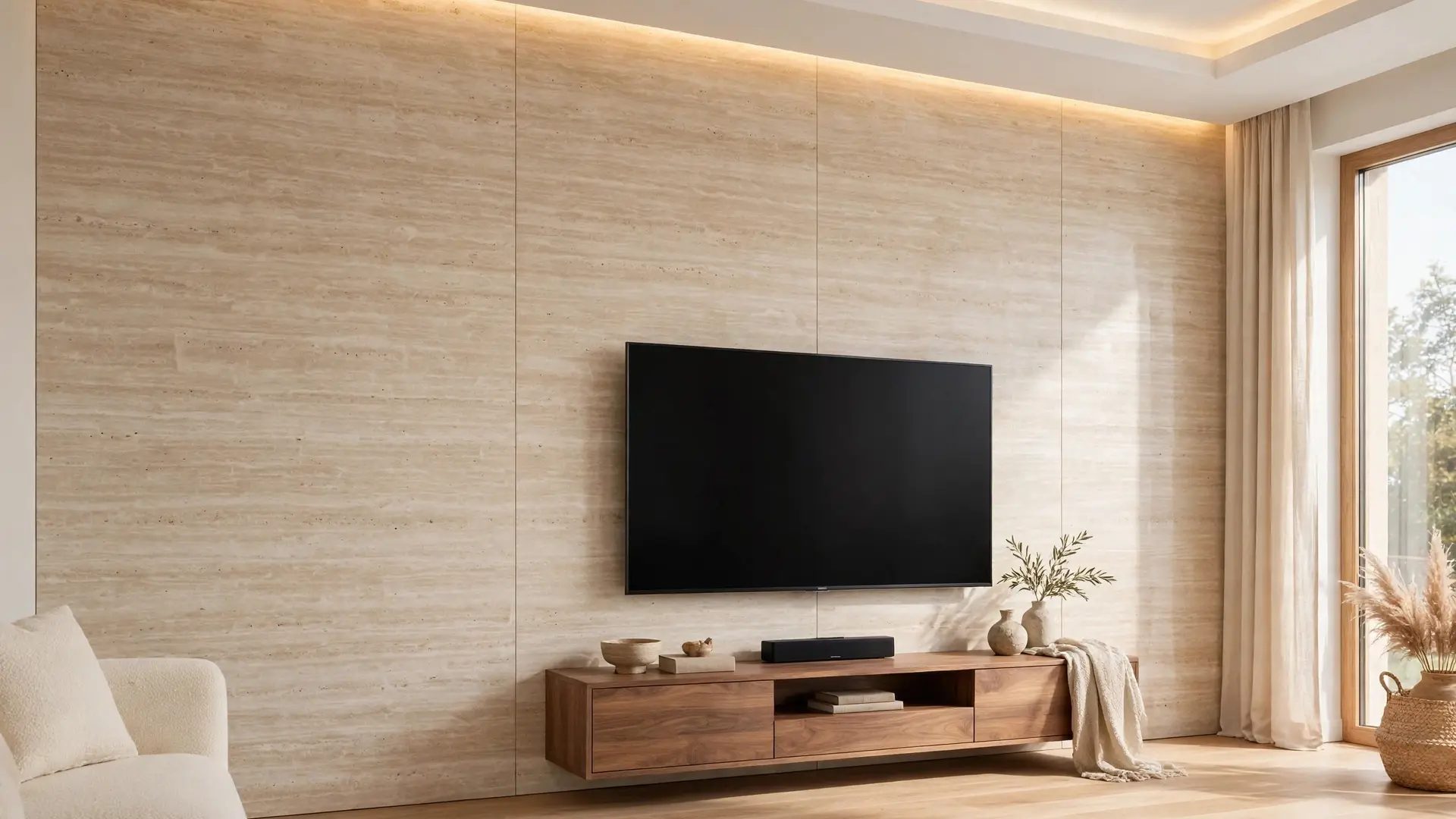
Every buyer asks me the same honest question first: is there any bamboo in this wall at all? Yes – as fiber or charcoal powder inside an engineered core. There are no bamboo poles on your wall, and no sheet of real bamboo either. I install wall panels for WOW Walls Studio here in South Florida, and for a full-height feature wall this is the class I reach for first. Below I explain what the board really is, why walls built with it hold up, which finish fits which room, and where the marketing runs ahead of the evidence.
My position, up front: this is a Chinese composite product, and I say so plainly to every client. The value is consistency – flat panels, even thickness, large floor-to-ceiling formats, minimal seams, and finishes from travertine to velvet. The risk is confusion. The same family sells under five names, spec sheets mix Chinese grades with American ones, and factory prices get quoted as if they were installed prices. I will untangle all three below.
What bamboo composite wall panels actually are
TL;DR: A bamboo composite panel is an extruded board with a core of bamboo fiber or bamboo charcoal powder, PVC resin, wood powder, calcium carbonate, and additives, finished with a decorative film face. The word bamboo names an ingredient in the core. It describes the feedstock, and it stops there.
Start with the core. The core is the product. Consmos describes its bamboo fiber integrated board – also sold as a wood plastic composite, or WPC, wall panel – as PVC resin, bamboo fiber, wood fiber, light calcium carbonate, and auxiliary materials, formed through a micro-foaming process (Consmos). Coowin gives a precise recipe for one fluted line: 45 percent PVC, 20 percent calcium carbonate, 28 percent wood powder, and 7 percent additives (Coowin). Other factories publish different splits – one listing shows 35 percent PVC, 62 percent calcium carbonate, and 3 percent additives (Ecer), and Mossen Decor lists PVC or PP plus wood powder plus stone powder (Mossen Decor). The key point is simple: there is no single fixed formula for this class. Recipes vary by factory and by line, so I never quote a bamboo content percentage to a buyer. Ask for the spec sheet and test reports for the exact panel you are buying.
How it is made explains how it behaves. In WPC extrusion, fibers and polymer are mixed with additives, heated and melted, forced through a die that shapes the profile, cooled, cut, and finished (Medium). One supplier comparison draws a line inside the family: plain bamboo wood fiber board is a substrate with PVC film hot-pressed onto it, while bamboo charcoal board is made by multi-layer co-extrusion, with a charcoal middle layer and PVC layers above and below it (China-Sups). That is why extrusion matters: the core stays the same through the whole sheet. Cut one open and the edge shows composite – no wood grain, since there is no solid wood there to show.
The naming maze is real. The same family sells as bamboo fiber board, bamboo charcoal board, bamboo charcoal wood veneer, carbon crystal board, and WPC wall panel – one supplier page even treats bamboo charcoal board as another name for PVC foam board and carbon crystal plate (Ecer). When five listings use five names, compare the recipe, thickness, and test reports. The name is the weakest evidence on the page.
Sizes, at least, stay consistent across factories. The standard sheet is 1220 mm wide, in lengths of 2440, 2600, 2800, and 3000 mm, most often 5 mm or 8 mm thick, with some lines also listing 9, 15, and 18 mm (Chanta; GlobalSources). In American terms, 1220 by 2440 mm is the metric 4x8 ft sheet, covering 32 sq ft – US retailer NewGen Depot sells its bamboo charcoal sheet in exactly that format (NewGen Depot). Weight: 3.0-6.0 kg per sq m (Mossen Decor), and per-sheet weights of 10.42 kg at 5 mm and 15.5 kg at 8 mm (Ecer) (single-source) – roughly 23 lb and 34 lb per sheet, one-person handling.
One spec-sheet item needs a plain explanation: formaldehyde grades. E1, E0, and ENF are emission grades under China GB/T 39600-2021, with limits of E1 at or below 0.124 mg per cubic meter, E0 at or below 0.050, and ENF at or below 0.025 (GIG QC; Rebon Cabinets). Even the strictest grade has a non-zero limit, so a listing title claiming zero formaldehyde is a vendor claim to check against a test report (vendor claim, Maystar). Units matter too: the desiccator method reports E0 and E1 in mg per liter (Sumec Building Material).
A note on what this product replaced in my work: the narrow wood slat wall was the default texture a few years ago, and it has dated fast. A broad, flat panel face reads current where slats no longer do. I compare the two older profiles in my fluted panels vs wood slat panels guide.
Why they last when the job is done right
TL;DR: These panels last when four ordinary conditions hold at once: a consistent engineered core, a flat and dry wall on install day, sealed cut edges, and a conditioned room with furniture-level care. In my experience on jobs, panel walls that fail early fail at planning and edges, rarely in the middle of a panel face.
First, the core itself. An engineered composite has no timber grain direction, so in normal indoor use it has no grain line to split along. Panel after panel behaves the same way. On a wall, that consistency is the whole game. Flat sheets at an even thickness let me plan seams tightly, so a large wall reads as one even surface. Trade opinion: consistency is the honest selling point of a composite, ahead of any talk about natural materials.
The second and third reasons are install-day decisions, which I cover below. A large rigid panel telegraphs the wall behind it: humps and hollows at install become flexing panels and shadowed seams later. Cut edges expose the core, so each one needs sealing or a proper edge finish. Fourth, the room. A conditioned home is a stable environment for this class. Weeks unconditioned in a Florida August will stress-test the seams and adhesives on any panel system. Care is modest – felt pads, gentle cleaning, no abrasive scrubbing. I compared how panel walls age against the common alternative in my wall panels vs wallpaper guide.
Now the lifespan numbers, handled honestly. Manufacturers publish service-life figures, and every one of them is a vendor claim: 30 years indoor from Chanta (vendor claim, Chanta), 30 years in the Consmos metallic FAQ alongside a 5-year warranty on that product (vendor claim, Consmos), 25 years or more in an Ecer roundup (vendor claim, Ecer), and 10-15 years or longer in one installation guide (vendor claim, WPCSPC). That spread is why I anchor buyers on the warranty instead: 3 years on the E-Well travertine lines (E-Well) and 5 years on the Consmos metallic line (Consmos). A warranty is an enforceable promise. A service-life figure is a hope printed in a listing. No independent long-term US field data for this exact panel was found in my research.
The documented failure patterns point the same way. Buyer-pain guides for PVC and WPC panels – products that share the film face, plastic core, and installation method with this class – warn about expansion opening gaps when spacing leaves no room for movement (Sugermint), fading under prolonged sunlight (Sugermint), and scratches and dullness in high-traffic areas (Coohom). None of those failures start in the middle of a sheet. They start at gaps, edges, light, and contact points – the planning details.
Bamboo composite vs PVC sheet vs MDF vs WPC and real wood
TL;DR: For a humid Florida feature wall, bamboo composite is the strongest all-round pick in this set when the substrate is dry and the edges are sealed. Plain PVC sheet is cheaper and fully moisture-proof with a less premium feel, MDF is the weakest choice anywhere humidity reaches, generic WPC follows the same logic as bamboo composite, and real wood asks for the most upkeep in this climate.
Buyers compare these five options on the same showroom visit, so here they are in one place. The sources discuss WPC in general, and bamboo composite is a WPC sub-type, so I apply them with that label attached.
| Factor | Bamboo composite | Solid or hollow PVC sheet | MDF panel | Generic WPC | Real wood |
|---|---|---|---|---|---|
| Core | Bamboo fiber or charcoal plus PVC, wood powder, calcium carbonate, and additives, extruded (Consmos; Coowin) | PVC only, often a hollow core or foam board | Wood fibers compressed with resin (BestBuy93) | Wood fiber plus polymer | Solid timber |
| Water and humidity | Low absorption claimed by makers; the core does not swell the way MDF does (vendor claims, Chanta; RunTai WPC) | Excellent water resistance; lightest and cheapest option, and the texture can look artificial (Connecticut Chronicle) | Highly sensitive to moisture; once exposed to water it swells and loses strength (FinancialContent) | Better moisture and mold resistance than MDF (FinancialContent) | Sensitive to humidity and temperature; can crack, warp, or expand (Connecticut Chronicle) |
| Weight | 3.0-6.0 kg per sq m documented (Mossen Decor; Wallcoverings) | Usually lighter than WPC (BestBuy93) | Dense and heavy for its size | Heavier than basic PVC, usually pricier than basic PVC (BestBuy93) | Varies widely by species |
| Strength and feel | Higher structural strength and a more realistic texture than standard PVC, per a syndicated WPC comparison (Connecticut Chronicle) – vendor-leaning source | Lower structural strength; a hollow feel on thin sheets | Smooth and paintable, good in dry rooms (BestBuy93) | Better scratch resistance with co-extrusion and embossing (Connecticut Chronicle) | Premium natural texture, repairable, needs sealing and upkeep |
| Maintenance | Damp cloth and neutral cleaner – see the care section below | Easy to clean; may discolor over time (FinancialContent) | Repaint after damage (FinancialContent) | Minimal; water or neutral detergent is enough (FinancialContent) – vendor-leaning source | Regular polishing and painting (FinancialContent) |
| Florida humidity verdict | Best fit of this set for humid rooms, given a dry substrate and sealed edges | Also moisture-proof, lower cost, less premium feel | Weakest choice for humid or wet-prone walls | Similar logic to bamboo composite | Highest movement and upkeep risk in humidity |
In plain language: MDF – medium-density fiberboard, wood fibers pressed with resin – makes a fine painted panel in a dry room, and it is the first material I rule out when a wall has any moisture history. PVC sheet is the budget workhorse: a trade-forum installer warns that 3 mm sheets warp at large sizes and advises 5 mm or thicker (uksignboards). Real wood is the only option here a craftsman can sand and repair back to new, and in Florida humidity you pay for that with movement, sealing, and upkeep.
Finishes: travertine, marble, porcelain-look, veneer, leather, velvet
TL;DR: All six finishes ride on the same composite core under a different film skin – PVC, PET, PP, or metal film. Travertine fits living rooms and TV walls, marble-look fits statement and fireplace walls, porcelain-look gives a grout-free slab read outside wet and heat zones, veneer fits offices and bedrooms, leather fits quiet tailored rooms, and velvet fits headboard walls and glare-sensitive media rooms.
When you ask for travertine or walnut, you are really choosing a film and a surface finish over the same core. Documented finish families include marble grain, wood grain, solid color, and 3D designs, with surface films in PP, PVC, PET, and metal film (E-Well), plus cloth color, PU skin color, PET metallic, metal brushed, and mirror on another line (BestSuppliers). Ask about the core and the film separately – they age separately. Here is how I match the six studio finishes to rooms, as trade opinion.
Travertine finish. A warm, matte, stone-with-pores look – one maker describes a travertine surface with layered pores (E-Well). In my experience this is the easiest finish to live with on a big wall: living room feature walls, TV walls, entry walls, hallways, and primary bedrooms. It hides dust and fingerprints better than a bright polished finish, and pairs naturally with warm LED at 2700K to 3000K.
Marble and stone look finish. White or light grounds with veining, the Calacatta family and its relatives. Best fit: statement walls, TV media walls, primary bedroom walls, and powder room walls outside wet zones – the finish buyers pick when they wanted real stone first. My gloss guidance: satin to medium polish reads as stone from normal viewing distance, and mirror gloss reads as laminate. One wall in a bold vein is a statement. Four walls of it is fatigue. Fireplace heat rules for this finish live in my fireplace accent wall guide, and the deep dive on varieties and gloss lives in my marble-look wall panels guide.
Large-format porcelain look finish. This gives you the read of big porcelain slabs – stone, concrete, or solid faces – in panel form. Best fit: living and dining walls where the buyer wants a slab look with a few planned joints in place of a grout grid, kitchen walls outside splash and heat zones, and bathroom walls outside the shower. Inside a shower or behind a range, use a material rated for direct water or heat. A look is a surface. It carries no rating with it.
Wood veneer finish. Real-wood-look warmth on a broad, flat face. Best fit: home offices, media rooms, primary bedrooms, dining walls, and built-in shelf compositions. This is the finish I suggest when a buyer liked wood slats and wants something current. Check grain repetition across panels on samples: a repeating grain rhythm is the giveaway of a print. The comparison behind that advice is in my fluted panels vs wood slat panels guide.
Leather finish. Matte, fine-grain, with a slightly soft visual texture. Best fit: home offices and studies, media rooms, headboard walls, and dressing room feature walls. It reads quiet and tailored alongside warm metal and low-glare lighting – a background finish, valued for calm. Dark tones show dust on sun-flooded walls.
Velvet finish. Soft, matte, fabric-like visual depth, and the lowest glare in the range. Best fit: headboard walls, dressing rooms, quiet alcoves, and media rooms where screen glare control matters. Keep it away from kitchens and greasy hands, and run the wipe test below before you commit. One clarification: I make no acoustic rating claim for these soft-look finishes. A velvet look is just a look.
The cross-finish rule I give every buyer: pick one statement finish per room and let the other walls go quiet. Two bold finishes fighting on adjoining walls is the most common planning mistake I get asked to fix on paper.
Florida humidity: where they belong and where they do not
TL;DR: This panel class is moisture-resistant. It belongs in conditioned living spaces with sealed cut edges and a dry substrate, and it stays out of showers and unprotected splash zones. The panel face handles humidity well. The wall behind the panel is where Florida jobs succeed or fail.
The evidence for the face is decent – with the labels attached. Chanta lists water absorption under 1 percent and describes its panel as waterproof (Chanta) (vendor claim, single-source for the under-1-percent figure). A WPC cladding guide states that the composite does not absorb water, so it will not swell or degrade, and positions it for coastal or tropical climates (WallPanelPVC). A manufacturer FAQ claims the substrate avoids swelling unlike natural solid wood, with anti-mold performance for humid seaside buildings (vendor claim, RunTai WPC). Makers routinely list mould-proof among their features (vendor claim, Coowin). A non-porous face gives mold very little to feed on compared with paper-faced drywall or raw MDF – a real advantage in this climate, stated at the right size.
Now the limit – the most important point in this section. A water-resistant face says nothing about moisture arriving from behind the panel. A disadvantages guide for PVC panels warns that moisture trapped behind paneling can support hidden mold growth, citing CDC guidance on concealed mold (Coohom). That applies to any impermeable covering over a damp substrate. My rule: fix leaks first, dry the substrate, and never panel over a wet wall. The panel will hide the stain, and it will keep hiding what grows behind it.
The everyday rules are simple. Keep the home conditioned year-round, and when you travel, hold the AC at a reasonable setpoint instead of switching it off. Seal every cut edge, at outlets, at the floor line, at niche returns – the finished face is the protected surface, and a cut edge exposes core. Keep the bottom edge out of standing water, and plan the skirting detail so mopping never soaks it. In a condo, check building rules and the wall assembly behind the drywall before planning.
Wet zones get a hard line. This class does not go inside a shower, does not serve as a shower surround, and does not belong behind a sink as an unprotected backsplash. Bathroom walls outside wet zones are a reasonable use, with a waterproofing plan anywhere splashing is routine. PVC and WPC cores are the waterproof classes here, and I keep the moisture-resistant label for composite separate on every quote. For the full core-by-core logic, see my Florida humidity guide.
How installation works: the drawing, the TV mount, cables, shelves, and LED
TL;DR: Installation starts with a drawing: panel layout, seam positions, TV position, shelf lines, LED coves, and cable paths, all fixed before the first panel goes up. Panels hang with adhesive on flat walls or on a frame where walls are uneven, the TV mount bolts into studs or blocking through the panel, and shelves fix to structure. The panel is a finish. Structure carries every load.
The drawing comes first on every job I run. Before we order or cut anything, we draw the wall: where each seam lands, where the TV sits, where shelves and LED coves run, and where outlets and cables go. Most bad panel walls I get called to assess were installed with skill and planned with none.
Under that drawing, wall prep decides the job. Kosmos guidance requires wall flatness within 2 mm per 1 m, a dry surface for the adhesive bond, and a frame system spaced at or under 50 cm when the wall is not flat or the panel is going on a ceiling (Kosmos). My own check matches: a long straightedge for humps and hollows, corners for plumb, and a substrate that is sound, dry, and clean. Unevenness gets corrected in prep – a rigid panel bridging a hollow will flex and throw a shadow at the seam. Panels rest in the room, in its normal conditioned climate, before fitting, stored flat and handled by the edges.
Two fixing methods cover most jobs. On a flat wall, direct glue: Kosmos advises neutral glue to avoid surface corrosion, with double-sided tape holding the panel while the glue cures (Kosmos); one supplier guide adds pressing within 10 minutes, no movement after bonding, and 1 day while the adhesive sets (BestSuppliers) (single-source for the timing details). On an uneven wall, a frame: screw fixing on wood or aluminum battens spaced 30-50 cm (Pusen Wood). Interlocking edges help alignment – Chanta lists interlocking as its method (Chanta), and tongue-and-groove edges give a flat seam or a V-seam (FindSupply). Interlocking never makes a seam invisible, so I plan seams where the eye expects a break: at a niche edge, a shelf line, or a change of plane.
Expansion gaps are a small detail that can cost you. One guide recommends a 1-2 mm gap for thermal movement (WPCSPC); a general WPC problem guide recommends one-quarter inch for its format (Sugermint). The figures conflict because the formats differ: follow the instructions for your specific panel. Seam finishing options include aluminum strips, PVC color-matched trims, and butt joints (WPCSPC). For corners, Kosmos mills a V-groove about 1 mm deep into the core for a 90-degree bend, leaving the film uncut (Kosmos). The WPCSPC mistakes list summarizes this section: damp walls, low-quality adhesive, ignored gaps, uneven prep, rushed alignment (WPCSPC).
The TV question deserves its own paragraph, because every media wall client asks it. The mount never hangs on the panel. Lag bolts pass through the panel into studs, or into blocking – for example plywood blocking fitted behind the drywall at the TV position – planned before the panel layout. I publish no TV weight rating for a panel, because the panel carries no TV. Cables are decided while the wall is bare: a recessed channel behind the panels carries HDMI, power, and low-voltage in one run to the console. After panels are up, the options are visible raceways or opening the wall. Leave room around a TV in a niche for air to move, and never seal a niche airtight. The full TV and LED method is in my TV accent wall guide.
LED and shelves finish the composition. Light should read as a glow. The strip sits in a cove, a channel, or the gap behind a floating element, with a diffuser where needed, so you see a lit surface and never count the diodes. Warm white at 2700K to 3000K keeps warm finishes reading true; cool white at 5000K and above turns them greenish and clinical – trade opinion. Plan driver location and switching on the drawing. Shelves follow the TV rule: recessed into the layout, sizes coordinated so a seam never lands mid-niche, every shelf fixed to structure. What a shelf can hold is a structure question. The panel face answers no load questions. One honesty note on speed: supplier claims include 10 sq m in one hour (vendor claim, YouTube) and 20-30 sq m per day per carpenter (vendor claim, FindSupply). Treat both as marketing.
The honest cost picture: factory prices, one US price, and no invented installed price
TL;DR: Documented prices for this product are China factory prices in bulk, plus exactly one US retail material price found in my research. No credible US installed price for bamboo composite panels specifically was found. Your installed cost in South Florida depends on wall prep, trim, and labor, and it comes from a local quote for your project.
Factory prices first, labeled as factory prices every time. Coowin lists its UV marble and bamboo veneer sheet at FOB US$13.32 per piece for 150-499 pieces, US$12.75 at 500-2,999, US$11.90 at 3,000-4,999, and US$10.48 at 5,000 and above (Coowin). Per-square-meter listings run lower: a travertine carbon crystal line at FOB US$2.35-4.32 per sq m, 50 sq m minimum (E-Well), a carbon crystal plate at US$2.25-3.96 per sq m (Ecer), and a bamboo fiber panel at US$5.40 per sq m, falling to US$5.10 at volume (Wallcoverings). Wholesale per-piece listings include US$9.69 (BestSuppliers) and US$7.93 (Consmos), and prior research found a broader China B2B band of roughly US$4.50-20 per panel (Alibaba; BestSuppliers). Aggregator pages mix unlike products at huge minimum orders, with ranges as low as US$0.29-0.35 per sq ft in bulk (Accio) – noise for a homeowner budget.
A factory price leaves out most of your real cost: freight, duty, US warehousing, breakage, trim, adhesive, labor, and installer margin. A US$10 factory sheet tells you the material class is inexpensive at origin, and nothing honest about a finished wall in Fort Lauderdale.
The US retail evidence is thin, so I present it at its true size. NewGen Depot, a US retailer in Saddle Brook, New Jersey, lists a Cocoa Gray bamboo charcoal sheet at 4x8 ft, 32 sq ft, for US$49.00 against a US$129.00 list price, shown as out of stock as fetched (NewGen Depot). The arithmetic gives about US$1.53 per sq ft, material only – a single retailer and a single SKU (single-source for US retail), never a national average. For contrast only, the same retailer class sells a plain PVC marble sheet at US$70 for 4x8 ft (NewGen Depot), priced here solely to show how close the budget categories sit at retail.
Now the gap, stated plainly. No credible US installed price – material plus labor, per sq ft or per wall – for bamboo composite panels specifically turned up in this research. No installer price list, no major cost-guide entry, no trade article quoting one. So this article publishes no installed number of its own. What drives yours is knowable, though: wall size and prep, finish, trim, built-in shelves, LED coves, and cable work, all priced by a local crew looking at your actual wall. For verified published estimates across panel types generally, see my wall panels cost guide. Get this number as a written, itemized local quote, and be suspicious of any site offering a national installed average for this product. At the time of this research, that number does not exist in public.
Fire ratings, honestly: what B1 means and what it does not
TL;DR: B1 on these spec sheets is a Chinese GB 8624 grade. It is a separate national system from the American ASTM E84 test, and the two do not convert into each other. ASTM E84 Class A means a flame spread index of 0-25 and a smoke developed index of 0-450. No ASTM E84 test report for a bamboo composite panel was found in this research, so ask for the actual report for the exact panel before anyone uses fire language on your project.
Fire language is where panel marketing gets slippery, so here are both systems, each with its own definition. In the United States, interior finish classes come from ASTM E84, the Steiner tunnel test, in which a sample is exposed to flame for 10 minutes while flame spread and smoke are measured (My Material Warehouse). Class A is a flame spread index of 0-25 and a smoke developed index of 0-450 (CSI Creative), with Class B at 26-75 and Class C at 76-200, smoke cap 0-450 across classes (T-FIT; US Made Supply).
B1 belongs to a different country and a different test. Under China GB 8624, grade A is non-combustible and B1 is the flame-retardant grade (Google Patents). A summary of the older GB 8624-97 describes B1 materials as difficult to catch fire, slow to spread flame, and stopping when the fire source is removed (OKorder). B1 is also the grade these panels actually claim: Chanta lists flame-retardant level B1 (Chanta), a BestSuppliers travertine line lists Grade B1 (BestSuppliers), and the Consmos metallic line lists B1 or B2 in its FAQ (Consmos).
The systems do not translate. An ALPOLIC technical bulletin warns that different national fire systems are not compatible or interchangeable, that a rating from another system gives no assurance a material will pass US tests, and that US projects need ASTM E84 and NFPA 285 where required (ALPOLIC Americas). So: words like fireproof on a retail listing are marketing (vendor claim), and a B1 grade tells you the maker tested to a Chinese system. Where US code language matters – a condo with finish rules, a commercial space, an insurer asking questions – ask for the ASTM E84 report for the exact panel, tested with its actual mounting method. In this research, no such report was found. That absence is a fact worth knowing before you buy.
Day-to-day heat is a separate topic, and it comes up on media walls with fireplaces. Care guidance sets its own limits – Kosmos advises keeping panels away from heat sources over 50 degrees C (Kosmos) – and fireplace walls have clearance planning of their own, covered in my fireplace accent wall guide. Keep the two separate: a temperature limit is a usage instruction, and a fire rating is a tested classification. Sellers blur them on purpose.
Care and maintenance: simple cleaning, and what ages first
TL;DR: Care is a soft damp cloth, a diluted neutral cleaner, and a ban on abrasives and hard brushes. No sealing, painting, or polishing appears in any care guide for this product. What ages first is predictable: cut edges, high-touch zones, sun-struck areas, and any spot where moisture sits unnoticed.
The published guidance all points the same way. Kosmos cleaning guidance: damp cloth, diluted neutral-pH solution, no sharp objects or hard brushes, maintenance every 3-6 months, avoid direct sunlight, keep temperature under 50 degrees C and away from heat sources over 50 degrees C, and hold room humidity at 40-70 percent (Kosmos). A supplier guide adds a slightly damp soft lint-free cloth daily, spills wiped immediately, and a monthly pass with a cleaner made for wooden furniture (Dreamhouse Panel). Two more guides land in the same place: mild detergent, no abrasives, no direct water flow, regular dusting (WPCSPC), plus an annual bonding check (Aesthedge Wall Panel).
Compare that with the other columns in the table. Real wood asks for polishing and painting. Painted MDF asks for repainting after damage. This panel asks for a cloth and a neutral cleaner, with nothing to seal, paint, or polish. Low maintenance is a fair claim. Maintenance-free is a claim nobody honest makes – a syndicated WPC review makes the same point for the wider family, noting that poorly sealed cuts are prone to staining (Washington Guardian). That review covers outdoor fence panels, so I cite it as a caution on language: seal cuts, expect washing, and treat zero-maintenance promises as a sales tell.
What ages first? This is trade opinion, built on the failure patterns above. Edges and seams go first, because every weakness in this system lives at a joint: an unsealed cut near a sink, a bottom edge meeting mop water every week, a gap planned too tight for summer expansion. High-touch zones go next – the Coohom guide notes scratches, dents, and dullness as PVC panels age, with aggressive cleaning making the sheen uneven (Coohom). Sun exposure follows: prolonged sunlight can fade paneling despite fade-resistance claims (Sugermint). Clean gently, check edges once a year, and the face is the last thing to age.
One air-quality note: the Coohom guide, citing EPA guidance on volatile organic compounds, warns that new PVC panels can give off a new-plastic smell that lingers for weeks in small or poorly ventilated spaces, and flags children and allergy sufferers as a higher concern (Coohom). Ask for the emission grade and test report for your exact panel before you buy, and ventilate the room well after installation.
The sample tests I want you to run before you buy
TL;DR: Run these tests on the actual finish you are buying: the light test at a window and under a warm lamp, the distance test at 10 to 12 feet, the seam and repetition test with two samples butted together, the edge test on the cut core, a gentle fingernail and coin test, a wipe test, a water-drop test on the cut edge, and a tap test. A sample that fails the light and repetition tests will fail on your wall at full size.
Never approve a finish from a photo or one small sample alone. Printed finishes mislead at small scale: a disadvantages guide notes that they often fail to mimic wood, marble, or stone up close, and that showroom samples do not predict everyday wear (Coohom); a designer review names visible pattern repeat as the detail that betrays a panel (Bigelow Designs). These eight tests take ten minutes and no equipment.
- The light test. Tilt the sample against daylight at a window, then check it under a warm indoor lamp. Cheap prints fail here: the surface glares flat, or the pattern looks painted on. A good finish keeps its contrast in both lights.
- The distance test. Hold the sample at arm length, then have someone hold it across the room, 10 to 12 feet away – how the wall will actually be seen. If it reads as travertine, stone, wood, or fabric from across the room, it will read that way installed. If it only convinces at six inches, the pattern is too fine or too repetitive.
- The seam and repetition test. Butt two or three samples or offcuts together – that joint is your wall in miniature. Watch whether the pattern rhythm breaks at the joint, and whether the same vein or grain figure repeats so the eye catches a grid. Visible repetition is the number one giveaway of a printed finish – that is trade opinion, and this is the test I weight most.
- The edge test. Spend as much time on the cut edge as on the face. The edge shows the core this article described: composite, all the way through. Check that the finish layer is well bonded at the edge, and ask how cut edges on the real wall will be finished and sealed. A vague answer at sample stage becomes an unsealed edge on your wall.
- The fingernail and coin test, gently. Press a fingernail into an inconspicuous corner, and drag a coin lightly across a back corner the seller agrees to sacrifice. You are checking whether the face marks at the slightest touch. No finish in this class is scratch-proof, and anyone who uses that word is selling.
- The wipe test. Add a fingertip smudge, and a drop of coffee or water if the seller allows it. Wait a few minutes, wipe with a damp soft cloth, and check for staining, gloss change, or finish lifting at the edge. This matters most for velvet and leather finishes.
- The water-drop edge test. Put a drop of water on the cut edge – on the core, away from the face – and watch for a minute. A composite core shows you it is a fiber composite. That teaches the two big rules of this article: edges get sealed, and this class stays out of showers.
- The tap test. Tap the face with a knuckle. It sounds like a panel, and it will never sound like stone or solid wood. Run this test now and the expectation is set before install day.
Bring the sample home, lean it against the actual wall, and live with it through a morning and an evening before you decide.
My verdict for South Florida homes
TL;DR: Bamboo composite panels are the honest buy for a full-height feature wall in a conditioned South Florida home: a consistent core, large formats with minimal seams, six finishes on one system, and care that fits on an index card. Pick a waterproof class for wet zones, real stone when the budget and structure truly support it, and a different seller when no spec sheet appears.
Here is my verdict as an installer. If your project is a living room, dining room, entry, or primary bedroom in a conditioned home across Palm Beach, Broward, or Miami-Dade, this is the panel class I install first, for four practical reasons. The format runs floor to ceiling as large sheets, so the wall reads as one continuous surface. The finish range – travertine, marble-look, porcelain-look, veneer, leather, velvet – rides on one system, so one team plans every room the same way. The weight keeps the job a routine install on normal residential walls, in place of the engineering a stone slab demands. And the install itself is a planned panel job over a sound, flat wall – no wet trades, no grout to cure or scrub.
If your wall sits inside a shower, takes direct splash daily, or lives in a room that sits unconditioned for months, choose a genuinely waterproof PVC or WPC product, or a rated wet-zone material. If you want real stone and your budget and structure support real stone, buy real stone – a marble-look finish reads as stone from normal viewing distance, and that sentence, with its limit inside it, is the honest one. My deeper comparison of that finish family is in my marble-look wall panels guide.
What I will never tell you: that this product is real bamboo, that a B1 grade equals an American fire rating, that a factory price predicts your installed cost, or that any panel in this class asks for zero care. Run the tests, ask for the spec sheet and test reports for the exact panel, get the installed price as a written local quote, and this wall will reward you every time you walk past it.
Sources
- Consmos, bamboo fiber integrated board / WPC wall panel listing (core: PVC resin, bamboo fiber, wood fiber, light calcium carbonate, micro-foaming; metallic line FAQ: B1 or B2, 30-year service life vendor claim, 5-year warranty, US$7.93). consmos.en.made-in-china.com and consmos.en.made-in-china.com
- Coowin, WPC bamboo fiber fluted panel listing (recipe 45% PVC, 20% calcium carbonate, 28% wood powder, 7% additives; moisture-proof and mould-proof vendor claims); FOB prices US$13.32 / 12.75 / 11.90 / 10.48 per piece by volume. coowinwpc.en.made-in-china.com and made-in-china.com
- Ecer, bamboo walls roundup and carbon crystal listing (recipe variants 35% PVC with 62% CaCO3 and 3% additive, and 35% PVC with 60% CaCO3 and wood powder; US$2.25-3.96 per sq m; sheet weights 10.42 kg at 5 mm and 15.5 kg at 8 mm, single-source; 25+ year service life vendor claim). ecer.com and ecer.com
- Mossen Decor, PVC marble wall panel listing (core PVC or PP plus wood powder plus stone powder; weight 3.0-6.0 kg per sq m; density 0.65-0.75). mossendecor.en.made-in-china.com
- Chanta, bamboo charcoal fiber board listing (sizes 1220x2440/2600/2800/3000 mm; thickness 5/8/9/15/18 mm; water absorption under 1 percent, vendor claim, single-source; flame-retardant grade B1; interlocking install; 30-year indoor service life vendor claim). cnchanta.en.made-in-china.com
- GlobalSources, wall panel listing (sizes 1220x2440/2800/2900 mm; thickness 5/8 mm). globalsources.com
- E-Well, travertine carbon crystal bamboo charcoal listings (travertine look with layered pores; films PP, PVC, PET, metal; designs marble, wood, solid, 3D; 3-year warranty; FOB US$2.35-4.32 per sq m). e-well.en.made-in-china.com and e-well.en.made-in-china.com and made-in-china.com
- BestSuppliers, bamboo charcoal listings (finish families incl. wooden, stone, cloth, PU skin, PET metallic, metal brushed, mirror; Grade B1 travertine line; US$9.69 per piece wholesale; tape-plus-adhesive install timing, single-source; slot and U-slot splicing; China B2B band context). bestsuppliers.com and bestsuppliers.com and bestsuppliers.com and bestsuppliers.com
- Medium, WPC extrusion guide (mix, melt, die shaping, cooling, cutting, finishing – paraphrase). medium.com
- China-Sups, supplier comparison (bamboo fiber board hot-pressed film vs bamboo charcoal board multi-layer co-extrusion – paraphrase). china-sups.com
- Maystar, bamboo fiber wall panel listing (double-layer co-extrusion; zero formaldehyde title claim flagged as vendor claim). maystar.en.made-in-china.com
- Jwell Machinery, WPC extrusion machinery listing (fiber prep: crush, mill, screen, dry, additives, single-source; 30-day immersion claim vendor claim). jwellmachinery.en.made-in-china.com
- GIG QC, formaldehyde grade summary (GB/T 39600-2021: E1 at or below 0.124, E0 at or below 0.050, ENF at or below 0.025 mg per cubic meter). gigqc.com
- Rebon Cabinets, formaldehyde emission grades (same E1, E0, ENF limits in mg per cubic meter). reboncabinets.com
- Sumec Building Material, plywood formaldehyde standards (desiccator method contrast: E0 0.5 mg per liter, E1 1.5 mg per liter – units warning). sumecbuildingmaterial.com
- NewGen Depot, Cocoa Gray bamboo charcoal wood veneer (US retail: US$49.00, list US$129.00, 4x8 ft, 32 sq ft, out of stock as fetched, single-source for US retail). newgendepot.com
- NewGen Depot, Calacatta Manhattan PVC marble sheet (plain PVC contrast only: US$70 for 4x8 ft – not bamboo composite pricing). newgendepot.com
- Wallcoverings, bamboo fiber wall panel listings (FOB US$5.40 / 5.10 per sq m by volume; water ripple board US$9.00 / 8.40 per sq m; weight 3.8-6.0 kg per sq m). wallcoverings.en.made-in-china.com and wallcoverings.en.made-in-china.com
- Alibaba, charcoal panel showroom (China B2B pricing band roughly US$4.50-20 per panel – factory prices). alibaba.com
- Accio, bamboo veneer wall panel aggregator (bulk ranges cited only with caution – not a consumer price). accio.com
- WPCSPC, bamboo charcoal wood veneer installation guide (expansion gap 1-2 mm; seam trims; cutting and corners; common mistakes; maintenance; 10-15 year life vendor claim). wpcspc.com
- Sugermint, WPC wall panel problems guide (expansion and contraction, gap and cracking risk, one-quarter inch spacing for its format, fading in sunlight). sugermint.com
- Kosmos, bamboo charcoal panel product page (flatness 2 mm per 1 m; neutral glue plus tape; frame spacing at or under 50 cm; V-groove corners; cleaning: damp cloth, neutral pH, 3-6 month maintenance, avoid sun, under 50 C, humidity 40-70 percent). en.kosmos.vn
- Kosmos, metal bamboo charcoal pricing article (Vietnam geography: up to 15 years vendor claim; material prices in VND, not used as US evidence). en.kosmos.vn
- Pusen Wood, WPC supplier site (glue method vs screw plus frame method, battens 30-50 cm). pusenwood.com
- Dreamhouse Panel, bamboo charcoal wall panel page (buckle plus steel nail installation; daily and monthly maintenance guidance). dreamhouse-panel.com
- Aesthedge Wall Panel, bamboo charcoal installation guide (mild non-abrasive cleaners; no sharp impacts; wipe moisture; annual bonding inspection). aesthedgewallpanel.com
- FindSupply, PVC marble sheet / bamboo veneer WPC panel (tongue-and-groove flat and V seams; 20-30 sq m per day per carpenter vendor claim). findsupply.com
- YouTube, supplier installation video (10 sq m in one hour vendor claim). youtube.com
- WallPanelPVC, WPC cladding for harsh weather (composite does not absorb water; coastal and tropical positioning – paraphrase). wallpanelpvc.com
- RunTai WPC, bamboo charcoal veneer board (anti-swelling and anti-mold FAQ for humid seaside buildings – vendor claim). runtaiwpc.en.made-in-china.com
- Coowin WPC, WPC vs wood panel comparison (mold and warp claims vendor claim; 20 years or more lifespan vendor claim). coowinwpc.com
- CSI Creative, wall cladding fire safety standards (ASTM E84 Class A: flame spread 0-25, smoke developed 0-450). csicreative.com
- T-FIT, application profile (ASTM E84 table: Class A 0-25 / 0-450, Class B 26-75, Class C 76-200). t-fit.org
- US Made Supply, ASTM E84 code summary (same Class A, B, C bands). usmadesupply.com
- My Material Warehouse, Class A fire rating explainer (Steiner tunnel test description; Class A FSI 0-25, SDI 0-450). mymaterialwarehouse.com
- OKorder, construction fire-proof rating Q and A (GB 8624-97: B1 flame-retardant definition – paraphrase). ask.okorder.com
- Google Patents, CN110790583A (GB 8624-2012 grades: A non-combustible, B1 flame retardant, B2 and B3 flammable – paraphrase of translation). patents.google.com
- ALPOLIC Americas, MCM combustibility technical bulletin (national fire systems not compatible or interchangeable; US projects need ASTM E84 / NFPA 285 where required – paraphrase). alpolic-americas.com
- Connecticut Chronicle, syndicated WPC comparison (WPC vs solid wood, PVC, and MDF: humidity, texture, strength, maintenance – paraphrase, vendor-leaning). news.connecticutchronicle.com
- FinancialContent / Kelowna Daily Courier, syndicated WPC comparison (same comparison: MDF swelling, WPC moisture and mold resistance, neutral detergent maintenance – paraphrase). markets.financialcontent.com
- BestBuy93, decorative wall panels buying guide (MDF: wood fibers compressed with resin; ordinary MDF not waterproof; WPC heavier and pricier than basic PVC). bestbuy93.in
- uksignboards trade forum (installer warning: 3 mm sheets warp at large sizes, use 5 mm or thicker – paraphrase, semi-public). uksignboards.com
- Coohom, PVC wall panels disadvantages guide (VOC smell citing EPA; concealed moisture and mold citing CDC; fake look up close; visible seams; scratches and dents). coohom.com
- Bigelow Designs, marble wall panels review (pattern repeat and print quality as what betrays faux panels). bigelowdesigns.com
- Washington Guardian, syndicated WPC fence panel review (cautious lifespan framing 15-25 years citing a 2022 Polymers review; not maintenance-free; sealed cuts – fence context, used only as caution). lifestyle.washingtonguardian.com
- WOW Walls Studio, Marble-Look Wall Panels 2026.
- WOW Walls Studio, Wall Panels in Florida Humidity: MDF vs PVC.
- WOW Walls Studio, Wall Panels Cost 2026.
- WOW Walls Studio, Fireplace Accent Wall Panels.
- WOW Walls Studio, TV Accent Wall with Wood Slats and LED.
- WOW Walls Studio, Fluted Panels vs Wood Slat Panels.
- WOW Walls Studio, Wall Panels vs Wallpaper.