
Marble Wall Panels for the Bedroom: Ideas Behind the Bed (2026)
Marble wall panels for the bedroom, planned around the bed: veining direction, book-match layout, lamp glare, warm and cool tones, and care.
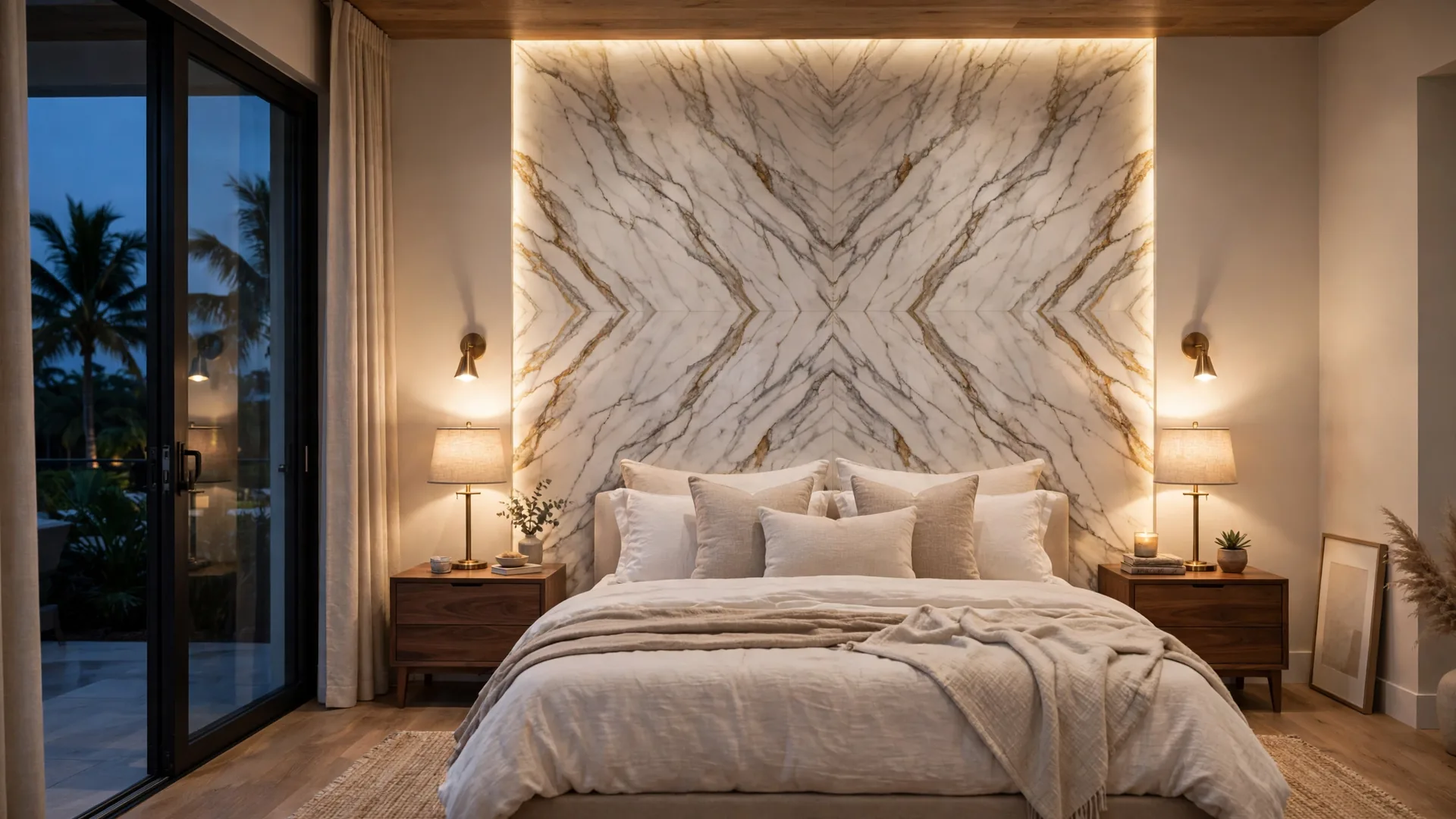
A marble wall behind a bed succeeds or fails on decisions that a living room wall never asks for. You see this wall from one fixed place, lying down, at close range, in low lamplight. The veins sit at eye level for hours. A seam can land in the middle of your pillow view. A glossy finish can throw a lamp reflection at your face. This article works through those bedroom decisions in order.
We are a South Florida studio that designs and installs large-format panel walls. The product our studio installs is a composite marble-look sheet. It gives the marble pattern without the weight of quarried stone. Our general marble wall panels guide compares the three products sold under this name – real marble, large-format porcelain, and composite sheet – by weight, water, care and room. That guide owns the material verdict. This article assumes you are already looking at a marble face for the bedroom. It answers the next question: how should that face be laid out around your bed?
One honesty note before the ideas. A composite marble-look sheet is a manufactured panel with a marble finish on its surface. It is a different product from quarried marble, and it behaves like one. Where real stone wins, we say so. Where the sheet wins, we say why. The bedroom is a dry room, and that fact shapes most of what follows.
The short answer: a marble wall behind the bed, in one view
TL;DR: Plan the wall from the pillow outward. Run the main veins so they read calmly from lying height. Center any book-match pattern on the bed. Keep vein scale in proportion to bed width. Choose a matte or low-sheen finish where lamps sit close. Match marble tone to your bedding before you match it to anything else.
The wall behind the bed has one main viewer position. Every other accent wall in a home gets seen while walking past. This one gets studied. Small layout choices stay visible for years, so the order of decisions matters. Veining direction comes first, because it sets the mood of the whole field. Layout comes second, because seams and mirror patterns lock in early. Scale comes third, because a vein that looks elegant on a sample can shout at full wall size. Finish comes fourth, because lamplight decides whether the wall feels restful. Tone comes fifth, because bedding covers half the view and the two have to agree.
The rest of this article takes those five decisions one at a time. It then covers the practical layer: nightstands, sconces, outlets, wall width, Florida humidity, and care at pillow distance. Cost gets one short section near the end, with no new price bands, on purpose. The money question deserves its own sourced treatment, and it already has one.
> Free design preview: send us a photo of your wall and see it in a new finish. Send the photo you take from the doorway, plus one from the pillow if you can. The pillow view is the one we plan around.
What you are looking at: three products behind one photograph
TL;DR: Real marble is quarried stone. Porcelain is a fired panel with a printed marble face. A composite marble-look panel is a manufactured sheet with a marble finish. All three photograph alike. They differ in weight, care, and how their pattern repeats across a wide wall.
Search results mix the three products freely, and showroom photos rarely label which one you are seeing. Real marble carries a natural pattern that never repeats. Porcelain carries a printed pattern, so a good print looks sharp and stays consistent from panel to panel. A composite sheet carries its marble finish on the surface of a light manufactured board. Our studio sheet measures 48 by 108 inches and 5 mm thick, and it goes up as whole sheets inside a finished project.
For a bedroom wall, the practical gaps between the three are narrower than in a bathroom. No shower spray hits this wall. No cooking grease lands on it. The gaps that remain are pattern behavior, weight, and care. Pattern behavior matters most here. Real stone gives you one-of-one veining and true book-match pairs from a single block. Printed and composite faces give you controlled veining, where the layout can be planned on paper before anything reaches the wall. Our marble wall panels guide walks through the full comparison, including the rooms that rule each product out. Read it before you sign anything. Then come back here for the bedroom layout work.
A plain limit belongs in this section, stated early. The composite sheet our studio installs belongs on dry interior walls. It has no place in a shower wet zone, where water sits on the surface daily. A primary bedroom wall behind the bed is a dry wall, so the sheet fits this job. An en suite shower wall is a different job, with a different product list.
Veining direction: the first decision on the wall
TL;DR: Veining means the mineral lines that run through marble. Behind a bed, gentle horizontal or soft diagonal flow usually reads calmest from the pillow. Strong vertical veins raise the visual energy of the wall and suit tall ceilings. Pick direction from lying height, with the bed in place, before you pick anything else.
Veins form inside the stone as minerals settle in cracks over long periods. On a panel face, they read as lines with direction, weight, and speed. A thick vein pulls the eye along its path. A thin vein whispers in the background. Direction decides where the eye travels while you lie in bed, and that is why it comes before color, before finish, and before layout.
Horizontal flow suits most bedrooms. Lines that drift across the wall echo the long line of the bed itself. The eye moves sideways, slowly, and the wall feels wide and settled. This is the safe direction for a primary bedroom. It also suits a guest room that should feel restful. Any room where the wall sits close to the pillow benefits too. Low ceilings gain from it too, since sideways lines stretch the room visually.
Diagonal flow adds movement. A soft diagonal, rising gently from one side, gives the wall a quiet energy and works well when the rest of the room is plain. Steep diagonals feel alert. In a sleep-first room, steep and busy diagonals can feel restless at close range. Judge them from the pillow, at night, with the lamps on. Daylight hides their energy. Lamplight shows it.
Vertical flow lifts the wall. Veins that climb make a ceiling feel higher and give the bed a formal, hotel-like frame. Tall rooms carry vertical veining well. Standard rooms can carry it too, when the veins stay thin and the background stays quiet. Thick vertical veins on a wide wall can read like stripes, and stripes behind a headboard fight with bedding patterns. If your bedding carries a print, keep vertical veins fine or choose another direction.
One test settles arguments. Hold the sample, or a large printed photo of the exact panel, at the head of the bed. Lie down. Look at it the way you will look at it every night. The direction that feels calm at that distance is the right one, whatever the showroom suggested.
Book-match layout behind a headboard
TL;DR: A book-match layout mirrors two matching faces across a center seam, like pages of an open book. Centered behind a bed, it gives the wall a calm symmetry that suits sleep. It earns its place with bold veining and a centered bed. It adds little on quiet, low-variation faces.
MSI Surfaces, a large stone and surface distributor, describes the method plainly. The technique aligns slabs taken from the same area of a block of stone to create a mirror image, with appealing symmetry. The same source adds a condition that matters for bedrooms. The mirroring technique is compelling when used for slabs featuring bold patterns or distinctive veining. Quiet faces gain little from mirroring, because there is little pattern to carry across the seam.
Behind a bed, the mirror line wants to sit at the center of the bed. The bed then frames the pattern, and the two halves of the design balance each other across the pillows. A centered book-match reads as one composed picture. An off-center one reads as a mistake, even when the workmanship is perfect. This is the layout to fix first on paper, before outlet positions, before sconce positions, and before nightstand widths get final numbers.
Real stone book-match pairs come from consecutive faces of one block, so the mirror is genuine and slightly imperfect. Veins meet at the seam and continue as reflections, with small natural shifts. Composite and printed faces handle the same layout in a planned way. The pattern can be mirrored by design, and the seam placement can be set to the bed width in advance. Both routes can look right. They differ in character. The stone pair carries natural drift. The planned pair carries exact symmetry. Some homeowners love the drift. Others prefer the calm of an exact mirror in a sleeping room. Neither preference is wrong. Know which one you are buying.
Scale the pattern to the bed. A book-match figure wider than the bed spills past the headboard edges and loses its frame. A figure much narrower than the bed looks lost, like a picture hung too small. As a working guide, let the mirrored figure span most of the bed width, with quieter field continuing past it on both sides. On a wide wall, that usually means a book-matched pair at the center and plainer panels at the edges. The eye lands on the composed center. The edges rest.
Skip book-match in three cases. First, when the veining is faint, since mirroring a whisper gives you two whispers. Second, when the bed sits off-center on the wall, since the mirror line and the bed center will disagree every night. Third, when the wall carries doors, windows, or a sconce pair that breaks the field into uneven parts. In those rooms, a calm running layout, where veins flow in one direction across the seams, serves sleep better. MSI puts the underlying rule in one line: the bolder the pattern, the greater the visual impact. Spend that impact only where the room can hold it.
Scale: vein size against bed width
TL;DR: Vein scale means how thick and how bold the marble lines are. Bold, thick veins suit wide beds and wide walls. Fine veins suit narrow beds and close walls. The test is proportion: the largest vein figure should feel like part of the bed composition, sized to it, and calm from the pillow.
A sample board lies. It shows a small slice of pattern at arm's length, under bright store light. The wall shows the full figure at pillow distance, under warm lamps. Veins that looked refined on the sample can dominate the wall. Veins that looked dull on the sample can sit perfectly at full size. Scale is the bridge between the sample and the wall, and bed width is the ruler.
Start with the bed, since it covers the lower half of the wall and sets the visual weight of the composition. A wide bed with a tall headboard carries bold veining well. The furniture mass balances the pattern mass. A low, narrow bed under bold veining gets overwhelmed, and the wall becomes the loudest object in a room built for rest. Match energy to mass. Heavy bed, stronger veins. Light bed, finer veins.
| Bed and wall setup | Vein scale that usually fits | Layout note |
|---|---|---|
| Wide bed, wide wall, tall headboard | Bold veins, strong figure | Book-match center can carry the full bed width |
| Wide bed, standard wall | Medium veins, one strong figure | Keep the boldest figure behind the headboard |
| Narrow bed or low headboard | Fine veins, soft figure | Running layout, quiet field, no mirror figure |
| Bed close to the wall, small room | Fine veins, low contrast | Judge from the pillow, since distance shrinks fast |
Read the table as a starting point for the sample test, which comes later in this article. The pattern also has a rhythm. Veins spaced far apart read as single drawn lines. Veins packed close together read as texture. Behind a bed, single drawn lines at wide spacing usually rest better, because the eye can follow one line and let it go. Dense texture stays busy at close range. If your bedding is plain linen, the wall can carry a touch more rhythm. If your bedding carries stripes, checks, or a floral print, the wall should carry less. One pattern per view is a good rule for a sleeping room. The wall and the bed share every photograph of this room, and they share your last view each night.
Height plays into scale too. A full-height wall shows the whole vein figure, top to bottom. A part-height field, ending above the headboard, shows a slice. Bold figures need room to finish. A strong diagonal that runs off the top edge of a part-height field can look interrupted. Fine veining slices gracefully at any height. Our general bedroom wall panels guide covers width and height rules for bedroom panels in general terms. The marble-specific point is this one: choose the field height after you choose the vein figure, so the figure fits the field.
Matte or polished: lamp glare in a sleeping room
TL;DR: A polished finish is glossy and reflective. A honed or matte finish is flat, with little or no shine. Beside bedside lamps, polished faces can bounce a bright reflection toward the pillow. Matte and low-sheen faces stay calmer at night and forgive small marks. Most bedrooms behind the bed favor matte or soft sheen.
Finish names confuse buyers, so here are plain definitions. Polished marble has been buffed to a shine, and its surface reflects light like a weak mirror. Honed marble has been ground smooth and left flat, so its surface holds a soft, low sheen. SurfacesGalore, a stone and tile retailer, sums the pair up in one sentence. Honed marble has a matte, non-reflective surface, offering a soft, natural look, while polished marble features a high-gloss, reflective finish that makes colors pop.
In a living room, that pop can be the goal. In a bedroom, the light sources sit close to the wall and close to your eyes. A bedside lamp beside a polished panel throws a bright spot onto the surface. From the pillow, that spot can sit right in your line of sight. Reading in bed gets harder. The wall looks restless. The same lamp beside a matte panel gives a soft wash. The veining stays readable, the reflection stays gentle, and the room keeps its evening calm.
| Finish | How it handles bedside lamps | How it shows marks | Bedroom fit behind the bed |
|---|---|---|---|
| Polished, high gloss | Sharp reflections, bright spots possible | Shows etches and dull spots clearly | Better on walls away from lamps |
| Honed or matte | Soft wash, little glare | Hides small etches and scuffs well | Strong fit beside lamps and pillows |
| Soft sheen, between the two | Mild reflection, gentle glow | Middle ground on marks | Good compromise for bright rooms |
Real marble adds one more finish fact. On polished real stone, an etch, meaning a dull mark left by an acid, stands out because the shine around it throws it into relief. On honed real stone, the same etch blends into the flat surface. Bedrooms see fewer acids than kitchens, yet cosmetics, hair products, and cleaning sprays still live on nightstands. The care section below covers that in full. For finish choice, the short version is simple. Matte forgives more, in glare and in marks. That forgiveness is worth a lot in the room where you end the day.
Composite marble-look panels come in set finishes rather than a stone finisher's range. Ask for the lowest sheen that still shows the veining clearly, then test it with your own lamp. Place the lamp where it will live, switch it on at night, and look from the pillow. Five minutes with a real lamp beats an hour of showroom debate.
> Free design preview: send us a photo of your wall and see it in a new finish. Tell us where your lamps and sconces sit today. Finish advice without lamp positions is guesswork, and we would rather plan with the real room.
Warm marble, cool marble: pairing tone with bedding
TL;DR: Marble tone means the background warmth of the stone face. Calacatta-style faces run warm, with gold and amber veins on a bright white ground. Carrara-style faces run cool, with fine gray veins on a blue-gray ground. Pair warm marble with warm bedding and cool marble with cool bedding, then break the match with one contrasting textile layer.
Tone decides whether the wall and the bed feel like one composition. Bedding covers a large share of the view, and it changes with the seasons. The marble stays fixed for years. So the pairing has to work with the bedding you own now and with the sets you rotate through the year. Start from the marble families buyers meet most often.
Calacatta-style faces are the warm family. The Oblist, a design publication, describes the stone this way, in paraphrase: thick, sweeping veins in gold, amber, or deep brown across a luminous warm-white ground. Those gold notes love warm company. White linen with a warm cast, greige, meaning a gray-beige blend, throws and cushions, oatmeal weaves, and walnut or warm oak furniture all sit comfortably against it. Cool blue-gray bedding against a gold-veined wall can look like two rooms arguing. The wall says evening sun. The bed says winter morning.
Carrara-style faces are the cool family. Their veining is fine and feathery, in soft gray, across a cooler blue-gray base. They pair cleanly with crisp white bedding, pale blue, soft gray, and silver-toned textiles. Chrome and nickel hardware feels at home beside them. Warm amber bedding can fight the cool ground in the same way, from the other direction. If your heart is set on warm bedding over a cool wall, bridge the gap with a mid-tone layer. A greige throw works. A warm wood bench at the foot of the bed works too. A bridge piece lets both tones stay.
Three working pairings cover most bedrooms we see. Warm marble, warm white bedding, walnut nightstands: a calm scheme with depth. Cool marble, white bedding, pale oak nightstands: a bright, airy scheme for east-facing rooms. Warm marble, white bedding, black metal lamp bases: a higher contrast scheme, where dark metal echoes the boldest veins. In each case, keep metals consistent across lamps, handles, and frames. Mixed metals beside marble read as clutter at close range.
Test tone at night as well as by day. Warm lamp light pushes every marble warmer. A cool Carrara-style face under warm lamps often lands in a pleasant middle. A warm Calacatta-style face under the same lamps can turn almost golden. If you love that glow, choose it with open eyes. If you want the wall to stay close to its daylight look, step one tone cooler than your first instinct. Our marble look wall panels guide decodes the Calacatta family names and the sample checks behind them, for readers who want the naming layer in full.
Nightstands, sconces and outlets on the marble field
TL;DR: Nightstands, wall sconces, meaning small wall-mounted reading lights, and outlets all land on or beside the marble field. Fix their positions before the layout is final. Center sconces on the panel rhythm, keep outlets reachable from the pillow, and let nightstand width decide where the boldest veining sits.
Furniture and fittings turn a pretty wall into a working bedroom wall. The mistakes here are small and permanent. A sconce that lands on a seam looks careless. An outlet hidden behind a nightstand drawer wastes its purpose. All three get prevented on paper, in one planning pass.
Start with the nightstands, since they anchor the composition. Their outer edges mark the zone where the wall should stay calmest at low height, because drawers, books, glasses, and chargers crowd that band. Bold veining belongs higher, above pillow height, where nothing competes with it. If the layout uses a book-match figure, center it on the bed and let it fade toward the nightstand zones. Floating nightstands, mounted on the wall, need their fixing positions settled before panels go up, since fixings and panel layout have to agree. Freestanding nightstands give more freedom later, and they let the panel field run clean behind them.
Sconces ask for symmetry and restraint. A pair, one above each nightstand, is the classic bedroom arrangement. Set each sconce on the same panel rhythm on both sides, at the same height, clear of seams. A sconce that sits half on a bold vein looks accidental. One that sits on a quiet patch of ground looks placed. Height should serve reading in bed: light near shoulder level while sitting up, with the shade or diffuser keeping bare bulb glare out of pillow view. Warm light suits marble at night. It deepens warm tones and softens cool ones, and it flatters every finish discussed above.
Outlets and switches need pillow logic. You charge a phone where your hand lands without thinking. Plan outlet positions at nightstand height, reachable from the bed, on both sides. A switch for the sconces belongs where a hand finds it in the dark, decided with the electrician before the wall closes. These positions get marked on the layout drawing and checked against seam lines. Moving an outlet after panels are up is the kind of small job that turns big.
How wide and how tall the marble field should run
TL;DR: The marble field can span the full wall or the zone behind the bed. Full-wall fields suit book-match centers and wide rooms. Bed-zone fields suit smaller rooms and doors or windows on the same wall. Sheet math is simple: each studio sheet spans 48 inches of width and 108 inches of height.
Width first. Our studio sheet spans 48 inches of wall width. Two sheets span 96 inches. Three sheets span 144 inches, which is 12 feet. Four sheets span 192 inches, which is 16 feet. A 12 foot wide by 9 foot tall field covers 108 square feet and takes three whole sheets side by side at full height. That arithmetic, which is our own working math from the sheet size, shows why layouts settle early. The sheet count sets the seam positions, and the seam positions set where a mirror line or a bold figure can sit.
A bed-zone field usually runs past the nightstands on both sides, so the composition includes the full sleeping setup. A field that stops at the bed edges looks like a headboard substitute, and the nightstands end up outside the design. A field that runs wall to wall gives the calmest background and the fewest edge decisions. It also shows the most marble, which suits bold book-match centers and quiet fine veining alike. Rooms with a door or window on the bed wall usually land between the two. Marble runs across the sleeping zone. Painted wall sits at the edges. A clean vertical stop line aligns with a seam.
Height follows the ceiling and the figure. Full height, floor to ceiling, is the house standard for our studio's panel walls, and marble wears it well. Part-height fields, ending in a ledge above the headboard, suit fine veining and low ceilings. Bold figures dislike part-height fields, since a strong vein running off the top edge looks interrupted. Decide height after the vein figure, as the scale section advised. The general bedroom sizing rules live in the bedroom guide linked earlier. The marble layer on top of them is seam and figure placement.
Florida air in the bedroom: humidity behind the panels
TL;DR: Florida bedrooms run humid for much of the year. The US Environmental Protection Agency advises keeping indoor relative humidity below 60 percent, ideally between 30 and 50 percent. A dry, conditioned bedroom at that level is a safe home for a panel wall. A damp room needs its moisture fixed first.
Relative humidity means how much water vapor the air holds, compared with the most it could hold at that temperature. Warm Florida air holds a lot. Bedrooms add their own moisture overnight, from breathing and from en suite showers with the door open. The wall behind the bed sits in that air all night, every night.
The federal guidance is short and clear. The US Environmental Protection Agency states that indoor relative humidity should be kept below 60 percent, ideally between 30 and 50 percent, if possible. The same agency advises drying water-damaged areas and items within 24 to 48 hours to prevent mold growth. Those two lines are the whole humidity rule for this project. Hold the bedroom in the target band with normal air conditioning and ventilation, and a panel wall lives in the conditions it was made for. Let a room sit damp for weeks, and any finish in it suffers, marble-look panels included.
Practical habits keep a South Florida bedroom in band. Run the air conditioning or a dehumidifier during the sticky months, rather than opening windows to humid night air. Vent en suite shower steam out of the suite, with the fan running during and after the shower. Fix leaks fast, and dry any wet patch inside that 24 to 48 hour window. Before a panel project starts, we want to hear that the room feels dry and smells neutral. A musty room is a moisture project first and a design project second.
Real marble handles humid air well as a material, since stone ignores water vapor. Its grout lines and setting bed are the parts that need a dry, sound wall behind them. Composite panels need the same sound, dry wall, with the added rule from earlier in this article: dry rooms only, never a shower wet zone. Meet the humidity band, and both products serve a bedroom for years.
> Free design preview: send us a photo of your wall and see it in a new finish. If the room has any damp history, tell us in the same message. Honest moisture notes at the start save everyone a second project later.
Care at pillow distance: dust, cosmetics and cleaning
TL;DR: A bedroom marble wall needs gentle dusting and prompt, gentle cleaning. Real marble needs a pH neutral cleaner and respect for acids, since it can etch. A composite marble-look face needs only mild cleaning and no sealer. Neither product asks for much, and both punish harsh chemicals.
This wall lives inches from pillows, hair, skin creams, and nightstand clutter. Dust settles on its ledges and seams. A hand with hand cream steadies itself against it in the dark. A spray bottle of cleaner sits on the nightstand below it. Care planning for this wall is really clutter planning: what touches the surface, and what gets sprayed near it.
Real marble first, with the chemistry in plain words. Polycor, a North American stone producer whose care guide reflects Natural Stone Institute guidance, explains the base fact. Marble is a metamorphic rock composed mainly of calcium carbonate, a common mineral compound found in stone, shells, and pearls. Calcium carbonate is sensitive to acidic solutions, so mild, non-acidic cleaners are recommended. The same guide gives the cleaning rule. Clean stone surfaces with a pH neutral cleaner, stone soap, or a mild liquid dishwashing detergent and warm water. A pH neutral cleaner means a cleaner in the middle of the acidity scale, harsh in neither direction. The guide also names the hazard list. Products that are citrus based or contain vinegar or other acids may dull or etch calcareous stones. Marble belongs to that stone family.
In bedroom terms, the hazard list means perfume sprays, some hair products, citrus room sprays, and vinegar-based cleaners stay off the wall. An etch on real marble is a dull patch where acid ate the shine. It needs a stone professional to refinish. Prevention is cheap: spray products away from the wall, wipe splashes promptly with a soft cloth and plain water, and keep the nightstand cleaning kit pH neutral.
Sealing real marble helps within limits. The same Polycor guide states the limit in one line: sealing does not make the stone stain proof, rather it makes the stone more stain resistant. A sealer buys time to wipe a spill. It gives no armor against acid. Behind a bed, spills are rare and small, so a sealed real marble wall asks for little beyond dusting and the odd gentle wipe. Porcelain faces ask for even less. They need no sealer and resist stains well. Their printed pattern and grout lines carry their own care notes in the hub guide.
A composite marble-look face has the simplest routine on this wall. Dust it with a dry or slightly damp soft cloth. Wash marks with a mild, pH neutral cleaner and water, then dry the surface. It needs no sealer, no stone soap, and no special products. It also carries no stone chemistry, so household acids cannot etch it the way they etch real marble. Keep abrasive pads and scouring powders away from it, since they can dull any manufactured finish. That is the whole routine. For deeper repair and long-term care questions across panel types, our wall panel care guide covers cleaning and repair in full.
What a studio bedroom project costs, without a new price list
TL;DR: This article gives no new marble price bands. Full pricing by material type lives in the marble cost guide. At studio level, a stock design starts at $850. A semi-custom design fitted to the wall size usually runs $2,200 to $2,700. A full turnkey project starts at $9,999. Every figure is preliminary until a specialist measures your wall.
Bedroom readers still deserve the money orientation, in its proper scope. Our studio prices panel projects as finished projects: design, panels, delivery, and installation by our own crew. The anchors are these. A stock design starts at $850. A semi-custom design fitted to the wall size usually runs $2,200 to $2,700. A full turnkey project starts at $9,999. Each figure is preliminary until a specialist measures your wall, since width, height, layout complexity, and electrical work move the final number. A book-match center, sconce coordination, and floating nightstand fixings all belong to the layout complexity side of that sentence.
Real marble slab work, porcelain work, and tile work price under different logics, with fabrication and labor carrying large shares. Comparing those logics line by line is the job of our marble wall panels cost guide, which prices one wall several ways from named sources. Read it before you compare a studio quote with a stone quote. A per-foot figure from one product tells you little about a finished project in another. What we can promise here is scope honesty. A studio quote covers the finished wall. The anchors above tell you which band your project shape resembles, before anyone visits.
The home test: judging a sample from the pillow
TL;DR: Judge every finalist sample in the bedroom, at night, from the pillow, with your own lamps and bedding in place. Check veining direction, scale, glare, and tone in that one view. A sample that passes the pillow test rarely disappoints on the wall.
Samples earn their keep in the room, under real conditions. Bring the largest sample you can get, or a full-size printed sheet of the exact panel face, and prop it at the head of the bed. Dress the bed in your most-used bedding set. Place the nightstand lamps where they live. Then wait for evening. The test needs lamplight, since lamplight is the light this wall will live in.
Run four checks from the pillow. Direction: follow the main veins with your eyes and notice whether the wall feels calm or busy. Scale: look at the largest vein figure and judge it against the bed width, using the scale table from earlier in this article. Glare: look for a bright lamp spot on the surface, and shift your head the way you shift while reading. Tone: compare the marble ground with the bedding, and decide whether they feel like one scheme. Note the results in plain words on the sample itself. Calm or busy. Fits or overwhelms. Spot or no spot. One scheme or two rooms.
Repeat the test on a bright morning if the room faces east. Morning sun can reveal a cool cast in a face that looked warm at night. If a sample fails one check, change one variable at a time: a finer vein, a lower sheen, a cooler or warmer tone. When a sample passes all four checks, photograph it in place. That photo becomes the reference the layout drawing follows. Readers who want the wider material verdict before testing should start with the marble wall panels guide and return here with a shortlist in hand.
Frequently asked questions
Can marble wall panels go directly behind a bed with no headboard?
Yes, and the look suits low platform beds well. The panel face becomes the headboard surface, so choose a matte or soft-sheen finish that tolerates pillow and hair contact. Keep the boldest veining above pillow height, where nothing rubs against it nightly.
Is a book-match layout worth it in a small bedroom?
Usually the room size matters less than the pattern strength. A small room with bold veining and a centered bed can carry a book-match center beautifully. A small room with faint veining gains little from mirroring. Judge the exact face from the pillow before paying for the layout.
Which is calmer at night, matte or polished marble?
Matte, in almost every bedroom setup. Polished faces reflect bedside lamps as bright spots, which can sit in your line of sight while reading. Matte and honed faces wash the same light softly across the veining. The finish section above shows the full comparison.
Do marble-look composite panels look like real marble up close?
At pillow distance, a good composite face reads as a marble pattern with clean, controlled veining. It feels smooth and even, without the cool touch and natural depth of quarried stone. Honest expectation helps: it is a marble-look panel, presented as one, and chosen for lightness, layout control, and simple care.
Can these panels go on the shower wall of an en suite bathroom?
The composite sheet our studio installs belongs on dry walls only, and a shower wet zone is outside its use. Real marble and porcelain have their own wet-zone rules, covered in the hub guide. Treat the bedroom wall and the shower wall as two separate projects with two separate product lists.
How do sconces work with a panel wall behind the bed?
Their positions get planned on the layout drawing before installation. Each sconce sits clear of seams, at the same height and panel rhythm on both sides of the bed. Wiring and switch positions get settled with the electrician at the same stage, so no fitting lands as an afterthought.
What cleaning products are safe on a real marble bedroom wall?
A pH neutral cleaner, stone soap, or a mild liquid dishwashing detergent in warm water, per Natural Stone Institute guidance shared by Polycor. Keep citrus, vinegar, and other acidic products off real marble, since they can dull or etch it. Composite faces need only a mild cleaner and a soft cloth.
How wide should the marble field be behind a king bed?
Let the field include the nightstands, so the whole sleeping setup sits inside the design. In sheet terms, three studio sheets span 144 inches and four span 192 inches, which covers most king setups with nightstands. The layout drawing fixes the final width against your wall, bed, and nightstand measurements.
Sources
- MSI Surfaces, "Slab Bookmatching: Stunning Symmetry in Stone" (msisurfaces.com, 2024) – book-match definition, bold veining condition, and pattern impact rule.
- Polycor, "How to Clean and Care for Marble" (polycor.com, reflecting Natural Stone Institute guidelines) – marble composition, acid sensitivity, pH neutral cleaning, etch hazards, and sealer limits.
- US Environmental Protection Agency, "Mold Course Chapter 2" (epa.gov) – indoor humidity target.
- US Environmental Protection Agency, "A Brief Guide to Mold, Moisture and Your Home" (epa.gov) – humidity below 60 percent, ideally 30 to 50 percent, and the 24 to 48 hour drying window.
- SurfacesGalore, "Honed Marble vs Polished: A Comprehensive Guide" (surfacesgalore.com) – matte and polished finish behavior and glare.
- The Oblist, "Calacatta vs Carrara Marble" (oblist.com) – warm Calacatta veining and cool Carrara veining descriptions, paraphrased in the article.
- WOW Walls Studio, published studio pages and prior articles (wowwallsstudio.com) – studio sheet size, project anchors, and service scope. All studio figures are preliminary until a specialist measures your wall.