
Marble Wall Panels: Real Stone, Porcelain or Composite?
Marble wall panels compared honestly: real marble, marble-print porcelain and composite panels by weight, installed cost, water, care and room.
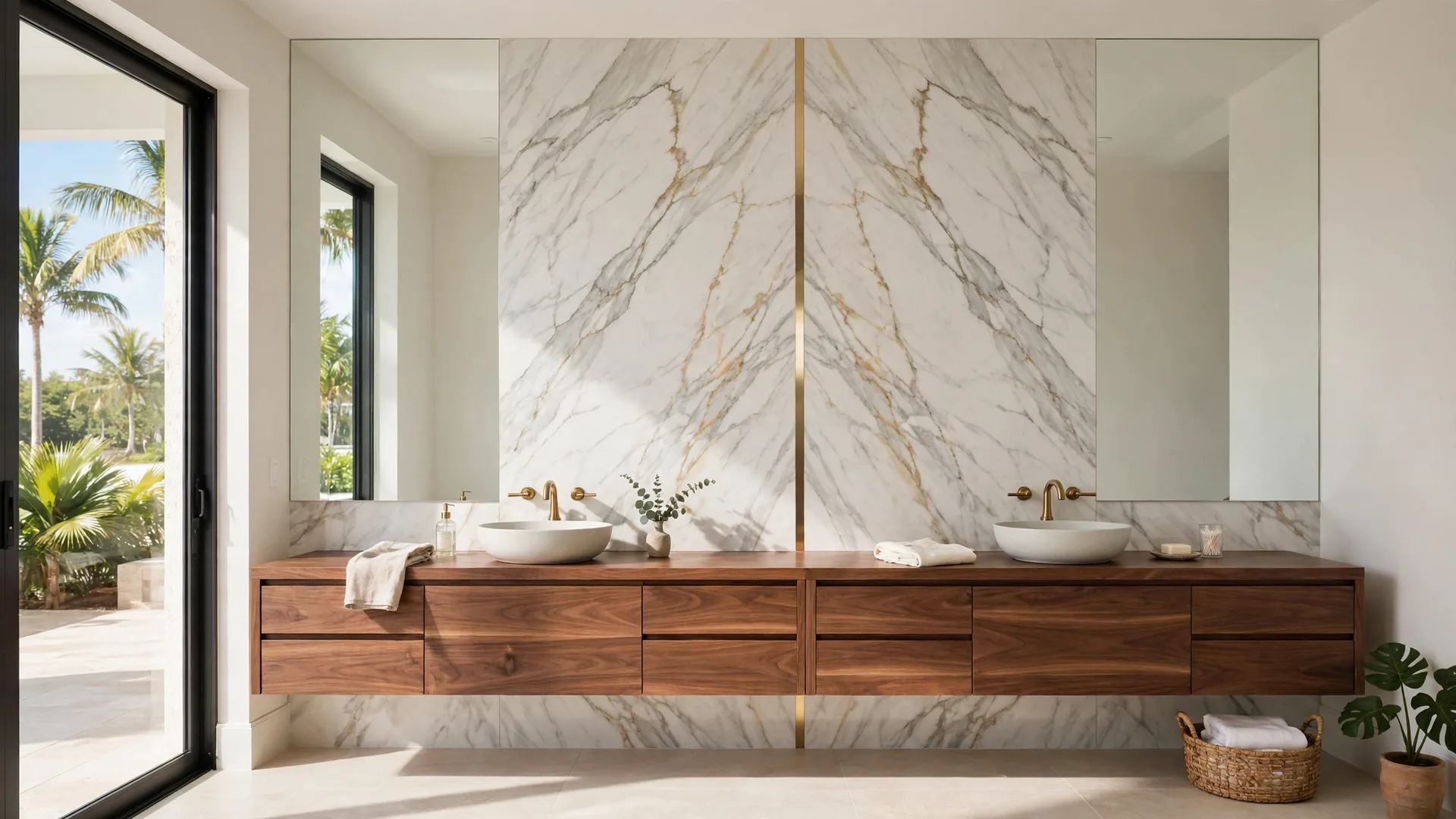
Type "marble wall panels" into a search box and you get three different products wearing one name. The first is real marble – quarried stone, cut into slab or tile, heavy and cool to the touch. The second is porcelain – a fired ceramic panel printed to look like marble, thin and hard. The third is a composite panel – a manufactured sheet with a marble-look surface, the lightest of the three. Sellers mix the three freely because the photograph looks similar. The invoice, the wall load and the ten-year care routine do not.
WOW Walls Studio is a South Florida studio that designs and installs large-format panel walls, and the composite sheet is the product the studio sells. That puts the studio's interest on the table from the start. This guide still tells you plainly where real stone and porcelain beat the studio's product, because the honest comparison is the only useful one: a shower wall, a kitchen splash zone and a living room feature wall are three different problems, and each of the three materials wins one of them. If you want the finish names and pattern styles, our marble look wall panels guide decodes the Calacatta family. This guide answers the question that comes first: which material class belongs on your wall at all.
Three products, one search term
TL;DR: Real marble is quarried calcium carbonate stone sold as slab or tile. Large-format porcelain is a thin fired panel, usually 3.5 to 6 mm, with the marble pattern printed and glazed on its face. A composite marble-look panel is a manufactured sheet – the studio installs a bamboo composite, 48 by 108 inches and 5 mm thick – with the marble finish on its surface. Same photograph, three different walls.
Start with what each product physically is, because every later difference – weight, water, repair – follows from what it is made of.
Real marble. Marble starts as limestone that heat and pressure recrystallized underground. The result is a stone made mostly of calcium carbonate, the same chemistry as chalk and limestone, hardened into a slab you can polish. It is sold two ways for walls: as slab, prepared to measure by a fabricator (a workshop that cuts and finishes stone), and as tile, smaller pieces set one by one with grout joints (the filled seams between tiles) between them. Slab gives you the continuous veining people picture. Tile gives you smaller pieces, easier handling and a grid of grout lines. Both are the genuine material, with its strengths and its one chemical weakness, which gets its own section below.
Large-format porcelain with a marble print. Porcelain is clay fired at very high temperature until it vitrifies, meaning the body turns dense and glass-like. The marble pattern is printed on the surface and covered by a glaze (a glassy coating fired onto the face). The large-format version, called gauged porcelain, stretches that fired body into panels around 48 by 96 inches and far larger – MSI lists its Stile slabs at 118 by 59 inches and 126 by 63 inches – at thicknesses the US standard ANSI A137.3 splits into wall-only panels of 3.5 to 4.9 mm and floor-and-wall panels of 5.0 to 6.5 mm (GetMediaWall). You get a slab-sized image with a fraction of slab weight, and a surface that is ceramic all the way down: hard, sealed by its glaze, and brittle until the mortar bed holds it.
Composite marble-look panels. The third product skips stone and ceramic entirely. The sheet the studio installs has a bamboo composite core (a core made with bamboo fiber and binders, not solid bamboo) at 48 by 108 inches and 5 mm thick, and the marble finish sits on its face. One sheet covers floor to ceiling on a 9-foot wall with no horizontal seam. There is no grout anywhere in the system: sheets meet at a small number of planned seams. The trade is plain: the finish is a look. It carries no water rating and no heat rating of its own, and the sheet is cladding, a decorative layer with no structural role. What you get in return is handling: it goes onto a dry, flat wall in a conditioned room without a tile crew, a wet saw or a grout float. Our large-format porcelain wall panels guide works through the porcelain version of this same choice in full depth.
One naming trap is worth clearing before prices enter the picture. Cultured marble, which Angi prices as its own category, is a fourth product – a cast resin material molded for vanity tops and shower surrounds. It appears in the same search results and it is none of the three above. If a quote says cultured marble, you are pricing molded surrounds, and the comparison in this guide does not apply to it.
Weight and wall load: the difference you feel in the framing
TL;DR: A 3 cm marble slab puts roughly 16 to 19 pounds on every square foot of wall. Marble tile at common thicknesses runs about 5.5 to 10 pounds per square foot before mortar. A 6 mm porcelain panel weighs about 2.8 to 2.9 pounds per square foot plus its thin-set bed. Weight decides crew size, substrate work and whether the framing itself becomes a project.
Weight is the line item buyers discover last, usually after the material is already chosen. Run the numbers on a plain feature wall – say 12 feet wide by 9 feet high, 108 square feet – and the three products stop looking interchangeable.
Real marble slab is the heavyweight by a wide margin. Fabricator data puts 3 cm marble at roughly 16 to 19 pounds per square foot (GetMediaWall, citing fabricator figures). Marble density references agree on the inputs: a standard density near 170 pounds per cubic foot works out to about 14 pounds per square foot for each inch of thickness: roughly 11 pounds at 2 cm and 17 to 18 at 3 cm (CalculatorsHub). Hunker's long-published rule lands in the same place: marble tile weighs 13.34 pounds per square foot for each inch of thickness. Multiply that across the example wall and a 2 cm marble slab wall carries roughly 1,200 pounds of stone before adhesive, backing and fixings. That is why full-height real marble on a stud wall is, in GetMediaWall's words, an engineering conversation rather than a tiling one, and why code guidance for adhered veneer caps saturated installed weight at 15 pounds per square foot, with an engineered design required above the applicable limits (ICC-ES evaluation reports referencing IRC Section R703.12, via GetMediaWall).
Marble tile lightens the load by thinning the stone. At 3/8 inch (10 mm) the same references give about 5.5 pounds per square foot, and tile-weight guides put marble at 7 to 10 pounds per square foot across the common 10 to 20 mm range (CalculatorsHub; Flooring Clarity). Add mortar and, on many walls, a cement backer board (a water-resistant board that replaces drywall behind tile), and the assembly still lands well under slab weight. Tile is how real marble most often reaches a residential wall: the stone is real, the pieces are manageable, and a competent tile setter is the crew.
Porcelain panels change the arithmetic again. MSI publishes its 6 mm Stile porcelain at 2.8 pounds per square foot, against 19 pounds per square foot for 3 cm granite, and notes a full stone slab can run 600 to 1,200 pounds while a Stile slab stays under 200 pounds (MSI Surfaces). Independent weight guides put thin porcelain panels at 2 to 3 pounds per square foot and standard porcelain tile at 3 to 6 (Flooring Clarity). The panel itself is light; the installed system is heavier than the brochure suggests. Thin-set mortar (the cement adhesive troweled behind tile) adds at least 50 pounds to each big MSI slab during setting (GetMediaWall), and the wall must be rigid and very flat – ANSI A108.19 allows no more than 1/8 inch of variation in 10 feet. A wall that looks fine painted can fail that check, so substrate correction is a real line in a porcelain budget.
The composite sheet sits at the handling end of the scale. The studio publishes no per-square-foot weight figure for its sheet, and this guide does not invent one. What the dimensions tell you is the handling story: a 5 mm sheet at 48 by 108 inches is a two-person carry that one installer can position against the wall, cut on site with panel tools, and fix without mortar. There is no wet bed adding weight and no backer board requirement on a sound dry wall. The load is different in kind from stone or porcelain – but what decides any installation is the framing and condition of the particular wall, which is why the studio checks the substrate at the measuring visit instead of certifying a wall it has not seen. If your wall is a lightweight built-out frame – a media wall carcass, a condo partition – that difference can decide the project before style gets a vote.
What each one costs installed in 2026
TL;DR: Published US figures put real marble walls anywhere from about $11 to $54 per square foot installed for tile work (Angi), $20 to $130 for marble backsplash-scale work (Angi), and roughly $100 to $150 per square foot for full slab walls. Marble-print porcelain lands far lower per foot on material, with South Florida large-format work quoted at $15 to $28 per square foot installed for common formats. The studio prices composite panel projects by the project: a stock design from $850, a design fitted to your wall usually $2,200 to $2,700, and full custom turnkey projects from $9,999, every studio figure preliminary until a specialist measures your wall.
Cost figures for these three products arrive in different units, and mixing them is how budgets go wrong. Market sources price marble and porcelain by the square foot. The studio prices panel projects as projects. Keep the piles separate and compare totals for your actual wall.
Real marble. Angi's 2026 bathroom data puts marble tile at $11 to $54 per square foot installed (Angi). HomeAdvisor's marble flooring guide, which uses the same tile market, puts materials at $2 to $30 per square foot with installation bringing the total to $8 to $50 per square foot, and marble tile material alone at $5 to $10 (HomeAdvisor). Angi's marble backsplash guide – the closest published cousin to a marble wall – puts materials plus labor at $20 to $130 per square foot on average, labor at $10 to $30 per square foot, and the variety drives the spread: Carrara material at $40 per square foot against Calacatta at $180 (Angi). Full slab walls sit above all of these: GetMediaWall's survey of published figures suggests roughly $100 to $150 per square foot installed for marble, with HomeAdvisor fireplace data listing marble surrounds at up to $350 per square foot all-in. On the 108-square-foot example wall, tile-format marble at Angi's band runs roughly $1,200 to $5,800 before substrate surprises; a slab wall at the surveyed rates runs into five figures quickly. The full market ladder, including paneling overall, sits in how much wall panels cost in 2026.
The full breakdown behind these bands, with material, fabrication and labor as separate lines, the hidden costs and a worked 90 square foot wall, sits in our marble wall panels cost guide.
Marble-print porcelain. The material itself lands in the low tens: design-press estimates put large-format marble-look porcelain at about $15 to $25 per square foot for material (GetMediaWall). South Florida numbers are more useful here. AP Stone, a South Florida tile installer, prices standard 24 by 48 porcelain material at $5 to $10 per square foot and extra-large formats at $8 to $25, with installation labor at $10 to $18 per square foot for standard large format and $15 to $30 for extra-large work with vacuum frames and laser leveling – $15 to $28 per square foot all-in for the popular 24 by 48 format in a Miami living room (AP Stone Inc). A Sarasota installer's 2026 pricing puts large-format porcelain installed at $9 to $15 per square foot at the simpler end (Sarasota Flooring Company). Treat slab-format porcelain – the 118-inch panels – as its own quote: the crew, the flatness work and the breakage risk push its price above tile-format work even when the material per foot looks similar.
Composite panels, the studio's figures. The studio publishes three project anchors, and a marble-look wall is priced through them like any other feature wall. A stock design, one of our finished designs installed as designed, starts at $850. A design fitted to your wall, a proven design reworked around your wall's proportions in the finish you choose, usually runs $2,200 to $2,700, and most single living room walls land in that fitted band. A full custom turnkey project, designed for your room, starts at $9,999. Design, panels, delivery and installation by our own crew are inside those figures. There is no per-square-foot studio price, and any per-foot figure someone derives from these anchors is their arithmetic, not a studio quote. Every figure is preliminary until a specialist measures your wall; wall size, the materials you choose, lighting, electrical or mounting needs, custom details and site conditions move the exact price.
Put the three side by side and the pattern is plain. Real marble charges for the stone, the fabrication and the structure to hold it. Porcelain charges for the setter's skill and the wall preparation. Composite panels charge for the design and the installation as one project, with the least trade labor around the sheet itself.
Water, stains and etching: the chemistry nobody puts on the sample card
TL;DR: Marble is calcium carbonate, and acid dissolves calcium carbonate. Lemon, vinegar, wine and many cleaners etch marble – a dull mark that is physical damage, and sealing does not stop it. Sealing only slows staining. Porcelain's glaze does not etch and needs no sealing. A composite marble-look finish has no stone chemistry at all, and also no water rating: it belongs on dry walls.
This is the section that decides kitchens and bathrooms, so here is the chemistry, straight.
Marble's beauty and marble's weakness are the same fact. The stone is mostly calcium carbonate, and when acid touches it, the acid reacts with that carbonate and dissolves a microscopic layer of the surface. Ed Stone, a stone fabricator writing about marble upkeep, puts the distinction every buyer should memorize: sealing prevents staining, meaning color seeping into the porous stone, but sealing does not prevent etching, because acid chemically eats the surface and leaves a dull matte mark no sealer can stop. A stain sits in the stone and can often be drawn out with a poultice (a paste that pulls a stain out as it dries). An etch is missing stone. Stone care guides agree on the remedy: an etch mark can only be fully removed by professional honing and repolishing – grinding the surface back down past the damage (Stone Wizards).
The practical consequences for a wall are narrower than for a countertop, and it is worth saying so directly. A living room wall meets almost no acid. A kitchen backsplash meets tomato, citrus, vinegar-based sprays and wine. A bathroom wall meets acidic cleaners, which is the quiet risk: many common bathroom sprays are acidic, and a cleaner chosen for the grout can etch the stone beside it. Marble is also soft – about 3 to 4 on the Mohs hardness scale (the 1-to-10 scratch-hardness scale for minerals) against granite's 6 to 7 (Stone Wizards) – so it scratches and chips more readily at edges. Sealing still matters: it buys you time to wipe a spill before it becomes a stain. High-use marble surfaces are commonly sealed every 6 to 12 months (Ed Stone Inc); a vertical wall with no food contact needs attention less often than a kitchen counter, and the water test tells you when – water that darkens the stone instead of beading means the sealer is spent.
Porcelain has no such chemistry. The glaze is glass. Acid cleaners that would etch marble leave a glazed porcelain face unchanged, the body absorbs almost nothing, and MSI states the maintenance plainly: unlike natural stone, porcelain needs no routine sealing, though cement grout between pieces may need sealing of its own (MSI Surfaces). The marble print cannot stain the way marble stains, because there is no porous stone under it for color to enter.
The composite panel needs the same honesty in the opposite direction. Its marble finish is a manufactured surface, so there is no calcium carbonate to etch and no pore structure to stain like stone. Mild cleaning is the whole routine, and our wall panel care, cleaning and repair guide covers it. What the panel does not have is a water rating. The finish is a look applied to a sheet made for dry, conditioned interiors. A splash wiped off a living room wall is a non-event; a daily soaking is a different exposure, and the sheet is not rated for it. That line leads directly to the wet-zone question.
Bathrooms and showers: where each material is allowed to go
TL;DR: Inside a shower or anywhere water runs daily, real stone and porcelain are the honest choices, each with a system behind it – waterproofing membrane, backer board, sealed grout. A composite marble-look sheet is for dry walls: a bathroom wall outside the shower, a powder room, a vanity backdrop that takes splashes wiped away, not spray. The studio states that plainly because it sells the sheet.
Wet zones sort materials faster than any other test, so here is the result without sales pressure.
Porcelain earns the shower. By standard, a tile only earns the name porcelain when its water absorption is 0.5 percent or less under the ASTM C373 test, which puts it in the impervious class (Edward Martin, citing ANSI A137.1). That body, set over a waterproofing membrane with proper backer board, is the standard residential shower wall across the country. One precision matters: the tile is impervious, the wall is a system. Grout joints pass water, which is why the membrane behind the tile does the waterproofing and why cement grout gets sealed even when the porcelain face needs nothing (Edward Martin; MSI Surfaces). Choose porcelain for the shower and you are choosing that whole assembly, installed by someone who builds it correctly.
Real marble also lives in showers, in hotels and in high-end homes, and it asks for the most upkeep of any option here. The stone itself is porous, the grout network is wide on a tile installation, and shower products – shampoos, body washes, descalers, hard-water cleaners – include acids that etch. A marble shower is a commitment to sealing, to pH-neutral products (cleaners balanced near neutral, neither acidic nor strongly alkaline) and to accepting that the surface will develop a lived-in patina (a soft change in sheen and tone over time). Some owners love exactly that. Nobody should discover it after installation.
The composite sheet does not go in the shower. The studio's position, published in the studio's porcelain comparison and repeated here, is that the marble-look sheet is for dry walls: living rooms, bedrooms, dining rooms, entries, and bathroom walls outside the wet enclosure. A powder room wall behind a pedestal sink, wiped when splashed, is inside its honest use. A shower surround, a tub splash zone with daily spray, or a steam room is outside it, and if your project is that wall, the studio's recommendation is porcelain or stone from a tile crew – our shower wall panels vs tile guide compares the wet-zone panel systems that are actually rated for it. A seller who will rate any decorative sheet for any room is telling you something about the rest of the quote too.
Florida humidity: the quiet test behind the wet test
TL;DR: South Florida indoor air should sit near 45 to 55 percent relative humidity; sustained levels above 60 percent invite mold on grout, drywall and organic cores. Porcelain and stone faces shrug humidity off, but their grout and the wall behind them do not. Composite panels belong in continuously conditioned rooms, with cut edges sealed.
Humidity is the slower version of the shower question, and in South Florida it runs all year. Guidance for Florida homes points to a practical indoor target of 45 to 55 percent relative humidity (relative humidity, or RH, is how much water the air holds compared with the most it could hold at that temperature), with the EPA ceiling at below 60 percent. Above 60 percent sustained, mold growth on building materials becomes increasingly likely, and at 70 percent for a day or two it is close to certain on organic surfaces (PuroClean of Melbourne, summarizing EPA, ASHRAE and CDC guidance). Sarasota field guidance lands in the same place: keep indoor RH below 55 percent and dry any leak within 24 to 48 hours.
What does that mean for a marble-look wall? The faces of all three materials handle humid room air. Marble, porcelain glaze and a composite finish are each, on their face, unfriendly to mold. The risks live at the joints and behind the surface. Grout is cement-based and porous: it darkens, holds grime and feeds mildew in a bathroom that steams daily, on marble and porcelain installations alike. Drywall behind any wall finish suffers if water reaches it repeatedly. And a home left unconditioned for weeks in August – the seasonal pattern across Palm Beach, Broward and Miami-Dade – stresses adhesives, caulk lines and any organic core in the assembly.
The studio's rule for its own sheet follows: composite panels belong in conditioned living spaces, rooms where the air conditioning runs and RH stays in the target band, on a dry, flat, sound wall, with cut edges sealed at installation. A snowbird condo that sits closed and unconditioned all summer is a harder brief, and it deserves a conversation about the whole wall assembly before any finish is chosen. The full core-by-room logic – which panel cores belong in which Florida rooms, and why fiberboard cores need continuous conditioning – is in our Florida humidity panel guide.
For the deeper pass on this subject – grout as the weak point, sealer wear in damp air, porcelain membranes, composite edges, and seasonal homes – see marble wall panels in Florida humidity.
Installation: three trades, three timelines
TL;DR: Marble slab work belongs to a stone fabricator, marble tile and porcelain to a tile setter working to a flatness tolerance of 1/8 inch in 10 feet, and composite panels to a panel installer fixing sheets to a prepared dry wall. The trade behind the quote explains most of the price and most of the schedule.
Ask who installs each product and the cost section above stops being mysterious.
A marble slab wall is fabrication work. The fabricator templates the wall, cuts the slab in the shop with water-cooled diamond tooling, transports a piece that can weigh several hundred pounds, and sets it with a crew and mechanical support. Openings for outlets and fixtures are precision cuts made once, in an expensive material. Marble tile removes the single-piece risk and replaces it with setter labor: hundreds of pieces leveled, spaced, grouted and then sealed, with lippage (a lip where one tile edge sits higher than its neighbor) as the visible quality test.
Porcelain panels borrow the stone crew's discipline at tile weight. MSI specifies suction cups with a stabilizer bar and a minimum three-person crew for its big slabs, and warns that once thin-set is on the panel, moving it is difficult and breakage is likely (GetMediaWall, summarizing MSI installation instructions). The standard asks for mortar on both the panel back and the wall, at least 80 percent coverage on walls, and installers certified for gauged porcelain work. The wall must meet that 1/8-inch-in-10-feet flatness tolerance before anyone opens a bucket of mortar. Every outlet, mount and niche is a diamond cut planned in advance, and the TV mount anchors back to framing or blocking, never to the panel – the same load rule our TV wall panels guide sets out for panel walls.
Composite panel installation runs at a carpentry pace by comparison. Sheets arrive at 48 by 108 inches, get trimmed on site to the wall, and are fixed to the prepared surface with the seam plan drawn first: which sheet carries the TV mount zone, where outlets land inside a sheet rather than on a seam, how the veining runs across joints. There is no mortar to cure, no grout to seal, and no wet trade in the room. What the speed does not excuse is prep: a wavy wall telegraphs through any large sheet, and gloss finishes show substrate flaws most, so the wall is checked and corrected before the first sheet goes up. The step order for a studio project – photo, preview, measure visit, exact quote, installation – is documented in our wall panel installation process guide.
Care and repair: the ten-year difference
TL;DR: Marble asks for pH-neutral cleaning, periodic sealing and professional honing if etching accumulates. Porcelain asks for almost nothing beyond grout care. Composite panels ask for mild cleaning and edge care – and if a sheet is damaged, the honest repair is replacing that sheet, not patching stone that was never there.
Everyday care ranks the three in the opposite order to risk. Porcelain is the easiest surface here to live with: wipe it with a soft sponge and a gentle cleanser, keep abrasives off the glaze, and reserve your attention for the grout lines, which are the only porous part of the wall (MSI Surfaces). It does not etch, it does not need sealing, and a decade of showers leaves the face itself essentially unchanged.
Marble care is a routine, light but non-negotiable. Clean with pH-neutral products only, because an acidic spray is not a cleaning mistake on marble, it is surface damage. Wipe spills that carry acid – wine, citrus, tomato, vinegar-based anything – promptly, and keep the sealer current on the maker's schedule for the surface's exposure. Chips at tile edges and slab corners are a stone repair specialist's work. Etch accumulation on a polished wall is corrected by honing, which is refinishing, not cleaning. None of this is ruinous on a vertical wall, where gravity keeps most spills brief. It is simply a recurring obligation that belongs in the buying decision.
Composite panels sit between the two on effort and last on repair options, and both halves matter. Care is mild: dust, a damp soft cloth, no abrasive pads and no harsh chemicals on the finish, with the detailed routine in the studio's care guide. Repair is the honest limit. A damaged porcelain tile can sometimes be cut out and replaced; a damaged marble tile likewise. A damaged composite sheet is replaced as a sheet – there is no filler that restores a printed marble finish invisibly, and the studio does not pretend otherwise, in a guide or on a job. The format is the practical mitigation: replacing one 48 by 108 sheet is a bounded job, and the seam plan from installation day tells us exactly which sheet carries the damage.
How to choose, room by room
TL;DR: Shower and wet walls: porcelain first, real marble if you accept its upkeep. Kitchen splash zones: porcelain or sealed marble tile, chosen with the cleaner cabinet in mind. Dry feature walls – living room, TV wall, bedroom, dining, entry: all three work, and the decision turns on weight, budget and how much pattern repeat you can see. That is where composite panels earn their place.
Pull the whole comparison into the rooms where these walls actually get built.
Shower walls and wet enclosures. Porcelain, on a membrane, by a tile crew. Real marble if the budget carries fabrication-grade installation and the household accepts sealing and pH-neutral discipline as a permanent routine. Composite panels: no, plainly.
Bathroom walls outside the shower. All three are defensible. Porcelain and marble tile bring grout to maintain in a steamy room. A composite sheet on the dry walls – the vanity backdrop, the wall opposite the shower – removes grout from exactly the surfaces that only ever get splashed and wiped. Many sensible bathrooms mix them: porcelain inside the enclosure, panel or paint outside it.
Kitchen backsplash and splash zones. This is acid territory. Porcelain is the low-regret choice, marble tile the romantic one with homework attached, and a composite sheet belongs on kitchen walls away from the range and sink spray rather than directly behind them.
Living room, TV and media walls. The dry feature wall is where the three products compete most evenly, and where composite panels were designed to win their share: full-height sheets, no grout, the lightest load on the frame, and a project price instead of a per-foot tile bill. Real marble makes its strongest case here too, since a dry wall spares it water and acid – if the structure, the fabricator and the budget are all available, a real slab wall is a genuine luxury object, and no printed surface should claim to be its equal at knuckle distance. Porcelain is the middle path: the most convincing stone read of the two look materials, at the price of the strictest wall preparation.
Bedrooms, dining rooms and entries. Dry, low-contact walls. Choose on looks, weight and budget. This is also where a bolder marble pattern is safest, because nothing in the room will attack it and the wall is seen at the distance where large-format veining reads best. For the bedroom layout decisions in full – veining direction, a book-match centered on the bed, lamp glare and pairing marble tone with bedding – see our guide to marble wall panels for the bedroom.
Seasonal and unconditioned homes. Decide the conditioning first. A home held near 50 percent RH can carry any of the three. A home left hot and closed for months pushes you toward porcelain or stone faces with inorganic assemblies, and toward talking directly with your installer about adhesives and cores, whichever finish you choose.
Frequently asked questions
TL;DR: Real marble is the heaviest and the only one that etches. Porcelain is the wet-zone and low-care winner. Composite panels are the dry-wall, low-weight, project-priced option – and they do not go in showers.
Are marble wall panels real marble?
Some are and some are not, which is exactly the confusion this guide sorts out. The term covers real marble slab and tile, porcelain panels printed with a marble pattern, and composite panels with a marble-look finish. Ask any seller which of the three the quote describes, in those words, before comparing prices.
How much do marble wall panels cost in 2026?
It depends on which product the name is hiding. Angi's 2026 data puts marble tile at $11 to $54 per square foot installed, marble backsplash-scale work at $20 to $130 per square foot for materials plus labor, and full slab walls survey at roughly $100 to $150 per square foot installed. Marble-print porcelain material runs about $15 to $25 per square foot, with South Florida large-format installation quoted at $15 to $28 per square foot all-in for common formats. The studio's composite panel projects run from $850 for a stock design, usually $2,200 to $2,700 for a design fitted to your wall, and from $9,999 for full custom turnkey projects, every studio figure preliminary until a specialist measures your wall.
How much does a marble wall weigh?
Enough to plan around. Marble runs about 13.34 pounds per square foot per inch of thickness (Hunker), so a 3/8-inch tile assembly starts near 5.5 pounds per square foot of stone and a 3 cm slab reaches roughly 16 to 19 pounds per square foot. A 6 mm porcelain panel, by contrast, weighs about 2.8 pounds per square foot before its mortar bed (MSI Surfaces).
Can marble wall panels go in a shower?
Real marble and porcelain can, inside a properly waterproofed assembly. Marble asks for sealing and acid-free products for the life of the installation. Porcelain needs the membrane and grout care behind and between the panels. Composite marble-look panels should not go in a shower – they are made for dry walls, and the studio installs them only outside wet enclosures.
Does sealing marble stop stains and etching?
Half of that. Sealing slows staining by giving you time to wipe a spill before it soaks in. It does not stop etching at all: acid reacts with the calcium carbonate in the stone itself, sealer or no sealer, and an etch mark is removed by honing, not by cleaning (Ed Stone Inc; Stone Wizards).
Which is better, porcelain or real marble for a wall?
For wet walls, splash zones and low care, porcelain. For a dry feature wall where the real material, its depth and its cool touch are the point – and the structure and budget support it – real marble. The two are not ranked in the abstract; they are ranked by the room, which is why this guide chooses room by room.
Do composite marble-look panels look real?
They read as a marble wall from normal viewing distance, with continuous veining across full-height sheets and no grout lines. At close inspection they are a manufactured finish, and the studio describes them that way. Choosing samples in your own light and checking pattern repeat across two sheets is the test that matters, and the studio's marble look guide walks through it.
How long does each option take to install?
Schedules belong in a written quote for your wall, and The studio does not publish timelines as promises. The shape of the work differs, though: slab marble involves shop fabrication before installation day, tile and porcelain involve setting, grouting and sealing stages with cure time between them, and composite panels involve no wet trades or cure stages once the wall is prepared. Ask each bidder what stages their price includes and what has to happen between them.
Humidity is the deciding factor for marble in this state, so it gets its own guide: marble wall panels in Florida humidity compares stone, porcelain and composite on grout, porosity and sealer wear.
Sources
- Angi, How Much Does a Marble Backsplash Cost to Install? [2026 Data] – materials plus labor $20-$130 per square foot; labor $10-$30 per square foot; Carrara $40 and Calacatta $180 per square foot material. angi.com
- Angi, How Much Will It Cost to Retile a Bathroom? [2026 Data] – marble tile installed $11-$54 per square foot. angi.com
- Angi, How Much Does Tile Installation Cost? [2026 Data] – tile bands and labor ranges. angi.com
- HomeAdvisor, How Much Does It Cost to Install Marble Flooring? – marble materials $2-$30 per square foot, installed totals $8-$50 per square foot. homeadvisor.com
- HomeAdvisor, Cost to Tile a Bathroom Floor – marble material $10-$20 per square foot. homeadvisor.com
- GetMediaWall, Porcelain Slab Media Wall Cost: Stone, Marble, Weight and Trade-Offs – installed marble roughly $100-$150 per square foot; porcelain material $15-$25; ANSI A137.3 thickness classes; 6 mm porcelain about 2.9 pounds per square foot plus thin-set; 3 cm marble 16-19 pounds per square foot; flatness and crew requirements. getmediawall.com
- MSI Surfaces, A Porcelain Revolution: Stile Large Format Slabs – 6 mm porcelain 2.8 pounds per square foot; slab sizes 59x118 and 63x126 inches; no routine sealing for porcelain. msisurfaces.com
- AP Stone Inc, Large-Format Tiles: Pros, Cons and Cost (2026) – South Florida material and labor bands; 24x48 installed $15-$28 per square foot in Miami. apstoneinc.com
- Sarasota Flooring Company, Tile Installation Sarasota FL – large-format porcelain installed $9-$15 per square foot (2026). sarasotaflooringcompany.com
- CalculatorsHub, Marble Weight Calculator – density near 170 pounds per cubic foot; weight by thickness from 5.5 pounds per square foot at 3/8 inch. calculatorshub.net
- Flooring Clarity, Tile Weight Per Square Foot – marble 7-10 pounds per square foot; thin porcelain panels 2-3 pounds per square foot. flooringclarity.com
- Hunker, How to Calculate the Weight of Marble Tile – 13.34 pounds per square foot per inch of thickness. hunker.com
- Ed Stone Inc, Is Marble Worth the Maintenance Hassle? – sealing prevents staining, not etching; calcium carbonate chemistry; sealing every 6-12 months on high-use surfaces. edstoneinc.com
- Stone Wizards, How to Clean Marble Countertops – etching removed only by professional honing; marble Mohs 3-4. stonewizards.ca
- EngineerFix, How to Take Care of Marble – calcium carbonate composition; sealer slows absorption without making marble stain-proof. engineerfix.com
- Edward Martin, Is Porcelain Tile Waterproof? – ANSI A137.1 absorption of 0.5 percent or less for impervious porcelain; waterproofing is a system of tile, grout, substrate and membrane. edwardmartin.com
- Johnson Tiles, How Water Absorption Affects Tile Suitability – impervious class below 0.5 percent absorption for wet areas. johnsontiles.com.au
- PuroClean of Melbourne FL, The Ideal Indoor Humidity for Melbourne Homes – Florida target 45-55 percent RH; mold risk above 60 percent. puroclean.com
- The Environmental Blog, Indoor Air Quality in Humid Climates – keep indoor RH below 55 percent; dry leaks within 24-48 hours. theenvironmentalblog.org
- WOW Walls Studio, Marble-Look Wall Panels: Calacatta Styles, Honest 2026 Guide – finish names and sample tests.
- WOW Walls Studio, Large-Format Porcelain Wall Panels – real porcelain vs porcelain-look panels in depth.
- WOW Walls Studio, Wall Panels Cost 2026 – the full installed-cost ladder.
- WOW Walls Studio, Wall Panels in Florida Humidity – core-by-room material logic.
- WOW Walls Studio, Shower Wall Panels vs Tile – wet-zone systems compared.
- WOW Walls Studio, Wall Panel Care, Cleaning and Repair – panel care routine and repair limits.
- WOW Walls Studio, TV Wall Panels: Sizing, Materials, Cables and Cost (2026) – TV mount load rule and panel-wall planning.
- WOW Walls Studio, Wall Panel Installation Process – project step order from photo to installation.