
Slat Wall Panels for the Bedroom: Ideas Behind the Bed (2026)
Slat wall panels for the bedroom, planned around the bed: slat rhythm, headboard layouts, sconce heights, veneer tones, honest sound limits and care.
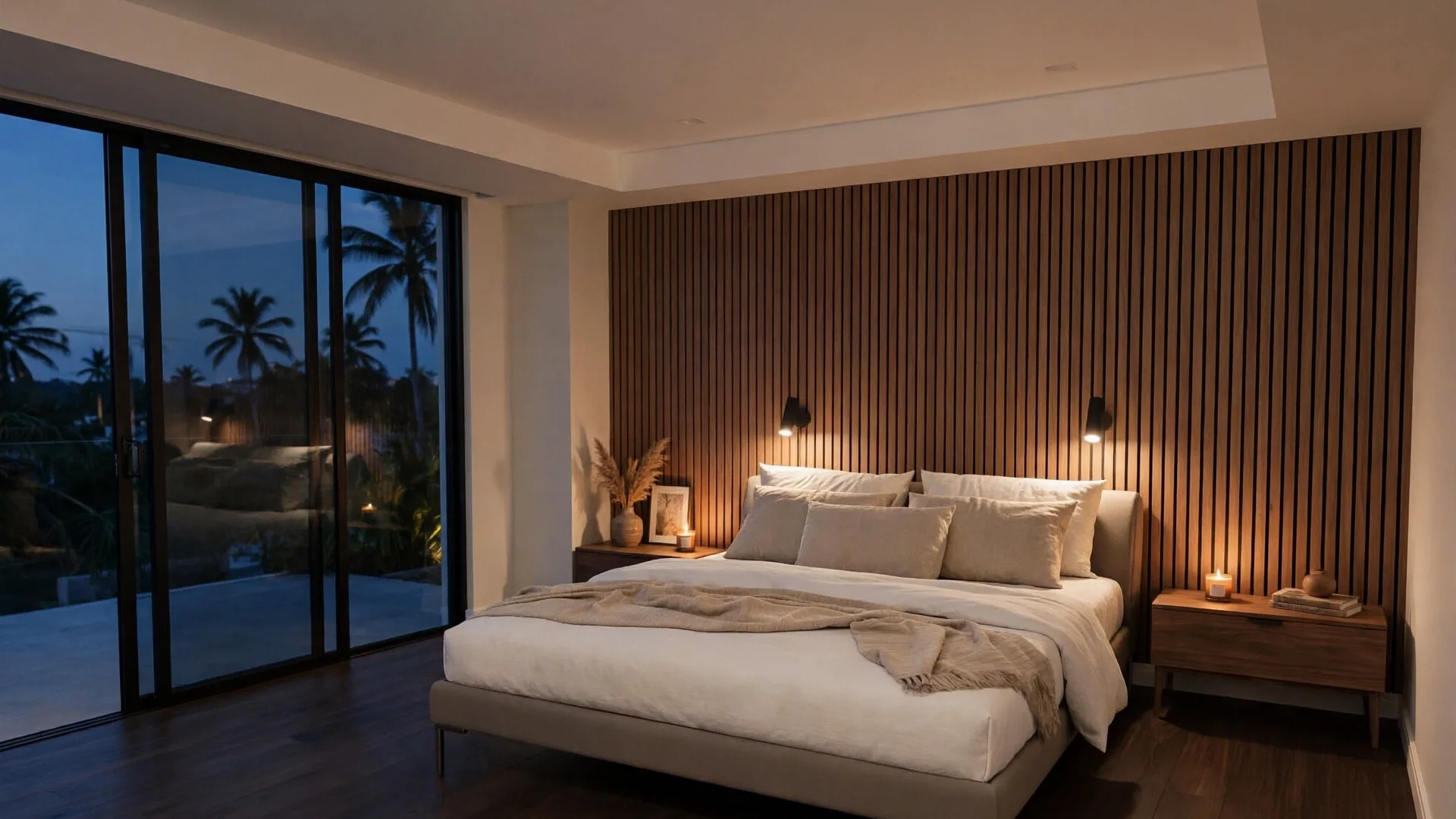
A slat wall behind a bed is the closest wall in your home. You face it from a few feet away, in dim light, with your head at pillow height and nowhere else to look. The rhythm of the slats either settles the room or keeps it busy. An off-center joint stays in your first view every morning. Dust that would go unnoticed in a hallway collects at the height where you breathe all night. Bedroom slats reward careful choices and punish casual ones. The choices here are specific to this room.
We run a South Florida studio that designs and installs large-format panel walls. Our studio does not sell or install slat panels, and this guide does not pretend otherwise. Our main slat wall panels guide owns the general verdict on the product. It covers what a slat panel is, the honest downsides, the sound story in full, Florida humidity, 2026 costs, and who should still buy slats. This article starts where that guide stops. It covers the bedroom decisions only. How wide should the slats and gaps run behind a bed? How does the wall work as a headboard? Where do lamps and nightstands fit? Which tones rest well against bedding? And what is it like to live with this wall, in a room built for sleep?
The short answer: slats behind the bed, in one view
TL;DR: Plan the slat wall from the pillow outward. Choose the standard rhythm first, with slats near 27 mm wide and gaps near 13 mm, and treat wider or tighter rhythms as deliberate changes. Let the bed set the layout: a full-width field, a bed-width inset, or slat side fields beside a calm center. Fix sconce, outlet and nightstand positions before the layout is final. Expect softer echo inside the room and no sound blocking at all. Accept a monthly groove pass at pillow height, or choose a smoother wall.
Every other accent wall in a home gets seen in passing. This one gets studied, morning and night, from one fixed position. Small decisions stay visible for years, so their order matters. Rhythm comes first, because it sets the tempo of the whole field. Layout comes second, because the bed frames whatever sits behind it. Fittings come third, because sconces and outlets land inside the rhythm and cannot move later without scars. Tone comes fourth, because bedding covers half the view and the two surfaces share every evening. Sound and upkeep close the list, because they decide how the wall feels after the photographs fade from memory.
The rest of this article takes those decisions one at a time, then gives the honest downsides their own section. A brief Florida note and a brief cost note follow. The article ends with the pillow test we recommend before anyone commits to a wall.
What a slat panel is, in bedroom terms
TL;DR: A standard slat panel is a set of narrow wood-faced strips on a dark felt backing. Acupanel, a manufacturer, describes strips of 1.06 by 0.43 inches on 0.35-inch black PET felt, spaced 0.52 inches apart. The felt shows in every gap, softens echo, and collects dust. The wood face is a real veneer skin over an MDF core on most panels sold under this name.
That build explains most of what follows, so here it is in plain words. MDF means medium-density fiberboard, pressed wood fibers formed into a board. PET felt means a soft sheet pressed from polyester fiber. In the Acupanel manual, the strips are made of black MDF with a real wood veneer, and they sit on the felt with a gap between each pair. The gaps are part of the design. They give the wall its rhythm, its shadow lines, and its dark background.
Three consequences follow for a bedroom. First, the wall has texture at close range: dozens of edges and grooves within reach of the pillows. Second, the felt in the gaps is a fabric surface, and fabric surfaces hold dust and lint in a way that a flat painted wall does not. Third, the panel sits proud of the wall by roughly its full depth. The bed, the headboard and the nightstands all meet a surface that stands forward of the drywall. None of these facts rules the wall out. All three shape the choices below. Our slat wall panels guide covers the full construction range, including solid wood and plastic builds that share the shelf name and behave differently.
Slat width and gap rhythm: the pattern your eyes rest on
TL;DR: Rhythm means the repeating pattern of slat, gap, slat, gap across the wall. The common recipe, stated by Naturewall, a manufacturer, is a 27 mm slat with a 13 mm gap and a 9 mm felt backing. Wider slats with a tighter gap read bolder and show more wood. At pillow distance, the standard rhythm is the calmest starting point, and bold rhythms need a wide bed and a wide wall to balance them.
Naturewall states the standard recipe plainly. The slat size is 27 by 12 mm. The gap is 13 mm on the standard version. The felt backing depth is 9 mm. The same maker offers a Grand version with a 10 mm gap and wider slats. In the maker's own words, the standard width offers a familiar, classic profile with uniform spacing. The Grand width delivers a bolder look. It uses wider slats, showcasing more wood and less felt. Read that as a tempo choice. Standard keeps wood and dark gap in balance. Grand pushes wood forward and turns the volume up.
At pillow distance, three rhythm rules hold up. First, keep the gap honest. The dark felt line between slats is what your eye tracks, and a tight, even gap reads as one calm pattern, while uneven gaps read as errors. Second, match rhythm to bed mass. A wide bed with a tall headboard carries a bold rhythm, because the furniture balances the pattern. A low, narrow bed under a bold rhythm gets outshouted, and the wall becomes the loudest object in a room built for rest. Third, count the lines over the bed. The field directly above the pillows is the part you see last at night and first in the morning. A calmer rhythm there, with the standard spacing, ages better than a busy one.
Vertical slats are the default behind a bed, for good reason. Their lines climb, the ceiling feels a touch higher, and the bed gains a formal frame. Horizontal runs exist, and they widen a room visually. But they also create long dust ledges at every groove, at exactly pillow height. In a living room that trade can be worth it. Behind a bed, we steer readers to vertical runs and let the bedding carry any horizontal lines in the room.
| Rhythm choice | Slat and gap, as sellers state it | How it reads from the pillow | Bedroom fit |
|---|---|---|---|
| Standard | Slat near 27 mm, gap 13 mm, felt 9 mm (Naturewall) | Even, balanced, quiet | The safe default behind most beds |
| Grand / wide | Wider slats, gap 10 mm (Naturewall Grand) | Bolder, more wood, less dark gap | Wide beds, wide walls, plain bedding |
| Narrow / fast | Narrower strips, frequent gaps (varies by brand) | Busy, energetic, textured | Better on a side wall than behind pillows |
Use the table as a starting point for the sample test near the end of this article. Rhythm is a sample decision. Catalog pages cannot settle it, because distance changes everything. A rhythm that looks refined on a small sample board can feel frantic at full wall size, three feet from your face. Judge it lying down, at night, with the lamps on.
Three layouts behind the bed: full field, bed-width inset, slat side fields
TL;DR: A slat wall behind a bed takes one of three layouts. A full-width field runs slats across the whole wall. A bed-width inset centers a slat panel over the bed with flat wall at both sides. Side fields put slats at the edges and a calm, smooth center behind the pillows. Full fields suit wide rooms. Insets suit tight budgets and centered beds. Side fields give rhythm with the calmest pillow view.
The layout decision is a decision about where the rhythm lives. Slats can run everywhere, sit only behind the bed, or sit everywhere except behind the bed. Each choice gives the room a different character. Each also fails in its own way when chosen carelessly.
A full-width field is the magazine photograph. Slats run from one side of the wall to the other, floor to ceiling, and the bed sits inside one continuous rhythm. The look is strong and simple to describe. It suits wide primary bedrooms where the wall has room to breathe.
A bed-width inset centers the slat run over the bed and leaves flat painted wall at both sides. Walls and Floors, a UK retailer with a slat headboard guide, gives the width principle behind this layout. A slat headboard should be at least as wide as the bed. Usually it runs slightly wider, so it frames the bed rather than sitting flush with it. The inset concentrates cost and rhythm where the eye lands, and the flat sides give nightstands a calm background. Its risk is proportion. An inset that ends exactly at the bed edges looks pasted on. Run it past the bed on both sides, and let the nightstands sit at least partly inside the composition.
Slat side fields reverse the inset. Two slat runs flank a smooth center panel or a flat painted field behind the pillows. The rhythm frames the bed, the pillow view stays calm, and the dusting load drops, because the grooves sit away from breathing height at the sides.
| Layout | Where the rhythm sits | Strongest point | Watch out for |
|---|---|---|---|
| Full-width field | Across the whole wall | One strong, simple statement | Busy rhythm feels enclosing; grooves behind nightstands |
| Bed-width inset | Centered over the bed | Rhythm and cost concentrated at the focal point | Edges that stop at the bed width look pasted on |
| Slat side fields | At both edges, calm center | Rhythm as a frame, calmest pillow view | Center needs its own finish decision |
Whichever layout you choose, fix its edges before anything else. A slat run should end on a whole slat or at a clean architectural line, such as a door frame or a corner. A run that ends mid-groove at a random point on the wall looks unfinished from the pillow, and you will see that edge every day. Our general bedroom wall panels guide covers width and height rules for smooth bedroom panels. Its framing logic carries over. The composition must include the nightstands, or it looks like a headboard substitute that forgot them.
Headboard or no headboard: how the bed meets the slats
TL;DR: A slat wall can act as the headboard on its own, because the panels fix to the wall and take almost no floor space. A low or slim headboard in front of slats adds a soft layer where heads and pillows land. A tall, heavy headboard hides most of the wall and wastes the rhythm. Match the choice to how you use the bed: readers and loungers usually want a soft surface to lean on.
Walls and Floors describes the basic fact well. A wood slat headboard is created by fixing slatted panels to the wall behind the bed. The headboard does not attach to the bed frame itself. And because the panels mount to the wall, the style takes up almost no floor space. In a small bedroom, that saved depth is real. A bed frame without a headboard, pushed close to the slat wall, gives the cleanest version of the look.
The cleanest look is not always the most comfortable. Slats are a hard, grooved surface. Leaning back against them to read puts ridges against your back and pillows, and the grooves sit exactly where pillow lint gathers. Many owners solve this with a low headboard or a pair of large leaning cushions. The wall stays visible above pillow height, and a soft surface sits at body height. That pairing is honest design: the slats do the visual work, the soft layer does the comfort work.
Height settles the rest. The same retailer guide notes a typical half-height finish. It lands somewhere between 60 cm and 120 cm above the mattress. A floor-to-ceiling design removes the height decision entirely. A half-height run behind a headboard wastes little, since the headboard covers its lower half anyway. A full-height run earns its keep only when the wall above the bed stays visible, which points to a low headboard or none. A tall upholstered headboard in front of a full slat wall is the one pairing we advise against. You pay for a full wall of rhythm, then hide the middle of it.
Lamps, sconces and nightstands: planning the working wall
TL;DR: Sconces, meaning small wall-mounted reading lights, land on the slat field with outlets and nightstands beside it. Their positions belong on the plan before panels go up. A lighting retailer rule of thumb puts the bottom of a sconce shade about 20 to 24 inches above the top of the mattress. Center each sconce over its nightstand, or set it just outside the headboard edge. Keep bold rhythm away from the crowded nightstand band.
Furniture and fittings turn a handsome wall into a working bedroom wall, and the mistakes here are small and permanent. A sconce whose backplate lands half on a slat and half on a groove looks careless. An outlet buried behind a nightstand drawer wastes its purpose. A lamp glow that rakes across the grooves at eye level turns texture into glare. One planning pass on paper prevents all three.
Start with the nightstands, since they anchor the composition. Their tops carry lamps, books, glasses, water and chargers, and that crowded band sits at the height where the wall should stay calmest. Bold rhythm belongs higher, above the nightstand clutter line. If the layout uses an inset or side fields, let the nightstand zones fall on the calm parts of the plan. Floating nightstands mount to the wall itself, so their mounting positions and the panel layout must agree before anything is ordered. Freestanding nightstands keep their freedom, and the slat field runs cleanly behind them.
Sconces ask for symmetry and for groove awareness. Vakker Limited, a lighting retailer, gives the height rule we see used most. Start from the mattress. Put the bottom of the shade about 20 to 24 inches above the top of your mattress. In most bedrooms, that puts the mounting point around 48 to 60 inches off the floor. The same guide gives the two horizontal options: center each sconce over its nightstand, or mount it about 6 to 10 inches outside the edge of the headboard. On a slat wall, we add one check. The backplate should sit on a flat, predictable part of the rhythm and hold the same slat position on both sides, so the pair matches. A sconce that straddles a seam or a groove edge will look wrong every night.
Outlets and switches need pillow logic. You charge a phone where your hand lands without thinking, and you want a switch your hand finds in the dark. Walls and Floors puts the planning rule in one line. Mark any sockets, switches or wall light positions before fixing. Have electrical work carried out or signed off by a qualified electrician. On a slat wall the rule carries extra weight, because an outlet that lands mid-groove is hard to finish cleanly. Fitting steps themselves live in our slat wall panels installation guide. This article insists only on the order: positions first, panels second.
Veneer tones against bedding
TL;DR: Tone means the warmth and depth of the wood face. Walnut runs warm and deep, oak runs lighter and calmer, charcoal and carbon finishes run dark and dramatic. Bedding covers half the view, so pair tone with the bedding you own. Warm slats go with warm whites and natural linen. Dark slats go with crisp white for contrast. Pale slats need mid-tone textiles, so the wall keeps its presence.
Tone decides whether the wall and the bed read as one composition. The slats stay fixed for years, while bedding rotates with the seasons and fills the lower half of every view of this wall. So the pairing has to work with the sets you own now. A styled photograph proves nothing here. Start from the three tone families buyers meet most often.
Warm mid-tones, walnut above all, are the bedroom default for good reason. They deepen under warm lamp light, they sit calmly behind white and cream linen, and they forgive the small color shifts between panels. That last point matters more with slats than with any flat finish. Acupanel notes in its manual that the natural wood veneer can vary in color, grain structure and appearance from panel to panel. WoodyWalls says the same in its own words. Veneer finishes can vary in tone and grain from panel to panel. A sample in your actual space and lighting is always a good idea. On a wide field behind a bed, order panels with that variation in mind. Lay the run out before fixing, so the lightest and darkest panels spread evenly instead of pooling at one side.
Pale oak and ash tones brighten small or north-facing bedrooms and pair cleanly with white bedding, pale blue and soft gray textiles. Their risk is washout: under bright morning sun, a pale slat wall behind pale bedding can lose its rhythm and read as flat texture. Mid-tone bedding, a darker throw, or walnut nightstands restore the contrast. Dark charcoal and carbon finishes run the other way. Walls and Floors describes the pairing directly. Paired with plush gray pillows and crisp white bedding, a carbon or charcoal finish gives depth without needing a bold color. The vertical lines keep the effect elegant rather than heavy. Dark slats behind dark bedding, by contrast, can swallow the bed entirely. Keep one light layer in the composition.
Three working pairings cover most bedrooms we see. Walnut slats, warm white bedding, oak nightstands: calm, warm, low risk. Pale oak slats, white bedding, a mid-gray throw and darker cushions: bright, with the contrast carried by textiles. Charcoal slats, crisp white bedding, warm metal lamp bases: a higher-contrast scheme where the lamps keep the dark wall from feeling cold. In each case, keep metals and wood tones consistent across lamps, nightstands and frames. Mixed warm and cool woods at pillow distance read as clutter.
Light across the slats: grazing, washing and dim evenings
TL;DR: Light that skims close along a slat wall is called grazing light, and it turns every groove into a shadow line. One lighting guide puts grazing fixtures 100 to 250 mm from the wall. A second puts the setback at 6 to 12 inches. Grazing is dramatic and unforgiving: it shows joints and flaws as clearly as good work. In a bedroom, reserve strong grazing for a dimmable evening scene, and let soft washed light do the everyday work.
No wall in the home depends on light more than this one. The slat rhythm exists only because light and shadow draw it. Flat, frontal light at noon can reduce the grooves to a printed pattern. Low, angled light carves them deep. Understanding the two lighting behaviors, grazing and washing, tells you what your wall will look like at the hours you see it.
Grazing light arrives almost parallel to the wall. Pert, a lighting design source, describes fixtures set very close to the wall, typically 100 to 250 mm. They rake the light almost parallel to the surface. Every ridge, joint and undulation casts its own small shadow. The texture becomes the subject. The same guide lists fluted and louvred wood panels among the surfaces grazing suits. Flux Lighting, a second lighting source, puts the usual grazing setback at 6 to 12 inches between fixture and surface. On slatted wood, it says, that raking light is what makes the material legible. Two sources, two close ranges, one shared point: a ceiling downlight or a cove near the headboard wall will graze your slats, whether you planned it or not.
Plan for its honesty. Pert warns that grazing is dramatic and unforgiving, and shows poor work as ruthlessly as good work. Behind a bed, that means every panel joint, every slightly proud slat and every uneven gap gets its own shadow at night. A well-fitted wall looks sculpted; a careless one looks striped with errors at the exact moment the room should wind down. If your ceiling lights sit close to the bed wall, put them on a dimmer. Treat full-brightness grazing as a cleaning and inspection light, not an evening light.
Sound in a bedroom: what slats can and cannot do
TL;DR: Felt-backed slats soften echo inside the room. Sellers publish NRC 0.5 for standard panels, and an independent acoustics source puts most legitimate felt-backed panels at 0.40 to 0.65 as a complete system. The felt does the absorbing; the wood itself absorbs almost nothing. Slats block no sound between rooms at all, and no bedroom buyer should choose them to keep noise out or in.
Bedroom sound questions arrive in two forms, and they have opposite answers. The first form: will the room itself sound calmer, less echoey, softer for conversation and television? Yes, within limits. The second form: will slats keep a hallway, a partner's schedule or street noise out of the bedroom, or keep bedroom sound from reaching the next room? No. Sellers and acoustics sources agree on both answers, in their own words.
Start with the number, labeled as sellers state it. NRC means noise reduction coefficient, a 0 to 1 score for how much sound a surface absorbs instead of reflecting. WoodyWalls publishes an NRC rating of 0.5 for its slat panels and explains that they absorb half of the sound energy that reaches them. WVH, the Wood Veneer Hub's Australian store, states the same 0.5 for panels fixed straight to the wall. The score is lab tested to ASTM C423, the standard lab method behind these scores. Burton Acoustix, an acoustics source that does not sell these panels, widens the frame. Most legitimate felt-backed slat panels land around a 0.40 to 0.65 NRC rating, when tested as a complete system. Treat 0.5 as the honest planning figure for a standard panel on a bedroom wall.
The same sources explain where the absorption lives. Burton Acoustix states a blunt fact. The wood slats themselves, whether MDF, natural veneer or solid wood, do not absorb any meaningful sound energy. Sound passes through the gaps. The backing absorbs it. In bedroom terms: the felt earns the sound benefit, the slats earn the look. A thin decorative slat product with little or no felt behind it is a look with a sound story attached, and the story does not hold.
Now the limit, in a seller's own words. WVH states that its panels reduce reverberation inside the room. They do not block sound passing through a wall. Stopping sound between rooms takes mass and sealing, the seller adds, which is a different job. Our acoustic slat wall panels guide works through the full ratings ladder, including the higher figures that only appear with rockwool or air gaps behind the panels. For a bedroom, the summary is enough. Expect speech and television to sound clearer. Expect the room to feel softer. Expect nothing at all through the wall. Let that honest split guide the purchase. A reader kept awake by hallway noise needs door seals and mass. A prettier headboard wall will not solve that problem.
The honest downsides in a sleeping room
TL;DR: The downsides of slats concentrate in a bedroom. Grooves and felt collect dust and bedding lint at breathing height, and the felt cannot be wet-wiped. The veneer skin is 0.5 to 1 mm thick, so pillow-height knocks reach the core fast. Panel-to-panel tone variation shows at close range. None of these kills the wall for every sleeper, and dust-sensitive sleepers feel them first.
Our slat wall panels guide gives the general downsides in full. This section keeps only the bedroom weight of each one, because the same facts land harder in the room where you sleep.
Dust comes first, at the worst height. The Panel Hub, a panel retailer, states the mechanism plainly. Wood slat and fluted panels accumulate dust in their grooves and gaps more readily than flat walls. In bedrooms and living rooms, monthly dusting is typically sufficient. Behind a bed, the load is specific: bedding lint, pillow fibers and skin flakes rise and settle into grooves and felt. They sit a few feet from your face, all night, every night. The US Environmental Protection Agency notes where dust mites live. They feed on human skin flakes. They are found in mattresses, pillows and bedcovers. Their body parts and droppings can trigger asthma in people with dust mite allergies. The EPA is describing bedding, and we will not stretch its words into a claim about panels. The bedroom point stands on the retailer's fact alone. This wall collects dust in grooves at breathing height, and its felt cannot be washed clean the way a flat wall can be wiped.
The routine is the real price. Makers describe a monthly pass with a soft brush vacuum attachment or a microfiber duster. Our slat wall panels cleaning guide gives the full bedroom workflow, including the pillow-height pass. Working a vacuum brush around and above a made bed, monthly, for years, is a chore some households keep and many quietly drop. A dropped routine shows on this wall first, as gray felt and dusty grooves in your closest view. Honest self-knowledge beats optimism here: if the monthly pass sounds unlikely, the smooth alternative at the end of this article deserves a serious look.
Damage comes second. The Panel Hub states that real wood veneer is a thin slice of actual timber, 0.5 to 1 mm, bonded to the core. Behind a bed, the knocks are predictable: a headboard frame shifting, a watch or ring against the wall in the dark, a book dropped behind the pillows. A shallow mark on veneer can reach the MDF core, and a core mark cannot be sanded back the way solid wood can. Low headboards and leaning cushions double as protection for exactly this band of wall.
Florida bedrooms: one short humidity note
TL;DR: A conditioned Florida bedroom suits slat panels, with one caution. The US Environmental Protection Agency advises indoor relative humidity below 60 percent, ideally between 30 and 50 percent. A bedroom on an exterior wall, with the bed slowing air against a cooled surface, deserves extra care. The full layer-by-layer treatment lives in our Florida humidity guide.
This article keeps Florida to one paragraph, because the subject has its own guide. Hold the bedroom inside the EPA band with normal air conditioning, and a standard slat panel stays within the conditions its makers publish. The caution is the exterior wall behind a bed. Furniture against a cooled wall slows the air exactly where condensation likes to form. The EPA describes that pattern for cold corners behind furniture. Our slat wall panels in Florida humidity guide gives the room-by-room verdicts, including the bedroom cases. It also gives the habits that keep a slat wall healthy in this climate. Read it before fitting slats on any exterior or bathroom-adjacent bedroom wall.
What the bedroom slat wall costs, in one short section
TL;DR: This article adds no new price bands. The Panel Hub, a US retailer, prices this wall in its 2026 guide, as of April 2026. A bedroom headboard wall in acoustic slat panels runs $1,260 to $2,640 in materials. Professionally installed, it runs $1,530 to $3,840. Full slat pricing lives in our cost guide. Our studio anchors for its own smooth panel projects sit at the end of this section, labeled as a different product.
Money gets one sourced paragraph and a link. The full breakdown already lives in our cost guide. The Panel Hub 2026 price guide is current as of April 2026. It prices a bedroom headboard wall of 90 to 120 square feet at $1,260 to $2,640 in acoustic slat materials. Professionally installed, the same wall runs $1,530 to $3,840. Those are one retailer's general figures for slat products, not a quote for your wall, and slat builds vary widely by material. Our slat wall panels cost guide breaks down materials by build, labor, extras and cost per year, and it is the right place to budget this project.
Our studio prices a different product: finished projects in smooth large-format panels, with design, panels, delivery and installation by our own crew. The anchors follow. A stock design starts at $850. A semi-custom design fitted to the wall size usually runs $2,200 to $2,700. A full turnkey project starts at $9,999. Every figure is preliminary until a specialist measures your wall. Those anchors cover the studio's smooth panels only. They are not a price for slat panels, which our studio does not sell.
The smoother alternative for this exact wall
TL;DR: For the same wall, a large-format smooth panel gives a calm field behind the bed with no grooves, no felt and no monthly groove pass. Our studio sheet is a bamboo composite sheet, 48 by 108 inches and 5 mm thick, with finishes that look like travertine, marble, stone or wood veneer. It trades rhythm for calm. Behind a bed, that trade deserves a fair hearing.
The alternative keeps this same bed wall and finishes it as one smooth surface, with long clean runs where a hundred slat lines would have stood. A large-format sheet runs floor to ceiling with minimal seams. It wipes clean in one pass with a soft cloth and gives lamps a gentle surface to wash, instead of grooves to carve. The smooth field also pairs naturally with the side-field layout from earlier in this article. Slats can frame the edges, and a smooth center keeps the pillow view calm. Or the whole wall can go smooth, letting bedding carry the texture.
Honesty cuts both ways here. Slats win on rhythm, on shadow play under grazing light, and on the felt's real softening of echo inside the room. A smooth sheet gives none of that texture back. What it gives is calm at close range, a one-pass cleaning routine, and no fabric surface at breathing height. Our bedroom wall panels guide covers smooth panels behind the bed in full, including finishes at pillow height. Our main slat wall panels guide closes the general comparison. Choose with your evenings in mind: the wall you will still enjoy maintaining and facing in year three is the right wall.
The pillow test: judging slats before you commit
TL;DR: Judge every finalist panel in the bedroom, at night, from the pillow, with your own lamps and bedding in place. Check rhythm, tone, glare and panel variation in that one view. A sample that passes the pillow test rarely disappoints on the wall, and a sample that fails it will not improve at full size.
Samples earn their keep in the room, under real conditions. Sellers themselves advise seeing a sample in your actual space and lighting before a full order. Behind a bed, that advice doubles, because no other wall gets judged from one fixed position for so long. Prop the largest sample you can get at the head of the bed. Dress the bed in your most-used bedding set. Place the nightstand lamps where they live. Then wait for evening.
Run five checks from the pillow. Rhythm: follow the grooves with your eyes and notice whether the pattern feels calm or busy at this distance. Tone: compare the veneer against the bedding and decide whether they feel like one scheme. Variation: look at the sample edges and imagine the next panel slightly darker or lighter, spread across the full run. Light: switch the lamps on, then the overhead light, and watch what grazing does to the grooves and joints. Sound expectation: clap once, speak once, and remember that the felt softens this room only, with no promise through the wall. Note each result in plain words on the sample itself.
Frequently asked questions
Do slat wall panels work behind a bed?
Yes, with the bedroom conditions in this article. The wall needs a calm standard rhythm and a layout that frames the bed. Fittings go on the plan before fixing, and the owner keeps the monthly groove pass at pillow height. Our main guide covers the general verdict, and dust-sensitive sleepers remain the household most likely to regret this wall.
Will slat panels make my bedroom quieter?
They make the bedroom itself sound softer, with less echo on hard surfaces. Sellers publish NRC 0.5 for standard felt-backed panels, and the felt does the absorbing. They block no sound through the wall at all, so hallway and street noise need a different fix.
How wide should a slat headboard wall be?
At least as wide as the bed, and usually slightly wider, so it frames the bed instead of sitting flush with it, per the Walls and Floors guide. In our layouts, the strongest compositions run the field past the nightstands or center a bed-width inset with calm wall at both sides.
Can I skip the headboard with a slat wall?
Yes, the panels fix to the wall and take almost no floor space, so the wall itself can act as the headboard. Readers and loungers often add a low headboard or leaning cushions anyway, since slats are a hard, grooved surface to lean against.
How do I clean slats behind a bed?
The makers' baseline is a monthly pass with a vacuum's soft brush attachment or a microfiber duster, with the felt vacuumed gently and never wet-wiped. Our cleaning guide gives the full bedroom workflow, including the second slow pass at pillow height.
Which slat tone works best with white bedding?
Warm walnut is the lowest-risk pairing, since it deepens under lamplight and gives white linen a calm background. Charcoal slats with crisp white bedding give a stronger contrast scheme. Pale oak can wash out behind white bedding unless a mid-tone throw or darker cushions restore the contrast.
Do slat panels help with noise from the next room?
No. A seller, WVH, states the limit directly: the panels reduce reverberation inside the room and do not block sound passing through a wall. Blocking takes mass and sealing, which is a different job from any surface panel.
How much does a slat headboard wall cost?
The Panel Hub 2026 price guide, current as of April 2026, gives the range. A bedroom headboard wall of 90 to 120 square feet runs $1,260 to $2,640 in materials. Professionally installed, it runs $1,530 to $3,840. Our cost guide breaks the figure down by build and labor. Studio smooth-panel projects use separate anchors, starting at $850 for a stock design, and every studio figure is preliminary until a specialist measures your wall.
Sources
- Naturewall, SlatWall Acoustic sample specification (naturewall.com) – slat 27 by 12 mm, gap 13 mm Standard and 10 mm Grand, felt backing 9 mm, Standard and Grand design descriptions. Seller-stated.
- Acupanel, Acoustic Wooden Wall Slat Panel User Manual (manuals.plus mirror of the manufacturer manual). Build of 0.35-inch PET felt with 1.06 by 0.43-inch MDF strips spaced 0.52 inches apart. Veneer variation note. Dust and vacuum care line. Manufacturer-stated.
- WoodyWalls, Oslo acoustic wood panels product page and FAQ (woodywalls.com) – NRC 0.5 rating, felt backing, veneer tone and grain variation, sample advice. Seller-stated.
- WVH Australia, Acupanel product page (wvh.com.au). NRC 0.5 fixed to the wall, lab tested to ASTM C423. Up to 0.95 only with 25 mm rockwool behind. Panels do not block sound passing through a wall. Seller-stated.
- Burton Acoustix, acoustic slat panels guide (blog.burtonacoustix.com). Legitimate felt-backed panels at 0.40 to 0.65 NRC as a complete system. Wood slats absorb almost nothing. The backing absorbs the sound. Independent acoustics source.
- The Panel Hub, wood wall panel maintenance guide and 2026 price guide (thepanelhub.com). Grooves collect dust more readily than flat walls. Monthly dusting typically sufficient in bedrooms. Veneer 0.5 to 1 mm. Bedroom headboard wall pricing as of April 2026. Seller-stated.
- Pert, wall washing and grazing lighting guide (pert.me) – grazing fixtures 100 to 250 mm from the wall, every ridge casts a shadow, grazing is dramatic and unforgiving.
- Flux Lighting, wall grazing versus wall washing (fluxlighting.ca) – grazing setback of 6 to 12 inches, raking light makes slatted wood legible.
- Vakker Limited, how high to hang bedside wall sconces (vakkerlimited.com). Shade bottom about 20 to 24 inches above the top of the mattress. Mounting around 48 to 60 inches off the floor. Sconce centered over the nightstand, or 6 to 10 inches outside the headboard.
- Walls and Floors, wood slat headboard ideas for a stylish bedroom (wallsandfloors.co.uk). Slat wall as the headboard. Width at least the bed width, usually slightly wider. Half-height finish 60 to 120 cm above the mattress. Socket and switch planning. Charcoal finish with white bedding.
- US Environmental Protection Agency, Asthma Triggers: Gain Control (epa.gov). Dust mites feed on skin flakes. They live in mattresses, pillows and bedcovers. Body parts and droppings can trigger asthma.
- US Environmental Protection Agency, Mold Course Chapter 2 (epa.gov) – indoor relative humidity below 60 percent, ideally between 30 and 50 percent.
- WOW Walls Studio, published studio pages and prior articles (wowwallsstudio.com) – studio sheet size, project anchors and service scope. All studio figures are preliminary until a specialist measures your wall.