Bedroom Wall Panels Behind the Bed: Sizes, Finishes (2026)
Bedroom wall panels behind the bed, sized honestly: how wide, how tall, which finish at pillow height, outlets, lights, and care.
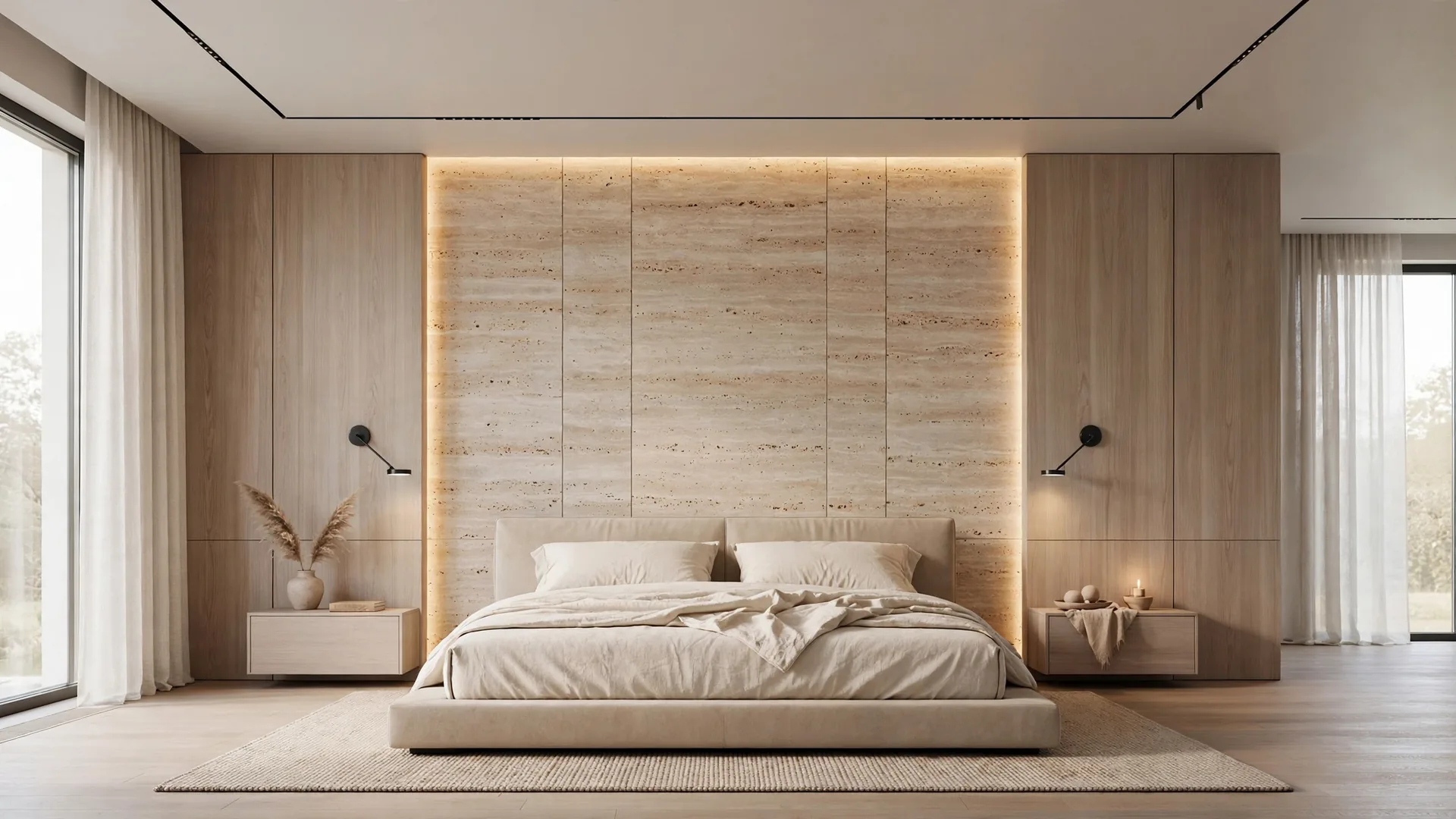
You see the wall behind your bed every time you walk into the room. You never see it while you sleep. That is exactly why it carries the whole bedroom. I install large-format bedroom wall panels for WOW Walls Studio here in South Florida, and clients almost never ask me about the panel itself. They ask about size: how wide, how tall, do the nightstands belong inside the composition? And they ask about finish: stone-look where your pillows rest, veneer, something soft. Get the size wrong and even a beautiful panel looks like a sticker. Get it right and the bed wall reads as architecture.
This guide walks through the sizing conversation I have before we order anything. You get the width rules, the height decision, and a worked table built on real US bed sizes. You see which finishes behave at pillow height and which ones quietly demand work. You see where outlets, reading lights, and switches have to go, because once the panels are up, they cannot move. You see how the wall lives with dust and Florida humidity. And you see what actually drives the price of one bedroom wall, so two very different quotes stop looking mysterious.
A panel wall is a different purchase from a headboard
TL;DR: A padded headboard is furniture: soft, fabric, made to lean on. A panel wall is architecture: a hard, wipeable surface that replaces the headboard visually and frames the whole sleeping zone. They solve different problems, and the honest trade is simple – panels give you the hotel look and near-zero weekly care, and pillows still do the leaning.
Most photos people send me show something else entirely: padded headboard panels from marketplace listings – foam and velvet on a board, sold by the piece. That is a real product. It just is not this one. I install large-format composite sheets – thin finish layers bonded over an engineered bamboo composite core (the build is covered in my bamboo composite wall panels guide), with finishes that read as travertine, marble, wood veneer, leather, or velvet – over a hard, wipeable surface.
Here is why that distinction matters at pillow height. Real velvet and fabric absorb sound and feel soft. They also collect what heads leave behind. Cleaning experts quoted in the home press say you should clean a fabric headboard weekly, because it acts as a magnet for dust, skin, and grease where heads rest, and velvet pile crushes and shades where pillows press it (Woman & Home; MyHomeReview). A stone-look or veneer panel does none of that. It also cushions nothing. If you read in bed sitting up, your pillows still do that job – and a slim headboard too, if you keep it. The wall does the looking.
Clients also ask: are accent walls over? The 2026 design press answers fairly clearly: the flat, single painted accent wall reads dated now, while full-height, textural, material-led walls are the current form – designers quoted by The Spruce point to texture and dimension, and bedroom-specific guides keep choosing the wall behind the bed because it anchors the room without stimulating you while you fall asleep (The Spruce; DesignShop; MeltFlex). A panel wall behind the bed belongs to that current form.
Width: the three layouts that work
TL;DR: Never narrower than the bed. Layout guidance for panel headboard walls starts from one rule: the composition runs at least as wide as the bed, and wider – framing the nightstands inside it – is the stronger option (EasyRest). In practice there are three layouts: bed-width, bed plus nightstands, and the full wall. Pick one on purpose; the failures I see are walls that landed between layouts by accident.
Start with the bed itself. US mattress sizes are standardized, and the panel math rests on them:
| Bed size | Mattress width x length |
|---|---|
| Twin | 38 in x 75 in |
| Twin XL | 38 in x 80 in |
| Full | 54 in x 75 in |
| Queen | 60 in x 80 in |
| King | 76 in x 80 in |
| California King | 72 in x 84 in |
Avocado Green Mattress and Texan Mattress agree on these sizes across the range. Two cautions before you order anything against this table. First, sizes are nominal: at least one major guide lists a Twin at 39 inches, and finished sizes vary slightly by brand (Casper; The Spruce). Second, your frame is wider than your mattress, sometimes by several inches a side. Measure the frame, not the mattress tag. If you size the field to the mattress alone, it can end up narrower than the furniture standing in front of it.
Layout 1 – bed-width. Match the field to your frame width. Your frame always measures wider than the mattress in the table above. This is the headboard substitute: the tightest, calmest option, and the right one when you have wide nightstands, short walls, or doors and closets crowding the sides.
Layout 2 – bed plus nightstands. Extend the field past both sides of the bed and take the nightstands in. You see this layout in most photos clients save, and layout guidance singles it out: wider, with the nightstands framed inside, anchors the whole sleeping zone as one unit (EasyRest). The math is plain: frame width plus both nightstand widths. Start from the mattress alone – a king at 76 inches plus two 24-inch nightstands already gives you a field of about 124 inches, over ten feet of wall – and then add whatever your frame measures beyond the mattress. That is why this layout starts with a tape measure.
Layout 3 – the full wall. Run the panels wall to wall. Choose this when the bed wall is short, or when side walls return at angles and a stopped field would look arbitrary. Finish choice matters most here, because your eye has nowhere to rest off the material.
Whichever layout you choose, do the cheap step first: mark the outline on the wall with painter's tape and live with it for a day. Layout guides give the same advice – tape it or lay it out before you fix anything, because ten minutes of tape prevents a crooked or undersized composition you then stare at every night (EasyRest). Add one check at the tape stage: sit in the bed, lean back, and look at where the edges fall against your pillows. You live with that view far more than the doorway view.
Height: part-height or floor-to-ceiling, nothing in between
TL;DR: Two heights work. A defined panel field that starts behind the mattress and stops short of the ceiling, or a deliberate floor-to-ceiling field. The awkward middle is a wall that ends right at pillow or mattress height: current bedroom guides put partial treatments at about two-thirds of wall height, and warn that a half-height band of 36 to 42 inches fights the pillows instead of framing them (EA Home Design).
The bottom edge is easy. Start the panels just behind or slightly above the mattress, so the field feels connected to the bed rather than floating above it (EasyRest). On a floor-to-ceiling run, the bed hides the bottom edge entirely – one reason that version is so forgiving.
The top edge is where taste and ceiling height meet. On a standard 9-foot wall, the classic partial proportion is about two-thirds – roughly 6 feet – which leaves a calm band of painted wall above (EA Home Design). The full-height version, floor to ceiling, is what most current bedroom guides show. It also makes a low room feel taller, because the verticals never stop. My rule on real jobs: if your ceiling is 8 feet or lower, go full height. A stopped line at two-thirds makes a low ceiling feel lower. If your ceiling is high and your composition is bed-width only, a defined field with air above it can look more tailored than a full slab.
Steer clear of half-height wainscot logic (wainscot – the partial-height paneling of dining rooms and halls) imported from other rooms. Behind a bed, it ends exactly where pillows and heads are, and it reads as an interruption where a frame should be (EA Home Design). Height also decides your light: a floor-to-ceiling field can hide a cove of warm light at the top (a concealed channel that washes light down the wall) – the subject of the section after next.
Finishes at pillow height: stone, veneer, and the soft looks
TL;DR: At the head of a bed, finishes rank by how calm they stay and how little they ask of you. Matte travertine-look and marble-look with soft veining stay quiet under bedside light; veneer brings warmth and hides small marks; velvet-look and leather-look composite finishes give the soft-wall picture with a hard, wipeable surface. Loud veining and gloss are the two things I talk bedroom clients out of.
Travertine-look. I install this warm, matte limestone look behind beds more than any other finish, and the reasons are in my travertine guide: it reads calm at close range, its pits and bands run horizontal and restful, and it flatters warm evening light. Compare it honestly with real travertine, which is porous – unsealed pores take moisture and stains, and natural travertine cladding needs sealing on installation and re-sealing every 1 to 3 years, with pH-neutral cleaning (Accio; Q-Furniture). The composite panel keeps the look and skips the sealing cycle.
Marble-look. One marble wall behind a bed works, because the headboard wall is already the room's focal point. The mistake is carrying marble around the room, where it turns cold and heavy. In a sleep space, vein choice is everything: high-contrast, dramatic veining competes with the bed and the art, while soft grey Calacatta-style veining, Carrara-style softness, and warm beige stones stay restful – and large formats keep the pattern calm because you get so few joints (Coohom; the styles are compared in my marble-look guide).
Veneer. Choose wood veneer finishes for warmth: visible grain and a grounded, hotel feel that flat paint cannot copy, on a surface that hides minor scuffs well. Shade steers the mood – pale oak reads airy, walnut and smoked tones read boutique (wood panel guides, summarized in my research from Medium and FEP). On a bed-plus-nightstands layout, I draw veneer side fields flanking a stone center most often. You see that combination in this article's hero composition too.
Velvet-look and leather-look. These composite finishes are printed and textured to read as soft material. They give you the upholstered-wall picture – the one that fills the marketplace listings – without textile at the head of the bed: the hard surface has no pile to crush where pillows rest, and you skip the weekly vacuuming with a soft brush (MyHomeReview; Next Divan). What they do not give you is softness itself. The surface is hard. If your picture of the wall includes leaning bare shoulders against velvet, you want real upholstery – and that product comes with the upholstery care routine described above. It is a fair trade, as long as you choose it with open eyes.
Outlets, sconces and switches: plan them before the panels
TL;DR: Every outlet, switch, and light on the bed wall becomes a cut in a panel, so the electrical map is drawn before the panels are cut, while changes are still cheap. Layout guidance is blunt about this: plan around sconces and outlets before anything goes up (EasyRest). After installation, confirm every device is still reachable and the panels' depth fouls nothing (WonderHowTo).
A typical bed wall carries two outlets (one per nightstand, for chargers and lamps), sometimes a switched outlet or a hardwired sconce pair, and occasionally a USB outlet. Each one needs a decision: keep it and cut around it, relocate it into the panel face, or – for hardwired sconces – set its exact position, because a sconce base lands on the panel face.
Sconce height has a working number: mount bedroom sconces at about 60 inches from the floor, roughly seated eye level for reading, and about 6 to 12 inches above the nightstand edge when you frame the bed, with adjustable heads so each partner aims their own light (Coohom). Keep the light warm, around 2700K to 3000K – the recommended range for a sleep-friendly room, and the same warm band I spec for backlit walls in my LED wiring guide.
One code-shaped caution matters here. Electricians discussing the bedroom receptacle rule (NEC 210.60(B)) put it this way: position receptacles behind a bed so the bed cannot press against an inserted plug, or guard them – and many of them use recessed receptacles as the practical answer (Mike Holt Forum). In panel terms: never let a layout bury a live outlet behind the bed or behind a fixed panel where a plug sits trapped. If an outlet has to move, book an electrician for an hour, planned and scheduled in advance.
One small furniture detail changes how the wall reads: let the nightstands stand an inch or two off the panel wall rather than pushing them hard against it, so the composition reads as a backdrop instead of a collision (EA Home Design). Floating nightstands mounted to the panel field, as in this article's hero photo, take that idea furthest – but you must fix them to structure, which is again a before-panels decision.
Light: the warm wash that makes it a bedroom
TL;DR: The glow in the saved photos is almost never a lamp. It is a concealed warm LED wash – a cove at the top of the panel field or a halo behind a raised section – run at warm color temperature and dimmed low for the evening. The electrical planning for it – drivers (the power supply boxes that feed the strips), dimming, voltage drop (the dimming that creeps in along long runs) – is a whole system, covered in my LED wiring guide; the bedroom-specific part is restraint: warm, dim, and indirect.
Bedrooms punish glare more than any other room, because you experience the wall lying down, looking up. Direct downlights over the bed rake across a stone-look finish and show every joint. A concealed wash does the opposite: it grazes the texture softly, hides the joints in gradient, and makes travertine-look and veneer look expensive at exactly the hour you use the room. Let pendants or sconces handle reading at the sides, at the heights given above.
If you add backlight, apply two bedroom rules from my wiring work double. First, buy the dimmer and driver as a matched pair and bench-test them before the wall closes, because low-end flicker that a living room forgives will keep you awake in a bedroom. Second, put the driver somewhere you can reach – a nightstand cabinet or closet – never sealed behind the panels. The full method is in my LED backlit wall panels guide.
Care, and the Florida part nobody mentions in the listings
TL;DR: A hard panel wall asks for a soft cloth and an occasional wipe. A fabric headboard wall asks for a weekly routine. In South Florida there is a second argument: keep indoor humidity below 60 percent, because mold needs only moisture and organic material – and fabric and foam at the head of a bed hold both (PuroClean; Markham Inspection Services).
The care contrast is concrete. For upholstered headboards, you vacuum weekly with a soft brush, blot spots immediately without rubbing, refresh velvet with a steamer, and test any cleaner in a hidden spot first (Next Divan; MyHomeReview; Woman & Home). For hard panels – stone-look, leather-look, velvet-look composite – you dust with a soft cloth and wipe with a damp cloth and a pH-neutral cleaner when needed, the same basic routine published for natural stone cladding (Accio). Veneer follows wood care instead: dusting, occasional polishing, and periodic sealing where humidity is high, per wood panel guides. That is the whole list. Behind a bed, where the surface sits inches from pillows and hair, the wipeable version wins on effort every week of the year.
Now the Florida part, which the listings never mention. Our bedrooms run air conditioning most of the year. Florida mold guidance is consistent: the state is mold-prone from heat, rain, and humidity, bedrooms are a priority room, and you should keep indoor humidity below 60 percent with ventilation and working AC (PuroClean; Markham Inspection Services). Material stability points the same way: solid wood swells and shrinks as moisture changes, while engineered composite materials stay more dimensionally stable (Design on a Dime Interiors) – one reason the composite core suits this climate, a point I make at length in my Florida humidity guide. In this climate, a fabric-and-foam headboard on a damp-prone wall is the highest-maintenance object in the room.
What drives the price of one bedroom wall
TL;DR: One wall, four cost drivers: the field area your layout creates, the finish, the number of electrical cuts and light features, and whether nightstands or shelving are built into the composition. A bed-width travertine-look field with two outlet cuts and a ten-foot bed-plus-nightstands field with sconces and a backlit cove are both "a bedroom panel wall" – and they are different projects. The full cost structure is in my wall panels cost guide.
Work through the drivers in the order I estimate them. Area first: the three layouts multiply panel area in the same room – a bed-width, part-height field is a fraction of a full wall run floor to ceiling, and the material count follows the drawing, so layout is the single biggest lever in the estimate. Finish second: your finish sets its own per-sheet line in the estimate, and a book-matched marble-look center (mirrored sheets whose veining reflects across the joint, like an open book) adds layout work, because you select and pair sheets before cutting. Third, interruptions: every outlet, switch, sconce, and TV point is a cut and a fitting, and a backlit cove adds the whole lighting system on top. Fourth, furniture: floating nightstands and shelving fixed through the panels are carpentry work, with a real cost line attached.
That is why I do not quote a bedroom wall from a photo alone, and why you should be suspicious of anyone who does. From a photo and a bed size, I can draw the field, count the cuts, and tell you which layout your wall honestly is – the estimate then follows the drawing. The general anatomy of panel pricing – materials, installation, and the Florida factors – is in my wall panels cost guide.
Questions I get about bedroom panel walls
TL;DR: The short answers: at least as wide as the bed frame; full height on low ceilings; stone-look or veneer if you want wipeable, real upholstery only if you accept its weekly care; outlets and sconces are planned before cutting; and yes, the accent wall is still current – in its textural, full-height form.
How wide should panels behind a bed be?
Start from the mattress – 60 inches for a queen, 76 for a king – then measure your frame, which is wider than the mattress, and let the frame set the minimum. Go wider still and frame both nightstands inside the field when the wall allows it – that is the stronger composition (EasyRest).
Is a panel wall better than an upholstered headboard?
They do different jobs. Panels give you the architectural, hotel look and wipe clean; upholstery feels soft to lean on and absorbs some sound, but it needs weekly vacuuming and spot care, and its pile crushes where pillows rest (Woman & Home; MyHomeReview). Many clients keep a slim headboard for leaning and let the panels do the looking.
Can panels go on the wall if my outlets are behind the bed?
Yes, with planning. Map each outlet and switch before you cut the panels, and place receptacles behind a bed so the bed cannot press on an inserted plug, or recess or guard them (NEC 210.60(B), per electricians' discussion). Moving an outlet is an electrician's job – schedule it before install day. Treat lights the same way: plan sconces at about 60 inches from the floor, 6 to 12 inches above the nightstand edge, in warm 2700K to 3000K light (Coohom).
Should bedroom wall panels go floor to ceiling or part height?
Both work; the middle fails. Part height means a defined field of about two-thirds of the wall – roughly 6 feet on a 9-foot wall – starting behind the mattress. Floor-to-ceiling suits ceilings of 8 feet or lower and hides a light cove at the top. A half-height band of 36 to 42 inches ends at pillow height and fights the bed instead of framing it (EA Home Design; EasyRest).
How do you clean wall panels behind a bed?
Wipe them. Dust with a soft cloth and clean with a damp cloth and a pH-neutral cleaner when needed – the routine published for stone cladding (Accio). Contrast that with fabric headboards, which need weekly vacuuming, immediate spot care, and steamer refreshes for velvet (Woman & Home; Next Divan).
Do wall panels work in a humid Florida bedroom?
Yes, and the composite core is part of the reason: engineered composites stay more dimensionally stable as humidity changes, while solid wood swells and shrinks (Design on a Dime Interiors). Keep indoor humidity below 60 percent with ventilation and working AC, as Florida mold guidance advises (PuroClean; Markham Inspection Services).
Which finish is best for a primary bedroom?
For most South Florida primary bedrooms, I start with matte travertine-look for calm, or veneer side fields around a stone center for warmth. Marble-look with soft veining suits brighter rooms. Velvet-look and leather-look finishes give you the soft picture with a hard surface. I steer sleep spaces away from loud veining and gloss (Coohom).
Are bedroom accent walls still in style in 2026?
Yes – in their current form. The 2026 design press treats flat single-color painted accent walls as dated, and full-height, textural, material-led walls as the modern version; bedroom guides specifically favor the wall behind the bed (The Spruce; EA Home Design; DesignShop).
My verdict for South Florida bedrooms
TL;DR: Draw the field before you pick the finish: bed-width at minimum, nightstands inside if the wall allows, full height on an 8-foot ceiling. Choose matte travertine-look or a stone-and-veneer mix for a wipeable wall that stays calm at pillow height. Map every outlet and light before cutting. Do that, and the wall behind your bed stops being the room's blank spot and becomes the reason the room feels finished.
Here is how I see it on real jobs across Palm Beach, Broward, and Miami-Dade. The bedroom is the easiest room in the house to get right with panels, because the composition already has a center – the bed – and a frame – the nightstands. The mistakes are never exotic: a field a few inches narrower than the frame, a top edge that stops where the pillows start, an outlet you discover behind a panel, a fabric wall that nobody warned the owners would need weekly care in Florida air. Every one of those is a drawing-stage mistake, and you can fix drawing-stage mistakes for free.
What I will never tell you: that a padded marketplace headboard and a panel wall are the same purchase; that width "does not really matter"; that the outlet will somehow work out; or that a price for your wall exists before you draw the field. Send the photo, tell me the bed size, and the drawing comes first – the finish, the light, and the number all follow from it.
Sources
- EasyRest, White Acoustic Panel Headboard Wall Ideas (composition at least as wide as the bed, wider to frame nightstands inside; bottom edge just behind or slightly above the mattress; comfortable ceiling gap unless floor-to-ceiling; plan sconces and outlets before mounting; tape the layout first). easyrest.com
- EA Home Design, 27 Bedroom Accent Wall Ideas for 2026 (partial-height proportion about two-thirds of wall height; half-height 36-42 in treatments warned against behind beds; full-height as the current form; nightstands an inch or two off the wall). eahomedesign.com
- Avocado Green Mattress, Mattress Sizes Guide: Twin, Full, Queen, King, and California King (standard US mattress dimensions). help.avocadogreenmattress.com
- Texan Mattress, Mattress Size Chart (dimensions cross-check; nominal vs finished sizes). texanmattress.com
- Casper, Mattress Size Comparison Guide (Queen, King, California King cross-check; brand variation note). casper.com
- The Spruce, Accent Walls Are Trending Again (designers on texture and dimension as the 2026 form) and Understanding Bed Size Dimensions (Twin listed at 39 in). thespruce.com
- Coohom, Bedroom Marble Wall Design (one marble wall as focal point; soft veining for bedrooms; large formats for fewer joints). coohom.com
- Coohom, Bedroom Wall Sconce Lighting (sconces at about 60 in from the floor, 6-12 in above the nightstand edge, adjustable heads, 2700K-3000K warm light). coohom.com
- DiyDekor, How to Install Wooden Wall Panels in Your Bedroom (wood panel care: basic dusting, occasional polishing; sealing in humid environments). diydekor.com
- Accio, Travertine Marble Wall Cladding FAQ (natural travertine porosity, sealing on installation and re-sealing every 1-3 years, pH-neutral cleaning, soft-cloth dusting). accio.com
- Q-Furniture, What Is Travertine? (natural travertine properties and care). q-furniture.com
- Woman & Home, The Forgotten Bedroom Item You Should Be Cleaning Weekly (experts: fabric headboards collect dust, skin, and grease and need weekly cleaning). womanandhome.com
- MyHomeReview, Velvet Headboards Buying Guide (velvet pile crush and shading at rest points, sun fading, soft-brush vacuuming, steamer refresh). myhomereview.com
- Next Divan, How to Clean a Fabric Headboard (vacuum with soft brush, dab spots without rubbing, test cleaners hidden first). nextdivan.co.uk
- Mike Holt Forum, NEC 210.60(B) discussion (receptacles behind the bed positioned so the bed cannot contact an inserted plug, or guarded; recessed receptacles suggested). forums.mikeholt.com
- WonderHowTo / Interior Design, How to Build Upholstered Fabric Wall Panels for a Headboard (post-install check: outlets and switches still accessible, panel depth fouls nothing). interior-design.wonderhowto.com
- PuroClean Zephyrhills via Medium, Why Florida Homes Are Prone to Mold (heat, rain, humidity; indoor humidity below 60 percent). medium.com
- Markham Inspection Services, Tips to Avoid Mold Growth in Florida Homes (bedrooms among humidity-priority rooms). cfmoldinspect.com
- Design on a Dime Interiors, Humidity-Proof Finishes (solid wood swells and shrinks with moisture; engineered composites stay dimensionally stable). designonadimeinteriors.com
- DesignShop, 5 Bedroom Accent Wall Ideas for 2026 (designers favor the bedroom accent wall; cocooning effect). designshop.com
- MeltFlex, Accent Wall Design Ideas 2026 (soft full-wall headboard materials; the bed wall faces away while sleeping). meltflexai.com
- WOW Walls Studio, Bamboo Composite Wall Panels: What They Are and Why They Last (2026).
- WOW Walls Studio, Travertine Accent Wall Panels: Real Stone vs Composite (2026).
- WOW Walls Studio, Marble-Look Wall Panels: Calacatta Styles, Honest 2026 Guide.
- WOW Walls Studio, LED Backlit Wall Panels: Wiring, Drivers and Dimming (2026).
- WOW Walls Studio, Wall Panels in Florida Humidity: MDF vs PVC (2026).
- WOW Walls Studio, How Much Do Wall Panels Cost in 2026? Materials + Install.