Wall Panels vs Paint: Cost, Durability and the Florida Test (2026)
Wall panels vs paint, honestly: day-one and 10-year cost, durability, the Florida humidity test, and the rooms where paint is the smarter buy.
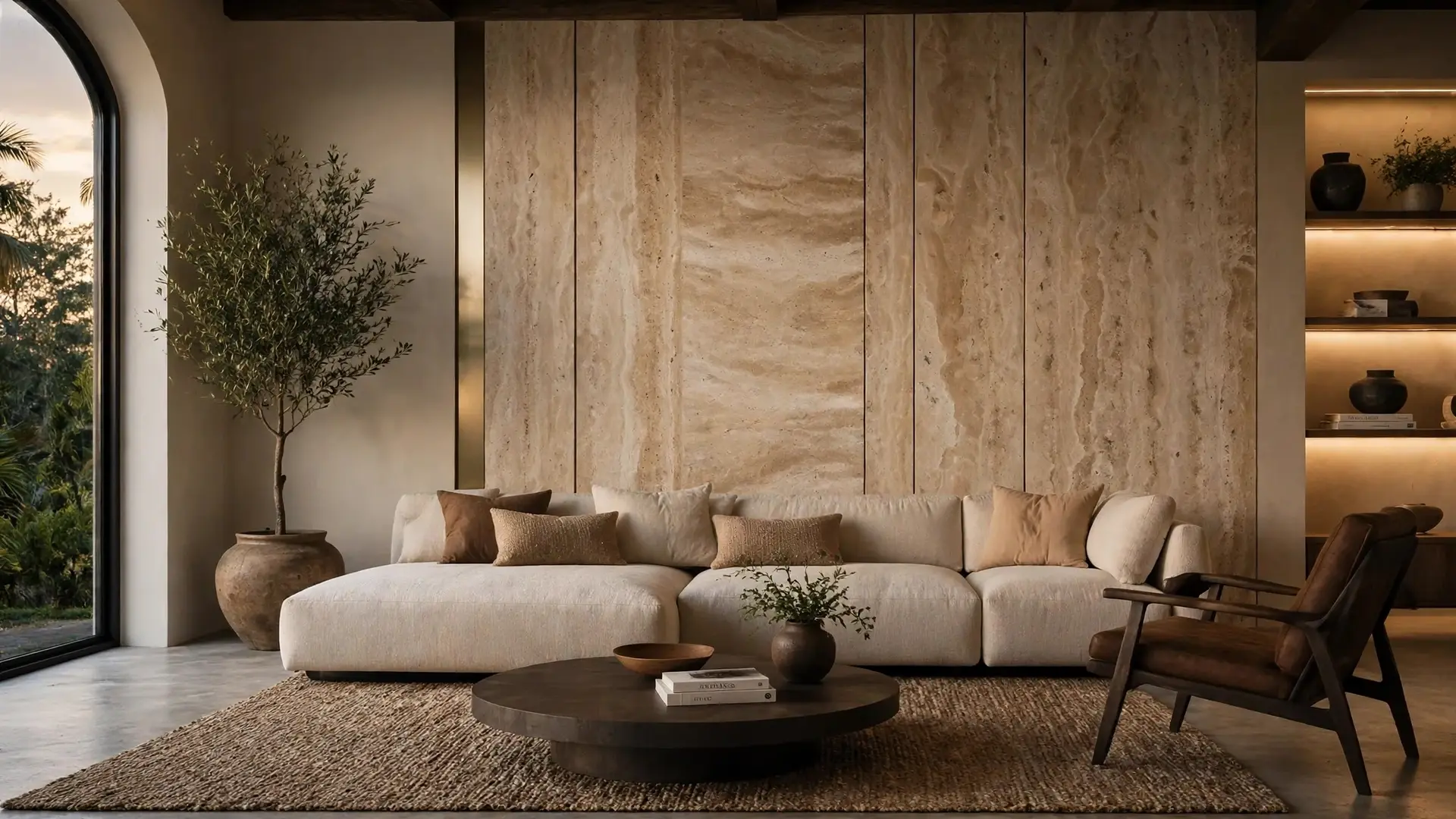
Paint is the finish every wall in South Florida already wears, so I use it as the honest baseline for any panel quote. When a homeowner asks me whether a panel wall is "worth it", they are really weighing wall panels vs paint against a painter's invoice. They deserve that comparison done straight: what paint costs, what it does well, where it quietly bills you again, and where a panel wall earns its higher first price. I install large-format panels for WOW Walls Studio, so my bias is on the table. The numbers below come from national cost guides and paint-industry sources, and the sections where paint wins are written as plainly as the ones where panels do.
The panels I install are big, thin sheets – 48 by 108 inches, 5 mm thick, with a bamboo-composite core (a board of bamboo fibre in a resin binder) and a finished face in a travertine look, a marble look, stone, porcelain-look, wood veneer (a thin layer of real wood over the core), leather or velvet. Paint is a thin film that you renew on a cycle. Almost every difference in this article grows out of those two facts.
The short answer first
TL;DR: Paint wins on day-one price, colour freedom, curved walls, and easy changes. Panels win on durability per year, on walls that take daily knocks, and on any wall where you want stone, wood or leather as the actual surface. In South Florida the tiebreaker is humidity: a damp wall defeats both finishes, and the one you pick matters less than fixing the moisture first.
Choose paint when the wall is a backdrop, the budget is tight, or you know you will want a new colour inside five years. Choose panels when the wall is the feature, the room works hard, and you are buying a finish you intend to keep for a decade or more. The sections below put numbers and failure modes on each of those claims. If your other candidate is wallpaper rather than paint, I ran that comparison separately in my wall panels vs wallpaper guide – the cost cycle there is different, because paper is removed, not recoated.
| Paint | Wall panels | |
|---|---|---|
| Day-one cost | $2-$6 per sq ft pro (Angi 2026); $15-$40 a gallon DIY | Higher first invoice: a manufactured finish plus installation |
| Cost rhythm | Repaint cycle: 5-7 years in lived-in rooms, 2-3 in hallways | One purchase, no repaint cycle |
| Surface | A thin film over drywall; sheen decides what shows | A rigid sheet; the finish is the material |
| Florida humidity | Mildew and blistering on damp walls; shortest cycles in wet rooms | Face wipes clean; a damp wall behind it still has to be fixed first |
| Changing your mind | A weekend repaint | Replacing the wall finish |
Upfront cost: paint wins the first invoice
TL;DR: A professional paint job runs $2 to $6 per square foot in Angi's 2026 national data, with a 12-by-12 room at $290 to $870 and a living room at $900 to $2,000. A panel wall costs more on day one by design – it is a manufactured finish plus installation, where paint is mostly labour and a few gallons.
Start with what a painter actually charges. Angi's 2026 cost data puts professional interior painting at $2 to $6 per square foot, a standard bedroom at $300 to $750, and a living room at $900 to $2,000. Doing it yourself cuts that to materials: Angi prices paint at $15 to $40 a gallon. No panel product competes with a $40 gallon on the first invoice, and any article that pretends otherwise is selling something.
Two honest qualifications. First, an accent wall (one painted wall in a contrasting colour) is not the cheap line item people expect: Angi notes it raises a room's painting budget by 20 to 30 percent, because of the extra taping, cutting-in (painting a clean edge by hand), and drying time. Second, the painter's price assumes a wall that is ready. Patching, sanding, and priming (sealing the surface with an undercoat so the paint grips and covers evenly) damaged drywall is prep labour on top, and in older Florida homes with patched-over patches, prep is where I watch paint quotes grow. My studio's panel prices sit in their own section at the end; the market-wide breakdown of panel materials and install pricing is in my wall panels cost guide.
The 10-year math: repaint cycles change the winner
TL;DR: Paint is a subscription. Painter guidance puts living rooms and bedrooms on a 5-to-7-year repaint cycle, hallways at 2 to 3 years, and kitchens and bathrooms at 3 to 4. Across ten years, a living room painted twice by a professional lands at roughly $1,800 to $4,000 for the whole room – and one fitted panel wall for that room's feature wall, at $2,200 to $2,700, sits inside the same ten-year spending window, bought once.
Here is the arithmetic nobody shows at the paint counter. Take Angi's living room range, $900 to $2,000 per professional repaint. Repaint guidance published by Colin Can Help puts a lived-in living room on a 5-to-7-year cycle, so a ten-year stay usually means two paint jobs: the one you do now and the refresh around year six. Two cycles land at $1,800 to $4,000, before the accent-wall surcharge and any prep repairs. The scopes differ, and I will state that plainly: Angi's figure repaints a whole room, while the studio figure finishes one wall of it – the feature wall this comparison is actually about. Premium paints stretch the cycle – a comparison of the two big brands' premium lines credits them with 8 to 12 years indoors – which is a real argument for buying good paint. The cycle gets longer; it still stays a cycle.
Hallways sharpen the point. At a 2-to-3-year cycle, a hallway gets repainted four or five times in a decade, because scuffs accumulate faster than the paint wears out chemically. Kitchens and bathrooms cycle at 3 to 4 years, driven by steam, grease, and cleaning. A panel wall has no repaint cycle in this sense: the finish is the material itself, and you maintain it by wiping it down. I am not going to print a lifespan figure for panels here, because no source I trust publishes one for this material – what I can say is that the cost comparison flips on the second repaint, and you can run your own room through the same arithmetic with your painter's last invoice.
| Room | Repaint cycle (painter guidance) | Pro repaints in 10 years | 10-year paint cost signal |
|---|---|---|---|
| Living room | 5-7 years | about 2 | 2x the per-job price (Angi: $900-$2,000 per job) |
| Bedroom | 5-7 years | about 2 | 2x the per-job price (Angi: $300-$750 per job) |
| Hallway / entry | 2-3 years | 4-5 | Scuff-driven, often partial repaints |
| Kitchen / bathroom | 3-4 years | 3-4 | Steam and grease drive the cycle |
Durability: scuffs, dents and daily life
TL;DR: Paint's durability is a trade you make with sheen (how glossy the finish is): flat paint hides flaws and marks if you touch it, satin and semi-gloss wipe clean and show every flaw and touch-up. A panel face takes chair backs, luggage, and vacuum bumps as a solid surface, and a mark usually ends at the surface instead of in a repaint plan.
Paint fails in two different ways. The soft way first: scuffs, shoe marks, and the grey shine a hallway wall develops where hands and bags brush it – cosmetic damage, and the reason hallways repaint on the shortest cycle. Then the structural way: a chair back or a door handle dents drywall through the paint film, and the repair is filler, sanding, priming, and repainting, which leads straight to the touch-up problem in the repairs section below. Better paint genuinely helps – the premium lines are sold on washability and scuff resistance, and they deliver more of both than builder-grade paint (the cheapest paint builders spray on new homes) – but the film is still a film over soft gypsum (the plaster core inside drywall).
A panel changes the surface itself. I fit a rigid sheet with its finish already on it, so the chair back and the vacuum meet the material directly. In the rooms where I see paint give up first – the entry wall behind the door swing, the hallway turn where luggage rounds the corner, the dining wall behind chair backs – the advantage I count is what a repair looks like when something does get through: a surface mark on a panel usually cleans off, and if a sheet is genuinely damaged, I replace that sheet, much like swapping a tile, and I leave the rest of the wall untouched.
The Florida test: humidity, mildew and damp walls
TL;DR: The U.S. EPA puts healthy indoor humidity below 60 percent, ideally 30 to 50 percent, and its first mold rule is to fix the moisture problem before anything else. Paint over a damp wall blisters, peels, and feeds mildew at the film; a panel over the same wall hides the problem while it grows. Neither finish is a waterproofing answer.
South Florida homes live at the humid end of the map, and air conditioning is the only thing holding indoor humidity near the EPA's 30-to-50-percent ideal. Paint responds to chronic humidity in documented ways: moisture behind the film pushes it into blisters, and steam rooms grow mildew on the paint surface itself – which is why the big paint brands sell dedicated mildew-resistant bathroom lines – and kitchens and bathrooms sit on the shortest repaint cycle in the guidance above. None of this makes paint a bad Florida finish; most Florida walls are painted and fine. What it does is tie paint's Florida lifespan to how wet the room runs – and that is where I start any honest quote.
Panels move the weak point to a new place. The finished face is a composite surface that wipes clean. The wall behind the panel is the same wall, though, and a leak or chronic damp behind any finish keeps growing where you cannot see it – the EPA's instruction to fix the water problem first, and to dry wet materials within 24 to 48 hours, applies under panels exactly as it does under paint. This is also why I pay close attention to material choice inside the panel family in our climate; I compared cores and humidity behaviour in my Florida humidity wall panels guide. If a wall in your home is actively damp, I run the same sequence every time: source, dry, verify – then we can argue about finishes.
What each finish hides – and what it shows
TL;DR: Flat paint is the best camouflage per dollar for minor wall flaws, and it still telegraphs patches and waves in raking light (light hitting the wall at a shallow angle, like low sun, which shows every bump). Panels cover texture and patchiness behind a rigid sheet, but they demand a wall that is flat to a few millimetres – a bowed wall gets repaired first, whoever finishes it.
Every South Florida home has one wall that tells the truth at 5 p.m., when low sun rakes across it: every patch, tape joint, and wave in the drywall shows. Paint's relationship with that wall is negotiated through sheen. Flat and matte paints hide imperfections best and mark easiest; each step up in gloss – eggshell (the low-sheen grade just above flat), satin, semi-gloss – washes better and shows the wall's geography more honestly. Painters know this trade cold, and it is why the same colour can look premium in one room and tired in another.
A panel sheet is rigid, so it does not follow the wall's small texture at all: orange-peel texture (the faint bumpy finish most drywall has, like orange skin), patch edges, and minor unevenness disappear behind it. I can also fit panels over existing paint when it is sound and flat. I take loose paint off, sand glossy paint for grip, and prime bare or chalky patches – that is the over-paint rule the installation guide details. What a panel cannot do is bridge a bow. Thin sheets fitted to a wall that curves will show the curve at their seams, which is why I start every panel installation with a flatness check and why, if a wall fails it, I quote the repair separately from the panel work – I walked through that verdict in my wall panel installation guide. The honest summary: paint hides small flaws in the finish and shows big ones; panels hide small and medium flaws behind the sheet and refuse big ones until they are fixed.
Texture and depth: the look flat paint cannot give you
TL;DR: Standard paint delivers colour, full stop. The paint family can reach for texture – limewash (a limestone-based paint with a cloudy, two-tone depth) at $5 to $8 per square foot and Venetian plaster (lime putty with marble dust, troweled and burnished) at $8 to $20 in 2026 applicator pricing – and at that point it costs what panels cost, takes longer, and still shows every flaw in the wall beneath it.
This is the section where panel marketing usually cheats, so let me be careful. A travertine-look panel gives you veining and pore texture in the surface itself, and its seams and inlay strips (slim metal strips set into the panel face) cast small shadows that flat paint cannot produce. Paint gives you the colour of travertine. For a lot of rooms, colour is genuinely enough – a well-chosen warm white behind good furniture is a finished design, and I say so to clients whose rooms do not need a feature wall at all.
Where the comparison gets interesting is decorative paint. Limewash (a limestone-based paint brushed on in crossing strokes for a cloudy, two-tone depth) runs $5 to $8 per square foot applied, and Venetian plaster (lime putty with marble dust, troweled in thin layers and burnished) runs $8 to $20, per a 2026 applicator comparison – panel money, for a finish 1 to 2 millimetres thick that, as one plaster supplier puts it, shows every drywall flaw and needs two to three times the prep work painting needs. Both are beautiful, both outlast standard paint, and limewash touches up gracefully. They are the strongest version of the paint argument. Both also come from a specialist trade with a specialist invoice, which moves them out of the paint-and-a-roller world entirely. If it is the material itself you want to read about, my bamboo composite wall panels guide covers what the sheet is made of.
Install week: fumes, dust and room downtime
TL;DR: Painting a room is a wet trade spread over days: masking, prep sanding, two coats with drying time between them, and a smell that lingers after the crew leaves. A panel fitting is a dry trade: the cutting makes the dust where the cutting happens, there are no wet coats to dry, and the one wait is the adhesive cure (the time the adhesive needs to harden fully) before the wall is loaded – the crew fitting your wall confirms that wait for the adhesive they use.
When I watch a repaint crew work a lived-in room, the first stretch is rarely painting: they centre and sheet the furniture, tape the trim, and sand the patches (that dust is the job's real mess), then lay a primer coat where needed and two finish coats with drying windows between them. The room is out of service while coats dry, and freshly painted rooms carry that new-paint smell into the following days. None of it is dramatic; all of it is spread out, and for a household living in the house, the spread is the cost.
Panel work concentrates its disruption into the fitting itself. I measure and plan on a quiet visit beforehand. The fitting is dry work – I cut the sheets to the plan, bond them, and trim them – so the room's downtime is the work itself plus the cure wait, with no coats drying in sequence. I detailed the full sequence, stage by stage, in the installation guide linked above.
Repairs and changes: paint's home ground
TL;DR: Paint is the easiest finish in the world to change and one of the trickiest to touch up invisibly: a dab from the original can dries to a different sheen and texture than the cured wall around it – flashing, the mismatch that shows at glancing light (light skimming along the wall). Panels reverse the trade – a colour change means a new wall, and a damaged sheet is a contained replacement.
Give paint its due first. Tired of the colour? A weekend and a few hundred dollars change it. Selling the house? A fresh neutral repaint is the best-value move in the business when a sale is coming. Renting, or outfitting a room whose use will change in two years? Paint, and it is not close. Any finish you might want to undo belongs to paint.
The touch-up story is less cheerful. Paint on a wall ages – light fades it, cleaning dulls it – while the leftover paint in the can ages differently, so a touch-up applied months later dries visibly different in sheen and texture; the faded colour around it may no longer match either. Painters call the sheen mismatch flashing, and it gets worse as sheen rises: satin and semi-gloss walls announce their touch-ups at glancing light, which is why painters so often end up repainting a whole wall to fix one scuff. Panels take the opposite deal. You cannot recolour them, and if your taste changes in three years, that is a real cost. In exchange, the panel finish runs without a repaint cycle, and damage stays local: I replace one sheet and leave its neighbours untouched.
Room by room: where each one belongs
TL;DR: Paint the rooms that are backdrops, short-horizon, or curved. Panel the wall that carries the room – the TV wall, the bed wall, the entry – and the corridors that repaint on the shortest cycle. Kitchens split the difference by zone, and bathrooms split it at the shower line.
I give these verdicts room by room because the finish question is never whole-house in the homes I measure. Living room: the feature wall is the panel's home ground, and the other three walls usually want paint – the combination is what most of my projects actually are, and my living room wall panels guide works the room in full. Bedroom: paint is restful and cheap to refresh; homeowners choose a panel wall behind the bed for looks, since durability rarely decides that room. Hallway and entry: the strongest durability case in the house, per the repaint table above. Kitchen: paint the general walls in a washable satin; the splash and heat zones behind cooking are a materials question I covered in my kitchen wall panels guide. Bathroom: outside the shower, both finishes work if the room is vented; inside the wet zone, neither paint nor these panels is the right tool, and tile or a rated shower system is. Curved walls, arches, and ceilings: paint, or plaster – large flat sheets do not bend, and I will not pretend otherwise.
What a panel wall costs at my studio
TL;DR: My studio publishes three ways to buy a wall: a stock design from $850, a design fitted to your wall at usually $2,200 to $2,700, and a full custom turnkey (design, panels, delivery and installation included) project from $9,999 – and every price is preliminary until a specialist confirms the exact price after measuring your wall. Set against two professional repaint cycles of a living room, the fitted design is the comparison most homeowners are really making.
Here is what each tier buys. The stock design is a finished design from our library, installed as shown. The fitted design takes a design from that library and re-composes it around your wall's proportions, in the finish you choose. Full custom brings surfaces, lighting, a TV niche, and storage into one composition, designed for the room and installed turnkey. Every turnkey wall includes design, panels, delivery, and installation by our own crew; I assess demolition, wall repair or leveling, new electrical circuits, and permits on site and confirm them in the exact quote. Paint is cheaper per visit and bills you per cycle; a panel wall is one purchase, priced after a person has stood in front of your wall.
Frequently asked questions
Are wall panels better than paint?
For a feature wall you intend to keep, I usually say yes: the finish is a real material, it takes daily wear without a repaint cycle, and it covers minor wall flaws. For a backdrop wall, a short-horizon room, or a tight budget, paint is the better tool. I answer the question per wall; a whole house rarely gets one answer.
How much does it cost to paint a room professionally in 2026?
Angi's 2026 national data puts professional interior painting at $2 to $6 per square foot: a 12-by-12 room at $290 to $870, a bedroom at $300 to $750, and a living room at $900 to $2,000. An accent wall adds 20 to 30 percent to the room's painting budget.
How often do interior walls need repainting?
Painter guidance puts living rooms and bedrooms at every 5 to 7 years, hallways and entries at 2 to 3 years, kitchens and bathrooms at 3 to 4 years, and ceilings and trim at 7 to 10 years. Premium paint lines stretch those cycles; they do not remove them.
Do wall panels last longer than paint?
A panel finish has no repaint cycle: the surface is the material itself, and you maintain it by wiping it down, while paint is a thin film renewed on the cycles above. I do not publish a lifespan figure for these panels, because no source I trust states one – the practical difference is the cycle itself, and I put no promised number of years behind the panel side.
Can wall panels be installed over painted walls?
Yes, over sound, flat paint: loose paint comes off, glossy paint is sanded so the adhesive can grip, and bare or chalky areas get primer. Over wallpaper, no – the paper layer is weak and humidity lifts it, so it comes off first. A bowed or damaged wall needs repair before either finish.
Which is better in Florida humidity, paint or panels?
Neither finish fixes a damp wall: the EPA's rule is to fix the moisture source first and keep indoor humidity below 60 percent, ideally 30 to 50 percent. On a dry, sound wall, I panel the splash-prone feature walls and paint the rest: the panel's finished face wipes clean after steam and splashes, and there is no paint film there to hold to the 3-to-4-year kitchen and bathroom repaint cycle.
Can paint look like stone or marble?
Standard paint delivers colour only; the material itself is missing. Decorative finishes get closer: limewash at $5 to $8 per square foot and Venetian plaster at $8 to $20 per square foot in 2026 applicator pricing. At those prices they compete with panels directly, and they demand more wall prep than either.
Which finish is easier to change later?
Paint, by a wide margin: a colour change is a weekend repaint. A panel wall is a commitment to the finish you chose; changing it means replacing the wall finish. If you expect to redecorate inside five years, that flexibility is worth real money and should decide the question.
My verdict
Paint is a good finish that Florida bills by the cycle, and for most walls in most homes it is the right purchase. A panel wall earns its price in a narrower set of places: the wall the room is built around, the corridor that repaints every two years, the home where the finish is meant to be the room's main surface. If you are pricing a feature wall, run the painter's number twice before you compare it with mine once – two repaint cycles are the honest basis for the comparison, and I show the arithmetic in this article.
Sources
- Angi – "How Much Does It Cost to Paint a Room?" (2026 data: professional interior painting $2-$6 per square foot, room-by-room prices, accent-wall surcharge; paint at $15-$40 per gallon). angi.com
- Colin Can Help – "How Often Should I Paint the Interior of My Home?" (repaint cycles by room: hallways 2-3 years, living rooms and bedrooms 5-7, kitchens and bathrooms 3-4, ceilings and trim 7-10). colincanhelp.com
- J Brown Painting – "Benjamin Moore vs Sherwin-Williams: Which Lasts Longer?" (premium interior paint lines lasting 8-12 years indoors). jbrownpainting.com
- U.S. EPA – "A Brief Guide to Mold, Moisture and Your Home" (indoor humidity below 60 percent, ideally 30-50 percent; dry wet materials within 24-48 hours; fix the moisture problem first). epa.gov
- Engineer Fix – "Can You Touch Up Satin Paint Without It Showing?" (touch-up flashing: sheen and texture mismatch against aged paint). engineerfix.com
- Smith & Company Painting – "Interior Paint Sheen Guide: Flat vs Eggshell vs Satin" (sheen trade-offs; flashing shows most on satin and semi-gloss). smithandcompanypainting.com
- Riot Reno – "Limewash vs Venetian Plaster: Complete Guide (2026)" (limewash $5-$8 per square foot; Venetian plaster $8-$20 per square foot; service lives of both). riotreno.com
- The Decora Company – "Venetian Plaster 101" (plaster 1-2 mm thick shows every drywall flaw; prep takes 2-3 times longer than painting). thedecoracompany.com
- WOW Walls Studio – Pricing page and FAQ (public price anchors, what is included and assessed on site, panel specification). wowwallsstudio.com