
Travertine Wall: Real Stone, Look Panels and Where Each Works (2026)
Full travertine wall systems compared: real stone tile and slab, flexible stone veneer, and travertine-look panels – cuts, sealing, weight, wet zones, Florida humidity, and 2026 costs.
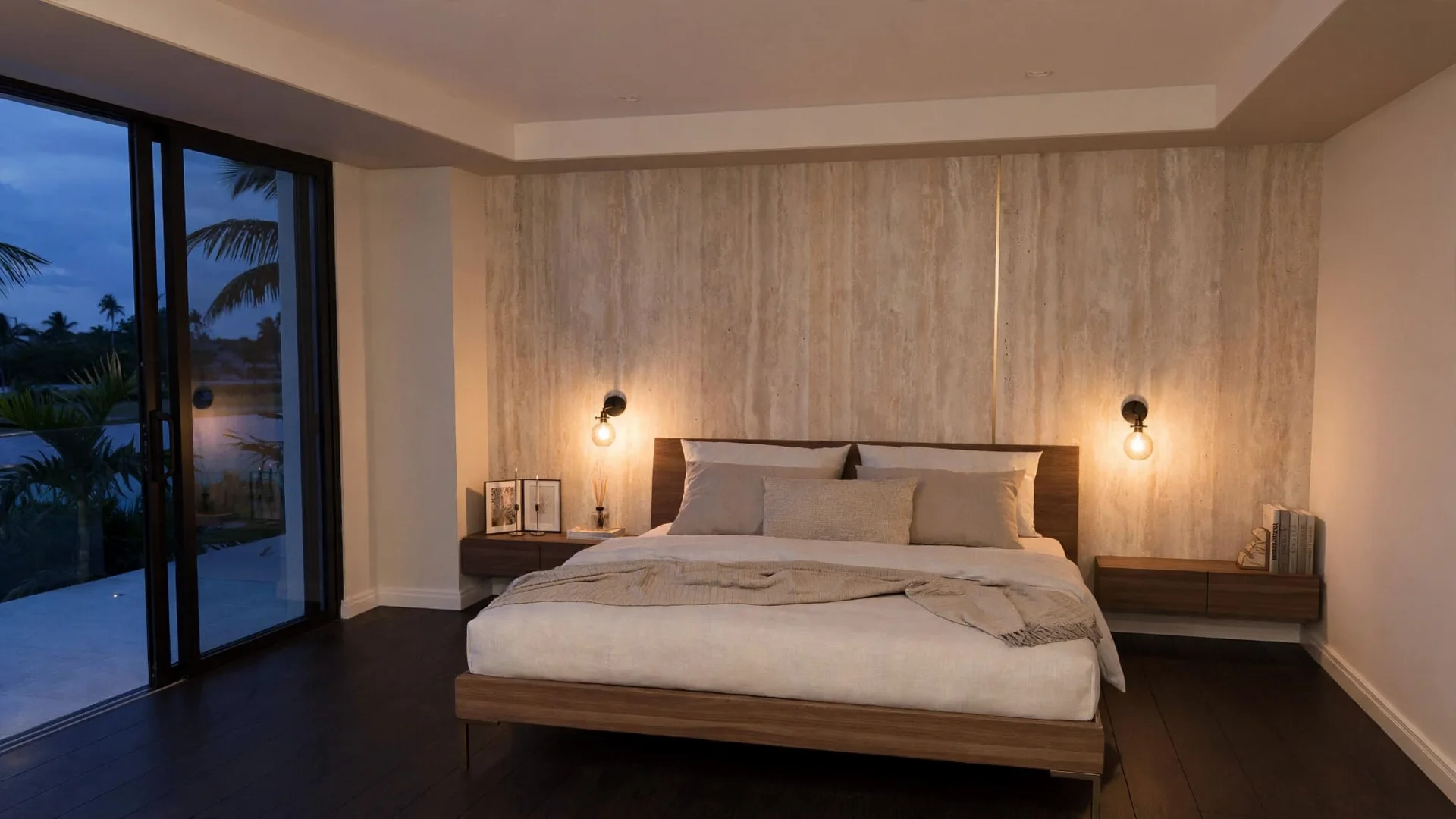
A homeowner in Fort Lauderdale sent us a photo and asked for "a travertine wall, the whole wall, like the photo." Her contractor had quoted real stone tile. A second quote, from a panel company, came in far lower and used the same two words. Both described a travertine wall. They described two different walls, built by two different trades, with different weight on her framing and different chores waiting in year two.
At WOW Walls Studio we install wall panels in South Florida, and our studio sells the panel side of this choice. We state that up front because this guide compares our own product against real stone, and you deserve to know which side pays us. What we can do cleanly is lay out the systems side by side: real travertine tile and slab, flexible stone veneer, and travertine-look composite panels. Our earlier travertine accent wall panels guide covers the narrower accent-wall question; this guide covers the full wall.
Short version: real travertine is quarried limestone with a sealing routine and an acid weakness. Flexible veneer is a thin stone-powder sheet that bends and weighs very little. A travertine-look composite panel is a manufactured sheet with the travertine finish on its face. Free design preview: send us a photo of your wall and see it in a new finish.
What does "travertine wall" mean? Three products share one name
TL;DR: Travertine is a freshwater limestone formed at mineral springs. A wall sold under its name today can be real stone tile or slab. It can also be a thin flexible veneer made from stone powder, or a composite panel with a travertine finish on its surface. The three share a look, and almost nothing else.
Start with the stone itself. Travertine is "a form of fresh water limestone deposited around mineral springs, especially hot springs" (Wikipedia), formed "by a process of rapid precipitation of calcium carbonate, often at the mouth of a hot spring or in a limestone cave" (Wikipedia). One supplier page puts the visible result in plain words: "Travertine is a limestone that formed at a spring, and the gas escaping while it set left the holes that define it" (AFINISHES). Those holes, called pores, drive nearly every practical difference in this guide. Porosity runs wide: "Fresh travertines vary widely in their porosity, from about 10% to 70%" (Wikipedia). A porous calcium carbonate stone drinks water, holds stains, reacts to acid and accepts sealer.
Real travertine tile and slab. Quarries cut the stone into tiles for mortar-and-grout installation and into slabs for large-format cladding. Tile is the common residential form: pieces set in a mortar bed, joints filled with grout, the whole surface sealed. Slab work covers a wall in fewer, larger pieces and usually involves a stone fabricator and heavier handling. Both forms are the actual stone, with the actual pores, and both carry the full care routine described later in this guide. Colors stay in the warm family the geology allows: the stone "exists in white, tan, cream-colored, and rusty varieties" (Wikipedia).
Flexible stone veneer. This is a manufactured sheet built from stone powder: "Travertine flexible stone is a modern wall cladding material engineered from natural stone powder, designed to replicate the warm, porous aesthetic of classic travertine" (Neosoft Stone). The construction explains the behavior: "The material achieves its flexibility through a double-layer reinforced mesh substrate embedded within the stone-powder composite" (Neosoft Stone). The sheet bends, cuts with light tools and bonds to a prepared wall with adhesive. The face is thin, and the maker's performance claims deserve the caution we give them in the wet-zone section below.
Travertine-look composite panels. Our studio installs this third product. The sheet is a bamboo composite, 48 by 108 inches and 5 mm thick, with the finish carried on its face; in travertine projects that finish reproduces the warm beige ground, the banding and the pitted texture of the stone. In the plainest form we have: the panel is a manufactured sheet with a finish that looks like real travertine. It is not a natural stone slab, and our studio does not install natural stone slabs. Homeowners who want quarried stone need a tile setter or a stone contractor.
A full travertine wall is a bigger commitment than one accent wall: more weight, more money, and a surface you will clean for years.
Vein cut or cross cut: which pattern fits a full wall?
TL;DR: The saw direction against the stone's layers decides the pattern. Vein cut shows long straight bands and runs in one direction, so a full wall needs a layout drawing. Cross cut shows soft clouds with no direction, which forgives layout mistakes across a large surface.
Real stone buyers meet this choice first, because the same block produces both looks. The supplier summary is the clearest we have found: "Travertine is a banded stone, so the way it is cut decides what you see: vein cut runs the bands in straight lines, cross cut opens them into clouds" (AFINISHES). The geology is simple: "Travertine is bedded, laid down in layers, and the direction of the saw against those beds sets the pattern on the face" (AFINISHES).
Vein cut comes from sawing across those layers. "Sawing across the bedding gives the vein cut: the layers show edge on, as long straight striations running the length of the piece" (AFINISHES). The result reads linear and architectural, and it carries a layout obligation: "Vein cut is directional, so it has to be set out to a drawing with every piece running the same way, and it will make a corridor read longer or a wall read taller depending on which way you turn it" (AFINISHES). Bands running in mixed directions, because nobody planned the layout, make a large wall look restless. If you buy vein cut stone, get the layout drawing before the first piece goes up.
Cross cut comes from sawing along the layers. "Sawing along the bedding gives the cross cut: the layers show face on, as soft irregular clouds and rosettes with no direction to them" (AFINISHES). The practical virtue is forgiveness: "Cross cut is non directional and forgiving, which is what you want across a large floor with awkward returns" (AFINISHES). The same logic holds on a large wall with door openings and corners: pieces can turn to fit a return without breaking a pattern. Most of the warm, quiet travertine walls in the photos homeowners send us are cross cut or a print of cross cut. Show your installer a photo and point at the pattern, because the words get swapped in conversation.
The pores follow the cut: "Vein cut opens them as elongated slots strung along the striations. Cross cut opens them as rounder holes scattered across the face" (AFINISHES). Ask for a sample of the exact cut and finish – a photograph flattens both patterns.
The look products carry printed or molded versions of both patterns, and the seam plan fixes which way the banding runs on every sheet. A printed pattern also repeats, which real stone never does. Across a very long wall, check how the repeat falls. A visible repeating motif is the tell that separates a good look panel from a careless one.
Filled or unfilled: what the pores do on a wall
TL;DR: Filled travertine has its pores packed with grout or resin and ground flat, so the wall cleans like a smooth surface. Unfilled travertine keeps the open holes, which give the strongest stone texture and collect dust and residue. For an interior wall that gets cleaned, filled is the calmer choice.
The fill decision is the second specification on every real stone order. The mechanics are plain: "Filling means the open pores are packed with a grout or resin tinted to the ground color, and the face is then ground flat" (AFINISHES). The result is a continuous plane, and "the stone reads calmer because the texture has been taken out of it" (AFINISHES). A filled wall wipes clean; an unfilled wall holds onto what lands in the holes.
Unfilled stone keeps the geology visible. "Unfilled leaves the pores as the spring left them" (AFINISHES). The texture is real: "The face has a texture you feel through a bare foot, grip is noticeably better once the surface is wet, and the stone reads as the material it is rather than as a flat panel" (AFINISHES). Grip matters on a pool deck; on a living room wall the cost side shows up in housekeeping. The supplier states it without softening: "every open pore is somewhere for grit, mop water, soap residue and grout haze to collect and stay" (AFINISHES). Indoors, read that as dust, kitchen film and soap residue. You clean unfilled stone with a soft brush and patience; you clean filled stone with a cloth.
The supplier's placement rule: "Filled belongs indoors, on anything walked on, wheeled over or cleaned with a mop. Unfilled belongs on a wall, a facade, a terrace or a pool surround, where it dries in the sun, gets hosed rather than mopped, and the grip is doing real work" (AFINISHES). An unfilled wall indoors is a legitimate choice when the buyer picks it for the texture and accepts the brush work.
Finish sits on top of the fill decision: honed is the common matte wall finish in the cost data below, and polished shows every etch mark more clearly.
Flexible veneer reproduces the pitted look as shallow texture rather than holes through a stone body. The travertine finish on our studio's composite sheet is a surface finish, with the pore pattern visible as image and light texture. Touch the actual sample before you decide; your hand settles the texture question fast.
How much does a travertine wall weigh, and why does it matter?
TL;DR: Half-inch real travertine tile weighs 6.5 pounds per square foot, so a 100 square foot wall of it adds about 650 pounds before mortar and grout. Flexible veneer weighs 3 to 4 kilograms per square meter in its maker's data. Weight decides handling, substrate demands and whether a lightweight partition can carry the project.
Start with the stone. "A typical 12-by-12-inch travertine tile that is 1/2 inch thick weighs 6.5 pounds" (Homesteady), and "tile generally is 1/2 inch or 5/8 inch thick while pavers are 1 1/4 inches thick" (Homesteady). "With a weight of 6.5 pounds per square foot for half-inch travertine tile, you will be adding 650 pounds of weight per 100 square feet of floor area" (Homesteady). That sentence was written about floors. On a wall the load hangs in shear on the substrate and the adhesive bed. That makes the substrate question sharper. The mortar bed adds its own weight on top.
The tile figure makes the practical point. A full stone wall is a heavy assembly. The wall behind it has to be a real substrate: sound masonry, cement board or properly built framing with a suitable tile backer. We publish no slab weight figure, because our sources priced slab work without a clean per-foot weight we could verify.
Now the contrast. The flexible veneer maker publishes these figures for natural travertine tile: thickness 10 to 20 mm and weight 25 to 30 kilograms per square meter. Its own veneer runs 2.5 to 3.3 mm thick and 3 to 4 kilograms per square meter (Neosoft Stone). In the maker's own words, "a travertine flexible stone veneer sheet weighs just 3-4 kg/m2, reducing structural load by more than 85%" against quarried slabs (Neosoft Stone, unit formatting as published). We treat manufacturer comparisons as manufacturer comparisons, and the direction matches the physics of a thin sheet against stone tile. Ask any supplier for the data sheet of the specific sheet you are buying.
For our studio's composite sheet we publish dimensions and no weight figure, because we have no sourced per-foot weight for it and we will not invent one. The handling story is still clear. A 5 mm sheet at 48 by 108 inches is a two-person carry. The assembly adds no mortar bed and no grout. On a lightweight media-wall build-out, a condo partition or a doubtful substrate, that lightness can decide the project before style gets discussed.
The TV rule follows: the mount hangs on studs or blocking behind the finish, with stone and panels alike, and the finish layer carries none of the load.
How does each system go up on a full wall?
TL;DR: Real stone tile goes up as a wet trade: backer, mortar, setting, grouting, then sealing before and after grout. Flexible veneer bonds on with polymer-modified adhesive and cuts with light tools. Composite panels fix as large dry sheets on a prepared flat wall with a planned seam layout.
Real stone tile. The wall gets checked for flatness and strength, and a suitable backer goes on where the substrate needs it. The setter seals the stone at the right point in the sequence – HomeGuide's instruction is to "Seal travertine tile before and after installing grout to protect it from stains and water damage" (HomeGuide) – because grout pigment in open pores is a stain you install yourself. Tiles set in mortar, joints grout after curing, and the surface gets its final seal. The AFINISHES page gives the same order from the stone side: "Seal travertine on installation, and before grouting where the program allows it" (AFINISHES). Cutting happens on a wet saw, and vein cut layout happens on paper first. The skill bar is real: stone is heavy, edges chip, and a lippage problem across a full wall shows in every raking light from a window.
Slab cladding replaces the many-piece layout with a few large pieces and a fabricator's shop work.
Flexible stone veneer. The maker sequence starts with the wall: "The substrate must be clean, structurally sound, and free of contaminants that would inhibit adhesive bond" (Neosoft Stone). Adhesive choice matters: "Use a flexible, polymer-modified tile adhesive rated for both the substrate material and the intended environment (interior, exterior, or wet zone)" (Neosoft Stone). Cutting is where the product earns its name: "Unlike ceramic tile, travertine flexible stone can be cut with ordinary scissors, a craft knife, or a circular saw" (Neosoft Stone). The sheet also bends to curves that would crack tile; the maker claims a minimum bending radius under 100 mm (Neosoft Stone). Joints take flexible grout or sealant at movement points.
Composite panels. Sheets arrive at full height. We trim sheets on site to fit the wall. A seam plan drawn before installation fixes the TV zone, the outlet positions, the banding direction and the repeat landing. There is no mortar bed, no grout and no sealing step. The prep obligation is the step buyers underestimate: a wavy wall telegraphs through any large sheet, so we check and correct the wall first. The full step order sits in our wall panel installation process guide.
Sealing and acid: the upkeep only real stone carries
TL;DR: Real travertine is porous calcium carbonate, so it gets sealed on installation and resealed on a cycle published sources put anywhere from once a year to every 1 to 2 years. Sealer slows stains. Sealer does not stop acid etching. This routine applies to real stone only; look products carry no sealing cycle.
Boundary first: the next paragraphs describe real travertine stone only. Neither look product gets sealed, and neither needs protection from acid etching, because neither face is calcium carbonate stone.
Why stone needs sealer comes back to the pores. "Travertine is porous, with tiny holes and fissures" (MSI Surfaces). An unsealed wall drinks what lands on it: kitchen film, tinted bathroom products, sink splashes. Sealer buys reaction time. The Natural Stone Institute position, reported in trade coverage, is worth quoting because the industry sells past it so often: sealers are impregnators that act as repellents, and "sealing does not make stone stain proof, it makes stone more stain resistant" (Natural Stone Institute, via Make Bespoke Studio). A second trade source reports the same limit (Dynamic Stone Tools, reporting NSI). The sealer maker's own page agrees: "No impregnating sealer will prevent acid-etching. This is because they do not physically stop a substance from touching the surface" (Dry-Treat).
Sealer types split by where they sit. MSI explains: "Two types of sealer are available: impregnating sealers and surface sealers. Impregnating sealers are absorbed into the tile below the surface" (MSI Surfaces). The AFINISHES page prefers the penetrating route: "A penetrating sealer soaks in and leaves nothing on the surface, which is what you want; a film sealer sits on top and eventually wears through in patches" (AFINISHES). A wall has no foot traffic, so a penetrating sealer wears far slower there than on a floor. Published cycles disagree, and we report the disagreement instead of picking a winner: MSI says the sealer "should be applied once a year, or more often if the tile is lighter in color" (MSI Surfaces), while HomeGuide's sealing answer ends with "reapply every 1 to 2 years based on use" (HomeGuide). A dry living room wall sits at the gentle end of both ranges; a bathroom wall at the demanding end. Water that soaks in and darkens the stone quickly means the sealer has faded there.
Acid is the second half of the stone bargain. Travertine is calcareous, so "citrus, vinegar and descaler etch it" (AFINISHES). Angi's FAQ gives the household version: "For travertine, you need to avoid anything acidic like vinegar" (Angi), and MSI adds: "Avoid contact with acidic foods such as citrus or vinegar, as these may etch the surface" (MSI Surfaces). An etch is a dull mark where acid dissolved a microscopic layer of the surface; cleaning cannot lift it, and honing removes it by removing stone. On a wall the realistic risks are cleaning products: acidic descalers, vinegar-based sprays, citrus cleaners. The daily rule: pH-neutral stone cleansers only, and "Do not use products containing ammonia, vinegar, or bleach" (MSI Surfaces).
Filled stone adds one footnote: the fill is softer than the stone around it – "A fill will open eventually on a floor that is used, and that is not a fault in the stone" (AFINISHES). Walls take no traffic, so wall fills live an easier life.
Bathrooms, showers and wet zones: where each wall honestly belongs
TL;DR: Real travertine can line a bathroom wall when it is sealed and the waterproofing layer behind it does the waterproof work; the stone itself is porous and never the waterproofing. Inside a shower, real tile over a proper waterproofing system is the honest specification. Our studio's composite panels stay out of the shower entirely.
Wet zones expose the difference between a surface and a system. A bathroom wall outside the shower is a splash-and-steam environment. Real travertine handles it with its seal maintained: "Bathroom and hammam walls take it well, along with feature walls, external cladding" (AFINISHES). The condition inside that sentence is the assembly behind the stone: tile and stone are finishes, and the waterproofing is a membrane or board system behind them. A wall with failed waterproofing behind it fails wet from the back while the face still looks fine. Our shower wall panels vs tile guide works through the shower version in full.
Inside the shower itself, our answer is conservative: real tile or stone over a proper waterproofing system, installed by a tile professional, is the specification we trust. Travertine in a shower asks for the full routine at its hardest setting. That means sealed stone, sealed grout, pH-neutral products only, and no acidic descaler ever. The reseal cycle sits at the short end of the published range. Buyers who want to spray a cleaner and walk away should pick a glazed porcelain with a travertine print; our large-format porcelain wall panels guide covers that family.
Now the two look products. Our studio's composite panel carries no water rating of its own, and we keep it out of showers and direct wet zones, full stop. Flexible veneer is the harder case: its maker lists bathrooms and shower enclosures among its uses and describes the surface as non-porous and waterproof (Neosoft Stone). We opened no independent test report behind that claim in this research run, so we record it as a manufacturer's claim rather than a verified fact. If a veneer seller wants your shower business, ask for the test documentation for the specific product and adhesive system.
Water management is a system property; the finish is its least waterproof part.
Florida humidity: the test that runs all year
TL;DR: EPA guidance says to keep indoor relative humidity below 60 percent, ideally between 30 and 50 percent. Real travertine tolerates humid air with its seal intact. Sheet products tolerate it when the wall behind them starts dry and stays dry. The shared enemy is moisture trapped behind any finish.
Humidity is the slow version of the shower question. The EPA target, quoted in the Florida HVAC guide we used for this research, reads: "If possible, keep indoor humidity below 60 percent (ideally between 30 and 50 percent) relative humidity" (EPA, via The HVAC Standard). Its summary line: "the key to mold control is moisture control" (EPA, via The HVAC Standard). Florida field guidance tightens the aim: "mold growth on building materials becomes increasingly likely as relative humidity consistently exceeds 60 percent" and "At 70 percent relative humidity, mold growth on organic surfaces is near-certain if that humidity persists for more than 24 to 48 hours" (PuroClean of Melbourne). Your air conditioner is the main defense, and every wall in this guide lives downstream of how well it runs.
Real stone in humid air behaves the way porous stone behaves. The face is mineral and gives mold little to eat. The dust film on it gives it more. That is why the cleaning routine matters more in Florida than in a dry climate. A sealed, wiped travertine wall in a conditioned room is a durable Florida surface. Grout lines are the softer target, and darkening grout in a humid bathroom is usually a cleaning and ventilation story first. Run the exhaust fan, and fix the slow leak behind the vanity in the week you find it.
Sheet products flip the risk to the back side. A veneer or panel bonded to a wall that starts dry, in a conditioned room, has no moisture story to tell. The failure pattern we warn about in our Florida humidity wall panels guide is the covered damp wall: a finish installed over an active moisture problem seals the evidence in and lets the problem grow in the dark. Check the wall, fix the source, and only then does a sheet go up.
What does a travertine wall cost in 2026?
TL;DR: Published US guides put installed real travertine tile between $5 and $47 per square foot (Angi), with standard-grade work at $17 to $35 per square foot installed (HomeGuide). No US installed price for veneer or look panels appears in our research, so we publish none. Our studio prices panel projects by the project: a stock design from $850, a design fitted to your wall usually $2,200 to $2,700, and full custom turnkey projects from $9,999. Every studio figure is preliminary until a specialist measures your wall.
Real stone tile: published installed prices. Angi's 2026 guide, updated October 28, 2026, states the wide band first: "Travertine tile installation costs between $5 and $47 per square foot for your project depending on tile quality and finish" (Angi), and scales it to a room: "In 2026, the national average cost to install travertine tiles runs $2,000 for a 100-square-foot project. Most homeowners pay between $600 and $3,200" (Angi). HomeGuide's 2026 figures sit inside that band and split by grade: "Travertine tile costs $7 to $15 per square foot for standard-grade materials. Including installation, travertine tile flooring costs $17 to $35 per square foot, or $1,700 to $3,500 for a 100 square foot space" (HomeGuide). Premium work runs higher: a first-grade tile at "$20 to $50 per square foot with installation" (HomeGuide). Commercial grade lands lower at "$14 to $27 per square foot installed" (HomeGuide). HomeGuide wrote its installed bands for flooring; treat them as a scale guide for a wall.
Labor is where the two guides visibly disagree, and the disagreement itself is information. Angi puts "Labor for travertine tile installation runs $3 to $17 per square foot" (Angi); HomeGuide puts professional installation labor at "$10 to $20 per square foot" (HomeGuide). Pattern complexity and region explain the spread. Be suspicious of any per-foot number quoted before a site visit, from anyone, including us. Finish moves material price too. Angi lists tumbled and honed at $5 to $15 per square foot. Polished and brushed run $8 to $30, and filled runs $10 to $20 (Angi). Removal and repair sit outside the headline bands. Budget "existing flooring removal at $1 to $7 per square foot and subfloor repairs at $2 to $10 per square foot" (Angi).
Slab walls price as fabrication projects. One written fabricator quote bundles stone selection, shop fabrication, transport and fixing. Our research produced no clean published per-foot slab band we could verify, so we publish none.
Flexible veneer and look panels: the honest gap. We found no US installed price for either product in this research run. Overseas factory pricing tells a Florida homeowner almost nothing about an installed wall in Broward County. Your veneer number comes from a local quote that names the product, the adhesive system and the joint treatment.
Our studio's panel projects price by the project, and these three anchors cover panel projects only – design, panels, delivery and installation of the composite sheet system in this guide. A stock design starts at $850. A design fitted to your wall usually runs $2,200 to $2,700. Full custom turnkey projects start at $9,999. Every studio figure is preliminary until a specialist measures your wall; wall size, finish selection, lighting or electrical work, mounting needs and site conditions move the exact price. There is no studio per-square-foot price. Free design preview: send us a photo of your wall and see it in a new finish.
Care and repair over the years
TL;DR: Real travertine asks for a pH-neutral cleaner, no acid products ever, a maintained seal and an occasional fill repair. Flexible veneer follows its maker's care sheet. Composite panels take dusting and a damp soft cloth, and a damaged sheet is replaced as a sheet. The long-term difference between these systems is mostly a difference in chores.
Daily care for real stone is short and strict. Dust with a soft dry cloth. Wash with a cleanser made for natural stone: MSI notes these cleansers "are pH neutral, and therefore will not damage the surface or remove the sealer" (MSI Surfaces), and warns, "Do not use products containing ammonia, vinegar, or bleach" (MSI Surfaces). The AFINISHES routine matches: "a neutral pH cleaner and as little standing water as the room allows. No acidic cleaner, no bleach, no abrasive pad" (AFINISHES), with a soft brush on unfilled stone. Wipe spills promptly; sealer buys time and time only. Angi's lifespan line explains why owners accept the routine: "As long as your travertine tiles are properly installed and maintained, they can last as long as 75 to 100 years" (Angi). That figure is the publisher's claim under proper care, passed on with its condition attached.
Veneer care follows the product: soft cloth, mild cleaning, no abrasive pads, and the maker's instructions govern. Joint lines deserve an annual look, because a cracked joint is where water enters behind any sheet. We found no published long-term repair data for flexible veneer in this run, so we make no lifespan claim for it.
Panel care in our studio's system is the shortest list in this guide, and the repair limit is the honest trade. Care: dust, a damp soft cloth, mild cleaning, no abrasive pads and no harsh chemicals; our wall panel care, cleaning and repair guide gives the full routine. The finish needs no sealer and no reseal cycle. Repair: a damaged sheet is replaced as a sheet. No filler restores a travertine-look finish invisibly. We state that limit in the guide and on the job.
Which travertine wall fits your room? Our verdict
TL;DR: Choose real stone when the material itself is the point and you accept sealing, acid discipline and a tile professional's bill. Choose flexible veneer when curves or a strict weight limit rule the project and the maker documents the product. Choose travertine-look panels when you want the full-wall read with dry, fast installation and minimal upkeep. That choice accepts a finish that looks like travertine rather than quarried stone.
Room by room:
Living room and TV walls. All three systems work here; the deciding factors are upkeep appetite and the TV plan. Real stone gives the genuine material and the genuine routine. Panels give the same warm read and ask for a cloth.
Dining rooms, entryways and bedrooms. These walls get seen up close. They face no kitchen film and no bathroom chemistry, and they are the easiest rooms in the house for every system. Filled real stone wipes clean and feels like stone under the hand. Unfilled stone shows its texture beautifully and collects dust in it. Panels read clean at this distance when the seam plan is good. This is the room group where the look products make their strongest case.
Showers and bathrooms. Real tile or stone over a waterproofing system, or a glazed travertine-look porcelain, per the wet-zone section. Outside the shower, sealed filled stone is proven and panels are a measure-visit call. Inside the shower, our studio's panels stay out.
Kitchens. As a backsplash or wall finish, real travertine still lives near citrus, vinegar and descalers. The acid rule follows it here: travertine "is the wrong call on a kitchen worktop" because "citrus, vinegar and descaler etch it" (AFINISHES). Panels and porcelain prints take kitchen splashes with fewer rules.
Fireplaces. Heat turns this into a ratings question that belongs to specific products and the fireplace maker's manual. Our research produced no clearance numbers we could publish responsibly, so we publish none; our fireplace accent wall panels guide covers surround projects.
The through-line is a trade. Real travertine gives you geology: variation no printer matches, a surface your hand believes, and a care routine that lasts as long as the wall. The look products give you back your weekends and your installation week, and ask you to accept a manufactured face in exchange. Blurring which trade you are signing is the only disreputable move in this market. The same test applies to marble in our marble wall panels guide.
Free design preview: send us a photo of your wall and see it in a new finish. Tell us the room and the water in it. We will tell you if a panel is the right answer for your wall, or if you should be calling a stone installer instead.
Frequently asked questions
Is a travertine wall real stone?
It depends on which product the name is covering. Tile or slab is real quarried limestone. Flexible veneer is a thin manufactured sheet made from stone powder on a mesh backing. A travertine-look panel, including our studio's, is a composite sheet with a travertine finish on its face. Ask which of the three he is quoting before you compare prices.
What is the difference between vein cut and cross cut travertine?
The saw direction against the stone's layers. Vein cut saws across the bedding and shows long straight bands in one direction, so the pieces need a layout plan. Cross cut saws along the bedding and shows soft clouds with no direction. Supplier summary: "vein cut runs the bands in straight lines, cross cut opens them into clouds" (AFINISHES).
Should I choose filled or unfilled travertine for a wall?
Filled, for most interior walls: the pores are packed and ground flat, so the surface wipes clean. Unfilled keeps the open holes and the strongest stone texture, and those holes collect dust and residue that need brush cleaning.
How often does a real travertine wall need resealing?
Published sources disagree, and the honest answer is a range. MSI says sealer "should be applied once a year, or more often if the tile is lighter in color" (MSI Surfaces). HomeGuide says "reapply every 1 to 2 years based on use" (HomeGuide). A dry living room wall sits at the gentle end; a bathroom wall at the demanding end. Water soaking in and darkening the stone is the practical test. Real stone only.
Does sealing stop travertine from etching?
No. Sealer slows stains by slowing absorption. Etching is acid dissolving the surface itself, and a penetrating sealer sits below that surface. The sealer maker Dry-Treat states it directly: "No impregnating sealer will prevent acid-etching" (Dry-Treat). Keep vinegar, citrus cleaners and acidic descalers off real travertine, sealed or not.
Can travertine go in a shower?
Real travertine tile can, over a proper waterproofing system, with its seal maintained and pH-neutral care only – the highest-upkeep version of a shower wall. Our studio's composite panels cannot; they carry no water rating and stay out of showers. Flexible veneer shower claims are manufacturer claims; ask for test documentation before accepting one.
How much does a travertine wall cost?
Real stone tile, installed: Angi's 2026 band is $5 to $47 per square foot; HomeGuide puts standard-grade installed work at $17 to $35 per square foot. Our studio's panel projects price by the project: from $850 for a stock design, usually $2,200 to $2,700 fitted to your wall, and from $9,999 for full custom turnkey projects. Every figure is preliminary until a specialist measures your wall, and the anchors are scoped to panel projects only.
How do I clean each type of travertine wall?
Real stone: dust, then a pH-neutral cleanser made for natural stone; no ammonia, vinegar or bleach (MSI Surfaces). Flexible veneer: soft cloth and mild cleaning per the maker's instructions, plus an annual check of joint sealant. Composite panels: dust and a damp soft cloth, no abrasive pads, no harsh chemicals; a damaged sheet is replaced as a sheet.
Sources
- Wikipedia, Travertine – definition, formation, colors, porosity. en.wikipedia.org
- AFINISHES, Travertine Slabs and Tiles, Filled or Unfilled – cuts, fills, sealing, care, placement. afinishes.com
- Angi, How Much Does It Cost to Install Travertine Tile? 2026 data, updated October 28, 2026 – installed bands, labor, finishes, lifespan claim. angi.com
- HomeGuide, How Much Does Travertine Tile Cost? 2026 – grade bands, labor, sealing routine. homeguide.com
- Homesteady, The Weight of Travertine Tiles Per Cubic Foot – tile weight and thickness. homesteady.com
- Neosoft Stone, Travertine Flexible Stone guide – construction, thickness, weight, adhesive and cutting. Manufacturer source; its waterproof and fire claims were not independently verified and are reported as maker claims. neosoftstone.com
- MSI Surfaces, Tips From The Trade: How To Easily Seal And Clean Travertine Tile – sealing cycle, sealer types, pH-neutral care. msisurfaces.com
- Natural Stone Institute position on sealers, as reported by Make Bespoke Studio and Dynamic Stone Tools – impregnators; stain resistant, not stain proof. https://www.makebespokestudio.com/trade/technical/sealing-staining-and-etching-of-stone and dynamicstonetools.com
- Dry-Treat, Travertine surface page – no impregnating sealer will prevent acid etching. drytreat.com
- US EPA indoor humidity guidance, as quoted by The HVAC Standard – below 60 percent, ideally 30 to 50 percent. thehvacstandard.com
- PuroClean of Melbourne, The Ideal Indoor Humidity for Melbourne Homes. puroclean.com
- Studio product facts are the studio's own published figures, also stated in my marble wall panels guide. wowwallsstudio.com