
Bamboo Wall Panels: The Complete Guide to Large-Format Bamboo Composite Panels
Bamboo wall panels explained: large-format bamboo composite sheets, finishes from bookmatch stone to charcoal, room picks, turnkey cost and Florida care.
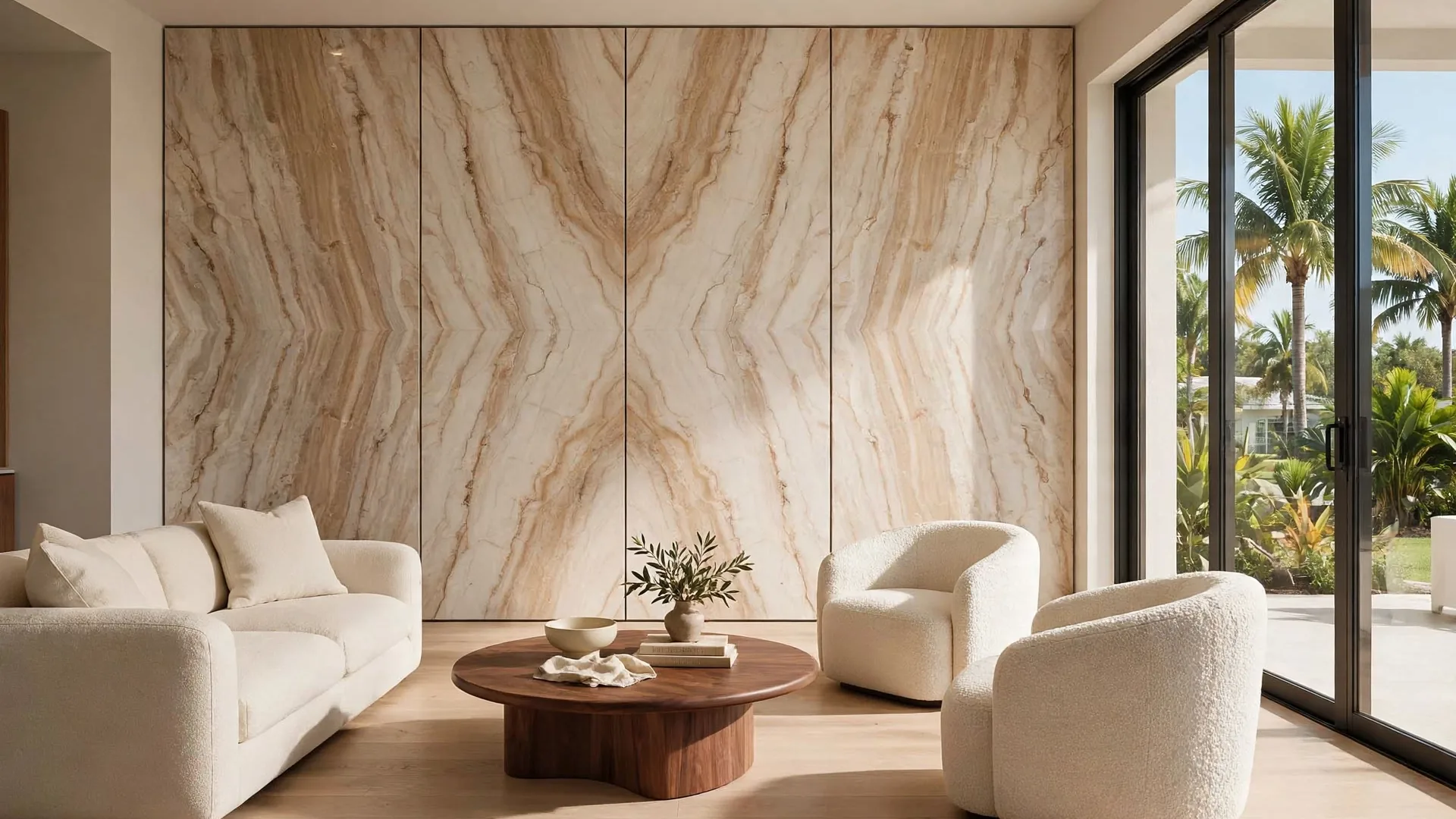
Bamboo wall panels is the search term. The product behind it splits into two very different things, and most buyer confusion starts right there. One product is a board of real bamboo, laminated from strips of the plant itself. The other is a large-format bamboo composite sheet. Its engineered core carries bamboo in powdered form. Its surface can read as travertine, marble, leather or dark charcoal. Both are sold under the same two words. They behave differently, they cost differently, and they belong in different conversations.
We are WOW Walls Studio, a South Florida studio. We design and install large-format panel walls. The sheet we install is the composite one: 48 by 108 inches, 5 mm thick. One full sheet covers 36 square feet of wall. This guide is the complete buyer pass over that product. How to choose it, which finish fits which room, and what a finished wall costs as one turnkey project. How it handles Florida humidity, how we install it, and how you look after it.
One link before the detail. Our guide to bamboo composite wall panels goes deep on the material itself. It covers what sits inside the core and how fire and emission ratings really work. It also covers the sample tests we want every buyer to run. This page links to that explainer instead of repeating it. This page is about the decisions around the material: selection, finishes, rooms, cost, climate, care and the install itself.
What bamboo wall panels are, and which kind this guide covers
TL;DR: Bamboo wall panels come in two families. Solid bamboo laminate is a board made from the plant itself. Bamboo composite is an engineered sheet: bamboo and wood flour bound in resin with a mineral filler, capped with a decorative face and a protective coat. The studio installs the composite sheet in a large 48 by 108 inch format, and that sheet is the subject of this guide.
Start with the plant. Bamboo is a grass, and a fast one. A review in the International Journal of Environment and Climate Change notes that bamboo reaches maturity in 3 to 5 years. It regenerates from underground rhizomes, so a harvest needs no replanting. Hardwood trees take decades to reach the same point. That growth story is real, and it explains why bamboo shows up in so many building products. It does not tell you what is inside any given panel. For that, we check the panel itself.
Solid bamboo laminate is the literal product. Bothbest Bamboo, a maker of bamboo wall paneling, describes its line as engineered from 100% Moso bamboo laminates. Strips of bamboo are pressed into boards, with the grain of the plant visible on the face. That maker reports formaldehyde emissions as non-detectable under EN 717-1 for its product. Those boards suit buyers who want the plant itself on the wall, in ribbed or flat profiles, at board widths.
The composite sheet is a different build. Instrava, a maker writing about the category, describes panels made through high-temperature extrusion. The primary raw materials are bamboo powder, wood powder, PVC resin and polymer processing aids. Its layer breakdown puts the core at bamboo and wood flour of 30 to 40 percent. PVC resin adds 40 to 50 percent, plus calcium carbonate as a mineral filler. Over the core sits a decorative film. Instrava lists what that film carries: wood grains, marble and stone textures, leather tones, textile weaves and soft-touch solid colors. A protective coat on top adds scratch resistance and slows fading.
So the honest sentence is this. A bamboo composite wall has real bamboo in it, as flour inside the core, and the face you see is an engineered finish. Buyers who want visible bamboo grain should shop the solid laminate family. Buyers who want a full-height stone look, a mirrored bookmatch pattern or a charcoal wall with very few seams should shop the composite family. Our studio works in the second family, and the rest of this guide stays there.
Format is the second half of the definition. The studio sheet runs 48 by 108 inches, a full 4 by 9 foot sheet at 5 mm thick. One sheet covers 36 square feet. A 12 foot wide wall takes three sheets side by side, with vertical seams landing every 4 feet. Compare that with narrow boards and small tiles, where the same wall carries dozens of joints. Fewer, larger pieces let the pattern flow across the wall. The seams sit in a calm rhythm. The finished surface reads as one design instead of a patchwork.
How to choose bamboo wall panels: the checks that actually matter
TL;DR: Choose on five checks, in this order: sheet size against your wall, core build, face quality, room fit, and who installs it. A large-format sheet from a full-service installer removes most of the risk that sinks panel projects. The usual killers are mismatched batches, busy seams, and a finish that fights the room. Price per sheet alone tells you almost nothing about the finished wall.
Check one: size against your wall. Measure the wall before you fall for a finish. A large-format sheet at 48 by 108 inches covers a 9 foot ceiling height in one piece, floor to ceiling, with no horizontal seam. On a 12 foot wall, three sheets finish the run. Shorter ceilings leave a fitted top edge, handled on site during installation. If a product needs six or eight pieces to cross your wall, every extra joint is a line your eye will follow for years. Ask any seller for the sheet size first, and do the division for your own wall before you discuss color.
Check two: the core build. The category recipe above is your baseline: plant flour, resin and mineral filler, extruded into a stable sheet. Two quality signals matter inside that recipe. The first is balance: a core loaded with cheap filler turns brittle and heavy, while a balanced core stays flat and holds its edges. The second is the bond between core and face. Instrava advises buyers to verify hot-melt PUR lamination rather than water-based cold glues, which tend to peel or bubble along edges in hot or humid climates. In Florida, that one line of the spec sheet decides whether a face stays down through its third summer.
Check three: the face. The face is the part you live with. Hold a sample at arm's length, then at the distance your sofa or bed will sit from the wall. A good stone look holds its depth at both distances. A weak print goes flat and repeats visibly: the same vein shows up three times across one sheet. Check the repeat. Check the sheen in side light, since gloss shows every wave in the wall behind. Check the edge of the sample too, because a face that wraps cleanly over the edge reads as a solid slab on the wall.
Check four: room fit. Every finish has rooms where it earns its keep and rooms where it fights the light or the traffic. The rooms section below maps the studio finishes room by room. The short version: hard stone looks take contact and sun, soft faces want protected walls, and dark finishes want a room with enough light to carry them.
Check five: who installs it, and as what kind of project. A panel wall fails at the seams, the edges and the layout, rarely in the middle of a sheet. We sell and install our walls as one turnkey project: design, panels, delivery and installation by our own team under one price. That structure means one party owns the layout, the sheet order and the finished seams. Our materials page shows the bamboo composite family we work with. If you buy sheets elsewhere, line up the installer before the sheets arrive, and confirm who owns a sheet that arrives damaged or off-tone.
Finishes: stone looks, the bookmatch series, charcoal and the soft faces
TL;DR: The studio finish families are stone looks, the bookmatch series, a bamboo charcoal dark finish, wood-look veneer faces, leather and velvet soft faces, and gloss solids. Stone looks include travertine, marble and other stone faces. Bookmatch pairs mirrored sheets into one symmetrical pattern. Stone looks are the workhorses. Bookmatch is the statement. Charcoal is the mood finish, and the soft faces belong on protected walls.
Stone looks. Travertine, marble and related stone faces are the most requested finishes we install, and the reason is practical. The matte, mineral pattern hides dust film, fingerprints and small marks that a flat painted wall announces. A marble look carries veining across the full sheet, so a 9 foot wall reads as one slab. Our marble-look wall panels guide covers that family in full, and our travertine accent wall panels guide does the same for travertine. Pale stone faces also forgive the Florida sun better than saturated colors, since a small tone shift barely reads on a light mineral pattern.
The bookmatch series. Bookmatch pairs two sheets whose patterns mirror each other, the way the two halves of an opened book face each other. Fitted side by side, the pair forms one symmetrical design: veining flows out from the center seam and back in again. It is the most architectural finish in the range, and the most demanding. The layout has to start from the mirror line. Starting from a corner breaks the centering. Both halves need even light. A tone difference between the pair breaks the symmetry the design exists for. On the right wall, behind a sofa or a bed, a bookmatched pair does the work of a stone feature wall at a fraction of the weight.
Bamboo charcoal. The charcoal finish is the dark end of the range. It carries a deep, near-black face with a soft, matte depth. That depth comes from the charcoal side of the bamboo family. It suits media walls, where a dark ground lets the screen disappear when it is off, and dining rooms that run on evening light. Two cautions come with it. Dark faces show dust sooner than pale stone, so the care routine below matters more. A charcoal wall also needs light planned around it. A wash of warm light down the face gives it depth. A dim room just goes flat and dark.
Wood-look veneer faces. These faces carry a wood grain over the composite core. They give a room the warmth of a timber wall with the sheet size and stability of the composite format. They sit well behind beds and in home offices, where a full stone look can feel cold. The grain direction is a layout decision: vertical grain lifts a ceiling line, horizontal grain widens a narrow wall.
Leather and velvet faces. The soft faces trade hardness for texture. A leather face reads warm and quiet, and a velvet face absorbs light in a way no mineral finish can. Our leather and velvet wall panels guide covers both. Their limit is contact: pile crushes where furniture rubs, and leather scuffs at hand height. We place them where nothing leans on them: the wall behind a bed, a dining wall away from the pass-by lane, a reading corner.
Gloss solids. A gloss solid is a single color with a reflective face. It is the most modern finish in the range and the least forgiving. Gloss shows every ripple in the substrate and every fingerprint at switch height. On a flat wall with good light it looks like lacquered joinery. We steer it toward small, controlled walls: a foyer panel run, a bar back, a single study wall.
| Finish family | What it reads as | Best first room | Watch out for |
|---|---|---|---|
| Travertine and stone looks | Matte mineral slab, quiet pattern | Living room, entry | Very pale tones can read flat in dim light |
| Marble look | Polished stone with flowing veining | Living room, TV wall | Gloss sheen shows substrate waves in side light |
| Bookmatch series | One mirrored, symmetrical stone design | Behind a sofa or bed | Needs even light across both halves |
| Bamboo charcoal | Deep matte near-black | Media wall, dining room | Shows dust sooner; needs planned lighting |
| Wood-look veneer face | Warm timber wall | Bedroom, home office | Grain direction drives the layout |
| Leather face | Warm, quiet, soft texture | Bedroom, dining room | Scuffs at hand height; keep off traffic lanes |
| Velvet face | Light-absorbing soft wall | Behind a bed, reading corner | Pile crushes where furniture rubs it |
| Gloss solid | Lacquered single color | Foyer, bar back, study | Shows fingerprints and wall ripples |
Room by room: where bamboo wall panels earn their place
TL;DR: Living rooms and bedrooms are the natural home of the large-format sheet: one feature wall, floor to ceiling, in a stone look, bookmatch or soft face. Media walls pair well with charcoal and marble looks. Dining rooms carry bookmatch and leather well. Kitchens and bathrooms need the splash rules in the humidity section: panels belong on dry walls there, away from direct water.
Living room. The feature wall behind the sofa or the media unit is the classic placement, and the large sheet was made for it. A 12 to 16 foot living room wall takes three to four sheets, and the pattern flows across all of them. Stone looks carry the room in daylight. A bookmatch pair centered behind a sofa gives the room a single strong image. Keep the soft faces for living rooms where the wall sits clear of the sofa back. A decade of daily rub is a real load on pile and leather.
TV and media walls. A panel wall behind a screen does two jobs. It gives the screen a designed ground. It also hides the cable story inside the installation. Charcoal and darker marble looks let the screen vanish when it is off. Pale travertine keeps a bright room bright while still reading as a feature. Our install process, below, routes cables and mounts as part of the job, so the wall you see is the wall with no wires showing.
Bedroom. The wall behind the bed is the gentlest wall in the house: contact comes from pillows, light is usually soft, and the wall is seen at rest. That makes the bedroom the safest home for the soft faces, leather and velvet, and for bookmatch pairs that would be wasted in a hallway. A wood-look face behind a bed warms the room without a headboard competing with it.
Dining room. Dining walls run on evening light and sit clear of traffic. Bookmatch, leather and charcoal all earn their place here. A mirrored pair behind a sideboard reads like a stone installation. Charcoal with a warm light wash turns dinner light into part of the design.
Entry and hallway. Entries take bags, keys, shoulders and delivery boxes at the same heights, every day. Hard stone looks are the right call here, in matte finishes that hide the contact story. We steer soft faces and gloss solids away from entry lanes: pile crushes, leather scuffs, and gloss shows every touch.
Home office. The wall behind a desk is now a video-call background for many owners. A wood-look or pale stone face reads calm and professional on camera, with enough texture to keep the shot from looking like a bare rental wall. Avoid high-gloss faces behind a desk: reflections fight the camera.
Kitchen and bathroom, with limits. Panels belong on the dry walls of these rooms. Picture a kitchen wall away from the range splash zone. Picture a bathroom wall outside the shower and away from direct spray. The humidity section below gives the full reasoning. Inside a shower, or as a backsplash behind a cooktop, is tile and stone territory, and we say so to clients even when it costs us the wall.
What a bamboo panel wall costs, turnkey
TL;DR: Our studio installs bamboo composite walls turnkey in two ranges. Range A runs $22 to $28 per square foot. Range B runs $30 to $38 per square foot. Both carry design, panels, delivery and installation in the one price. Public project anchors: stock projects from $850, semi-custom projects at $2,200 to $2,700, and full turnkey projects from $9,999. Every figure is preliminary until a specialist sees a photo and measurements of your wall.
Turnkey means one price for the finished wall. The ranges above cover the design work, the panels, delivery and installation by our team. There is no separate material bill and no installer to find. Range A covers the core stone-look and wood-look finishes in straightforward layouts. Range B covers the premium end: bookmatch layouts, charcoal and soft faces, and walls that need more layout work, more sheets or harder access. Your wall lands in a range based on finish and layout, and the exact figure comes after photo and measurements, never from a square-foot guess over the phone.
A worked example makes the math concrete. Take a living room wall 12 feet wide and 9 feet high. That wall is 108 square feet, and it takes three full sheets. At range A, the turnkey band for that wall is $2,376 to $3,024. At range B, the band is $3,240 to $4,104. The example assumes a flat, sound wall and a standard layout. A wall with a fireplace, a stair slope or heavy trim work moves the figure. That is exactly why the quote follows the measurements.
| Project shape | Public anchor | What it usually covers |
|---|---|---|
| Stock project | from $850 | A set design from the studio range on a standard wall |
| Semi-custom project | $2,200 to $2,700 | A chosen finish and layout fitted to your wall |
| Full turnkey project | from $9,999 | Larger or multi-wall projects, premium finishes, full design work |
| Turnkey range A | $22 to $28 per sq ft | Core finishes, straightforward layouts, one price installed |
| Turnkey range B | $30 to $38 per sq ft | Bookmatch, charcoal, soft faces, complex layouts |
Market context helps you read those numbers. Angi, the home services marketplace, puts professional wall paneling installation between $1,200 and $6,000 per project in its 2026 data. The national average sits around $2,800. Paneling types range from $5 to $25 per square foot depending on material and style. That band covers generic paneling: beadboard, shiplap, wainscot and similar products, often on partial walls. A full-height, large-format feature wall with design work sits at the premium end of the paneling world, and our ranges reflect that position honestly. What the turnkey figure buys over a generic job is the layout, the sheet-scale pattern, and one team answering for the finished wall.
Two cost habits protect buyers. First, compare finished walls. Sheet prices alone mislead: a cheap sheet with a busy seam pattern and a separate installer bill is a different product from a designed wall. Second, treat any exact quote given without a photo and measurements as a guess wearing a suit. Our wall panels cost guide breaks down what moves a project between the anchors.
Florida humidity: what the climate does to a bamboo composite wall
TL;DR: In a conditioned Florida home, a bamboo composite wall is a stable product. The resin-bound core takes up very little water. The face cannot rot or feed mold the way paper and raw wood faces can. The risks sit at the edges: water behind the sheet from a leak, and a home left closed and humid for long stretches. The US Environmental Protection Agency advises keeping indoor humidity at 30 to 60 percent. That band decreases mold growth. The agency calls moisture control the key to mold control.
The core is the first line of defense. Instrava describes the mechanism plainly. Encapsulation of plant fibers by the resin ensures extremely low water absorption. That prevents the warping, rotting or mold growth common to real wood in high-humidity areas. The plant flour inside the sheet never meets room air directly. The face is a sealed film under a protective coat. A composite wall in a running, air-conditioned home has very little to fear from a normal Florida summer.
The wall behind the sheet is the second story. Moisture can also arrive from behind: a plumbing leak, a slider track or condensation on a cold exterior wall. From there it attacks the substrate and the bond. The face still looks perfect while it happens. That failure is sudden, not gradual, and it is the one we warn every Florida client about. A damp smell at the base of a panel wall, or a soft spot low on the sheet, deserves a look behind the panel. It does not deserve a coat of cleaner on the face.
Homes left closed are the third case. A snowbird home shut up for months with the air off can sit at high humidity for a whole season. The EPA guidance was written for mold, and it doubles as panel guidance. Reduce indoor humidity to 30 to 60 percent to decrease mold growth. Vent bathrooms and dryers to the outside. Use air conditioners and dehumidifiers. The same EPA page advises cleaning and drying any damp or wet building materials within 24 to 48 hours to prevent mold growth. A home that follows that guidance is a home where panel walls, wood floors and everything else hold up. Our accent wall panels and Florida humidity guide goes deeper on this climate.
Splash zones set the placement limits. We install panels on dry bathroom walls and kitchen walls away from direct water. We do not install them inside showers, and we keep them off the direct splash line behind a range. Steam from a shower, vented by a working fan, is normal bathroom air and the panels handle it. Standing water and daily direct spray are a different exposure, and tile owns that territory.
How installation works: from photo to finished wall
TL;DR: Our process runs in five steps. You send a photo of the wall. We return a design preview in a chosen finish. A specialist measures the wall in person. We plan the sheet layout from those measurements. Our team then installs full sheets fitted on site. We supply panels as full sheets and fit them during installation; we do not run a separate cutting service for loose sheets.
Step one: the photo. Send a straight photo of the wall, taken from across the room, with the whole wall in frame. The photo tells us the wall shape, the light it takes, and the furniture it lives with. Most finish advice we give starts from that single image.
Step two: the preview. We render the wall in the finish or finishes you are weighing. You judge the design on your own room rather than on a showroom photograph. Bookmatch centering, charcoal against your light, a pale stone against your floor: the preview settles arguments that samples cannot.
Step three: measurements. A specialist visits, measures the wall, checks flatness and substrate, and notes outlets, switches, vents and trim. Flatness decides how a gloss face will behave. Substrate condition decides the fixing plan. This visit is also where the exact quote comes from, since the measurements replace every estimate in the cost section above.
Step four: the layout plan. We plan the run sheet by sheet. The plan fixes where the first full sheet starts and where seams land. It also fixes how a bookmatch pair centers and how edges meet corners and trim. On a standard wall the first sheet goes in whole from the chosen start edge, and seams land every 4 feet. The plan also settles grain direction on wood-look faces and the mirror line on bookmatch walls before anyone lifts a sheet.
Step five: install day and walkthrough. Sheets arrive whole and are fitted on site. They are trimmed to the wall edges, ceiling line and openings as the run proceeds. Then they are fixed, seamed and finished. Cables and mounts for a media wall are routed as part of the same job. At the end we walk the wall with you in the room's real light. We check seams and edges together. We leave you the care routine below in plain terms. Our wall panel installation process guide walks the same steps with more detail.
A note on what we do not do. We do not sell a cutting service, and we do not supply pre-cut pieces for self-install projects. The product is a full sheet fitted by the installing team, and that is how the seams and edges stay under one team's responsibility: ours. Buyers set on a self-install route should shop the board and kit formats instead, where small pieces forgive layout learning curves.
Care: keeping the face you paid for
TL;DR: Care is light and specific. Dust dry with a soft cloth. Clean with a barely damp cloth and no soaking. Keep abrasives and strong solvents off the face. Give seams their own gentle pass. The two ways owners hurt these walls are grit dragged under a wet cloth, and water pushed into a seam. Both are easy to avoid.
Dust first, and dust dry. Dust holds grit, and grit under a cloth is sandpaper. A soft dry cloth or a duster takes the film off a stone-look or charcoal face in one pass. Charcoal shows dust sooner than pale finishes, so dark walls want the pass more often: little and often beats a big clean twice a year.
For marks, use a cloth dampened with water, wrung out well, and wipe once. The face is a sealed film under a protective coat, and it gives up fingerprints and most household marks to plain water. Skip abrasive pads, scouring powders and strong solvents. They dull the coat in a single session, and a dulled patch on a feature wall cannot be polished back to match its neighbors.
Seams get their own pass. A seam traps a line of dust along its length, and on a pale face that line darkens month by month. Draw the dry cloth along each seam first, then the damp cloth along it once. Never flood a seam. Water pushed into a join is the one route moisture has toward the core edge and the bond line. The humidity section above explains why that route matters.
Soft faces have their own rules. Leather wants dry dusting and distance from heat sources, and it scuffs rather than dirties, so prevention beats cleaning: keep bags and chair backs off it. Velvet wants a soft brush along the pile and nothing pressed against it for long stretches. Our wall panel care, cleaning and repair guide covers repair decisions too. It explains what a lifted seam edge means and when a chip is a small fix. It also covers when a sheet should be replaced.
Bamboo wall panels vs paint, wallpaper, tile and board kits
TL;DR: Paint is cheaper per event and needs redoing every few years. Wallpaper gives pattern at the price of seams and paste in a humid climate. Tile owns wet zones and carries weight, grout and mason labor. Board and slat kits give texture in small pieces with many joints. A large-format bamboo composite wall sits in its own slot: a full-height designed surface, very few seams, one turnkey install, priced at the premium end of paneling.
The comparison that matters is the finished wall in your room, over the years you will live with it. Paint asks little money and little commitment, and it asks again on a painter's cycle. Every repaint also resets the room: a feature treatment has to hold its looks against fresh paint beside it. Wallpaper brings pattern without construction. In Florida it also brings paste and paper edges into a humid climate. On walls that take steam and cooking air, seams lift and edges curl.
Tile and stone are the permanence play. They shrug off water and heat, and they belong in showers and behind ranges. They also bring weight, grout lines that need their own care, and a wet-trade install with curing time. On a dry living room wall, that armor is more than the wall needs, and the grout grid breaks the calm that a large sheet gives a room.
Board kits and slat formats give real texture at friendly prices, in small pieces. The trade is joints: dozens of them, each one a line, a dust ledge and a place for tone to vary piece by piece. Owners who love that rhythm should buy it on purpose. Owners picturing one calm surface with a flowing pattern should compare the two side by side before deciding. A kit wall and a sheet wall read as opposites.
| Option | What you get | What it asks of you | Best use |
|---|---|---|---|
| Paint | Color, lowest cost per event | A fresh coat every few years | Walls that may change often |
| Wallpaper | Pattern with no construction | Paste and seams in humid air; careful removal later | Dry rooms, shorter design cycles |
| Tile or stone | Waterproof, heat-proof armor | Weight, grout care, wet-trade install and curing | Showers, ranges, wet zones |
| Board and slat kits | Texture in small pieces | Many joints, dust ledges, piece-by-piece tone | Owners who want a ribbed rhythm |
| Large-format bamboo composite | One designed surface, seams every 4 feet | Turnkey budget at the premium end of paneling | Full-height feature walls in dry rooms |
Frequently asked questions
TL;DR: The short answers: bamboo composite panels are engineered sheets with bamboo flour in the core and a finished face. The studio sheet is 48 by 108 inches and 5 mm thick. Turnkey walls run $22 to $38 per square foot by range, quoted exactly after a photo and measurements. Panels suit dry walls in Florida homes, with showers and direct splash zones left to tile.
Are bamboo wall panels real bamboo?
Partly, and the honest answer depends on the family. Solid bamboo laminate panels are made from the plant itself, in laminated strips. Bamboo composite panels, the kind our studio installs, carry bamboo as flour inside an engineered core of plant flour, resin and mineral filler, under a decorative face. If you want visible bamboo grain, shop the solid family. If you want a stone look, a bookmatch pattern or a charcoal wall in very large sheets, shop the composite family.
What size are the studio's bamboo composite panels?
One sheet is 48 by 108 inches and 5 mm thick, covering 36 square feet. A 12 foot wall takes three sheets, with seams every 4 feet. Sheets arrive whole and are fitted on site during installation. We do not run a separate cutting service for loose sheets.
How much does a bamboo panel wall cost installed?
Our turnkey ranges are $22 to $28 per square foot for range A and $30 to $38 per square foot for range B. Both ranges carry design, panels, delivery and installation in the one price. Project anchors: stock projects from $850, semi-custom projects at $2,200 to $2,700, and full turnkey projects from $9,999. The exact quote for your wall follows a photo and in-person measurements.
Can bamboo wall panels go in a bathroom or kitchen?
On dry walls, yes: a bathroom wall outside the shower, a kitchen wall away from the range splash line. Inside a shower or under daily direct spray, no: tile owns that exposure. Normal bathroom steam with a working vent fan is fine. Keep indoor humidity in the EPA's 30 to 60 percent band and fix any leak behind a panel wall promptly.
What is the bookmatch series?
Bookmatch pairs two sheets with mirrored patterns. Fitted side by side, the pair forms one symmetrical design, with veining flowing out from the center seam and back. It is the most architectural finish we install, and it needs a layout that starts from the mirror line plus even light across both halves.
What is the bamboo charcoal finish?
It is the dark finish in the range: a deep, matte, near-black face with a soft depth. Owners choose it for media walls, where the screen disappears against it when off, and for dining rooms that live in evening light. It shows dust sooner than pale finishes, so it wants a more regular dry dusting, and it needs planned light to show its depth.
How do we clean bamboo composite panels?
Dust dry with a soft cloth first, since dust holds grit. Then wipe marks with a cloth dampened with water and wrung out well. Keep abrasive pads, scouring powders and strong solvents off the face, since they dull the protective coat. Give seams their own gentle pass, and never flood a seam with water.
Do we offer panels only, without installation?
Our walls are turnkey projects: design, panels, delivery and installation by our team under one price. We do not run a cutting service, and we do not supply pre-cut pieces for self-install projects. If a project needs panels only, tell us what you are planning. We will say plainly whether our format fits it or a board kit serves you better.
Sources
- Instrava, Decoding Bamboo-Wood Fiber Panels. Category composition of bamboo composite sheets. Bamboo and wood flour run 30 to 40 percent. Resin runs 40 to 50 percent. A decorative film and a protective coat cap the core. Resin encapsulation keeps water absorption extremely low. Hot-melt PUR lamination resists peeling in humid climates. https://instrava.com/decoding-bamboo-wood-fiber-panels-the-secret-logic-behind-simpler-stylish-interiors/
- Bothbest Bamboo, Bamboo Wall Paneling. Solid bamboo laminate paneling. The line is engineered from 100% Moso bamboo laminates. Formaldehyde emissions are reported non-detectable under EN 717-1 for that product. Cited for contrast with composite sheets. https://www.bambooindustry.com/product/bamboo-wall-paneling-engineered-cladding
- International Journal of Environment and Climate Change, bamboo review. Bamboo reaches maturity in 3 to 5 years. It regenerates from underground rhizomes. Sustainable harvesting needs no replanting. https://journalijecc.com/index.php/IJECC/article/download/5134/10963
- US Environmental Protection Agency, Ten Things You Should Know About Mold. The key to mold control is moisture control. Reduce indoor humidity to 30 to 60 percent to decrease mold growth. Clean and dry damp or wet building materials within 24 to 48 hours. https://www.epa.gov/mold/what-are-ten-things-i-need-know-about-mold
- Angi, How Much Does It Cost to Install Wall Paneling (2026 data). Professional paneling installation costs between $1,200 and $6,000. The national average sits around $2,800. Paneling types range from $5 to $25 per square foot. https://www.angi.com/articles/cost-to-panel-wall.htm?stream=top
- WOW Walls Studio, Bamboo Composite Wall Panels explainer and Wall Panels Cost. Studio sheet dimensions and finish families. Public preliminary price anchors and turnkey ranges used in the cost section. https://www.wowwallsstudio.com/blog/bamboo-composite-wall-panels-2026