
Leather Wall Panels: Upholstered Walls in Luxury Homes
Leather wall panels in luxury homes: padded leather and suede walls for headboards, suites and media rooms, honest acoustics, care and turnkey cost.
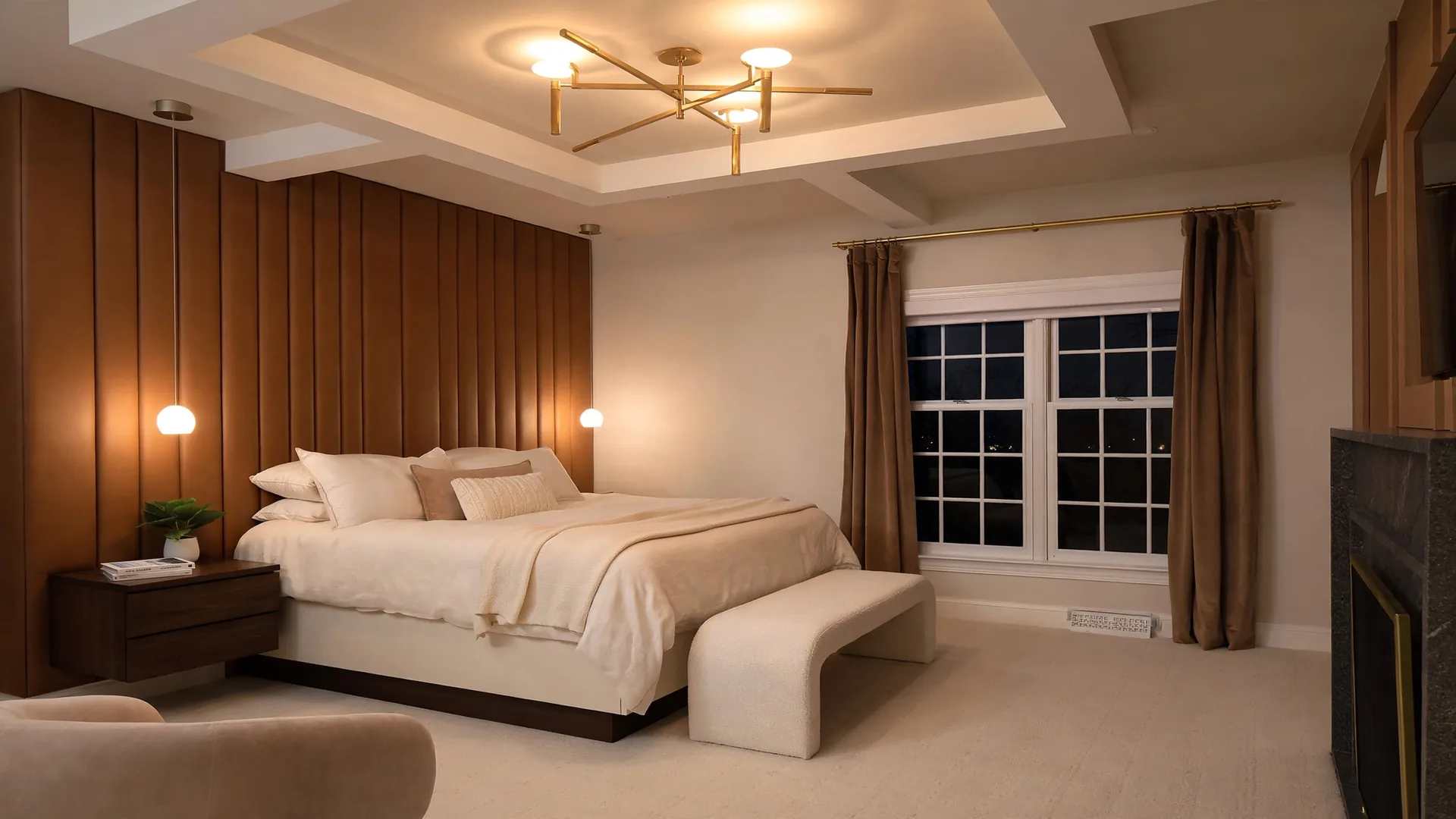
Leather wall panels are padded panels wrapped in a leather or suede face. They turn one wall of a room into upholstery. The wall behind a bed becomes a full-height headboard. The wall behind a screen becomes a soft, quiet backdrop. And the room gains the one surface that every hard finish in a modern home lacks. A surface that gives a little under your hand.
We are WOW Walls Studio, a South Florida studio. We design and install panel walls turnkey, from the first layout to the final trim. This page is the hub for our padded leather and suede range. It covers the family, the construction, the rooms where these walls work, and the cost. Our companion guide to leather and velvet wall panels goes deeper on soft finishes and daily care. It sorts genuine leather from bonded and faux, and it explains velvet pile. Read this page for the padded family as a whole. Read that one for the soft-finish detail.
One promise before the detail. Padded walls attract soft claims, and this page makes none of them. We publish no acoustic rating for these panels, because no tested rating exists for the family. We publish no lifespan in years, because no maker publishes one. What we can do is show you how the panels are built. We can show you where they work and where they fail. And we can show you whose guidance the care advice comes from.
What leather wall panels are
TL;DR: A leather wall panel is a padded panel with a leather or suede face, built like furniture and mounted like a panel. It differs from a hard panel in one way that matters. The face yields under touch, absorbs a share of the room's reflections, and asks for gentler care than stone or wood.
Start with the object itself. A hard panel in our range is a large-format sheet with a finished face. Stone-look, wood-look and mirror faces all sit in that family. A leather panel belongs to a different family. It starts as a board, gains a padding layer, and then gets wrapped in its face. The result reads less like cladding and more like furniture stood upright. Interior people call the whole family upholstered wall panels, and the name is accurate.
The face decides the character. Smooth leather gives a tailored, quiet surface with a fine grain. Suede gives a matte nap that drinks the light and reads softer still. Both faces come in the deep, warm tones that luxury rooms use. Cognac, espresso, charcoal and ink blue lead the range. Pale tones exist, and they ask for the most care of any color in the family. The sections below treat the two faces separately where their behavior splits.
The padding decides the feel. A shallow pad keeps the wall architectural, with crisp edges and a firm press. A deeper pad rounds the face and invites a lean. Neither is better in the abstract. A headboard wall wants enough give for a reader propped on pillows. A dining wall wants a flatter, calmer field that stays out of the way. We settle padding depth room by room, at the layout stage, before anything is cut.
Where does this family sit in our wider range? Our hub guide to accent wall panels maps every finish family we install. Hard faces carry the bright, reflective rooms. Padded leather and suede carry the quiet ones. Many of our strongest rooms use one of each. A padded wall behind the bed, a hard stone-look wall in the bath beyond it. The contrast is the design, and it only works when each material does its own job.
The padded family: four shapes, one range
TL;DR: The padded range comes in four shapes. Flat padded panels give a calm, tailored field. Channel panels carry slim vertical ribs of padding. Deep-buttoned panels give the classic tufted luxury read. Large padded planes stretch one soft surface across a whole wall with minimal seams.
Flat padded panels. This is the quietest shape in the family. Each panel is a clean rectangle with a smooth, even face. Seams sit tight and regular, and the wall reads as one tailored surface. Flat panels suit primary suites that want calm more than drama. They also suit dining rooms, where the wall should warm the room without performing. In a pale suede, a flat field can carry a whole room on texture alone.
Channel panels. Channels divide the face into slim vertical bands. Each band is its own padded rib, stitched or formed along the joins. The rhythm suits tall walls, because the eye travels up the channels. Behind a bed, channels draw the wall upward and make a standard ceiling feel taller. In a media room, the same rhythm reads modern and controlled. Cognac leather in channels is the shape clients ask for most in this family.
Deep-buttoned panels. Buttons pull the face into a pattern of soft diamonds or squares. This is the oldest luxury shape in upholstery, borrowed from chesterfield sofas and club chairs. It suits traditional rooms and rooms that mix old pieces with new ones. It asks the most of the maker, because every button must sit at the same depth. It also asks the most of the owner, because dust settles in every hollow.
Large padded planes. Some walls want no pattern at all. A large plane stretches the padded face across wide sections with very few seams. The effect is architectural and calm, closer to a leather-wrapped wall than to furniture. Planes suit modern suites and media rooms with wide walls. They also show every flaw in the wall behind them. The substrate work in the next section matters most for this shape.
| Shape | Read in the room | Best first room | Care note |
|---|---|---|---|
| Flat padded | Calm, tailored, quiet | Primary suite, dining room | Easiest face to dust |
| Channel | Tall, rhythmic, modern | Headboard wall, media room | Dust settles along the channels |
| Deep-buttoned | Classic, rich, formal | Traditional suite, study | Dust settles in every hollow |
| Large plane | Architectural, minimal | Wide modern suite, media room | Shows substrate flaws first |
One rule holds across all four shapes. The shape is a layout decision, and the face is a material decision. Choose them separately. A client who loves channels in a showroom may need flat panels at home. The wall's light, the room's furniture and the cleaning routine all vote. We draw the layout on the real wall's measurements before the choice is final. That drawing is where most shape regrets get prevented.
How a padded panel is built
TL;DR: A padded panel has three layers. A rigid backing board gives it shape. A foam or wadding layer gives it give. A leather or suede face is stretched over both and fixed at the rear. Panels are built one by one and mounted individually, so one damaged panel can come down alone.
Goodrich Global, a fabric supplier that documents this construction, describes the anatomy plainly. An upholstered panel combines a rigid backing, a layer of foam or wadding, and a carefully chosen fabric stretched over the top. The backing board is typically plywood or MDF. It is shaped for each panel, padded, and then wrapped. The face is stretched taut and fixed at the rear. Panels are made individually and mounted to the wall in a grid, in vertical bands, or as one continuous padded plane.
Each layer earns its place. The backing board keeps the panel flat and gives the mounting something solid to hold. A panel without a sound backing warps, and a warped padded panel shows wavy seams. The padding layer sets the press of the wall. Foam gives a firmer, more even give. Wadding gives a softer, rounder crown on each panel. The face layer carries the color, the grain and the wear. It takes the touch, the light and the cleaning for the whole assembly.
The wrap is where craft shows. The maker stretches the face over the padding and around the board. Corners decide whether a panel looks tailored or homemade. A good corner sits tight, with the fold hidden and the grain running true. Stitching, where a design uses it, must run straight across a whole field. One wandering stitch line ruins a channel wall, because the eye finds it in seconds. This is furniture work, done at wall scale, and it is why padded walls cost what they cost.
Mounting matters more than most buyers expect. Individual panels hang or fix one by one, in a planned order. That order lets an installer level the field as it grows. It also gives the wall a repair path that hard sheet walls lack. If one panel takes damage years from now, that panel comes down alone. A maker can rewrap it or rebuild it to match. The rest of the wall never moves. Ask any installer about the repair path before you buy. The answer tells you how the wall was built.
What we do not publish for this family is as important as what we do. We state no foam density figure for the studio range. We state no padded thickness as a family spec. And we state no fire rating, because ratings belong to specific tested products. A maker who quotes you a rating should name the exact product it covers. ArtePura, the leather wall maker cited in our sources, offers fireproof finishes as a project option on its own panels. That option describes their product, and it transfers to no one else's.
Headboard walls and primary suites
TL;DR: The headboard wall is the first home of the padded leather wall. A full-height padded field behind the bed replaces the headboard, softens the room's hardest wall, and gives readers and late talkers a surface worth leaning on. Primary suites take these walls better than any other room.
The bed wall carries a strange load in a primary suite. It is the largest bare surface in the room. It sits behind the largest piece of furniture. And it is the wall you face last at night and first in the morning. Paint leaves it flat. A hard panel makes it shine. A padded leather wall makes it restful. That restfulness is the product. Owners describe the change in one word, and the word is quiet.
A padded headboard wall also solves a furniture problem. A separate headboard covers part of the wall and stops at its own height. A padded wall runs the full width and height of the bed wall. Tall channels can carry the eye to the ceiling. Flat panels can stretch wider than the bed and frame it. Nightstands and lamps sit against a finished backdrop instead of bare paint. Our bedroom wall panels guide covers bed wall sizing and layouts in full. Those layouts apply to padded faces with no changes.
Comfort is the daily dividend. Readers lean against the wall above the pillows. A padded face gives under the shoulders where paint and hard panels never do. The wall also takes the small knocks of bed-making without a mark. Pillows, books and elbows meet a surface built for contact. In a suite with a sitting corner, the same field warms the whole room's read. The bed wall stops being the leftover wall. It becomes the reason the room feels finished.
Two planning notes decide these projects. First, outlets and switches need a drawn plan. A padded field swallows standard outlet positions, so locations move at layout stage. Reading lights, sconces and chargers all belong in that drawing. Second, the bed itself must sit in the plan. The padded field should start where the mattress ends its travel. Beds move a few inches over a year of making and cleaning. A small shadow gap at the base keeps that movement silent and harmless.
Guest rooms deserve a word here. A padded wall turns a spare room into the room guests remember. The cost logic differs from a primary suite, since the room sleeps fewer nights. Many owners choose a flat padded field in a guest room. It gives the luxury read with the simplest care in the family. The primary suite then takes the richer shape, in channels or buttons. Both rooms gain, and the budget lands where the nights are.
Media rooms and quiet living rooms
TL;DR: Media rooms are the second home of the padded wall. A soft field behind or around a screen kills glare, calms reflections and gives the room a cinema hush. Quiet living rooms use the same wall at lower drama, as the warm backdrop for conversation.
A screen wants a dark, matte world around it. Glossy walls throw window light back at the viewer. Pale paint glows in the spill from the screen. A padded leather wall in a deep tone does neither. The face absorbs light instead of returning it. The picture gains contrast because the wall around it stays down. This is a light effect, and it is half the reason media rooms choose this family. Our TV wall panels guide covers screen walls across all finishes. Padded leather is the soft entry in that family.
The other half is sound, and the next section treats it honestly. Here it is enough to say the room feels different. Voices sit lower. The small echoes of a hard room fade. A film's quiet scenes stay quiet, because the room adds less of its own noise. Owners notice this in the first evening and mention it before the picture. The wall changes how the room sounds to sit in, not only how it looks.
Living rooms use a lighter touch. A full padded wall behind a sofa can over-soften a bright family room. Many living rooms do better with a padded section. One bay between windows, or the field behind a reading chair. The section warms the seating zone and leaves the rest of the room hard and bright. That balance matters in Florida homes, where living rooms carry glass on two sides. The padded section becomes the evening corner. Lamplight, a soft wall and a chair that faces into the room.
Dining rooms sit between the two patterns. A padded wall behind a dining table softens the clink and chatter of a long dinner. It also gives the room a restaurant hush that guests read as luxury. Keep the field clear of the serving path, though. Chair backs and passing trays belong in the layout drawing. A scuff at chair height is the most common dining room mark. The layout can prevent most of them by shifting the field or the table.
The sound question, answered honestly
TL;DR: A padded wall absorbs part of the sound that strikes it, so its own room sounds calmer and less echoey. It does not block sound from the next room. No tested acoustic rating exists for this panel family, so we claim the feel and publish no number.
This section exists because padded walls attract the boldest claims in our trade. Sellers call them soundproof. They are not, and the difference matters to your wallet. TAP Acoustics, an acoustic treatment firm, draws the line cleanly. Acoustic treatment manages sound within a room. Soundproofing reduces sound transmission between spaces. Those are two different jobs, with two different toolkits. A padded wall does the first job. It was never built for the second.
Here is what the first job feels like. Sound strikes a hard wall and bounces back into the room. Enough bounces build the echo and ring that make rooms feel harsh. Absorptive materials capture part of that sound energy instead of reflecting it all. A padded face over a soft core is an absorptive surface. Voices lose their edge. A media room's dialogue reads clearer at lower volume. A primary suite feels hushed in a way guests notice. None of this needs a number to be real. It also does not become a number by being real.
What the wall will not do is just as clear. It will not stop a television's sound reaching the nursery. It will not keep a hallway's noise out of the suite. Blocking sound takes mass, sealed gaps and separated structures inside the wall itself. A surface panel adds none of those in any serious amount. If your problem lives between rooms, solve it in the construction. Then dress the wall however you love. Our acoustic slat wall panels guide covers the rated end of this topic. It explains the numbers that tested products carry, and why we quote none here.
Placement still helps within the room. A padded field on the wall behind the listener calms the strongest reflection in a media room. A padded headboard wall calms the wall a suite's voices hit first. One soft wall will not transform a glass box. It will take the ring out of the room's daily sound. Buy it for that, and it will never disappoint you. Buy it as soundproofing, and no panel in this family can save the purchase.
Leather or suede: choosing the face
TL;DR: Smooth leather is the forgiving face. It wipes clean, shrugs off daily touch and suits walls near doors and dining chairs. Suede is the softer, moodier face. Its nap drinks light and shows touch, and it belongs on protected walls away from hands, sun and spills.
Smooth leather first. The face carries a finished surface that resists marks better than any other in the family. Dust lifts off with a dry cloth. A splash dabs away before it settles. The grain reads tailored and calm, and deep tones hold their color well. ArtePura makes a point worth repeating here. Leather is not an excessively delicate material, provided you take care of it over time using the necessary precautions. On a wall, away from shoes and seat wear, finished leather lives an easy life.
Suede trades that ease for atmosphere. Townsend Leather's care guidelines describe what suede is. Suede is the lower split of the hide, brushed to a nap. Its fiber structure is exposed, so the leather is porous and will absorb liquids spilled on the surface. Read that as a placement rule. Suede belongs where spills and wet hands never reach. Behind a bed, above a console, on a wall that hands admire from a distance. In return it gives the deepest matte in the family. A suede wall can look almost shadowed at noon and glow under lamps at night.
Touch marks split the two faces further. Smooth leather shows a scuff as a shine change, and most scuffs buff back. Suede shows touch as a nap change. A hand pressed on suede leaves a lighter patch until the nap is brushed back. Some owners love that living surface. Others read every patch as dirt. Decide which owner you are before the sample leaves the table. We settle it with a full-size sample on the real wall, in the real light. Swatches under bright lamps have settled nothing in our experience.
Color choice follows the same split. Deep tones forgive on both faces. Cognac and espresso hide a year of dust between cleanings. Pale suede is the bravest choice in the whole range. It shows touch, dust and sun drift sooner than any other face. Pale smooth leather sits one step safer, since its finish takes a wipe. If your heart is set on pale, put it on the most protected wall you own. The headboard wall of a primary suite is usually that wall.
Where padded walls fail
TL;DR: Padded leather walls fail in wet rooms, in hard direct sun, and in pass-by lanes where bags and chair backs strike daily. They also fail on damp walls and in homes left closed and humid. Every failure on this list is a placement failure, and placement is decided before ordering.
Wet rooms first, without hedging. A padded face over foam belongs nowhere near a shower's splash zone. The face can survive humidity in the air. Standing water and daily soaking are a different exposure. Water finds seams, sits in padding and feeds trouble behind the face. Bathrooms take our hard stone-look and porcelain-look faces instead. A powder room's dry wall, away from the sink's splash, is the only bathing space where padding earns a hearing.
Sun is the second failure, and it works slowly. Leather UK, the industry care body, states the rule for all leather. All leather fades in UV light to a greater or lesser extent. A padded wall that takes a hard afternoon patch will drift in color on that patch. Suede drifts sooner and shows the drift more. The wall does not fail as a structure. It fails as a matched field, because one section ages faster than its neighbors. Window film and sheers cut the load. A different wall removes it. Both decisions belong to the layout stage.
Contact lanes are the third failure. A padded face is soft, and soft faces record contact. Entry walls take keys, bags and shoulders at the same heights every day. Dining chair backs strike one line across a field. Hallway walls take the corners of everything carried past. Hard faces shrug this traffic off for years. Padded faces polish, scuff and shine along the lane. Put padding where people settle, and it thrives. Put it where people pass, and it keeps a diary of the traffic.
The last failure hides behind the wall. A padded installation over a damp substrate traps the problem out of sight. The face can look perfect while moisture works behind it. This is why our site check includes the wall itself, not only its measurements. A wall with a leak history gets its answer before it gets a design. Dry, sound and flat is the entry ticket for this whole family. No face in the range can compensate for a wall that lacks those three.
Care, week to week and year to year
TL;DR: Care for a padded leather wall is light and mostly dry. Dust with a dry cloth or a soft vacuum brush. Dab spills at once and never soak the face. Brush suede to lift its nap. Keep conditioners for smooth leather only, and keep every face out of hard sun and away from heat.
The weekly round takes minutes. ArtePura's guidance for its leather walls is the routine we hand our owners. For normal cleaning, periodically dust with a dry cloth, or with the help of a vacuum cleaner. A soft brush attachment keeps the vacuum off the face itself. Work along channels and into button hollows, where dust gathers first. That is the whole weekly job for most walls. Leather asks for cleaning sparingly, and a wall gives it an easy life.
Spills follow one rule: fast and dry. Any liquid that reaches the face gets dabbed off promptly with a dry cloth. Dab, never rub, because rubbing drives liquid into seams and nap. Never soak a padded face to clean it. The water you add has nowhere good to go. It sits in the padding and dries on its own schedule. A stain that survives dabbing belongs to a leather specialist, not to a stronger household cleaner. Household sprays and solvents can strip a finish in one pass. Our companion guide to leather and velvet wall panels covers stain cases in more detail.
The two faces split on products. Smooth leather can take creams and waxes made for leather care. They maintain its appearance and softness over time. Suede takes none of them. ArtePura states the boundary directly: those products are not suitable for leather with a suede finish. Suede care is mechanical instead. Brush the nap with a soft bristle brush to restore it. Blot spills at once with a soft, white absorbent cloth. Townsend's guidelines add the standing orders for suede. Keep it free of dust and direct sun, and brush and vacuum to remove surface soil.
Year to year, the checks are few. Walk the wall once a season and look at the seams. A seam that gapes or a corner that lifts deserves an installer's visit while it is small. Check the sun patch, if your wall has one, for early drift. Check the contact heights for shine. And keep heat sources honest. Radiators, fireplaces and strong lamps dry a leather face over time. The maker's rule covers all of it. Avoid direct exposure to the sun and heat sources, which could alter its appearance over time.
What a leather wall costs, turnkey
TL;DR: Padded leather work prices in our upper turnkey work. Our studio turnkey ranges run from $22 to $28 per square foot for range A work. Range B work runs from $30 to $38 per square foot. Public starting points are a stock project from $850, a semi-custom project at $2,200 to $2,700, and a full turnkey project from $9,999. Your exact quote comes only after a photo and measurements.
Start with how turnkey pricing works in our studio. One range covers design, panels, delivery and installation by our own team. We do not split material and labor into separate teasers. Range A covers simpler walls in standard finishes. Range B covers the upper work: complex layouts, premium faces and detailed fields. Padded leather and suede walls sit in that upper work. The craft in the wrap, the layout and the mounting all live there. Our wall panels cost guide explains the ranges across every family.
The public anchors give the shape of a budget. A stock project starts from $850. A semi-custom project runs $2,200 to $2,700. A full turnkey project starts from $9,999. Treat all three as starting points, not quotes. A padded headboard wall in a primary suite usually lands in full turnkey territory. Its size, its shape and its face decide where inside that territory it settles. Buttons cost more than flat fields. Suede in a pale tone costs more care, if not always more money.
Run one honest example on the ranges. Take a bed wall twelve feet wide and nine feet high. That wall covers 108 square feet before openings. At range B rates, the square-foot math alone gives $3,240 to $4,104. Layout complexity, trim and the final field design then shape the real figure. This example shows the arithmetic, and it promises nothing. Two walls with the same area can price apart. One is a flat field in a standard tone. The other is a buttoned field with moved outlets and sconces in the drawing.
What moves a padded quote most? Face choice comes first, since leather grades and suede tones price differently. Shape comes second, because buttoned and channeled fields take more bench time. Wall condition comes third. A wall that needs flattening or moisture answers costs money before any panel exists. Access and layout details follow: outlet moves, light positions, trim metals. None of these is a surprise line. Each one appears in the written quote before work starts. The quote becomes exact only after we see a photo and take measurements. That rule protects your budget more than any estimate on a page.
Florida notes: sun, humidity and closed homes
TL;DR: Florida loads a padded wall in two ways. Strong sun works on the face for more hours a year. Humidity works on seams, padding and the wall behind. A conditioned home that holds indoor humidity in the EPA's 30 to 60 percent band gives these walls their easiest life.
Sun first, because Florida sun is a quantity, not a mood. Long bright days mean more hours of load on any wall near glass. South and west glass loads a face hardest. A leather wall that would coast in a northern bedroom spends its color faster here. Pale and saturated tones spend fastest of all. Plan the field's wall with the sun map in hand. Morning light is the gentle load. Afternoon light on an unshaded wall is the expensive one. Film on the glass, chosen at install time, protects the wall for its whole life.
Humidity second, because padding changes the stakes. The US Environmental Protection Agency gives the household rule. The key to mold control is moisture control. The same guidance advises reducing indoor humidity to 30 to 60 percent to decrease mold growth. Leather UK adds the material side of the warning. High temperatures and humidity can cause mould growth in the fibres. A padded wall in a conditioned Florida home sits inside both rules comfortably. Its seams and padding stay dry, and its face stays stable.
Closed homes are the risk case. A home left shut for weeks, with the cooling off or set high, drifts humid. That drift is where padding earns its only Florida caution. Air the home or hold a modest cooling setting while away. Check the wall on your return, seams first. A musty smell at the base of a padded wall deserves a look behind the panel. It does not deserve a spray on the face. Caught early, moisture behind a panel is a repair. Left for a season, it becomes a rebuild.
None of this makes padded walls a poor Florida choice. It makes them a planned one. The suites that take these walls are conditioned, shaded and settled rooms. Those are exactly the rooms where leather and suede hold their looks longest. Choose the wall with the climate in the drawing, and the climate mostly leaves the wall alone.
Frequently asked questions
TL;DR: The short answers: a leather wall panel is a padded panel wrapped in leather or suede. It works best behind beds, screens and dining tables. It softens sound inside its room and blocks none between rooms. Care is dry, light and weekly. The eight answers below give the detail.
What is a leather wall panel?
A leather wall panel is a padded panel with a leather or suede face. A rigid backing board carries a foam or wadding layer. The face is stretched over both and fixed at the rear. Panels are built one by one and mounted individually on the wall. The result is upholstery at wall scale, in flat, channel, buttoned or large-plane shapes.
Where do leather wall panels work best in a home?
Headboard walls in primary suites come first. Media room walls around a screen come second. Dining walls and quiet living room sections follow. All four share one trait: people settle near them instead of passing them. Padded faces thrive on settled walls. They record traffic on pass-by walls, so entries and halls take hard finishes instead.
Do leather wall panels soundproof a room?
No. A padded wall absorbs part of the sound that strikes it inside its own room. Echo drops and voices read calmer. Sound passing to the next room is a different problem. Blocking it takes mass, sealed gaps and separated structures inside the wall. No tested acoustic rating exists for this panel family, so we publish no number for it.
Are leather wall panels hard to maintain?
No, and the routine is mostly dry. Dust with a dry cloth or a soft vacuum brush each week. Dab any spill at once with a dry cloth, and never soak the face. Brush suede to lift its nap, and keep creams and waxes for smooth leather only. The full routine takes minutes, and the care section above gives it step by step.
Can leather wall panels go in a bathroom?
Not in a wet zone. Splash and daily soaking reach seams and padding, and that exposure defeats the construction. Hard stone-look and porcelain-look panels take shower and bath walls in our range. A dry powder room wall, away from the sink's splash, is the only bathing space where a padded field earns a hearing.
How long do leather wall panels last?
No maker publishes a year range for this family, so we invent none. Their life is set by exposure more than by the calendar. A leather wall out of direct sun, in a conditioned room, holds its character for a long service life. The same wall under a hard sun patch drifts in color first. Placement and care decide the years, which is why both get full sections above.
What does a leather wall panel project cost?
Padded leather work sits in our upper turnkey work. Studio turnkey ranges run $22 to $28 per square foot for range A. Range B runs $30 to $38 per square foot. Public starting points are a stock project from $850, semi-custom at $2,200 to $2,700, and full turnkey from $9,999. Your exact quote comes only after a photo of your wall and real measurements.
Can one damaged panel be repaired without redoing the wall?
Usually, yes. Padded panels are built and mounted one by one. A damaged panel comes down on its own, and a maker can rewrap or rebuild it to match. The rest of the wall stays in place. Ask about this repair path before you order any padded wall. The answer tells you how well the wall was built.
Sources
- ArtePura, FAQ: leather art walls are handmade by master leather craftsmen. Cleaning should be done sparingly. Avoid direct exposure to the sun and heat sources, which could alter appearance over time. Dust periodically with a dry cloth. Dab liquids promptly with a dry cloth. Creams and waxes maintain smooth leather and are not suitable for a suede finish. artepura.design
- Goodrich Global, Upholstered Fabric Wall Panels: an upholstered panel combines a rigid backing, a layer of foam or wadding, and a fabric stretched over the top. The backing board is typically plywood or MDF, padded and wrapped, with the face fixed at the rear and panels mounted individually. goodrichglobal.com
- TAP Acoustics, Soundproofing Panels vs Acoustic Panels: acoustic treatment primarily manages sound within a room, while soundproofing focuses on reducing sound transmission between spaces. Absorptive materials capture part of the sound energy rather than reflecting all of it back. tapacoustics.com
- Soundproof Direct, Soundproof Panels vs Acoustic Panels: acoustic panels absorb echo inside a room, and soundproofing blocks noise passing between rooms. soundproofdirect.com
- Townsend Leather, Suede Care Guidelines: suede is the lower split of the hide with an exposed fiber structure, so it is porous and absorbs liquids. Brush and vacuum to remove surface soil, blot spills immediately, and keep suede free of dust and direct sun. staging.townsendleather.com
- Leather UK, Leather Care: all leather fades in UV light to a greater or lesser extent, and high temperatures and humidity can cause mould growth in the fibres. leatheruk.org
- US Environmental Protection Agency, Ten Things You Should Know About Mold: the key to mold control is moisture control. Indoor humidity should be reduced to 30 to 60 percent to decrease mold growth. epa.gov
- WOW Walls Studio, Leather and Velvet Wall Panels and Wall Panels Cost: the soft-finish companion guide. Also the studio turnkey ranges and the three public preliminary price anchors used in the cost section. wowwallsstudio.com