
Wavy Wall Panels: The Wave Profile Everyone Will Want in 2027
Wavy wall panels explained: fine vs coarse wave scale, light in the valleys, raking light, rooms, curves, Florida notes and honest turnkey cost.
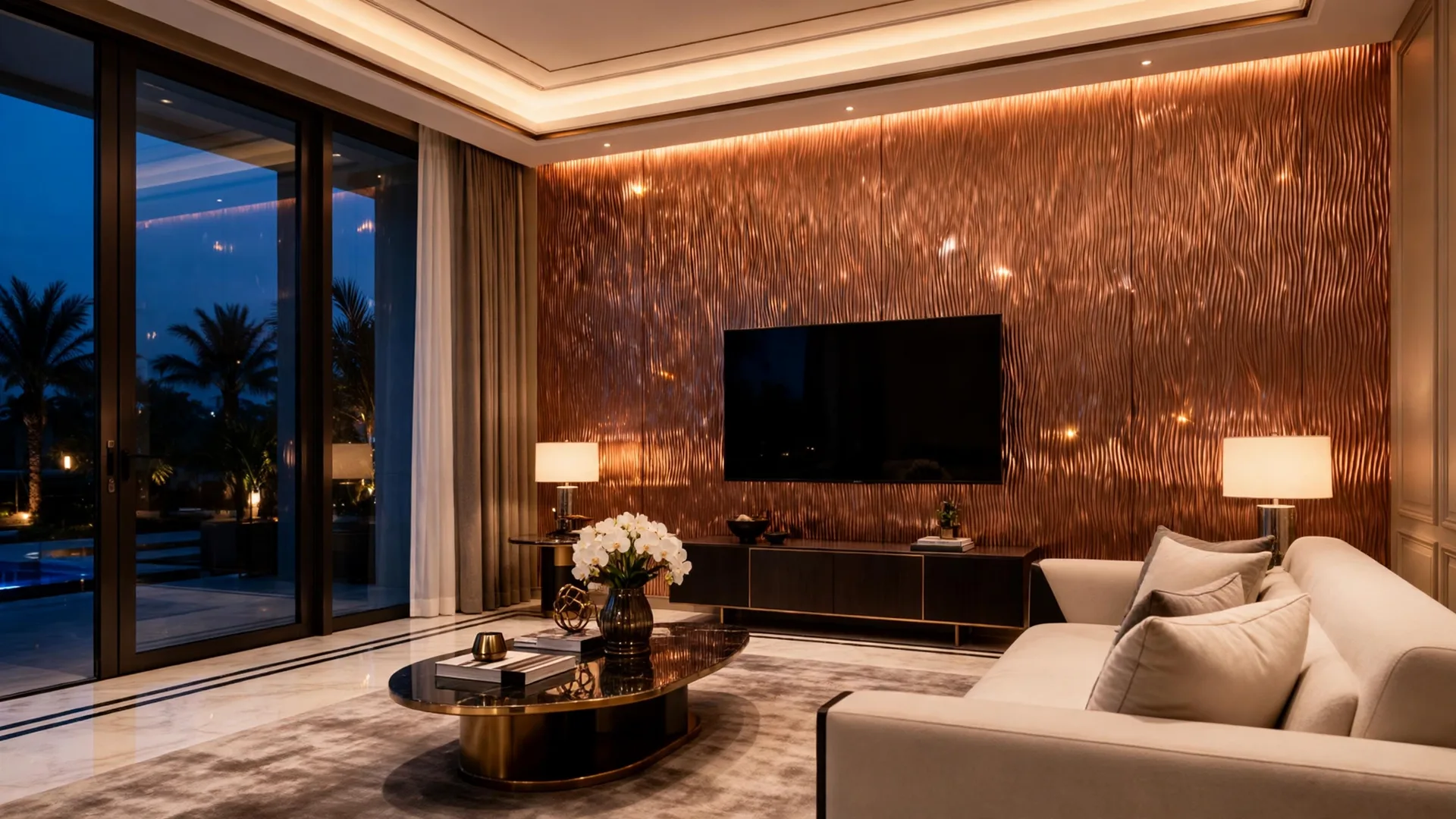
Wavy wall panels are wall panels whose face runs in a continuous wave instead of sitting flat. The wave can be fine and dense, with many narrow curves packed across the sheet. It can also be coarse, with a few broad swells that read as sculpture. Those two ends of the market share a name and almost nothing else. They light differently, they clean differently, and they age differently in a room. This guide separates them, because the scale of the wave is the first decision and the one most buyers make from a photograph that hides it.
We are WOW Walls Studio, a South Florida studio. We design and install large-format panel walls, and our wave panel sits at the fine end of the scale. Our hub guide to accent wall panels covers which wall to panel and what a project costs. This page stays on the wave itself: how the profile is built and how light moves across it. It covers where hidden light belongs, which rooms carry it well, and what a finished wall costs.
One honesty note before the detail. The market uses "wavy" loosely. Small PVC tiles, narrow WPC boards, carved MDF sheets and composite sheets all sell under the same word. Where this article gives a maker's figure, it names the maker. Where it describes our own panel, it says so.
What wavy wall panels are: one profile, four constructions
<strong>TL;DR:</strong> A wavy wall panel carries a repeating curved profile across its face. The profile repeats at a set pitch, and the pitch plus the depth set the character. Four constructions dominate the market: small PVC tiles, narrow WPC boards, CNC-carved MDF sheets, and large-format composite sheets like ours. The construction decides seam rhythm, cleaning, curve options and price far more than the word "wavy" does.
Start with the two measurements that define any wave. Pitch is the distance from one crest to the next. Depth is the distance from a crest down to the valley floor. A fine wave pairs a tight pitch with shallow depth. A coarse wave pairs a wide pitch with deep relief. Everything a wave wall does in a room follows from those two numbers and from the material carrying them.
Small PVC tiles. The budget end sells wavy 3D tiles in PVC, glued up tile by tile. Art3d is the name most buyers meet first. The tiles are light and cheap, and the pattern restarts at every tile edge. On a small splash zone that restart reads as texture. Across a full living room wall it reads as a grid. Your eye finds the tile seams inside the wave.
Narrow WPC boards. WPC means wood-plastic composite, wood fiber and polymer formed into boards. NewGen Depot sells a wave-shaped fluted board in this family. Each panel measures 6.3 inches wide by 106 inches high by 0.98 inches thick. Boards like this build the wave from many narrow vertical pieces. The wave runs down each board, and the rhythm across the wall comes from the board joints as much as from the profile itself.
CNC-carved sheets. Corint Industries, a Florida maker, carves its wave line from MDF and engineered cores. The sheets join on all four sides so the wave continues across the wall. Carved sheets give the cleanest large waves on the market. They also carry MDF's known weakness at cut edges around moisture, and they arrive thick, at 0.75 to 1 inch in Corint's line.
Large-format composite sheets. Our studio's format is a full sheet, 48 by 108 inches and 5 mm thick, on a bamboo composite core with a finished face. Seams land every 4 feet on a run, and the wave flows across them as one field. The sheet is fitted on site as a full sheet. We offer no cutting service, and the layout plan works around whole sheets from the first sketch.
| Construction | Typical format | How the wave reads | Watch for |
|---|---|---|---|
| PVC wavy tiles | Small tiles, glue-down | Texture with a visible tile grid | Pattern restarts at every tile edge |
| WPC wave boards | Narrow boards, about 6 inches wide | Vertical rhythm from boards plus profile | Joint rhythm competes with the wave |
| CNC-carved MDF | Full sheets, 0.75 to 1 inch thick | Cleanest broad waves | Moisture at cut edges, weight |
| Bamboo composite sheet | 48 by 108 inches, 5 mm | One fine, dense wave field | Layout planned around whole sheets |
Read the table as a buying filter. If the photograph that sold you shows a wave with no visible joints, ask which construction made it. The answer tells you what your wall will actually look like at full size.
Wave scale: fine and dense vs coarse and sculptural
<strong>TL;DR:</strong> Wave scale is the decision under every other decision in this article. Corint, which sells the same wave design in three scales, puts it plainly: its Small reads as fine texture and its Large reads as bold sculptural gesture. Fine waves behave like a material. Coarse waves behave like furniture. Our studio panel, WW-BAM-071, is a fine, dense wave, and from a distance it reads like a distorted copper mirror with a light shimmer.
Corint's three-scale line is the clearest public yardstick the market offers. The same PAN 010 wave design comes as Small, Medium and Large. The maker describes the Small as fine, tightly packed grooves. It describes the Large as broad, sweeping curves. Between them sits the Medium, closer-spaced than the Large and more open than the Small. One design, three rooms' worth of difference, set only by pitch and depth.
A fine, dense wave works at two distances. Up close, you see the tight rhythm and the way each small curve catches a slightly different tone. Across the room, the rhythm dissolves. What remains is a surface with movement in it, a shimmer that shifts as you walk past. That distance behavior is why fine waves suit large walls and open plans. The wall stays calm from the sofa and rewards a closer look.
A coarse wave works at one distance only: across the room. Each swell is a shape, and shapes demand agreement from everything near them. A coarse wave behind a television fights the screen rectangle. A coarse wave in a narrow entry reads as an obstacle the room is flowing around. In a tall, quiet space with little furniture against it, the same profile can carry the whole interior. The profile is not better or worse. It is louder, and loud surfaces need empty stages.
Our own panel belongs firmly to the fine end, and we describe it exactly as it behaves. WW-BAM-071 carries a fine, dense wave in a copper-toned metallic finish family. From across a room it does not read as a row of big curves at all. It reads like a distorted copper mirror with a light shimmer, the reflections breaking and reforming as you move. Anyone picturing a huge sculptural swell when they picture our wave panel is picturing a different product. If a coarse sculptural wave is what you want, the carved-sheet makers above sell it honestly. During a consultation we will say so plainly rather than sell you the wrong wall.
Judge scale in person before you commit. Stand a sample upright against the actual wall. View it from the sofa distance, then from the doorway. A sample that charms at arm's length can turn busy at full height. A coarse sample that looks bold in a showroom can overwhelm a 12-foot wall at home.
How the wave reads in raking light
<strong>TL;DR:</strong> Raking light is light that travels nearly parallel to the wall, and it is the light that draws a wave profile. JMS Decor, a flexible stone maker, describes the mechanism directly: light at a shallow angle skims across the relief and turns physical texture into visible shadow. Flat frontal light flattens a wave wall. One consistent grazing direction gives it depth. Two grazers from opposite sides cancel each other and leave the wall lit but flat.
A wave profile is a shadow machine. Each crest catches light on one side and throws a soft shadow into the valley beside it. Move the light and the shadows move, which is why a wave wall changes through the day while a printed pattern stays still. Morning sun from a side window rakes across the wall and the wave stands at full depth. Midday overhead light fills the valleys and the same wall calms down. Evening lamplight from one side brings the depth back at a warmer tone.
Direction decides the strength of the effect. Light arriving straight at the wall lands evenly on crests and valleys, and the wave nearly disappears. Light arriving along the wall skims the profile and draws every curve. Designers call the close, steep version grazing. JMS Decor notes that grazing exaggerates relief, which suits a profile you bought for its depth.
The same honesty applies in reverse. Grazing light reveals installation flaws as faithfully as it reveals the profile. JMS Decor says it plainly: grazing light is also the light that reveals them, meaning lifted edges, substrate ripples and seam steps. A wave wall planned for a strong graze needs a flat substrate and tight seams more than a flat wall does. We check wave walls under a raking work light before handover for exactly this reason. What the graze will show at night, we would rather find at noon.
Consistency matters as much as angle. Two light sources grazing from opposite ends draw two shadow systems that fight. The wall looks busy and oddly flat at once. One shadow direction across the whole field reads as depth. This is also why the window wall in a Florida room matters at layout time. If sliders rake strong afternoon sun across your chosen wall, the sun is your primary grazer. Fittings should support that direction, not compete with it.
Color temperature rides on top of the geometry. JMS Decor gives the warm band for warm faces directly: warm white at 2700 to 3000 K deepens travertine, rammed earth and wood-grain faces. The same band flatters copper and bronze-toned wave finishes, which is the family our fine wave lives in. Cool light on a warm metallic wave greys it. One temperature across the whole wall is the rule, because the eye reads a temperature seam between two lamps before it reads the profile.
Light in the valleys: hidden LED as a design layer
<strong>TL;DR:</strong> A wave valley can carry a hidden light line, and the effect is a glow that follows the profile instead of a lamp you can see. Al Tareeq Decor, a media wall specialist, describes the channel version. A strip placed in a fluted channel creates a glowing line running up the wall. A reveal of 8 to 12 mm behind the face usually hides the strip itself. On a fine, dense wave, restraint wins. Light a few valleys or wash the wall from a cove. Lighting every valley turns a shimmer into a barcode.
Three placements cover almost every lit wave wall we design. The first is the cove wash: a concealed strip above the wall, or below it behind a console, washing light down or up the profile. The wave draws its own shadows under the wash, and no strip is visible anywhere. Al Tareeq calls the cove above a profiled wall one of the most popular treatments in its media wall work. The directed light makes the shadow lines more pronounced. The second placement is the side wash: a vertical strip hidden in a corner or behind a trim, lighting across the profile. Sky Build Mart, a panel retailer, notes that side wash is strong on wave and round slat profiles. The light travels along the curves instead of into them. The third placement is the in-valley line: a strip seated inside one or more valleys, glowing out of the profile itself.
The in-valley line is the one buyers picture, and the one that needs the most discipline. The strip must sit back far enough that you see glow, not diodes. Al Tareeq gives the working figure for channel work. A reveal of 8 to 12 mm behind the rib face usually hides the strip from normal viewing angles. It still lets light reach the groove base. A channel with a frosted diffuser spreads the light further and hides the individual points. On a coarse wave, a lit valley reads as a deliberate light sculpture. On a fine, dense wave like ours, the valleys are narrow and close together. Lighting all of them produces a striped wall that fights the shimmer the finish was chosen for.
Al Tareeq's restraint rule for dense profiles is worth quoting in spirit: avoid running strips in every groove on a dense profile in a small room. Light two to four channels at a wider spacing, or run a single cove above the panel, and let the geometry do the work. We design our fine wave the second way by default. A cove wash plus, at most, one lit valley line as an accent. The wall keeps its calm at television distance and still gives you the evening glow in the photographs that sold you.
Two planning points decide whether any of this works. First, the light detail is a cladding-stage decision. The channel, the reveal depth and the cable route are set before the sheets go up. A strip line cannot be cut cleanly into a finished wave wall later. Materia Collection, an architectural panel maker, makes the same point for integrated lighting generally: position, concealment, wiring path and access are considered during design and fabrication. Second, service access is part of the design. JMS Decor warns that a channel sealed into a detail must stay reachable for the day the strip needs replacing. A removable profile or a diffuser that pulls out is a design feature, not a compromise.
The electrical depth behind these placements lives in our guide to LED backlit wall panels and wiring. Driver sizing, voltage drop, dimmer matching and the code lines for cords and hardwired work are all covered there. Read it before anyone quotes you a lit wall. The short version for this page is three rules. The driver lives somewhere accessible and ventilated. The dimmer and driver are bought as a matched pair. Any hardwired connection is permit work for a licensed electrician. Our studio plans the lighting and the panels together, and the electrical connection itself follows that rule on every job.
Wave vs fluted vs flat: choosing the profile family
<strong>TL;DR:</strong> Fluted panels draw straight ribs and hard shadow lines. A wave profile draws curves and soft shadow gradients. Flat large-format panels draw nothing and let the finish carry the wall. Choose fluted for rhythm and order, wave for movement and softness, flat for stone and mirror finishes that need a quiet field.
Our fluted wall panels guide covers the straight-rib family in full. The contrast with wave is simple geometry. A flute is a straight channel with a flat or sharp rib between channels. Light draws a row of even stripes, and the wall reads as rhythm, almost musical in its regularity. A wave has no straight lines and no flat ribs. Light draws gradients that swell and fade along each curve, and the wall reads as movement. Rooms feel the difference even when visitors cannot name it. Fluted walls feel tailored. Wave walls feel relaxed.
Flat panels sit at the other pole. A book-matched marble-look wall or a mirror-finish wall wants no profile at all, because the pattern or the reflection is the design. Adding a wave to a busy stone pattern creates two designs competing on one surface. The compositions that work pair one quiet element with one expressive element. A wave wall beside flat panels. A flat television field framed by profiled sides. A wave behind a bed with plain walls around it.
Acoustics deserve one honest sentence, because sellers stretch this claim. A hard wave profile scatters sound slightly, the way any uneven surface does. Al Tareeq states the general truth for profiled hard panels. They contribute almost nothing to sound absorption. A room that needs echo control needs soft treatment planned separately. We sell the wave for how it looks and feels. If a seller sells it to you as acoustic treatment, ask for a test report.
Which rooms carry a wave wall
<strong>TL;DR:</strong> Living rooms and primary bedrooms carry wave walls best, because both give the profile viewing distance and evening light. Media walls work when the wave frames the screen instead of running behind it. Dining rooms suit a fine wave as a calm backdrop. Entries and hallways suit short wave runs that you pass at an angle, where the shimmer does its work. Bathrooms and kitchens ask harder questions about moisture and grease, answered in the Florida section below.
Living room. The classic placement is the wall you face from the sofa. Distance is the fine wave's friend: from 10 feet and more, the dense profile settles into shimmer. Keep the wave to one wall. Two wave walls set up competing shadow systems under most lighting, and the room starts to feel like it is moving.
Primary bedroom. The wall behind the bed is the second classic. A fine wave behind a headboard reads as texture at pillow distance and as calm pattern from the door. Bedside lamps graze it at a low angle, the kindest light a wave can get. Coarse waves behind a bed are the risky version: big swells at close range can feel restless in the room meant for sleep.
Media wall. The working composition puts the screen on a flat field and the wave at the sides. The wave can also run across the whole wall, with the screen mounted over it, when the profile is fine. A coarse profile behind a screen throws curved shadows across the picture zone and reflects room light in moving bands. A fine, dense wave behind a screen behaves more like a textured backdrop, and its shimmer sits below the threshold that distracts from a film. Hidden light belongs in the side valleys or the cove here, dimmable to a low evening level.
Dining room. A fine wave makes a strong dining backdrop. Candlelight and pendant light rake it at exactly the shallow angles that draw the profile. Pair it with plain chairs and a simple table. The wall is the decoration.
Entry and hallway. A short wave run in an entry works on passers-by: you cross it at an angle, the shimmer moves, and the house makes its first impression. Hallways give a wave its longest raking light when a door or window sits at the far end. Keep hallway waves fine. A coarse profile narrows a passage visually on both sides of every swell.
Home office. The wave behind a desk appears on video calls as a textured backdrop that reads premium without showing a logo or a bookshelf performance. Fine profiles photograph as soft texture on camera. Coarse profiles can moire and band on some cameras under strong side light. Test the actual wall on a call before the whole office is built around it.
Curves and columns: when the wave itself bends
<strong>TL;DR:</strong> A wave profile and a curved wall are two different curves, and a product can carry one without the other. Whether any panel follows a curved wall depends on four variables together: the radius, the panel build, the temperature on installation day, and the substrate it bonds to. Thin flexible materials follow tight curves. Deep relief needs a wider radius. Rigid sheets do not bend at any radius, and our large-format sheet is planned for flat walls and gentle geometry confirmed by a specialist on site.
Buyers mix up two questions here. Question one: does the panel face carry a wave profile? Question two: can the panel bend around a curved wall or column? A carved MDF wave sheet answers yes to the first and no to the second. A plain flexible stone sheet answers no to the first and yes to the second. Products that answer yes to both exist at the flexible end of the market. The bend figures belong to the flexible materials, not to wave panels in general.
MR Building Materials states the governing rule in its curve guide for panel installers. A wall panel curve holds when four variables sit inside the same working window. The radius. The panel build. The temperature on installation day. And the substrate the panel is bonded to. Keep all four aligned, the guide says, and a 2 to 3 mm flexible stone panel will follow a 150 to 250 mm column without cracking. Push one variable out of the window and even a wide, gentle curve can fail at the edges.
Depth works against bending. The same guide notes that deep 3D relief patterns are thicker and stiffer, so they need a wider radius. A coarse wave is deep relief by definition, so the most sculptural wave products are the worst candidates for tight curves. A fine, shallow wave on a flexible build is the only wave family with any business on a column. Even there, the radius belongs to the specific product's test, not to a category promise.
Light changes on a curve too. JMS Decor observes that grazing a curve multiplies relief effects unevenly: the side facing the light shows deep shadow, and the far side flattens. On strongly curved work, the maker recommends replacing the graze with a continuous diffuse wash and letting the drama come from the curve itself. A wave on a curve already has two movements to read. The lighting job is to calm one of them down.
Our studio position is plain. Our sheet is a flat-wall product: full sheets, fitted on site, seams every 4 feet. Gentle curves come up in South Florida homes, around rounded corners and wide-radius walls. Those are site questions. A specialist measures the radius, tests the material against it, and tells you plainly whether the wave runs around it or stops at a designed edge.
What a wavy wall costs: formats, ranges and the LED question
<strong>TL;DR:</strong> Wavy walls price by construction first and finish second. Small tiles cost the least per box and the most in visible seams. Our studio's public anchors are a stock design from $850, a semi-custom project at $2,200 to $2,700, and a full turnkey project from $9,999. Turnkey per-foot ranges run A at $22 to $28 per square foot and B at $30 to $38 per square foot. Every figure is preliminary until a specialist sees your photo and measurements.
The format ladder explains most quote gaps. A box of PVC wavy tiles covers a wall for the price of a nice dinner. The wall shows it: tile grids, glue lines, a pattern that restarts every few inches. WPC wave boards sit in the middle, priced per board, with the wall's quality set by joint alignment. Carved sheets price as millwork, because they are millwork: made to order, thick, heavy, and finished on site or in the shop. Large-format composite sheets price as a system: material, design, delivery and installation by one team, quoted as one number for the finished wall.
Our studio sells the finished wall, so our anchors describe projects, not sheets. A stock design starts from $850. A semi-custom project runs $2,200 to $2,700. A full turnkey project starts from $9,999. The turnkey ranges behind those anchors run in two bands. Range A sits at $22 to $28 per square foot. Range B sits at $30 to $38 per square foot. The band is set by finish family and wall condition. All of it is preliminary. The exact quote comes after a photo of your wall and real measurements. Openings, corners and substrate repairs move a real number more than any rate card can.
The LED question deserves its own paragraph, because lit valleys change a quote in ways sellers hide. No honest per-foot price exists for adding hidden light to a wave wall as a standalone line. The cost rides on wall length, the number of lit valleys or the cove length, the driver and dimmer class, and whether the wall needs new electrical work. A quote that names a flat LED surcharge without asking those questions is guessing with your money. In our quotes the lighting plan is drawn with the panel plan and priced as part of the project. Any hardwired connection is scoped as electrical work under permit by a licensed electrician.
One more cost note. The comparison that matters is the painted wall a wave wall replaces, refreshed every few years. Spread across its service life, a turnkey wave wall costs less per year than most owners expect. The math only works if the profile still pleases you in year ten. That is why the scale section matters more than this one.
The Florida adjustment: sun, sliders and humidity
<strong>TL;DR:</strong> South Florida gives a wave wall its best light and its hardest climate in the same room. Sliders rake strong sun across profiles for hours, which draws the wave beautifully and fades exposed faces unevenly over years. Humidity works on seams, edges and bonds. The US Environmental Protection Agency advises reducing indoor humidity to 30 to 60 percent to decrease mold growth, and calls moisture control the key to mold control. A composite wave wall in a conditioned home holds up well. A board-cored wave wall in a home left humid spends its edges first.
Sun first, because Florida sun is a design material here. A wave wall opposite or beside sliders gets a daily raking wash that northern rooms never see. The profile stands at full depth for hours. The bill arrives slowly, as tone drift on the most exposed sheets. Pale and metallic faces forgive small shifts. Saturated colors and wood tones show them sooner. Choose the finish with your wall's sun hours in view, and treat window film or sheers as part of the wall budget on a west-facing placement.
Humidity works at the joins. Our guide to accent wall panels and Florida humidity covers the climate in full. The wave-specific point is surface area: a profiled face has more edge, more valley and more seam length per square foot than a flat face. Valleys hold dust that holds moisture against the finish. Seams on a wave wall must stay tight and clean, because a darkened seam line inside a valley reads as a broken wave. The EPA guidance was written about mold, and it doubles as panel guidance. The same moisture control that protects a house protects the bond line behind a profiled wall.
Material choice carries the climate. A composite face cannot rot or feed mold, and its valleys wipe clean. An MDF-cored carved wave in a bathroom or a kitchen splash zone carries its maker's moisture warnings with it. Florida adds months of humid air to every warning. Kitchens ask a second question: grease settles in valleys and needs the cleaning routine below on a schedule, not on a whim. Our placement advice is plain. Wave walls earn their keep in living rooms, bedrooms, dining rooms and entries. In a Florida bathroom, choose the composite family, keep the wave out of the direct wet zone, and let ventilation do its work.
Care: dust lives in the valleys
<strong>TL;DR:</strong> A wave wall asks for dry dusting first and almost no water. Dust settles in the valleys and along the seam lines, and grit dragged under a wet cloth scratches the crests. Brush the valleys dry, wipe crests with a barely damp cloth, and keep abrasive pads, steam and strong solvents away from the face. NewGen's care line for its wave boards says the same in fewer words: clean along the wave-shaped grooves, and avoid abrasive tools and harsh chemicals.
The routine is short. Dust the wall dry with a soft brush, working along the valleys so dust leaves the groove instead of packing into it. Al Tareeq gives the same sequence for fluted grooves: a soft dry brush, a clean paintbrush or a makeup brush works, before any damp cloth touches the wall. Then wipe the crests with a barely damp cloth and dry the wall as you go. Water should never pool in a valley or sit in a seam.
Our guide to cleaning accent wall panels gives the full routine for smooth and profiled faces, including the seam pass. The wave adds one habit: check the valleys under raking light twice a year. The same light that draws the profile shows dust film and early seam grime months before flat light does. Five minutes with a brush under a side lamp is the whole maintenance budget of a composite wave wall in a living room.
What not to do matters more. Steam cleaners push moisture and heat into grooves and bonds; Al Tareeq warns against them on profiled panels for exactly that reason. Abrasive pads dull metallic faces on the crests first, and a dulled crest line reads as wear across the whole wall. Strong solvents can cloud printed and coated finishes in one session. A wave wall rated for decades of looks can be aged in an afternoon by its cleaning supplies. That is the saddest sentence in this article, and also the most avoidable.
Frequently asked questions
<strong>TL;DR:</strong> The short answers: wavy wall panels are profiled panels whose face runs in a continuous curve. Scale decides character, with fine waves reading as shimmering texture and coarse waves as sculpture. Our studio panel is a fine, dense wave. Hidden light works best as a cove wash or a few lit valleys. Turnkey wave walls run from $9,999, with per-foot ranges of $22 to $28 and $30 to $38. The eight answers below give the detail.
What are wavy wall panels?
Wavy wall panels are wall panels with a continuous curved profile across the face, defined by pitch, the distance between crests, and depth, from crest to valley floor. The market sells them as PVC tiles, WPC boards, CNC-carved MDF sheets and large-format composite sheets. The construction decides seams, cleaning and price as much as the wave itself does.
Are wavy wall panels going out of style?
The wave is a profile, and profiles age more slowly than colors or patterns. Fluted and slat profiles ran the same course: a surge, then a settled place as a standard texture family. A fine wave reads as texture, and texture dates gently. A very coarse, themed wave dates faster, the way any loud gesture does. Choose the scale you would still like at year ten.
What does the WOW Walls Studio wave panel actually look like?
Our wave panel, WW-BAM-071, carries a fine, dense wave in a copper-toned metallic finish family. From a distance it reads like a distorted copper mirror with a light shimmer, not as a row of large curves. Up close you see the tight rhythm of many narrow waves. It is a full sheet, 48 by 108 inches and 5 mm thick, fitted on site with seams every 4 feet.
Can you put LED light inside wavy wall panels?
Yes, with planning. A strip can sit in a valley or channel as a hidden light line. It can also wash the wall from a cove above it, or light across it from a side trim. On a fine, dense wave, a cove wash or a few lit valleys looks best; lighting every valley turns the wall into stripes. The electrical plan, driver sizing and code lines are covered in our LED backlit wall panels wiring guide.
Do wavy wall panels work on a curved wall or column?
Only some do. Bending depends on the radius, the panel build, the temperature on installation day and the substrate, taken together. Thin flexible materials follow tight curves. Deep relief needs a wider radius, and rigid carved sheets do not bend at all. Our large-format sheet is a flat-wall product; gentle curves are judged on site by a specialist before anyone promises them.
How much do wavy wall panels cost installed?
Installed cost follows construction. Our studio's public anchors are a stock design from $850, a semi-custom project at $2,200 to $2,700, and a full turnkey project from $9,999. Turnkey ranges run A at $22 to $28 per square foot and B at $30 to $38 per square foot. The exact quote comes after a photo and measurements of your wall.
Are wavy wall panels hard to clean?
No, but the method matters. Dust settles in the valleys, so brush them dry first, working along the groove, then wipe crests with a barely damp cloth. Skip abrasive pads, steam cleaners and strong solvents, which dull crests and push moisture into seams. A composite wave wall in a living room needs about five minutes of this, a few times a year.
Do wavy wall panels suit Florida homes?
Yes, in the composite family and in the dry rooms of the house. Florida sun rakes the profile beautifully and can drift exposed tones over years, so finish choice follows the wall's sun hours. Humidity works on seams and bonds. Indoor humidity in the EPA's 30 to 60 percent band and tight, clean seams matter here more than in a dry climate.
Sources
- Corint Industries, Wave Wall Panel PAN 010 Medium. The maker's scale language for one wave design in three sizes. The Small reads as fine texture. The Large reads as bold sculptural gesture. Sheets join on all four sides so the wave continues without interruption. cnc-panels.com
- NewGen Depot, Royal Oak Wave WPC Fluted Wall Panel. WPC wave board measuring 6.3 by 106 by 0.98 inches. Suitable for TV walls, feature walls and accent walls. Care guidance: clean along the wave-shaped grooves. Avoid abrasive tools and harsh chemicals. newgendepot.com
- Yuheng WPC, 3D WPC Wall Panel. Maker claims for relief depth. Tongue-and-groove indexing creates a seamless ripple effect across any wall width. yuhengwpc.com
- JMS Decor, Lighting a Flexible Stone Feature Wall. Shallow-angle light skims across relief and turns texture into visible shadow. Grazing also reveals installation imperfections. Warm white at 2700 to 3000 K deepens warm faces. A sealed-in light channel must stay reachable for strip replacement. Curved work usually takes a diffuse wash instead of a graze. jmsdecor.com
- Al Tareeq Decor, Fluted TV Wall Panels UAE. A strip in a fluted channel creates a glowing vertical line. A reveal of 8 to 12 mm behind the face usually hides the strip. Warm white at 2700 to 3000 K complements wood-effect and stone-effect finishes. Avoid lighting every groove on a dense profile in a small room. Brush grooves dry before wiping. Avoid steam cleaners. altareeqdecor.ae
- Sky Build Mart, LED Lighting for Wall Panels. Side wash is strong on wave and round slat profiles. Use an aluminium channel with a frosted diffuser. Keep the driver accessible, not sealed behind the panels. skybuildmart.com
- Materia Collection, Wall Panels With Integrated Lighting. Integrated light is designed with the panel assembly. Position, concealment, wiring path and access are considered during design and fabrication. materiacollection.com
- MR Building Materials, Wall Panel Curve Guide. A curve holds when radius, panel build, temperature and substrate sit inside one working window. A 2 to 3 mm flexible stone panel will follow a 150 to 250 mm column. Deep 3D relief needs a wider radius. Rigid sheets do not bend. mr-buildingmaterials.com
- US Environmental Protection Agency, Ten Things You Should Know About Mold. The key to mold control is moisture control. Reduce indoor humidity to 30 to 60 percent to decrease mold growth. epa.gov
- WOW Walls Studio, LED Backlit Wall Panels: Wiring, Drivers and Dimming. The studio's electrical plan for lit panel walls. It covers driver sizing, voltage drop, dimmer matching and cord rules. wowwallsstudio.com
- WOW Walls Studio, Accent Wall Panels hub and Wall Panels Cost. Studio sheet dimensions and finish families. The public preliminary price anchors and turnkey ranges used in the cost section. wowwallsstudio.com