
Wall Paneling vs Wainscoting: Cost, Look and Florida Reality (2026)
Wall paneling vs wainscoting in 2026: installed costs, materials, Florida humidity, and which option fits your room.
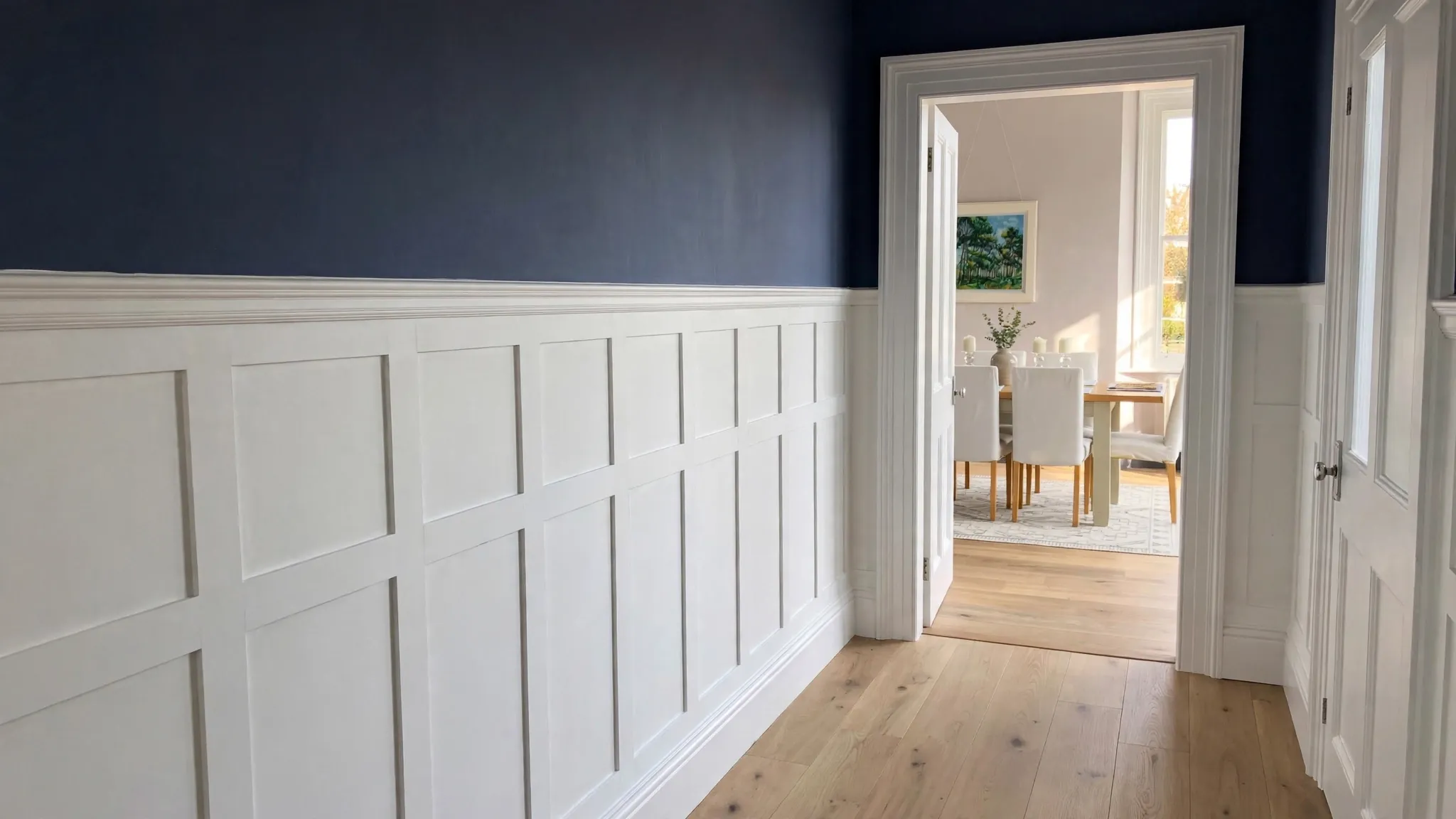
If you are choosing between wall paneling vs wainscoting, the decision comes down to coverage. One wall, one room, one decision: cover the whole wall, or cover the lower third and cap it with a chair rail. A chair rail is the horizontal trim molding at the top edge of the run. The two options look related, and they are. Wainscoting is a kind of wall paneling. That one choice changes the cost, the look, the install and the maintenance.
We run a South Florida studio that designs and installs large-format panel walls. We do not sell or install wainscoting, and this guide does not pretend otherwise. Our main wall paneling guide owns the general verdict on paneling types, costs and where each one works. This article stays inside one comparison. It prices both options from the same national cost guides, explains what each material does in Florida humidity, and says plainly where each option wins.
The short answer: paneling vs wainscoting in one view
TL;DR: Wall paneling is the broad term for any applied panel system, at any height up to floor-to-ceiling. Wainscoting stops at the lower third, about 32 inches on an 8-foot ceiling, capped by a chair rail. Professional paneling runs $1,200 to $6,000 per project, averaging about $2,800 (Angi, Oct 2026). Professional wainscoting runs $1,050 to $2,400, averaging $1,325 (Angi, Oct 2026). In Florida, material matters more than height: standard MDF swells when wet, while PVC and sealed composite handle humidity better.
The price gap looks large until you divide by coverage. A wainscoting run covers roughly one third of a wall. A full panel wall covers all of it. Per square foot, the two overlap heavily. The real choice is about the room. Wainscoting adds trim and protection to the lower wall and leaves the upper wall painted. Full paneling makes the wall itself the feature. One is an accent. The other is a new surface.
What each term actually means
TL;DR: Paneling is the umbrella term. Wainscoting is one member of the family: paneling on the lower part of the wall only. The name comes from wainscot oak, a strong wood once used for the job. The idea is centuries old, Dutch in origin, and it started as protection for plaster walls.
Houzz puts the broad definition in one line. "Paneling is molding in large, solid pieces instead of strips, dressing one or many walls in panels."
That covers everything from a full-height sheet wall to a single framed rectangle of trim. Angi lists the rest of the family.
"Other types of wood paneling include shiplap, board and batten, and raised panel wainscoting."
Shiplap (horizontal boards that overlap at a stepped groove), beadboard, board and batten, slats and fluted profiles are all paneling. Wainscoting is the coverage choice inside that family.
Angi defines wainscoting directly: "Wainscoting is a type of decorative wall molding that runs along the lower portion of an interior wall."
Originally, it insulated older homes from drafts and dampness. Today it is mostly about looks and shielding walls from everyday scuffs caused by shoes, furniture, and playful pets. The height rule is consistent across Angi, HomeAdvisor and Bob Vila: about one third of the wall height. HomeAdvisor states it as a rule of thumb: "The best rule of thumb for wainscoting is to stop the panels at about one-third of the wall height. In a room with a nine-foot ceiling, that's roughly three feet up." On an 8-foot ceiling that lands near 32 inches. On a 9-foot ceiling, near 36 inches. Most installations sit between 30 and 36 inches, capped by a chair rail.
The history is older than the style. This Old House dates the practice to the 1300s. The Dutch used it "to shield the bottom half of plaster walls from such hazards as jostled chairs, spurs on riding boots, perhaps even carelessly swung scabbards."
Angi traces the name to the wood itself: "The term 'wainscot' started as a name for a high-quality oak known for its strength and resistance to warping. Over time, the word shifted to refer to the paneling itself rather than the wood." Angi's styles page dates the invention to the 18th century. The sources disagree on the century of invention. So we call it centuries-old Dutch protective paneling, without pinning down a single invention date.
Wainscoting comes in six styles named by Angi. Raised panel is the formal one, with center panels sitting slightly behind beveled molding (molding with a sloped edge). Flat panel sits level with the surrounding trim, which reads clean and current. Beadboard is narrow vertical boards with evenly spaced grooves, called beads. Wall panel, in Angi's usage, means trim applied directly onto the wall to form frames, giving the illusion of inset panels. Overlay layers one panel on top of another, usually a flat base with a smaller raised detail. Board and batten is wide vertical boards with thin strips, called battens, placed over the seams.
Picture-frame molding is related but different: applied rectangular trim frames on the wall surface, with no separate panel behind them.
Full-height paneling has its own profiles. Shiplap is horizontal boards with a rabbet at the top and bottom of each plank. A rabbet is a stepped groove. The boards self-space and form a tight joint with a shadow line. Beadboard also appears at full height, though it is most common as wainscoting. Slat panels are narrow wood-faced strips with visible gaps over a felt backing. Fluted panels have grooves cut inward, which is the precise meaning of fluted, while rounded ribs that project outward are reeded. Our shiplap wall guide covers shiplap in Florida in full, and our slat wall panels guide does the same for slats.
The look: a new wall vs a trimmed wall
TL;DR: Full paneling changes the room. Wainscoting decorates the lower wall and protects it. Wainscoting suits traditional, coastal and cottage rooms and reads best in dining rooms, entries and hallways. Full-height paneling suits modern rooms, TV walls, bedrooms and any wall that should carry the room. The wrong height in the wrong room is an expensive mistake, because it costs a full reinstall to fix.
Stand in the room and look at the wall as a picture. Full paneling fills the whole frame. The material, the seams and the finish become the wall. That is why it works behind a bed, behind a TV, on a fireplace wall, and in a dining room, where the wall is the backdrop for every meal. It also means the finish has to be good across the full height, because there is nowhere for the eye to rest. A cheap finish at full height reads cheap at every height.
Wainscoting fills the bottom third of the frame and leaves the top two thirds painted. The eye reads it as trim. That is its strength in rooms that already have plenty going on. Think of a dining room with a chandelier, an entry with a console and a mirror, or a hallway where the lower wall takes scuffs. Angi names that protective role directly, and it is real. The lower third of a hallway wall takes more scuffs than most surfaces in a house. A painted flat wall there shows every mark. A wainscot run takes the marks and hides them in the profile.
Style is where the two part company. Wainscoting is a traditional form. Raised panel and overlay read formal and suit dining rooms and libraries. Beadboard reads cottage and coastal, and it is the default wainscoting in Florida beach houses and older bungalows. Flat panel and board and batten read transitional: traditional bones with a cleaner line, workable in a modern coastal home.
Full-height paneling is freer. A travertine-look or Calacatta marble-look sheet wall reads modern and premium. A shiplap wall reads coastal. A slat wall reads warm and contemporary. Our wall panel colors and finishes guide walks through how finish and light interact. The same rules apply here: dark finishes shrink a room visually, while pale finishes open it. A glossy finish shows every wave in the wall behind it.
Ceiling height decides more than taste does. On an 8-foot ceiling, a 32-inch wainscot run leaves about two thirds of the wall painted above it, a comfortable proportion. On a 9-foot ceiling, the run rises to about 36 inches and still reads right. On a 10-foot ceiling, a standard 32-inch run can look short. The fix is a taller run. That starts to cost like a different project.
Full-height paneling has no such proportion problem, because it takes the whole wall. It has the opposite risk: in a small room with a low ceiling, a busy full-height profile can press down on the space. That is why our wall paneling for small rooms guide recommends calm finishes and restrained coverage in compact rooms.
One more look question matters and rarely gets asked: what happens at the corners and the ends. A wainscot run has to end somewhere, and every end needs a clean return (a trim piece that turns the corner and finishes the end) or a cap. A run that stops mid-wall with a raw edge reads unfinished. A full-height panel wall has the same problem at its vertical edges. For our large-format sheets, supplied as whole sheets only, a seam that lands on a sliver at the corner announces itself across the whole wall. Both options punish a layout that was never counted.
Cost side by side: the same guides, the same year
TL;DR: For wall paneling vs wainscoting, Angi's 2026 guides put professional paneling at $1,200 to $6,000 per project, averaging about $2,800, and wainscoting at $1,050 to $2,400 per project, averaging $1,325. Per square foot the ranges overlap: $5 to $25 for paneling, $5 to $40 for wainscoting. Wainscoting wins per project because it covers less wall. Neither is a Florida quote, and neither is a price for our studio's large-format panels, which no national guide prices.
For wall paneling vs wainscoting, every figure in this section is national. Headline paneling and wainscoting figures are from Angi guides updated in October 2026. Angi and HomeAdvisor publish identical wainscoting figures because the two brands share cost data: one data family, not two independent confirmations. The beadboard explainer is July 2026, HomeGuide is September 2025, and HomeAdvisor data is 2025. We date each figure where we use it. We found no reliable Florida-specific installed price for either option, and we are not inventing one. South Florida labor, permitting and material delivery differ from national averages, so treat these as planning bands and confirm the exact figure after a specialist measures the wall.
| Figure | Wall paneling | Wainscoting |
|---|---|---|
| Professional project range | $1,200-$6,000 | $1,050-$2,400 |
| Professional average | About $2,800 | $1,325 |
| Installed, per square foot | $5-$25 | $5-$40 |
| Labor, per hour | $40-$100 | $50-$125 |
| Accent wall, 8 by 10 feet | $500-$1,000 | No room-type total in the wainscoting guide |
| Bedroom, 12 by 15 feet | $2,000-$3,500 | No room-type total in the wainscoting guide |
| Living room, 16 by 20 feet | $3,500-$6,000 | No room-type total in the wainscoting guide |
| DIY (do-it-yourself) materials only | $500-$2,000 | DIY MDF kits $2-$7 per sq ft, materials only (iBuyer) |
| Removal, per square foot | Replace when repair tops 50% of new | About $1.50, plus drywall $1.60-$2.35 |
Read the table with care. Angi's paneling page carries two different project ranges on the same page: the headline $1,200 to $6,000 and a do-it-yourself-versus-pro table showing a professional total of $2,200 to $10,000. We use the headline range and name the wider one here so you are not misled. Angi's wainscoting page has its own internal wrinkle. The intro text mentions most homeowners paying between $1,575 and $1,600. That conflicts with the $1,050 to $2,400 range and $1,325 average repeated in the cost box, the HomeAdvisor twin page and Angi's own definition page. We use $1,325 and $1,050 to $2,400 and do not quote the conflicting line as fact.
Per square foot, wainscoting looks more expensive at the top end, and that is a scope effect. A wainscot project is small, so fixed costs, measuring, cutting, trim, paint and cleanup, spread over fewer square feet. A full room of paneling spreads the same fixed costs over a larger area.
The style table explains the rest. Angi's wainscoting guide prices flat panel at $7 to $10 per square foot, board and batten and beadboard at $7 to $20, raised panel at $10 to $30, and overlay at $10 to $40. The material table starts with PVC (polyvinyl chloride) at $5 to $9 per square foot, with MDF and plywood at $6 to $12. Cedar runs $8 to $16, oak $12 to $22 and maple $12 to $21. Mahogany tops the table at $26 to $40.
Beadboard deserves its own warning, because the guides disagree with each other. Angi's beadboard explainer, updated 9 July 2026, prices professional installation at $4 to $6 per square foot, with real-wood materials near $1 per square foot and imitation near $0.50 to $0.75. Angi's paneling guide prices beadboard at $6 to $15 per square foot. Angi's wainscoting guide prices it at $7 to $20, matching HomeAdvisor. HomeGuide prices it at $10 to $20. Same product, same publisher in three cases, four different bands. So we report each range with its source. Any article that quotes one beadboard price without naming its guide is picking a number.
Shiplap has the same problem. Angi's dedicated shiplap guide, updated 6 Oct 2026, prices interior shiplap at $2 to $7 per square foot installed, with an average project of $1,000 and most projects between $500 and $1,500. Angi's general paneling guide prices shiplap at $7 to $16 per square foot. Same publisher, different scope, neither page reconciles the gap. We report both and use the dedicated guide's figures for shiplap itself.
The same Angi guides fill in the rest of the tables. Paneling labor runs $40 to $100 per hour, or $3 to $10 per square foot. Paneling by type also lists laminate at $5 to $12 and tongue and groove (boards that join with a matching ridge and slot) at $8 to $18 per square foot. PVC sits at $7 to $20, wainscoting at $10 to $25 and raised panel at $15 to $25. The wainscoting guide lists its own shiplap figure at $2 to $7.50 per square foot. Beadboard trim runs $0.30 to $2.50 per square foot. HomeGuide puts wainscoting overall at $10 to $40 per square foot installed. Its labor runs $70 to $100 per hour.
Our studio's own figures sit outside these tables, because no national guide prices large-format bamboo composite panels as an installed category. Our anchors for our panel projects are three figures. A stock design from $850. A design fitted to your wall usually $2,200 to $2,700. Full custom turnkey projects (design, panels, delivery and installation included) from $9,999. Every figure is preliminary until a specialist measures your wall, and the anchors cover design, panels, delivery and installation by our own crew. They carry no wainscoting price, no per-square-foot rate and no shiplap price. Our wall paneling cost guide breaks the anchors down in full.
What drives the price up or down
TL;DR: Material is the biggest lever, then height, then style complexity. PVC and MDF sit at the bottom of the wainscoting table. Domestic hardwoods sit in the middle. Mahogany and overlay profiles sit at the top. Full-height coverage multiplies the material and the labor together, which is why the project totals diverge even when the per-square-foot rates overlap.
Start with material. The cheapest wainscoting materials in Angi's table are PVC at $5 to $9 per square foot and vinyl at $5 to $10, with MDF and plywood at $6 to $12. Cedar runs $8 to $16, redwood $11 to $19, oak $12 to $22, maple $12 to $21, and mahogany $26 to $40. The spread from PVC to mahogany is eightfold on material alone, before labor. A painted MDF wainscot run and a mahogany raised-panel run are different projects that happen to share a name.
Style is the second lever. Flat panel is the cheapest style at $7 to $10 per square foot. Board and batten and beadboard sit at $7 to $20. Raised panel runs $10 to $30. Overlay runs $10 to $40, because it layers one panel on top of another. More pieces, more cuts, more time. Angi puts the labor point plainly: most of the labor cost comes from measuring, cutting and applying the panels. A profile with many small pieces costs more in labor than a profile with few large pieces, even at the same material price.
Height is the third lever and the one buyers underestimate. Wainscoting covers about one third of the wall. Full paneling covers all of it. Double the height and the material roughly doubles, the cutting time rises, and the finishing, paint or sealant, rises with it. That is the whole explanation for the project-total gap: $1,325 average against about $2,800 average, with overlapping per-square-foot rates.
The extras add up quietly. Chair rail trim runs $1 to $45 per linear foot (per foot of length, not per square foot of area), according to HomeAdvisor. HomeAdvisor prices paint at $25 to $50 per gallon, and painting at $2 to $6 per square foot of paintable area.
Angi notes that site prep, including demolition of old wall coverings or wall repairs, is often billed separately. Projects requiring wall repairs or removal of old coverings add labor time. A wall with peeling paint, a wavy surface or old wallpaper costs more before the first panel goes up. Our wall panels over existing walls guide covers what can go over tile, drywall, texture and wallpaper, and where the old surface has to come off first.
Permits rarely enter the picture. Angi notes that most wall paneling projects do not require a permit as long as no structural changes are involved. Permit fees of $50 to $300 apply when structural modifications, fire-rated panels or commercial spaces are involved. A straight decorative install in a living room or bedroom normally needs no permit. Electrical work, moving outlets or adding lighting, is a separate trade and a separate price.
Materials in Florida humidity: the decision that outlives the install
TL;DR: In Florida, pick the material for humidity first and the look second. Standard MDF swells when wet and does not shrink back. Solid wood moves with humidity and can recover, but it is termite food. PVC is waterproof and termite-immune, but it takes paint poorly. Bamboo composite is our studio's material, and its moisture claims come from manufacturers, not from independent lab tests.
The EPA (Environmental Protection Agency) rule is the anchor for this whole section. RH means relative humidity: the amount of moisture in the air compared with the maximum the air can hold at that temperature.
"Indoor relative humidity (RH) should be kept below 60 percent – ideally between 30 percent and 50 percent, if possible."
The EPA also warns that mold hides. "The back side of drywall (also known as gypsum board, wallboard, or SHEETROCK), paneling, and wallpaper" is among the possible locations of hidden moisture. That hidden moisture can grow mold. Wet materials must be dried within 24 to 48 hours to avoid mold growth.
Outdoor humidity in Fort Lauderdale averages about 73 to 74 percent across the year, 67 percent in April to 78 percent in September, according to airport climate data. That is the load on the house. Indoor air runs drier. An air-conditioned Florida home holds indoor humidity far lower, and the air conditioner does that work. The material question is what happens when the air conditioner is off, when a leak happens, or when a closed-up summer house sits humid for weeks.
SRQ Woodworks is a Gulf Coast trade source citing the USDA (US Department of Agriculture) Wood Handbook. It calls the closed-up summer house the riskiest stretch. Interior woodwork in damp warm coastal areas sits near 11 percent moisture content (water as a share of the wood's dry weight), against about 8 percent nationally. Miami outdoor equilibrium moisture content sits between roughly 12 and 14 percent in every month of the year.
MDF is the budget painted choice and the riskiest one near water. Angi prices MDF and plywood wainscoting at $6 to $12 per square foot, and MDF takes paint beautifully, with a smooth finish that flatters a painted wainscot run. The failure mode is moisture. SRQ Woodworks states it plainly. Particleboard and MDF absorb Gulf Coast moisture and do not shrink back. Once moisture slips past the skin, the compressed wood particles inside expand and never fully settle back. A decoration guide puts the same point in plainer terms. If water penetrates the protective paint layer or reaches an unsealed cut edge, the fibers will swell and delaminate (the layers split and peel apart). The profile is permanently ruined.
Standard MDF should not be used in bathrooms. Moisture-resistant MDF exists and is the minimum for wet-adjacent work, but it is not waterproof either. Our Florida humidity guide compares MDF and PVC in full. The verdict there holds here. MDF belongs on dry walls with sealed edges, kept away from floor-level water.
Solid wood behaves differently. It takes on moisture too, but it shrinks back as the air dries, which MDF does not. That recovery is why a solid oak or cedar wainscot run can last many years in a dry room and still look right. That fits Angi's 15 to 40 year lifespan for high-quality panels.
The costs run higher: cedar $8 to $16, redwood $11 to $19, oak $12 to $22, maple $12 to $21 and mahogany $26 to $40 per square foot in Angi's table. Wood also needs care Angi prices at $100 to $500 every few years for refinishing, repainting or resealing.
And wood is termite food. Drywood termites live entirely inside dry wood, need no soil contact, and stay active year-round in Florida. Slug-A-Bug cites University of Florida IFAS (Institute of Food and Agricultural Sciences) research. It names the West Indian drywood termite as the most economically significant drywood termite in the state.
Infestations can sit hidden for years in framing, floors and furniture. Florida ranked first in the country for termite activity in the 2025 Terminix national report, according to a pest-control trade source. No source quantifies termite risk for interior wall panels specifically, so we claim none here. The point is narrower: a solid-wood wall is more wood in the house, and in Florida that is a fact worth knowing before choosing it.
PVC is the humidity-proof answer with a styling cost. Angi prices PVC wainscoting at $5 to $9 per square foot, the cheapest material in its table. Angi's paneling guide calls PVC panels moisture resistant and easy to clean. A decoration guide states the chemistry plainly: because PVC contains no organic wood fibers, it is entirely waterproof, rot-proof, and immune to termite damage.
The trade-off is paint. The same guide warns that the smooth, non-porous surface (with no tiny holes for paint to grip) does not bond easily with standard household paints. A PVC wainscot run is best left in its factory finish, usually white, which suits bathrooms and laundry rooms and limits a living room. Heat can also distort it, and wood glue holds poorly on it, so the install method differs from wood.
Bamboo composite is our studio's material, and this guide is careful about what is known and what is claimed. Our sheets are bamboo composite, 48 by 108 inches and 5 mm thick, supplied as whole sheets only. The panels are bamboo powder, wood powder, PVC resin and polymer processing aids, formed by high-temperature extrusion (forcing the hot mix through a shaped opening). That is the manufacturer Instrava's description.
Instrava states that encapsulation (coating each fiber in plastic so water cannot reach it) of plant fibers by PVC resin ensures extremely low water absorption. That, the maker says, prevents warping, rotting, or mold growth common to real wood in high-humidity areas.
The claimed composition is bamboo and wood flour at 30 to 40 percent with PVC resin at 40 to 50 percent, plus calcium carbonate (a mineral filler, powdered limestone) and additives. Those are manufacturer claims. No independent lab test was found. No ASTM (American Society for Testing and Materials) water-absorption figure was found either. No installed cost per square foot for bamboo composite was found in any neutral source.
We present the material as a composite with a plastic-bound core. It is not a waterproof membrane (a waterproof barrier layer), and the fiber fraction is organic, so a blanket termite-proof claim is not supported. Our bamboo composite guide explains the material in full, including its limits.
| Material | Humidity behavior | Paint | Termites | Price, per sq ft |
|---|---|---|---|---|
| Standard MDF | Swells when wet, no recovery | Excellent | Wood fiber; no immunity claimed | $6-$12 |
| Solid wood | Moves, then recovers as air dries | Excellent, needs reseal | Food for drywood termites | $8-$40 by species |
| PVC | Waterproof, rot-proof | Poor adhesion | Immune, no organic fiber | $5-$9 |
| Bamboo composite | Low absorption per maker claims | Factory finish, not repainted | Not proven termite-proof | No national guide price |
Installation: time, skill, mess and prep
TL;DR: Wainscoting is a small, fiddly job. A pro finishes beadboard in less than a day. A 12 by 12 foot room can take more than 15 hours of careful measuring and cutting. Full paneling runs from a day or two for a simple accent wall to a week or more for a large or complex job. Both need a flat, dry, sound wall first (solid, undamaged, firmly attached), and prep is often billed separately.
Neither option is a weekend project in the casual sense, though both get sold that way. Angi's beadboard page says a pro will take less than a day, with DIY skill rated beginner to intermediate and a day or two of work, possibly longer. Angi's wainscoting guide is blunter about quality. Wainscoting is not particularly difficult to install, but getting it to look good is a whole different matter. Precision matters more than enthusiasm.
HomeAdvisor notes that a 12-foot by 12-foot room can easily require more than 15 hours of work, most of it measuring, cutting and fitting. Angi's paneling guide gives the full-height range. A simple accent wall takes a day or two do-it-yourself. Larger or complex jobs take a week or more. A pro is recommended for tricky corners, high ceilings or a custom look.
Prep is the same for both and it is not optional. Angi's wainscoting prep list runs in five steps. Measure and mark the wall. Remove the baseboards. Locate and mark the studs (the vertical framing boards inside the wall) for heavy wooden panels. Fill holes and cracks. Apply a coat of primer (the first sealing coat of paint).
Angi's paneling guide adds that site prep, including demolition of old wall coverings or wall repairs, is often billed separately. A wall with peeling paint, a wavy surface, loose tile or old wallpaper costs more before the first panel goes up. A panel over a damp wall seals the moisture in. Repair first. Our install rule, published in our install and over-existing-walls guides, is direct: the wall must be flat, dry and sound. Wallpaper comes off first, tile is decided at the measure visit, and damp or unsound areas are repaired first.
The two installs differ in what goes wrong. Wainscoting has many small pieces: a chair rail, a base cap and paint. The base cap is the trim finishing the bottom edge. The failure points are joints, miters and paint lines. A miter is the angled cut where two trim pieces meet at a corner.
Angi warns that poorly installed wainscoting can be a major eyesore, and the reason is visible: every cut shows at eye level in a small room. Full-height paneling has fewer, larger pieces, so the failure points are layout and flatness. A sheet that starts out of plumb (not perfectly vertical) ends out of plumb at the ceiling. A seam that lands on a sliver at the corner announces itself across the whole wall. That is one reason our studio installs with its own crew.
Painting splits the two as well. MDF and wood wainscoting are normally painted after install, and Angi's cost tip is to paint or stain panels after installation, to cut contractor fees. HomeAdvisor prices wainscot paint at $25 to $50 per gallon, and painting at $2 to $6 per square foot of paintable area. Shiplap repainting later runs $2 to $6 per square foot, per Angi's shiplap guide. PVC is the exception: standard household paint does not bond well to its smooth surface, so a PVC run is usually left in its factory white. Bamboo composite panels are also a factory finish in our work.
Cleaning, repair and lifespan
TL;DR: Both options clean with dusting and a mild detergent wipe. Wood needs refinishing, repainting or resealing at $100 to $500 every few years. Repairs run $150 to $600. High-quality panels last 15 to 40 years, per Angi. Wainscoting is cheaper to remove, about $1.50 per square foot for demolition, while full paneling is usually replaced when repair costs pass half the replacement price.
Day to day, the two are close. Angi describes routine panel maintenance as dusting and wiping with a mild detergent, with wood panels needing occasional refinishing, repainting or resealing at $100 to $500 every few years. Beadboard is the exception: its grooves collect dust and are hard to clean, which Angi lists as a paneling-table con.
PVC is the easy end of the range, wiped clean with no grain to hold dust. Our wall panel care guide gives the routine we recommend for hard finishes. Dry dust first. Then use warm water with a mild pH-neutral cleaner (neither acidic nor alkaline, so it does not attack the finish) on a microfiber cloth. Rinse, and dry immediately. Keep abrasives, bleach, ammonia, acetone, solvents, citrus cleaners and steam away from hard panels.
Repair costs overlap too. Angi prices repairing dents, scratches or water damage at $150 to $600, depending on severity and material. Small scratches, dents or isolated water spots can often be repaired. That is most likely when spare panels or the same style are still available. The availability point matters. A standard profile is easier to match later than a custom-milled one. Check availability before assuming a match. A custom-milled raised panel or a discontinued sheet finish cannot be matched, and then the repair becomes a replacement of the whole run. Keep a spare board or a spare sheet from the original install. It is the cheapest insurance in this whole comparison.
Lifespan is a single range for both options. Angi states that high-quality panels typically last 15 to 40 years before needing replacement, and no source breaks that range down by wainscoting against full paneling. The range is wide because the material and the room decide it. A PVC wainscot run in a dry hallway will typically last longer than a standard MDF beadboard run in a damp bathroom. Our how long wall panels last guide breaks lifespan down by material for full paneling, and the same material logic applies at wainscot height.
Removal favors wainscoting, and it is worth knowing before install. Angi prices professional wainscot demolition at about $1.50 per square foot, with drywall replacement after removal at $1.60 to $2.35 per square foot. Rails-only wainscoting means trim strips only, with no panel behind them. The trim is applied directly onto the wall. It is easier to remove: the rails can be pried off and painted over.
Full wood panels cost more to remove. Beadboard removal is tedious, with nail holes to fill meticulously. For full paneling, Angi's rule is economic: if repair costs exceed 50 percent of the replacement price, replacement is usually the smarter spend. A buyer who dislikes wainscoting can remove it cheaply. A buyer who dislikes a full panel wall faces a bigger job, which is one more reason to choose the full wall deliberately.
Resale and buyer perception
TL;DR: Neither option adds a line item to a formal appraisal. Wainscoting is marketable, cheap to remove and easy for a buyer to live with or take out. Full paneling is a stronger statement that narrows the buyer pool and costs more to undo. Angi's wainscoting FAQ states the point directly: it cannot be tied to an increased house price, but it generates significant interest from buyers who enjoy the style.
Angi's wainscoting FAQ states the resale point directly. "Wainscoting isn't a design element that can be directly tied to an increased house price."
Despite that, Angi calls it highly marketable, generating significant interest from buyers who enjoy the style, and relatively inexpensive to remove for those who don't. HomeAdvisor agrees in softer terms, saying wainscoting adds architectural interest and perceived quality and can justify higher listing prices, without giving any number. A home-buying blog, iBuyer, adds the appraiser view. Appraisers treat wall paneling as a cosmetic finish. No wainscoting line item appears in a formal appraisal. No appraiser adds $5,000 to $10,000 to a home appraisal specifically for wall paneling. That blog is a home-buying company, so we lean on Angi's FAQ for the same point and treat the blog as corroboration.
Angi's paneling guide does carry a return-on-investment figure, 50 to 70 percent. The page gives no methodology for it. We do not present it as a measured fact. We found no source measuring the resale impact of full-height large-format paneling specifically. The usable statement is qualitative. A well-executed feature wall photographs well, shows well and helps a listing stand out. It does not add appraised value dollar for dollar.
The practical resale logic follows from the removal costs. Wainscoting is a low-commitment improvement. A buyer who loves it sees craft. A buyer who hates it sees a weekend of removal and paint. Full-height paneling is a high-commitment improvement. A buyer who loves it sees a finished room. A buyer who hates it sees demolition, drywall work and repainting across a whole wall. That asymmetry is why agents like wainscoting in a listing. It is also why a full panel wall should match the house. A modern home with a stone-look feature wall reads coherent. The same wall in a traditional cottage reads like a stranger moved in.
When wainscoting wins, when full paneling wins
TL;DR: Choose wainscoting for dining rooms, entries and hallways, for traditional or coastal style, for a tight budget, and when the upper wall is already good. Choose full paneling for a feature wall, a TV or bed wall, a modern room, and when the wall itself is the problem. Choose neither for a wet shower wall, where tile over a proper membrane (the waterproof layer under the tile) is the proven answer.
Wainscoting wins in five cases. First, the dining room, where the lower wall takes chair scuffs and the upper wall carries art and light. Second, the entry and hallway, where protection matters more than drama. Third, the traditional or coastal home, where beadboard or flat panel reads native to the house. Fourth, the tight budget, where $1,050 to $2,400 covers a room. Full paneling runs $1,200 to $6,000. Fifth, the good upper wall, where the paint is fresh and the architecture is already right, and only the lower wall needs help.
Full paneling wins in five cases too. First, the feature wall, where one wall should carry the room. Second, the TV wall and the bed wall, where a full-height finish frames the furniture. Third, the modern room, where a stone-look or wood-veneer (a thin layer of real wood over a core) sheet wall sets the tone. Fourth, the damaged or ugly wall, where a new surface beats repeated patching and painting. Fifth, the room that needs warmth, where a full field of panels changes the feel of the room. Our accent wall panels guide covers which wall to choose and which material suits it. The same test applies here. Pick the wall the room already looks at.
There are two cases where neither wins. The first is the wet shower wall. No wainscoting and no shiplap of any material belongs inside a shower. Our shower panels versus tile guide explains why tile over a proper membrane is the proven wet-zone answer. The second is the bathroom wainscot run in standard MDF. It can work with moisture-resistant board, sealed edges, a 5-step sealing sequence and a fan that runs. Our wainscoting in a bathroom guide gives that sequence in full. But standard MDF in a bathroom is a repair waiting for a leak, and PVC or a sealed composite belongs there instead.
Florida reality: which material survives humidity and termites?
TL;DR: In Florida, the material ranking changes. The definitions and prices stay the same. Humidity loads every wall from outside, termites eat solid wood, and a closed-up summer house is the hardest test a panel will face. The winning combination in South Florida is a humidity-tolerant material, sealed edges, a dry sound wall, and an air conditioner that actually runs.
Three Florida facts sit behind every recommendation here. First, outdoor humidity averages about 73 to 74 percent in Fort Lauderdale, against an indoor target below 60 percent and ideally 30 to 50 percent. The gap is closed by the air conditioner and, where needed, a dehumidifier. A panel material that needs dry air to survive is a material that needs the air conditioner to never fail, and in Florida air conditioners do fail.
Second, drywood termites are active year-round. Florida leads the country in termite activity, per the 2025 Terminix national report, via a pest-control trade source. Solid wood carries a termite risk that plastic does not. Composite's termite risk is unproven. Its fiber fraction is organic, so no termite-proof claim is supported.
Third, salt air and AC cycling have no reliable quantified effect on interior paneling in any source found, so we claim none. What is documented is that wood moves with humidity, that MDF swells irreversibly, and that a closed-up summer house is the riskiest stretch for any wood-based wall.
The practical Florida rules follow. Keep the material off the floor edge where mop water and leaks strike first. Seal cut edges, because unsealed MDF edges wick water (draw it up like a candle wick). Run the bathroom fan for 20 to 30 minutes after a shower, and vent it outside, not into the attic. Let materials acclimate (sit in the room until they match its temperature and humidity) in the room before install, with the air conditioning on. Choose the material for the room it will live in. PVC or sealed composite for wet-adjacent walls. Sealed MDF or wood for dry living spaces. Nothing wood-based inside a shower.
FAQ
TL;DR: The eight questions below cover the decisions readers actually ask us. The difference, the cost, the height, the bathroom, the material, the paint, the resale value and the removal.
Is wainscoting the same as wall paneling?
No. Wainscoting is one kind of wall paneling: paneling that covers only the lower part of the wall, about one third of the height, capped by a chair rail. Wall paneling is the broad term for any applied panel system, at any height up to floor-to-ceiling.
How much does wainscoting cost vs full wall paneling in 2026?
Nationally, professional wainscoting runs $1,050 to $2,400 per project, averaging $1,325, at $5 to $40 per square foot (Angi, updated 20 Oct 2026). Professional paneling runs $1,200 to $6,000 per project, averaging about $2,800, at $5 to $25 per square foot (Angi, updated 30 Oct 2026). Neither figure is a Florida quote. Our anchors for our panel projects are three figures. A stock design from $850. A design fitted to your wall usually $2,200 to $2,700. Full custom turnkey projects from $9,999. Each figure is preliminary until a specialist measures your wall.
How high should wainscoting be?
About one third of the wall height: near 32 inches on an 8-foot ceiling and near 36 inches on a 9-foot ceiling, per Angi and HomeAdvisor. Most installations sit between 30 and 36 inches. Taller runs exist on high ceilings, but they cost more and start to read as a different project.
Can you put wainscoting in a bathroom?
Yes, with the right material and sealing. PVC works in bathrooms because it is waterproof. Standard MDF does not belong in a bathroom: it swells when wet and does not recover. Our bathroom wainscoting guide gives the full 5-step sealing sequence, and no shiplap or wainscoting of any material belongs inside a shower.
Which material is best for wainscoting in Florida?
PVC for wet-adjacent walls, because it is waterproof and termite-immune, with the trade-off that paint bonds poorly to it. Sealed MDF or solid wood for dry living spaces, painted and kept off the floor edge. Bamboo composite for a full-height feature wall where a factory finish suits the room. Keep indoor humidity below 60 percent, ideally 30 to 50 percent, per the EPA.
Can you paint wainscoting and wall panels?
MDF and solid wood take paint well, and painted wainscoting is the normal finish. PVC takes paint poorly because its smooth surface does not bond with standard household paint. Bamboo composite panels from our studio are a factory finish and are not repainted. Shiplap repainting later runs $2 to $6 per square foot, per Angi.
Does wainscoting or wall paneling add home value?
Neither adds a line item to a formal appraisal. Angi states that wainscoting cannot be directly tied to an increased house price, but it is highly marketable and relatively inexpensive to remove. A well-executed feature wall photographs well and helps a listing stand out, without adding appraised value dollar for dollar.
Is wainscoting easy to remove?
Yes, relative to full paneling. Professional wainscot demolition runs about $1.50 per square foot, with drywall replacement at $1.60 to $2.35 per square foot, per Angi. Rails-only wainscoting is easiest: the rails pry off and the wall paints over. Beadboard removal is tedious, with nail holes to fill. Full paneling is usually replaced when repair costs pass half the replacement price.
Sources
- Angi, "How Much Does It Cost to Install Wall Paneling? [2026 Data]", updated 30 Oct 2026. angi.com
- Angi, "How Much Does It Cost to Install Wainscotting? [2026 Data]", updated 20 Oct 2026. angi.com
- Angi, "What Is Wainscoting?", updated 9 Jul 2026. angi.com
- Angi, "What is Beadboard? | Everything to Know About Beadboard Paneling", updated 9 Jul 2026. angi.com
- Angi, "How Much Does It Cost to Install Shiplap? [2026 Data]", updated 6 Oct 2026 (search-verified). angi.com
- HomeAdvisor, "How Much Does It Cost to Install Wainscoting? [2025 Data]", 2025 data. homeadvisor.com
- HomeGuide, "Wainscoting Cost", updated 2 Sep 2025. homeguide.com
- US EPA, "Mold Course Chapter 2: Why and Where Mold Grows". epa.gov
- This Old House, "All About Wainscoting", 20 Nov 2022 (accessed via search; the original thisoldhouse.com URL was not returned).
- Houzz, "How to Design With Wainscoting, Paneling, Molding and Other Millwork". houzz.com
- Bob Vila, "Chair Rail Height and Width", updated 9 Jan 2015. bobvila.com
- SRQ Woodworks, "Why Cabinets Swell in Florida Humidity", published 5 Nov 2026. srqwoodworks.com
- Instrava, "Decoding Bamboo-Wood Fiber Panels". instrava.com
- WOW Walls Studio, "Wall Paneling: Types, Costs and Where It Works (2026)". wowwallsstudio.com
- WOW Walls Studio, "Wall Paneling Cost: Materials, Labor and Project Totals (2026)". wowwallsstudio.com
- WOW Walls Studio, "Slat Wall Panels: Downsides, Costs and Alternatives (2026)". wowwallsstudio.com
- WOW Walls Studio, "Can You Put Wainscoting in a Bathroom? Waterproofing (2026)". wowwallsstudio.com
- WOW Walls Studio, "Wall Panels in Florida Humidity: MDF vs PVC (2026)". wowwallsstudio.com
- WOW Walls Studio, "Wall Panel Care, Cleaning and Repair: What Actually Works (2026)". wowwallsstudio.com
- WOW Walls Studio, "Bamboo Composite Wall Panels: What They Are and Why They Last (2026)". wowwallsstudio.com
- WOW Walls Studio, "Shiplap Wall in Florida: Pros, Cons, and What Holds Up Better (2026)". wowwallsstudio.com
- WOW Walls Studio, "How Long Do Wall Panels Last? Lifespan by Material (2026)". wowwallsstudio.com
- WOW Walls Studio, "Wall Panels Over Existing Walls: Tile, Drywall and Texture (2026)". wowwallsstudio.com
- WOW Walls Studio, "Accent Wall Panels: Which Wall, Which Material, What It Costs (2026)". wowwallsstudio.com
- WOW Walls Studio, "Shower Wall Panels vs Tile: Cost, Grout and Waterproofing (2026)". wowwallsstudio.com
- WOW Walls Studio, "Wall Panel Colors and Finishes: How to Choose (2026)". wowwallsstudio.com
- WOW Walls Studio, "Wall Paneling for Small Rooms: Ideas That Add Space, Not Bulk (2026)". wowwallsstudio.com