
Decorative Wall Panels: Pick the Effect First (2026)
Decorative wall panels sorted by the effect they create: flat print, relief, 3D depth, metallic sheen, soft panels and backlight, with costs and limits.
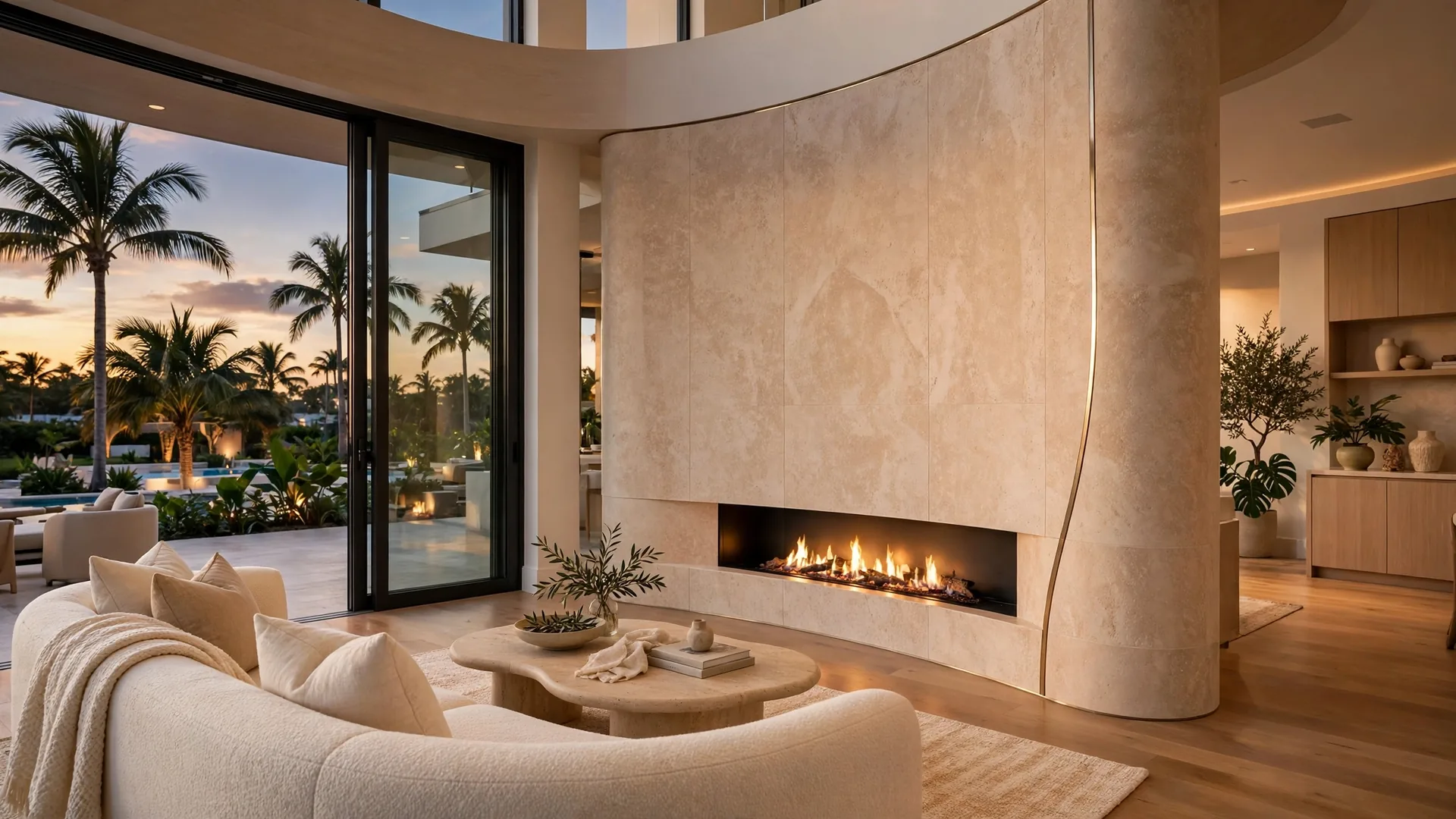
Search "decorative wall panels" and the results split into two piles that rarely talk to each other. One pile sells tiles by the box: waves, hexagons, bricks, diamonds. The other pile shows finished rooms: a calm stone wall behind a sofa, a ribbed wall behind a bed, a soft padded wall in a hotel-style bedroom. Most buying mistakes happen in the gap between those piles. A tile can photograph beautifully and still give you the wrong effect – in your room, under your light, on your wall.
We are a South Florida studio that designs and installs large-format decorative panel walls, so let us put our interest on the table: the flat, large-format end of this market is the product we sell. We built this guide around your decision anyway – and that decision starts better from the effect than from a product photo. Start from the effect. Every decorative panel produces one main effect – a surface that reads calm, a rhythm of shadow lines, real sculptural depth, a metallic sheen, physical softness, or light itself. Name the effect first, and the right family, the right room and the real price range follow from it. Our wall paneling guide covers the basics of paneling as a category – what it is, what the cores do, where it works room by room. This guide covers the layer above the basics: what the wall will do to the room.
What the word "decorative" promises – and what it leaves out
TL;DR: A decorative wall panel is a pre-formed covering installed over an existing wall to add texture, pattern or dimension. The word promises a visual effect. It promises nothing about water, fire or sound: each of those is a separate, tested product category, and a decorative panel joins it only when that exact product carries the test result.
The trade definition is refreshingly plain. Tilton, a manufacturer of coffered (recessed-panel) ceilings and wall panels, defines decorative wall panels as "architectural surface coverings, made from wood, MDF, PVC, composite, or lightweight polyurethane, installed to add texture, dimension, or a defined accent to an interior wall" (Tilton). Home Depot's buying guide says the same thing in retail language: decorative veneers and textured boards "go over existing drywall" (The Home Depot). Lowe's adds the historical footnote: paneling once insulated and protected walls, and "its main purpose today is to look good" (Lowe's). Two abbreviations run through everything below: MDF is medium-density fiberboard (wood fiber pressed into a board with resin), and PVC is polyvinyl chloride (a rigid plastic). A veneer, in the Home Depot line above, is a thin face of real wood bonded onto a board core.
That definition has three consequences. They organize everything below.
First, a decorative panel is a layer over a wall that stays put. It is cladding (a finish layer fixed over a structural wall), with no structural role. Our own studio's sheet is described the same way in our marble wall panels guide: "the sheet is cladding, a decorative layer with no structural role."
Second, very different materials can produce the same look – and the material, not the look, decides where the panel may live. Tilton makes the point with slats: one slatted style "can be built in solid wood, engineered wood, or lightweight composite, and each version fits a different budget, room, and maintenance expectation" (Tilton). A photograph cannot tell you which version you are buying. The material line on the spec sheet can.
Third, performance words belong to other categories entirely. Wet-environment walls are a separate product family – Home Depot lists FRP (fiberglass reinforced plastic, a glass-fiber composite sheet made for wet rooms) as the panel intended for "wet environments, like bathrooms, kitchens, or pool houses," apart from its decorative lines (The Home Depot). Fire performance belongs to products tested under ASTM E84 (the standard tunnel test that measures how fast flame spreads across a surface). Sound absorption belongs to assemblies tested under ASTM C423 or ISO 354 (the US and international laboratory methods behind an NRC – noise reduction coefficient – rating, explained below). A decorative panel earns any of those claims only with its own published test result. The claims section near the end of this guide shows how to check each one in under a minute.
Effect one: a calm, continuous surface
TL;DR: Flat decorative panels put the image on the wall and keep the surface smooth: printed marble, stone, wood and concrete looks on laminate, PVC or composite sheets. Angi prices installed laminate panels at $5 to $12 per square foot. The effect reads calm because there are few seams and nothing for light to trip over – and it asks for even, washed light, since a flat wall has no relief to graze.
The quietest effect is also the one most people live with longest. A flat panel carries its design as an image: the veining of marble, the grain of oak, the tone of travertine or polished concrete, printed or laminated onto a smooth face (a laminate is that printed layer, bonded onto a board core). Lowe's describes the flat end of the range as "a minimalist option, providing a sleek and unadorned surface" (Lowe's). What your room gets is scale. A large sheet covers floor to ceiling with only a few planned seams. The wall reads as one surface, not a grid – and a room with one continuous wall tends to feel calmer and more open. Our wall panel colors and finishes guide works through that mechanism in depth – fewer joints, one reading, less visual noise.
This is the family our studio installs. The sheet is a bamboo composite (a manufactured core made with bamboo fiber and binders, not solid bamboo), 48 by 108 inches and 5 mm thick, carrying a finish: marble look, travertine look, stone look, porcelain look, real-wood veneer, leather or velvet. One sheet covers a 9-foot wall floor to ceiling with no horizontal seam, and the system has no grout (the filled seams between tiles) anywhere. The full sheet story – core, finishes, humidity limits, fire position stated plainly – lives in our bamboo composite wall panels guide.
This family has two honest limits. A printed marble is a surface, not a stone. It carries no water rating and no heat rating of its own, and it belongs on a dry, flat wall in a conditioned room. Our marble wall panels guide sets the composite sheet against real marble and marble-print porcelain by weight, cost and chemistry, and porcelain wins the wet and hot zones outright. A flat wall is also a lighting commitment. With no relief to catch a raking light (light skimmed across a surface at a shallow angle), it wants an even wash of light from fixtures set well off the wall. The lighting section below gives the working distances from a lighting designer's guide.
Pricing for the flat family is the gentlest in this article. Angi's 2026 per-type table puts laminate panels (a printed surface layer on an MDF core) at $5 to $12 per square foot installed, and PVC panels at $7 to $20 (Angi). Those are market figures for paneling products generally; our studio's project anchors sit in their own section near the end, because a designed and installed project is a different kind of figure from a per-foot product price.
Effect two: rhythm – lines, grooves and shadow stripes
TL;DR: Relief panels (relief – a pattern raised or molded so you can feel it) – fluted boards, slats, beadboard, board-and-batten (wide boards with narrow strips over the seams) – turn one wall into a repeating rhythm of lines and thin shadows. The effect is real and it is bought with upkeep: every groove is a dust shelf, and the absorption numbers quoted for slat panels come from the felt backing behind the slats, tested as a system. WPC fluted boards from named makers run about 6 to 20 mm thick depending on the line.
Relief is the shallow end of depth: a pattern you can feel with a fingertip. The traditional forms are beadboard, with "long, continuous vertical grooves and raised beads spaced every inch or two" (The Spruce), and wainscoting (paneling that covers the lower one-half to one-third of a wall, usually around the whole room). Today's versions are fluted boards (boards with concave, half-round grooves cut or molded along their length) and slat panels (narrow vertical strips with a visible gap between them, often over a dark felt backing). Tilton groups them as panels "designed primarily for surface texture rather than a defined pattern," including "textured composite tiles" alongside slats (Tilton).
You can see the rhythm in the sizes. A common WPC (wood plastic composite, a board of wood fiber locked in a plastic matrix) wall panel runs 170 to 195 mm wide (about 6.7 to 7.7 inches), 9 to 12 mm thick and 2,700 or 3,000 mm long (about 8.9 or 9.8 feet), while fluted WPC lines run wider and thicker, 140 to 240 mm wide and 12 to 20 mm thick (Aesthedge). One named maker, Protex, lists its fluted WPC at 6.0 or 8.0 mm thick in 600 or 1,220 mm widths (about 24 or 48 inches) (Protex Flooring). Read those numbers as a range across makers, never as one standard size. This market has no single standard – and any seller who quotes one dimension as "the standard" is really describing his own shelf.
Our two dedicated guides spell out what that rhythm costs you. We will not soften it here. Grooves collect dust along every line, and cleaning a ribbed wall is a slower job than wiping a flat one – the routine itself is in our wall panel care guide. Slat panels carry a second, quieter cost – the sound story. A tested acoustic slat panel is a system of veneer slats, an MDF core and an acoustic felt backing, and the published figure belongs to the system: the Acupanel Luxe sheet lists an NRC (noise reduction coefficient, the 0-to-1 scale for how much sound a surface absorbs) of 0.80 from tests run to ISO 354, the international counterpart of the US absorption test (Acupanel Luxe technical sheet). The slats are the decorative face; the felt and the air gap do the absorbing. Our fluted wall panels guide covers profile shapes and the light behavior of the grooves, and our slat wall panels guide gives the full downside list, including the smoother alternative our studio usually installs instead.
Effect three: real depth – 3D panels and the shadows they cast
TL;DR: True 3D panels carry pronounced sculptural relief – waves, diamonds, hexagons – that casts real shadow. The standard module is a tile of about 19.7 by 19.7 inches, sold in packs covering roughly 32 square feet. The tile skin can be under 2 mm thick; the relief, around 15 mm of it on a plant-fiber tile, is what you are buying. Keep bold 3D to one accent wall, especially in a small room.
Home Depot draws the line between textured and truly three-dimensional plainly: many panels are textured, but "true 3D panels often have select panels or designs that protrude, or stick out more, from the wall" (The Home Depot). Tilton describes the family as panels with "pronounced sculptural relief, geometric, organic, or abstract patterns that cast real shadow and depth under light," and adds the placement rule in the same breath: 3D panels "make the strongest visual statement on this list and are best used as a single accent wall rather than a full-room treatment" (Tilton). The same guide warns that large 3D or heavily textured panels "can overwhelm a small room."
Across sellers, the product facts line up. Art3d and VEVOR both sell PVC 3D tiles at 19.7 by 19.7 inches, twelve to a pack, covering 32 square feet (Art3d; VEVOR via Bigshopper). Dundee Deco sells a larger PVC module, 38 by 19 inches, through Home Depot Canada (Dundee Deco). Two numbers on these listings deserve a careful read. First, thickness: the Art3d PVC wave tile lists a skin thickness of 0.05 inches, because the tile is a thin thermoformed (heat-shaped) PVC skin. The depth effect comes from the relief height; the thin skin only carries the shape. The second is the plant-fiber version of the same idea: WallArt's bagasse (sugarcane pulp) tile is 500 by 500 mm (about 19.7 by 19.7 inches) and 275 grams (about 9.7 ounces), with a material thickness of about 1.75 mm and a total height of about 16.75 mm (about two-thirds of an inch) once the relief is counted (WallArt). Light, paintable, and clear about its limits. That brings up the two warnings this family carries.
The first warning is water. The plant-fiber Art3d panel lists its water resistance level as "Not Water Resistant" (Art3d) – while PVC tiles on the neighboring shelf are sold for bathrooms. Same family name, opposite moisture behavior; the material line decides, again. The second warning is fire. WallArt's specification sheet lists the bagasse tile's flammability as "Class C," and advises a Class A fireproof coating where that performance is needed (WallArt). Class C is the lowest of the three ASTM E84 classes explained below. None of this makes 3D tiles a bad product. It makes them a dry-room, one-wall product whose spec sheet, not whose photograph, should close the sale.
Effect four: sheen – metallic faces and metal inlay
TL;DR: Most metallic wall panels are a metallic look on a light plastic body: Home Depot notes they "mimic punched tin or copper" and are "usually made of lightweight plastic, known as PVC paneling." Real metal panels – aluminum and steel – are a different product, which Angi prices at $10 to $22 per square foot installed, with denting as the listed trade-off. Sheen is the highest-glare effect in this guide, so it earns its place in small doses.
Metal is the effect people want in the smallest quantity and notice the most. Start with the retail reality, because the shelf name misleads. The punched-tin and copper faces in a home center are mostly PVC wearing a metallic finish. That is exactly why they are light and cheap – they "give the look of metal without the weight or high cost" (The Home Depot). Angi's table prices the genuine article separately: metal panels in aluminum and steel at $10 to $22 per square foot installed, with "modern, fire/moisture resistant" on the pro side and "can dent, limited warmth" on the con side (Angi).
In our studio's compositions, metal appears in the accent role the 2-to-3 materials rule intends: a measured line, counted as an accent. Our rule, published in our wall panel colors and finishes guide, is "a maximum of two or three main materials in one composition, with a thin metal insert and LED light counting as accents rather than materials." A single champagne inlay line across a travertine-look wall gives the eye a measured flash of sheen and gives the stone look its scale. A full metallic wall in a Florida living room fights the daylight for attention – and usually costs the room its calm. Treat sheen like salt: the dish needs some, and the dose is the whole skill. Which wall deserves the strongest effect in the first place is a decision of its own – our accent wall panels guide walks through choosing it.
Effect five: softness – upholstered and padded panels
TL;DR: Upholstered panels are foam or sponge padding wrapped in fabric, velvet, bouclé (a looped, nubby fabric) or faux leather, fixed to the wall as individual padded sections. A typical module is about 40 by 40 cm and 3 cm thick (about 16 by 16 by 1.2 inches), or long headboard sections around 46 inches high. The effect is tactile as much as visual, and it is the natural headboard wall – with two plain caveats: an untested soft panel is not a soundproofing product, and soft faces lose to sun, water and crushing sooner than hard ones.
Every family so far changes how a wall looks. This one changes how a wall feels – and how the room sounds at the edges. A representative listing describes the build plainly: a 40 by 40 by 3 cm panel (about 16 by 16 by 1.2 inches) in PU leather (a synthetic leather coating on a fabric base) over "high density sponge" (Amazon UK listing). Vänt, the best-known US maker of upholstered headboard panels, sells individual sections such as a scalloped panel 7.8 inches wide by 46 inches high, and a king layout of 18 panels spanning 140.4 by 46 inches (Vänt Panels). A build guide for the same product class gives the standard range as 12 to 15 inches by 30 to 45 inches per panel, over a half-inch plywood or OSB (oriented strand board, a pressed wood board) backing with 3/8 to 3/4 inch of padding (WonderHowTo).
The same guide carries the two sentences we would want read aloud in every soft-panel showroom: "These panels are decorative wall coverings, not structural supports," and of a home-built version, "This project is decorative, and its acoustic performance is untested" (WonderHowTo). A porous soft face does absorb some high-frequency sound. That is physics, and it is why a padded headboard wall feels quiet. But it is not a tested NRC figure, and it is nowhere near soundproofing. For the soft finishes our studio installs – leather and velvet looks on the composite sheet – the limits and the care routine are set out in our leather and velvet wall panels guide: pile (the raised fiber surface of velvet) direction shifts the color, direct sun fades, water marks, and crushed pile turns into a shiny patch that rubbing only fixes in place – and direct steam damages the pile instead of restoring it. Softness is a bedroom and media-room effect. It does not belong behind a dining chair rail or a hallway's passing traffic.
Effect six: light itself – backlit panels
TL;DR: A backlit panel is a light fixture wearing a decorative face. Edge-lit systems need 15 to 25 mm of total depth (roughly 0.6 to 1 inch) and reach about 150 to 300 candelas per square meter (cd/m2, the brightness of the lit surface); direct backlit grids need 60 to 120 mm (about 2.4 to 4.7 inches) and reach 500 or more. A residential made-to-order line runs as thin as 0.25 inches at 225 lumens per foot on 12-volt power. Either way, power, a driver (the power supply that converts household current to the low voltage the LEDs run on) location and service access are part of the design from day one.
Backlighting is the only effect in this guide that adds a trade to the project. Ballesta, a manufacturer of illuminated panel systems, separates three constructions: edge-lit panels, where LEDs fire into a light guide plate, at "15-25mm" total depth; direct backlit panels, an LED grid behind the face, at "60-120mm"; and perforated systems between the two. The brightness follows the depth: "Edge-lit panels typically achieve 150-300 cd/m²; direct backlit panels can achieve 500+ cd/m²" (Ballesta). The same specification lists LED life at "50,000+ hours" and color temperatures from 2,700K to 6,500K (kelvin, the warmth-to-coolness scale of white light). At residential scale, ATI's LumiSplash line is made to order from 12 by 12 inches up to 4 by 8 feet, "as thin as 0.25" inches in its single-sided build, delivering 225 lumens (lumens measure light output) per foot on 12 V DC (direct current, the low-voltage side) power that plugs into a 110 V outlet (ATI LumiSplash via Roos International).
Those numbers teach one lesson: even light needs depth. Place LEDs too close behind a face and they print as bright dots. The 15 to 120 mm of build-out is the price of a glow with no visible source. Our studio uses light more narrowly – and, we would argue, with better manners: LED runs as an accent inside a panel composition – a cove (a recessed channel that hides the light source) behind a floating section, a halo around a TV field – while the panels themselves stay unlit. The wiring, driver and dimming decisions behind that approach are the whole subject of our LED backlit wall panels guide, and the TV-specific version is in our TV wall panels guide. If a seller offers you a glowing wall, ask where the driver lives and how you reach it in year six. A good answer is a design detail. A blank look is a future invoice.
Three claims to check before you pay for any of them
TL;DR: Fire class, sound and waterproof claims are the three places decorative panel marketing runs ahead of testing. Fire: ASTM E84 Class A means a flame spread index of 0 to 25, and even Class A "can still burn" – the test measures surface burning only, while fire resistance is a separate hours-long assembly rating. Sound: NRC measures absorption inside the room, never soundproofing between rooms, and counts only with a named test standard. Water: a waterproof face still leaves the joints, edges and wall behind it unproven.
Fire. NGC Testing Services, a fire testing laboratory, explains the ASTM E84 scale used across this market: "Class A identifies the best performing materials, falling within the range of 0 to 25 FSI. Class B is mid-range, with 26 to 75 FSI, and Class C is the lowest rating of 76 to 200 FSI," with all classes capped at a smoke developed index of 450 (NGC Testing Services). The smoke developed index, SDI, measures how much smoke the burning surface produces in the same test. FSI is the flame spread index – how fast flame travels across the tested surface. The laboratory then corrects the two misunderstandings it meets most: a Class A material "can still burn under high heat or prolonged exposure," and "flame spread ratings are not the same as fire resistance ratings" – fire resistance is about how long a whole wall assembly holds fire back, measured in hours, and E84 gives no hour rating at all (NGC Testing Services). You saw both halves of this in the effect sections: one WPC fluted line publishes an E84 Class B for its own product (Protex Flooring), while a plant-fiber 3D tile sits at Class C and advises a coating (WallArt). The check is one question: show us the E84 or UL 723 result (UL 723 is the same tunnel test under UL's name) for this exact product. A rating for a different product in the same catalog is not an answer.
Sound. NRC, the noise reduction coefficient, "is a single number value ranging from 0.0-1.0 that describes the average sound absorption performance of a material," averaged from absorption measured at 250, 500, 1,000 and 2,000 Hz (hertz, the pitch points of the test, from low to high) under a standard method such as ASTM C423 (The Free Dictionary, summarizing ASTM C423). Absorption is what happens to sound inside your room: less echo, softer edges. It says nothing about sound passing through the wall to the next room. Blocking transmission is a different property, built from mass and sealed construction. An acoustic buying guide puts it in one line: "NRC measures absorption, not soundproofing – it will not stop noise passing through to a neighbor" (Akuwood Panel). The check: an NRC figure with a named standard (ASTM C423 or ISO 354) and a stated mounting is a claim you can use. An NRC figure with neither is decoration on the packaging.
Water. The word "waterproof" on a decorative listing usually describes the face material alone. PVC itself "does not easily surrender to water, so it is used in bathrooms and kitchens" (Lowe's) – true of the plastic, and silent about the joints, cut edges, adhesive and the wall behind, which is where installed walls actually fail. MDF sits at the other pole: it "can swell under humidity" (Lowe's), and Tilton warns it "performs poorly in consistently humid environments unless specifically moisture-rated" (Tilton). We hold our studio's own sheet to the same standard in print: a look finish carries no water rating of its own, so the sheet stays out of showers and off unprotected splash zones. For what a wall genuinely built for direct water has to contain, see our shower wall panels versus tile guide. If the room has direct water, buy the wet-wall system. If it has humidity alone, the next section is the one that matters.
Light decides whether the effect survives the room
TL;DR: Relief and light are one decision. Grazing means light raked close and almost parallel to the wall; washing means even light thrown from farther off. Fixtures set 100 to 250 mm (about 4 to 10 inches) from the wall with a narrow 10 to 24 degree beam graze the surface and turn texture into shadow; fixtures set 600 to 900 mm (about 24 to 35 inches) off wash it flat. A lighting designer's field test settles which one your wall wants: "If you can feel relief, graze it. If it is smooth, wash it."
Pert, a lighting design practice, published the working numbers in September 2026. For grazing – light raked almost parallel to the surface – "fixtures set very close to the wall (typically 100-250mm, about 4 to 10 inches)" with a "beam angle for grazing: 10°-24°," and the result is that "every ridge, joint and undulation casts its own small shadow, and the texture becomes the subject" (Pert). For washing, fixtures sit "typically 600-900mm" (about 24 to 35 inches) off the wall and spread light evenly, and "texture disappears" (Pert). Flux Lighting's guide lands on the same distances in inches: a grazing setback of "6 to 12 inches" from the surface (Flux Lighting).
Apply that to the six effects, and several expensive disappointments explain themselves. A fluted or 3D wall under a flat ceiling wash reads as a slightly dirty flat wall, because the shadows that carry the effect were never switched on. A flat printed wall under a hard graze shows every seam and fastener line, because grazing "will show a badly laid stone course as ruthlessly as it shows a well-laid one" (Pert) – and it treats a smooth wall's joints the same way. Metallic faces sit between the two. Sheen needs directional light to live – but that same directionality produces glare at seated eye level. So put metallic accents where light crosses them at an angle, not where it fires straight at the people facing them. Decide the effect and the fixture position in the same conversation – ideally before you buy either. Our wall panel colors and finishes guide adds the daylight half of this: window direction, undertone and sheen behave differently in Florida sun than under showroom spots.
The Florida check: humidity reads the spec sheet first
TL;DR: The EPA puts indoor relative humidity below 60 percent, ideally between 30 and 50 percent, and names "the back side of dry wall, wallpaper, or paneling" as a place mold hides. In South Florida that makes the order of operations non-negotiable: fix moisture at the source, dry any leak within 24 to 48 hours, then decorate. Material choice follows the room's humidity, and the room always goes first.
The EPA's mold guidance is unusually direct about our product category. Its brief guide lists where mold hides: "Mold may be hidden in places such as the back side of dry wall, wallpaper, or paneling, the top side of ceiling tiles, the underside of carpets and pads, etc." (U.S. EPA). Its mold course sets the indoor target – "Indoor relative humidity (RH) should be kept below 60 percent – ideally between 30 percent and 50 percent, if possible" – and the response window after water arrives: materials "must be dried or 'allowed to dry' quickly (within 24-48 hours) in order to avoid mold growth" (U.S. EPA). A decorative panel installed over a damp wall does not solve the damp. It furnishes it with a finished face and removes your view of it.
Tilton's moisture rule for this exact product class is the buyer's version of the same paragraph: "A bathroom or humid basement rules out untreated MDF and most natural wood; PVC, treated composite, or polyurethane become the safer starting point" (Tilton). Home Depot gives the household version: use natural wood panels "in a room without moisture," and in a bathroom or kitchen "go with faux wood instead to avoid warping" (The Home Depot). Our studio applies the rule to its own product without exception: panels go onto a wall that is dry, flat and sound, cut edges are sealed, and a wall with a leak history is diagnosed and repaired at the source before any finish is discussed. The core-by-core version of this check, material by material, is in our wall panels in Florida humidity guide. In Florida, decoration is the last step of a wall project. Any installer who offers to make it the first step is selling you the second project as well.
What decorative panels cost in 2026
TL;DR: Angi's 2026 figures put professional paneling at $1,200 to $6,000 per project, averaging about $2,800, at $5 to $25 per square foot installed; an 8 by 10 accent wall runs $500 to $1,000. Mapped to effects: flat laminate $5 to $12, fabric panels $8 to $18, real metal $10 to $22 per square foot. Our studio prices designed panel projects as whole projects: stock design from $850, fitted design usually $2,200 to $2,700, full custom turnkey from $9,999, every figure preliminary until a specialist measures your wall.
Keep two piles of money separate. They buy different things. The market pile prices products by the square foot. Angi, updated October 30, 2026, reports that "professional wall paneling installation costs between $1,200 and $6,000, with a national average around $2,800 for your project," with "per-square-foot prices ranging from $5 to $25 depending on the material and style," labor at "$3 to $10" per square foot, and an 8 by 10 accent wall at "$500-$1,000" (Angi). Its per-type table is the most useful map onto this guide's effects: laminate panels $5 to $12 per square foot (the flat-print family), PVC panels $7 to $20 (printed and thermoformed 3D starting points), fabric panels $8 to $18 (the soft family), metal panels $10 to $22 (real metal, not metallic-look), and raised panel work at $15 to $25 at the formal end (Angi). Angi publishes no separate installed line for 3D tiles or for "decorative panels" as a class, and neither does any other source we could verify for this guide – a retailer guide that prices materials only puts solid-wood 3D mosaic at $18 to $35 per square foot for material alone (The Panel Hub). Treat any single "decorative panels cost $X" figure without a source and a date as marketing.
The studio pile prices something else: a finished wall. Our studio publishes three anchors, covering panel projects only: a stock design from $850, a design fitted to your wall usually $2,200 to $2,700, and full custom turnkey projects from $9,999 – one price covering design, panels, delivery and installation by our own crew – every figure preliminary, with the exact price confirmed after a specialist measures your wall. They are not a per-square-foot price, not a price for shiplap (overlapping horizontal boards) or board-and-batten (wide boards with narrow strips over the seams), and not a shower price. Most single living room walls land in the fitted band. The full market ladder, including the costs that hide outside the panel price itself, is in how much wall panels cost in 2026.
Picking your effect: a short pass over your own room
TL;DR: Name one primary effect for the wall. Check it against the room's moisture and the light you can actually give it. Keep the composition to two or three main materials, with metal and LED as accents. Then test the finalist finish on your own wall, in your own light, before the project is priced.
One effect per wall. The walls that disappoint are usually carrying two effects at war: deep 3D relief plus a metallic finish plus backlighting is three statements in one sentence. Tilton's placement rules point the same way – bold texture on a single accent wall, slats as a defined field behind a bed or a TV, soft texture where "the goal is usually a calm, cohesive backdrop rather than a bold statement" (Tilton). Pick the effect the room lacks. A room full of flat painted walls and hard furniture usually lacks softness or scale; a room already busy with pattern lacks calm.
Run the two checks before the shortlist hardens. Moisture first, in the Florida sense above: is the wall dry and sound, and does the room's humidity rule out the material you are picturing? Light second: with the fixtures the room can actually take, can this wall be grazed if it has relief, or washed if it is flat? An effect that fails either check gives you a different, worse wall than the one in the photograph.
Compose, then test. Hold the composition to two or three main materials – that is a studio rule we apply on every project – and keep a thin metal inlay or lighting inside the accent allowance. Then put the finalist finish against your own wall and look at it morning, afternoon and evening. A sample test on the real wall, in the real light, is the method our guides keep returning to, because showroom light is a promise no Florida room keeps. When the effect is chosen, the deep guide for that family does the rest: fluted panels for rhythm, leather and velvet for softness, marble panels for stone scale, TV wall panels for the media wall.
Frequently asked questions
What is the difference between decorative wall panels and wall paneling?
TL;DR: Paneling is the category – any pre-formed finish layer over a wall. "Decorative" describes the intent: the panel is bought for the effect it creates, texture, pattern or dimension, rather than for protection or wet-room duty. The same product can sit in both descriptions; the decorative question is always "what will this wall do to the room?"
Tilton's definition covers both halves: decorative panels are surface coverings "installed to add texture, dimension, or a defined accent to an interior wall" (Tilton). Paneling, as the wider category, also includes protective and wet-environment products such as FRP. Our wall paneling guide treats the category itself; the decorative intent inside it is the subject here.
Are decorative wall panels waterproof?
TL;DR: Some face materials are, and the installed wall usually is not. PVC does not absorb water; a plant-fiber 3D tile is explicitly not water resistant. Joints, cut edges and the wall behind decide what happens in a wet room, and direct water calls for a purpose-built wet-wall system.
Put the two listings side by side and the point is clear: Lowe's notes PVC panels "do not easily surrender to water" (Lowe's), while Art3d lists its plant-fiber 3D panel's water resistance as "Not Water Resistant" (Art3d). Read the material line of the exact product, and keep decorative panels out of shower enclosures either way.
Do decorative wall panels soundproof a room?
TL;DR: No. A tested acoustic panel absorbs sound inside the room – that is what an NRC rating measures – and absorption does not stop sound traveling to the next room. An untested decorative tile has no verified acoustic claim at all.
NRC averages absorption at 250 to 2,000 Hz on a 0-to-1 scale under a standard such as ASTM C423 (The Free Dictionary). The felt-backed slat systems that publish figures around 0.80 earned them as tested assemblies (Acupanel Luxe technical sheet). Soundproofing – blocking transmission – is mass and sealed construction. A different build entirely.
Can decorative panels go in a bathroom?
TL;DR: In the dry zone, with the right material, yes. Inside the shower, no. Humidity alone rules out untreated MDF, natural wood and plant fiber; PVC, treated composite or polyurethane are the safer starting points, and the wall behind must be dry before anything is fixed to it.
Tilton's rule is the short version: "A bathroom or humid basement rules out untreated MDF and most natural wood" (Tilton). The EPA's hidden-mold list – the back side of paneling included – is the reason the dry-wall check comes first (U.S. EPA).
Are metallic wall panels real metal?
TL;DR: Usually not. Most retail metallic panels are PVC with a metallic finish mimicking punched tin or copper. Real aluminum and steel panels exist as a separate, heavier product that Angi prices at $10 to $22 per square foot installed, and they can dent.
Home Depot states the retail reality directly: metallic panels "mimic punched tin or copper" and are "usually made of lightweight plastic, known as PVC paneling" (The Home Depot).
Can you paint 3D wall panels?
TL;DR: The plant-fiber versions, yes – paintable is their selling point. A 20 by 20 inch paintable fiber tile is a standard retail product. PVC tiles take paint less willingly and need the maker's preparation instructions followed exactly.
Dundee Deco sells its Falkirk Fifer as a "20-inch x 20-inch Paintable Fiber 3D Decorative Wall Panel" through Home Depot Canada (Dundee Deco). Painting changes the fire picture, too: the tile's published class belongs to the unpainted product unless the coating itself is a rated one, as WallArt's Class A coating advice implies (WallArt).
Which decorative effect suits a small room?
TL;DR: The calm end of the range: a flat, large-format surface or fine, shallow relief. Large 3D patterns and heavy texture overwhelm small rooms, and strong effects of any kind belong on one wall rather than wrapped around all four.
Tilton warns that large 3D or heavily textured panels "can overwhelm a small room," and advises reserving bold texture for a single accent wall in tight spaces (Tilton). A continuous flat wall with few seams works the other way – one surface, read as a single piece.
Do backlit wall panels need their own power supply?
TL;DR: Yes – a backlit panel is a light fixture. Systems run on low-voltage DC power through a driver or power supply, from a plug-in 12-volt unit on a residential line to hardwired commercial grids. Plan the driver's location and service access before the panels go up.
ATI's residential LumiSplash runs on "12 V DC" and "plugs into 110 V," at 225 lumens per foot (ATI LumiSplash via Roos International). Ballesta's commercial systems add dimming and color-temperature options on top of the same electrical logic (Ballesta). The driver is a component with a lifespan. Bury it behind a sealed wall and a simple swap becomes a demolition.
Sources
- Tilton Coffered Ceilings, Decorative Wall Panels: Types, Materials and Design Ideas tiltoncofferedceilings.com
- The Home Depot, Wall Paneling buying guide homedepot.com
- Lowe's, Types of Wall Paneling: Easy Guide for Your Home lowes.com
- The Spruce, 7 Types of Wood Paneling for Your Home thespruce.com
- Angi, How Much Does It Cost to Install Wall Paneling? [2026 Data], updated October 30, 2026 angi.com
- U.S. EPA, Mold Course Chapter 2: Why and Where Mold Grows epa.gov
- U.S. EPA, A Brief Guide to Mold, Moisture and Your Home epa.gov
- NGC Testing Services, Flame Spread Ratings: What Class A, B and C Mean ngctestingservices.com
- The Free Dictionary, Noise reduction coefficient (ASTM C423 summary) encyclopedia.thefreedictionary.com
- Akuwood Panel, NRC Rating on Acoustic Panels: How to Read It (2026) akuwoodpanel.uk
- Acupanel Luxe Technical Sheet, via Manuals.plus (tests to DS/EN ISO 354:2003) manuals.plus
- Pert, How to Plan Wall Washing and Accent Lighting, September 6, 2026 pert.me
- Flux Lighting, What Is Grazing Light? Wall Grazing vs Wall Washing fluxlighting.ca
- Protex Flooring, WPC Fluted Wall Panels (specification table) protexflooring.com
- Aesthedge, What Is the Standard Size of a WPC Wall Panel? aesthedgewallpanel.com
- Art3d, PVC Wave Board Textured 3D Wall Panels, 19.7 x 19.7 in, 12-pack (Amazon listing) amazon.com
- VEVOR, 3D Wall Panels, 12-pack, 19.7 x 19.7 in PVC, via Bigshopper bigshopper.co.uk
- Dundee Deco, Falkirk Retro III 38 x 19 in PVC panel and Falkirk Fifer 20 x 20 in Paintable Fiber panel, via The Home Depot Canada homedepot.ca
- Art3d, 3D Wall Panels, Brick Design, Plant Fiber (Amazon listing) amazon.com
- WallArt, Product Specification (bagasse plant fiber, 500 x 500 mm) walldecor3d.com
- Amazon UK, Soft Padded Upholstered Wall Panel, 40 x 40 x 3 cm amazon.co.uk
- Vänt Panels, Scalloped and Pack of 4 Upholstered Wall Mounted Panels vantpanels.com
- WonderHowTo, How to Build Upholstered Fabric Wall Panels for a Headboard interior-design.wonderhowto.com
- Ballesta, Backlit Wall Panels (engineering parameters) ballestaceiling.com
- Roos International, ATI LumiSplash Backlit Panels roosintl.com
- The Panel Hub, How Much Do Wall Panels Cost? (2026 Price Guide), materials only thepanelhub.com